
Why Circuit Breaker Repair Is Critical for Business Continuity
Circuit breaker repair is one of the most important — and most overlooked — maintenance priorities for commercial and industrial facilities. A single failed breaker can shut down production lines, compromise critical systems, and create serious fire hazards.
Here is a quick summary of what businesses need to know:
| Question | Quick Answer |
|---|---|
| What causes breaker failure? | Age, overloads, short circuits, power surges, and corrosion |
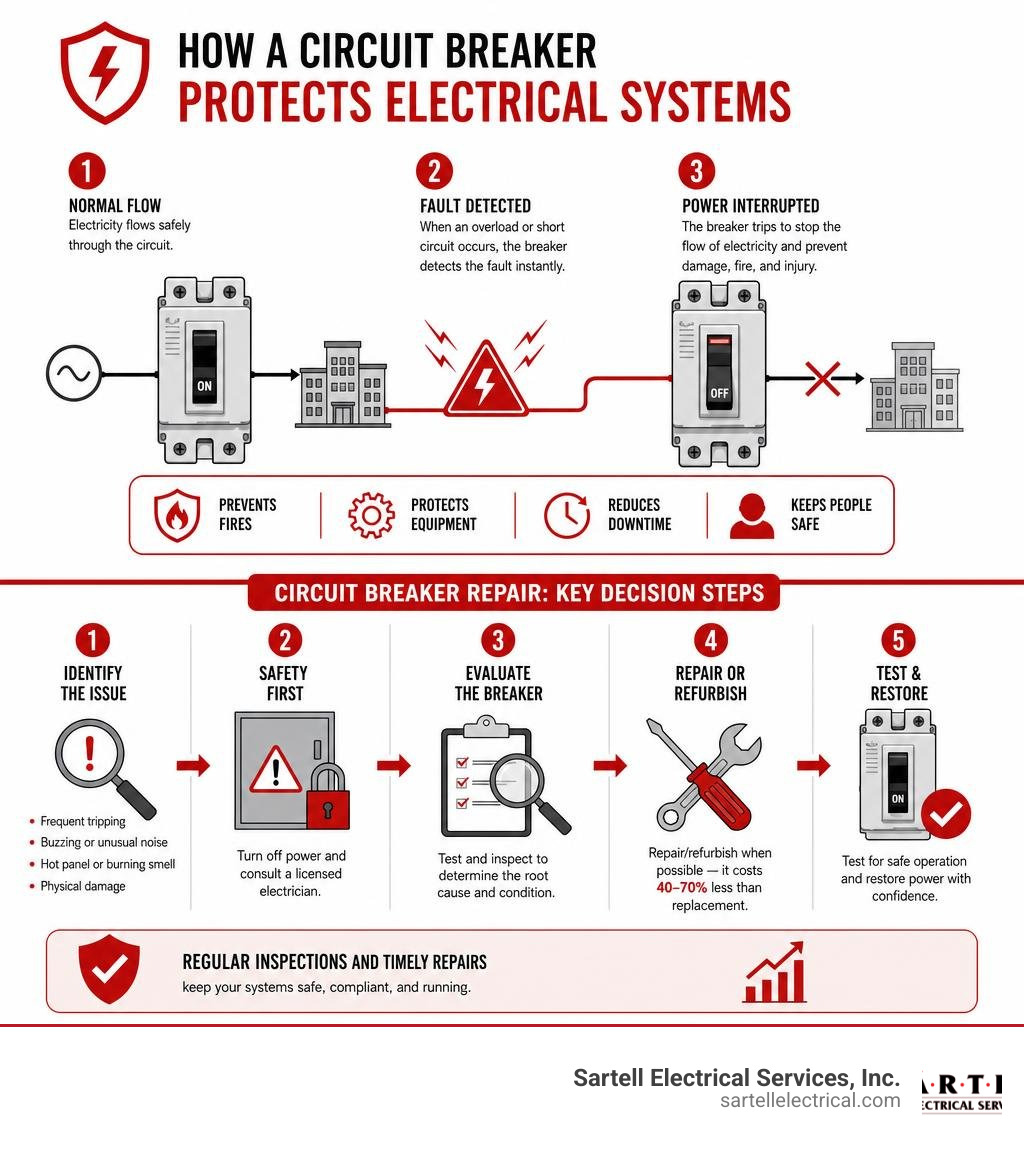
| How do I know a breaker needs repair? | Frequent tripping, buzzing, hot panel, burning smell, or physical damage |
| Repair or replace? | Repair/refurbish when possible — it costs 40-70% less than replacement |
| Can I do it myself? | No — always use a licensed electrician for safety and code compliance |
| How long does professional repair take? | Typically 2-3 business days; emergency service is often available |
The stakes are high. Faulty circuit breakers are linked to approximately 25% of all residential electrical fires each year. For businesses, the consequences extend beyond fire risk — unplanned downtime, damaged equipment, and liability exposure can all follow a neglected breaker problem.
I'm Ed Sartell, President of Sartell Electrical Services, Inc., and I've been diagnosing and overseeing circuit breaker repair work across Massachusetts since 1985. In this guide, I'll walk you through exactly how to identify, test, repair, and maintain your circuit breakers — so your facility stays safe, compliant, and running.
Learn more about Circuit breaker repair:
Understanding Circuit Breaker Failure: Causes and Safety Risks
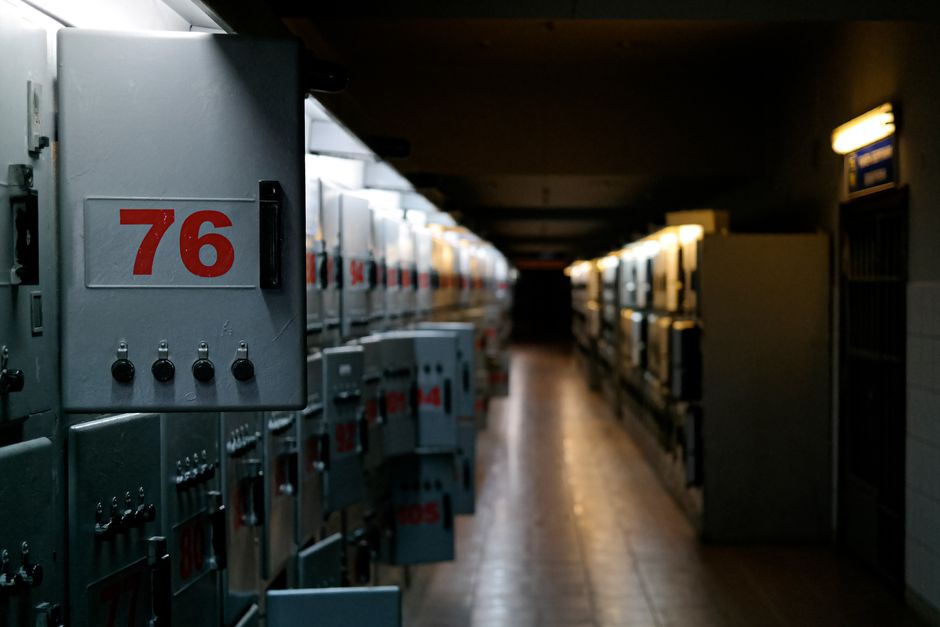
To keep your facility running smoothly, it helps to understand why these vital safety devices fail in the first place. Circuit breakers are mechanical switches designed to interrupt the flow of electricity when they detect an unsafe surge or fault. However, because they are mechanical devices under constant electrical and physical stress, they do not last forever.
Over time, several factors contribute to the degradation of a circuit breaker:
- Age and Heat Cycling: Every time a breaker handles fluctuating electrical loads, its internal components expand and contract. This constant "heat cycling" weakens internal springs and bi-metallic strips over decades of use.
- Excessive Use: Breakers are safety valves, not light switches. Repeatedly turning circuits on and off using the breaker handle can wear out the mechanical linkages.
- Power Surges: Lightning strikes, utility grid fluctuations, and heavy industrial machinery startups can send massive surges through the breaker, pitting the electrical contacts or melting internal components.
- Environmental Factors: Massachusetts is famous for its humid summers and freezing winters. This moisture, combined with salt air in coastal areas like Boston, Essex County, and Norfolk County, leads to rapid corrosion of the copper and silver contacts inside the panel.
To better understand how these breakers fit into your building's overall electrical framework, you can Learn more about what is a breaker box.
Common Causes of Breaker Malfunctions
When we are called out to perform circuit breaker repair, we usually find that the breaker failed while trying to protect the system from one of three major system faults:
- Overloaded Circuits: This happens when you plug in too many high-draw devices or run heavy machinery beyond the circuit's rated amperage. The breaker heats up and trips to prevent the wires from melting.
- Short Circuits: A short circuit occurs when a hot wire touches a neutral wire. This creates an immediate, massive spike in current that forces the breaker to trip instantly.
- Ground Faults: Similar to a short circuit, a ground fault occurs when a hot wire comes into contact with a grounded portion of the junction box, appliance frame, or ground wire. This is especially dangerous in wet environments.
If your facility is experiencing frequent interruptions, you can check out our detailed guide on the subject: Read our guide on circuit breaker tripping.
The Critical Safety Risks of Neglecting Repairs
Ignoring a faulty breaker is a recipe for disaster. When a circuit breaker fails to trip during an overload or short circuit, the electrical current continues to flow unchecked. The copper wires inside your walls or conduit will rapidly heat up, melt their protective plastic insulation, and ignite surrounding materials.
This is why circuit breaker failures are responsible for roughly 25% of all residential electrical fires each year, and they present an even greater threat in industrial settings.
Beyond structural fires, a malfunctioning breaker can cause:
- Arc Flash Incidents: A catastrophic discharge of electrical energy that can cause severe burns, blindness, and structural destruction.
- Severe Equipment Damage: Sensitive electronics, servers, and industrial motors can be fried instantly if a breaker fails to clear a fault.
- Ground Fault Hazards: Without a functioning breaker to cut power, a ground fault can leave metal machinery casings energized, posing a fatal shock hazard to your employees.
For specialized information on handling ground-level faults, you can Find out about ground fault repair.
How to Diagnose and Test a Malfunctioning Breaker
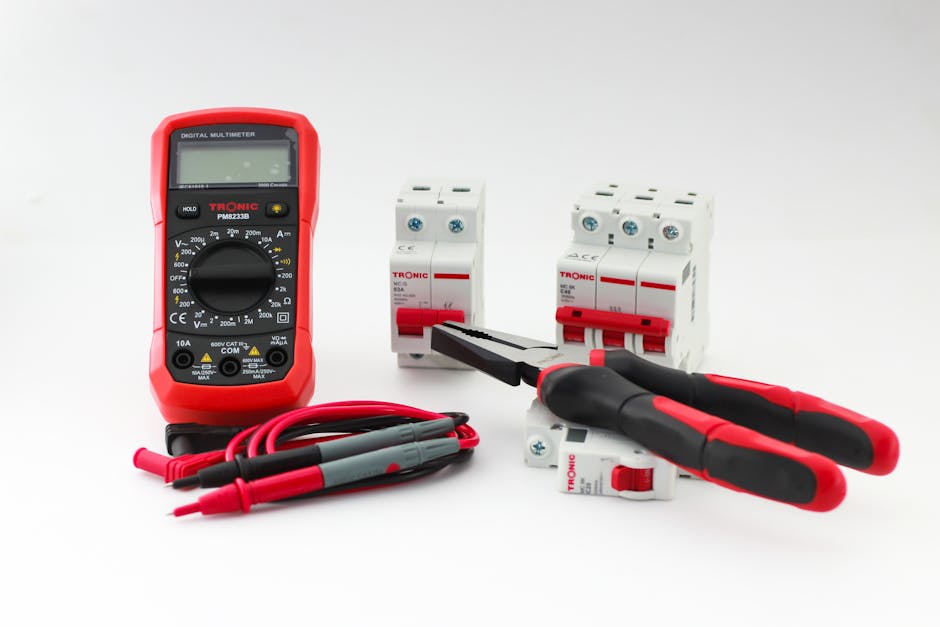
Before jumping into a repair or replacement, a professional technician must perform a series of sophisticated diagnostic tests to pinpoint the exact failure point. You cannot simply look at a breaker and know if its internal mechanisms are functional.
Professional diagnostics typically involve:
- Visual and Mechanical Inspection: Checking for physical cracks, discoloration from heat, loose connections, and verifying the mechanical operation of the toggle switch.
- Insulation Resistance Testing (Megger Testing): This test evaluates the integrity of the plastic and ceramic insulation barriers inside the breaker to ensure electricity isn't leaking where it shouldn't.
- Contact Resistance Testing: By measuring the resistance across the closed contacts in micro-ohms, technicians can determine if the contacts are pitted, corroded, or worn. High resistance generates heat, which leads to premature failure.
- Primary and Secondary Injection Testing: This involves injecting a simulated fault current directly into the breaker to verify that the solid-state trip unit responds exactly within the manufacturer's specified time frame.
To explore how these diagnostics fit into an overall electrical safety plan, you can Discover professional electrical troubleshooting services.
Signs Your Business Needs Immediate Circuit Breaker Repair
As a business owner or facility manager in Greater Boston, you should keep an eye out for these warning signs that indicate a breaker is on the verge of failing:
- Frequent or Nuisance Tripping: If a breaker trips under normal, everyday loads, its internal spring mechanism or trip unit is likely worn out.
- Buzzing, Humming, or Crackling Noises: A quiet hum is normal for large industrial breakers, but loud buzzing or crackling indicates loose connections or electrical arcing.
- A Hot Panel Cover: If the metal cover of your panel or the breaker casing itself feels hot to the touch, high electrical resistance is generating dangerous levels of heat.
- Burning Smells: The smell of burning plastic or ozone near your electrical room is an absolute emergency. Shut down power and call a professional immediately.
- Visible Discoloration or Rust: Any sign of soot, melted plastic, or rust on the breaker or bus bar means moisture has compromised the system.
If you suspect your system is experiencing these issues, you can get a better idea of what to expect financially by reading our breakdown: Understand electrical troubleshooting costs.
Professional Diagnostic and Testing Methods
For industrial and medium-voltage vacuum breakers, advanced diagnostic tools are required to ensure safety. One such method is MAC testing (Magnetic Arc-Casing testing), which utilizes the Penning discharge principle.
Unlike traditional high-potential (HiPot) tests — which only provide a simple pass/fail result and can sometimes temporarily mask a failing vacuum interrupter due to ion recombination — MAC testing measures the actual internal pressure of the vacuum bottle. This allows technicians to predict the remaining service life of the vacuum interrupter with incredible accuracy.
By adhering to these rigorous testing standards, we ensure that your critical infrastructure is backed by scientific data, not guesswork.
The Process of Professional Circuit Breaker Repair and Refurbishment
When a commercial or industrial breaker fails, you don't always have to throw it away. Professional refurbishment programs can restore your existing equipment to like-new condition.
To help you understand your options, let's look at how the different service levels compare:
| Service Level | Process | Best For | Typical Lifespan Extension |
|---|---|---|---|
| Basic Repair | Spot-fixing specific broken components without full disassembly. | Minor mechanical issues or broken handles on newer units. | 2–5 years |
| Reconditioning (Class 1) | Disassembly, deep cleaning, lubrication, contact polishing, and recalibration. | Standard preventive maintenance for aging but functional breakers. | 5–10 years |
| Remanufacturing (Level 3) | Complete teardown, replacement of all wearable parts with OEM components, replating, and full factory testing. | Obsolete, mission-critical, or heavily damaged industrial breakers. | 15–20+ years (matches new) |
Step-by-Step Industrial Circuit Breaker Repair Process
When a breaker is sent in for professional in-house repair or remanufacturing, it undergoes a highly structured process:
- Incoming Inspection and Testing: The breaker is visually inspected and subjected to baseline mechanical and electrical tests to document its current state.
- Complete Disassembly: The unit is completely stripped down to its individual components, including the operating mechanism, contacts, arc chutes, and frame.
- Deep Cleaning and Degreasing: All metal parts are chemically cleaned, and insulated parts are washed with specialized solvents to remove decades of dirt, soot, and dried lubricants.
- Component Restoration and Replacement: Contacts are polished or replated. Worn springs, latches, and bearings are replaced with genuine OEM parts.
- Reassembly and Lubrication: The breaker is carefully reassembled using manufacturer-specified lubricants on all moving linkages.
- Final Calibration and Quality Testing: The breaker is calibrated and subjected to rigorous primary injection, insulation resistance, and contact resistance testing to ensure it meets or exceeds original factory specifications.
For businesses looking for dependable repair solutions, utilizing certified in-house repair services or consulting with expert electrical equipment repair and reconditioning shops can ensure that obsolete or hard-to-find components are restored safely and efficiently.
Reconditioning vs. Remanufacturing
It is important to distinguish between standard reconditioning and full remanufacturing.
Standard Class 1 reconditioning involves cleaning, lubricating, and testing a breaker to ensure it operates within safe parameters. It is an excellent, cost-effective choice for routine preventive maintenance.
On the other hand, Level 3 remanufacturing is a complete factory-authorized rebuild. It uses genuine new components and proprietary fixtures to restore the breaker to a state that is physically and operationally indistinguishable from a brand-new unit.
Many leading manufacturers offer specialized programs for this, such as those highlighted in Power breaker reconditioning | remanufacturing | repair | Eaton . These programs frequently allow businesses to upgrade their older breakers with modern solid-state trip units, adding features like arc flash reduction systems without the extreme cost of replacing the entire switchgear line-up.
Repair vs. Replacement: Making the Cost-Effective Choice for Your Business
Every business owner wants to minimize capital expenditures while maintaining a safe facility. When faced with a malfunctioning electrical system, the big question is: Should we repair the existing breaker or buy a new one?
For small, standard molded-case breakers (like the 15-amp or 20-amp breakers in a standard office panel), replacement is almost always the most practical option. They are mass-produced, inexpensive, and quick to swap out.
However, for large industrial air circuit breakers (ACBs), vacuum circuit breakers (VCBs), or insulated-case breakers, refurbishing or remanufacturing can save your business 40% to 70% compared to the cost of purchasing new equipment. Furthermore, refurbishment avoids the massive lead times associated with ordering new custom switchgear, significantly reducing operational downtime.
When to Choose Replacement Over Repair
While repairing or remanufacturing is highly cost-effective, there are several scenarios where a complete replacement is the only safe choice:
- Severe Physical Damage: If the outer casing or ceramic chassis of the breaker is cracked, warped, or charred from an internal arc fault, it cannot be safely repaired.
- Heavy Corrosion and Rust: If water intrusion has caused deep pitting and rust on the internal bus bar connections and frame, structural integrity has been lost.
- Obsolete or Uncertified Equipment: If a breaker is so old that replacement parts are completely unavailable, or if it lacks modern safety certifications, upgrading to a modern panel is necessary.
- Cross-Brand Swapping: If a previous technician installed an incorrect brand of breaker into your panel, it voids the UL listing of the assembly and poses a severe fire hazard. You must replace it with a manufacturer-specified model.
If you are dealing with complex faults that might require swapping out components, you can learn more by reading about how we handle system faults: Learn how to fix ground faults.
For regional assistance, businesses should partner with a licensed, local electrical contractor who understands the specific electrical codes and environmental challenges of the Greater Boston area.
Preventive Maintenance to Avoid Costly Failures
The absolute best way to handle circuit breaker repair is to prevent the need for it in the first place. Over 50% of industrial circuit breaker failures are directly caused by a lack of proper maintenance and delayed repairs.
Implementing a regular maintenance program offers massive benefits:
- 70% Risk Reduction: Regular inspection, cleaning, and testing can reduce the overall risk of catastrophic electrical system failures by up to 70%.
- Extended Equipment Life: Keeping mechanisms clean and properly lubricated prevents premature wear, allowing your switchgear to last for decades.
- Improved Operational Safety: Routine testing ensures that if a fault does occur, your breakers will trip exactly when they are supposed to, protecting your employees and your facility.
To help you stay on top of your system's health, we have compiled a handy guide: Check out our circuit breaker maintenance checklist
Frequently Asked Questions About Circuit Breaker Repair
How much does circuit breaker repair or remanufacturing typically cost compared to replacement?
For large commercial and industrial circuit breakers, professional reconditioning or remanufacturing typically costs 40% to 70% less than buying new equipment. This price difference becomes even more dramatic when you factor in the "hidden" costs of replacement, such as modifying existing bus bars, updating conduit layouts, and the extended business downtime caused by waiting weeks or months for new custom switchgear to ship.
What warranties or guarantees are offered with professional circuit breaker repair services?
Reputable electrical contractors and remanufacturing facilities stand behind their work. Standard professional reconditioning typically comes with a one-year warranty that matches the original manufacturer's warranty. For comprehensive Level 3 remanufacturing, some programs even offer an extended three-year warranty, providing ultimate peace of mind that the equipment will perform reliably.
Can I perform circuit breaker repair myself or should I hire a professional?
You should never attempt to repair or replace a circuit breaker yourself unless you are a licensed and qualified electrician. Working inside an electrical panel exposes you to live, uninsulated bus bars carrying lethal voltages.
Furthermore, improper installation, using the wrong breaker brand, or failing to torque connections to exact manufacturer specifications can void your business's insurance policy, violate local building codes, and create a severe fire hazard.
If you are experiencing issues with smaller, specialized safety devices in your facility, you can read our DIY-diagnostic warning guide: Stop the trip: A guide to fixing your GFCI outlet.
Conclusion
When it comes to keeping your business safe, compliant, and fully operational, proactive circuit breaker repair and maintenance are non-negotiable. Whether you run a manufacturing plant in Middlesex County, a medical facility in Greater Boston, or a retail space in Essex County, taking care of your electrical infrastructure today prevents catastrophic failures tomorrow.
At Sartell Electrical Services, Inc., we have been serving commercial, industrial, telecom, healthcare, and residential clients across Massachusetts for over 30 years. Based in Reading, MA, our team of highly skilled, licensed electricians is committed to excellence, unmatched customer service, and absolute safety. We have the specialized tools and deep expertise required to diagnose, repair, recondition, and maintain your electrical systems — keeping your business powered and protected.
Don't wait for a costly blackout or an electrical emergency to take action. Contact our commercial electricians for professional circuit breaker services today, and let us help you build a reliable power distribution system for your business.