
Why Electrical Maintenance Contracts Are Essential for Your Business
Electrical maintenance contracts are formal service agreements between a business and a qualified electrical contractor — covering scheduled inspections, testing, repairs, and emergency response for your facility's electrical systems.
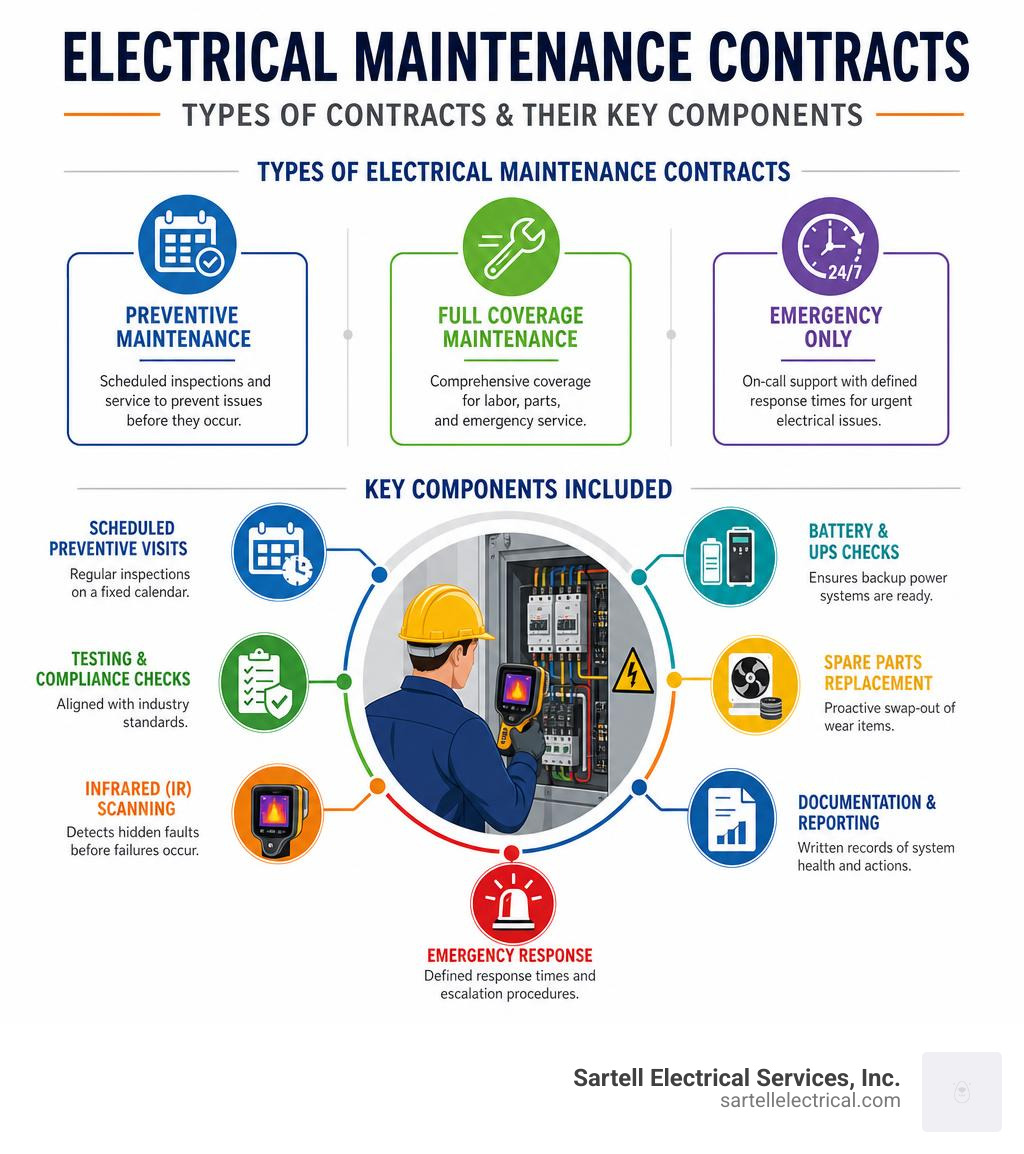
Here's what a solid electrical maintenance contract typically includes:
- Scheduled preventive visits — regular inspections on a fixed calendar
- Testing and compliance checks — aligned with standards like NFPA 70B and ANSI/NETA MTS
- Infrared (IR) scanning — detects hidden faults before they cause failures
- Battery and UPS checks — ensures backup power systems are ready when needed
- Spare parts replacement — proactive swap-out of wear items like capacitors and fans
- Documentation and reporting — written records of system health and recommended actions
- Emergency response — defined response times and escalation procedures
Think about what happens when the power goes down unexpectedly. A single unplanned outage can cost a business far more than a full year of scheduled maintenance. Yet many facilities still rely on a "call when something breaks" approach — reactive service that leaves equipment running past its safe limits and leaves budgets exposed to unpredictable repair bills.
There's a better way. A structured maintenance agreement shifts your operation from reactive to proactive. Instead of scrambling when something fails, you have a plan — and a partner.
It's also worth understanding the scale of what's at stake. Electrical demands in the average building have grown dramatically over recent decades, yet much of the installed equipment hasn't kept pace. Panels running near capacity and components operating in high-heat environments wear out faster, and the consequences of ignoring that are real.
I'm Ed Sartell, President of Sartell Electrical Services, and I've been working with Massachusetts businesses on electrical maintenance contracts since 1985 — helping facility managers, healthcare operators, and commercial property owners move from reactive chaos to planned, predictable electrical reliability. In this guide, I'll walk you through everything you need to know to structure, evaluate, and get the most out of a professional service agreement.
Electrical maintenance contracts further reading:
- Commercial Electricians
- Commercial electrical contractors
- residential and commercial electrical services
The Strategic Value of Electrical Maintenance Contracts

Relying on one-off, reactive service calls is a bit like waiting for your car's engine to seize before you change the oil. You save a few dollars this month, but the eventual tow truck and engine replacement bills will make those minor savings look like pocket change. In commercial and industrial facilities across Greater Boston, the stakes are even higher.
The average life expectancy of standard electrical equipment is roughly 15 to 20 years, but this lifespan is deeply contingent on heat and electrical load. Modern business operations have placed an unprecedented burden on older infrastructure. Over the past 75 years, electrical demands in the average building have surged by 35% to 50%, yet in many historic commercial spaces from Boston to Salem, the core electrical equipment has never been upgraded.
When you push systems to their limits, heat builds up. Overloaded and overcrowded electrical panels have a significantly shorter service duty than a well-balanced panel operating at or below 75°C (167°F). Without regular intervention, this thermal stress quietly degrades insulation, loosens connections, and invites catastrophic failure.
By establishing a formal maintenance contract, you transition from firefighting mode to strategic asset management. Instead of waiting for a critical breaker to trip and halt production, you schedule minor, controlled interventions. This strategic foresight is detailed extensively in our Ultimate Guide to Electrical Maintenance, which highlights how planned checkups protect your bottom line.
Structuring Your Agreement: Types, Services, and Customization

No two facilities are identical. A high-tech data center in Burlington has vastly different electrical needs than a manufacturing plant in Woburn or a retail complex in Peabody. Therefore, a generic, one-size-fits-all contract simply won't cut it.
To build an agreement that actually delivers value, you must account for equipment criticality, the operating environment (such as dust, humidity, or extreme Massachusetts winter temperatures), and your specific operational constraints. A comprehensive Commercial Electrical System Maintenance Guide can help you identify exactly where your facility falls on the risk spectrum.
Types of Electrical Maintenance Contracts and Their Applications
When selecting a contract structure, it helps to understand the distinct flavors of maintenance agreements available:
| Contract Type | Key Features | Ideal Scenario | Relative Cost Structure |
|---|---|---|---|
| Preventive Maintenance | Calendar-based cleaning, tightening, and testing | Standard commercial offices, retail, and schools | Moderate, highly predictable annual fee |
| Predictive Maintenance | Condition-based monitoring (IR scanning, vibration analysis) | Continuous manufacturing, data centers, hospitals | Higher upfront diagnostic cost, low repair waste |
| Corrective Maintenance | Focuses on rapid repair and component replacement | Non-critical systems where downtime is tolerable | Pay-as-you-go with pre-negotiated labor rates |
| Total Maintenance | All-inclusive coverage (preventive, predictive, and parts) | Mission-critical facilities wanting zero budget surprises | Premium fixed annual or multi-year fee |
| On-Call Agreements | Guaranteed response times and priority dispatch | Small to mid-sized businesses needing emergency backup | Retainer fee plus discounted hourly rates |
| Annual Contracts | Comprehensive yearly review and system tune-up | Standard municipal buildings and corporate offices | Fixed annual price with modular add-ons |
Key Components of Commercial Electrical Maintenance Contracts
A robust commercial contract is built on clear, measurable deliverables. When you review an agreement, look for these foundational services:
- Routine Inspections: Visual assessments of panels, switchgear, and conduit pathways to spot corrosion, physical damage, or overcrowding.
- Comprehensive Testing: Ground fault testing, circuit breaker testing, and load balancing to ensure your system behaves predictably under stress.
- Battery and UPS Checks: Regular verification of uninterruptible power supply (UPS) systems, checking environmental conditions and main battery parameters at the string level to prevent sudden backup failures.
- Infrared (IR) Scanning: Thermal imaging to identify hot spots caused by loose connections or unbalanced loads before they spark a fire.
- Proactive Spare-Parts Replacement: Swapping out high-wear components like cooling fans and capacitors before they reach their manufacturer-rated failure points.
- Detailed Documentation: Receiving a comprehensive technical report after every visit to prove compliance and guide future capital planning.
These services ensure your facility remains safe and operational, forming the core of professional Electrical Safety Checks.
Compliance, Standards, and Customization Constraints
Modern electrical maintenance is highly regulated. A solid contract must align with rigorous national standards, specifically NFPA 70B (which transitioned from a recommended practice to an enforceable standard for electrical equipment maintenance) and ANSI/NETA MTS (Maintenance Testing Specifications).
Furthermore, your agreement must adapt to your unique environment. If your facility operates in a dusty industrial setting in Lawrence or experiences high humidity, your service intervals must be compressed. We detail these heavy-duty requirements in our Industrial Electrical Maintenance Complete Guide, helping industrial operators stay compliant and safe.
Financial Models, Logistics, and Service Level Agreements
Understanding the financial and operational mechanics of your contract is crucial to maximizing your return on investment. Contracts can be structured in several ways, from fixed-price annual agreements to multi-year partnerships that offer long-term price stability. Some providers even offer modular packages—such as dedicated UPS packs that include full module replacement and obsolescence monitoring over a five-year cycle.
When structured properly, these agreements significantly lower your total cost of ownership by eliminating emergency premium rates and extending the operating life of expensive switchgear. For a look at how large-scale organizations structure these formal relationships, you can review the legal frameworks used in major utility agreements, such as the Amended and Restated Services Agreement.
Logistics, Escalation, and Emergency Response
A contract is only as good as its execution when things go sideways. Your service agreement should explicitly outline:
- Spare-Parts Logistics: Does the contractor maintain local stock of critical breakers and fuses, or are you responsible for storing them on-site?
- Escalation Procedures: If a complex issue arises, how does the field technician escalate the problem to senior engineering specialists?
- 24/7 Emergency Response: What are the guaranteed response times (e.g., 2-hour or 4-hour on-site arrival) during a power emergency?
Large public-sector contracts provide excellent templates for these requirements. For example, the Cambridgeshire County Council Maintenance Contract features a highly structured 24/7 helpdesk system integrated directly with asset management software to track statutory testing and emergency response times across hundreds of facilities.
Evaluating Proposals and Managing Contract Lifecycles
When comparing proposals from different electrical contractors, don't just look at the bottom-line price. Evaluate the following:
- Scope Clarity: Are exclusions (like rental of scaffolding, crane services, or utility fees) clearly defined?
- Key Performance Indicators (KPIs): Are there clear metrics for response times, first-time fix rates, and preventative maintenance completion windows?
- Reporting Standards: Will you receive digital, compliance-ready reports with thermal images and torque specifications?
- Scheduling Automation: Does the contractor use modern field service software to push scheduled visits onto the calendar automatically, ensuring nothing slips through the cracks?
Managing these details is a core part of long-term planning, as discussed in our Electrical Asset Management Complete Guide.
Key Benefits of a Professional Service Agreement
Partnering with a dedicated electrical contractor under a formal agreement delivers several immediate and long-term benefits:
- Maximized Uptime: Regular maintenance catches minor issues (like a loose termination heating up to 80°C) before they trigger a main breaker trip, keeping your doors open and your assembly lines moving.
- Predictable, Controlled Budgets: Instead of facing a surprise $15,000 emergency repair bill on a Sunday morning, you pay a flat, predictable fee that fits neatly into your annual operating budget.
- Prioritization of Core Activities: Your facility managers can stop worrying about electrical compliance and focus on what they do best—running your business.
- Expertise on Demand: You gain access to highly trained technicians who understand your specific infrastructure, backed by an internal escalation process for complex troubleshooting.
- Risk and Liability Reduction: Documented proof of regular testing and compliance with NFPA 70B can lower your commercial insurance premiums and shield your business from liability in the event of an incident.
To take your reliability a step further, many modern agreements now incorporate Condition-Based Asset Monitoring, utilizing continuous sensors to track system health in real-time.
Frequently Asked Questions About Electrical Service Agreements
How do electrical maintenance contracts reduce total cost of ownership?
By replacing high-wear parts (such as cooling fans, batteries, and contactors) proactively, you prevent them from failing and damaging larger, more expensive components like transformers or switchgear. Additionally, clean, tight connections reduce electrical resistance, which improves overall energy efficiency and lowers utility bills.
Even massive industrial entities leverage this math; for instance, large-scale public tenders like the WBPDCL Thermal Power Station Contract—which covers miscellaneous electrical maintenance and renovation jobs—are structured specifically because scheduled preventive maintenance is vastly cheaper than handling emergency power outages.
What is the role of infrared scanning in a maintenance contract?
Infrared (IR) scanning uses thermal imaging cameras to detect invisible heat patterns within your electrical systems. High temperatures are a direct indicator of electrical resistance, usually caused by loose connections, corroded terminals, or severely overloaded circuits.
By identifying these hot spots early, technicians can clean, re-torque, or balance the circuit during scheduled downtime. Today, many commercial property insurance providers in Massachusetts require annual IR scanning of main distribution panels as a mandatory condition for policy renewal.
How often should commercial electrical systems undergo comprehensive testing?
While visual inspections and basic safety checks should occur monthly or quarterly, comprehensive testing (including breaker injection testing and ground system verification) is typically recommended on an annual or biennial basis. Under NFPA 70B, the specific frequency depends on the criticality of the equipment and the operating environment.
Regular, documented testing is essential to verify that your safety devices will actually trip when a fault occurs, protecting your building and your staff. You can read more about these protective cycles in our guide on Electrical Installation and Maintenance.
Conclusion
An electrical service agreement isn't just an insurance policy against unexpected blackouts; it is a strategic investment in your business's safety, efficiency, and long-term financial predictability. By moving away from reactive emergency repairs and partnering with a trusted professional team, you protect your equipment, control your budget, and gain invaluable peace of mind.
At Sartell Electrical Services, we’ve spent more than 30 years helping businesses across Massachusetts navigate their commercial, industrial, and institutional electrical needs. From local retail spaces to complex healthcare facilities, our commitment to technical excellence and outstanding customer service ensures your systems are always in safe, expert hands.
Ready to stop worrying about unexpected power failures and take control of your facility's electrical health? Partner with our Commercial Electricians today to design a customized service agreement tailored perfectly to your business.