The Breaker Box for a House: Your Home's Electrical Backbone
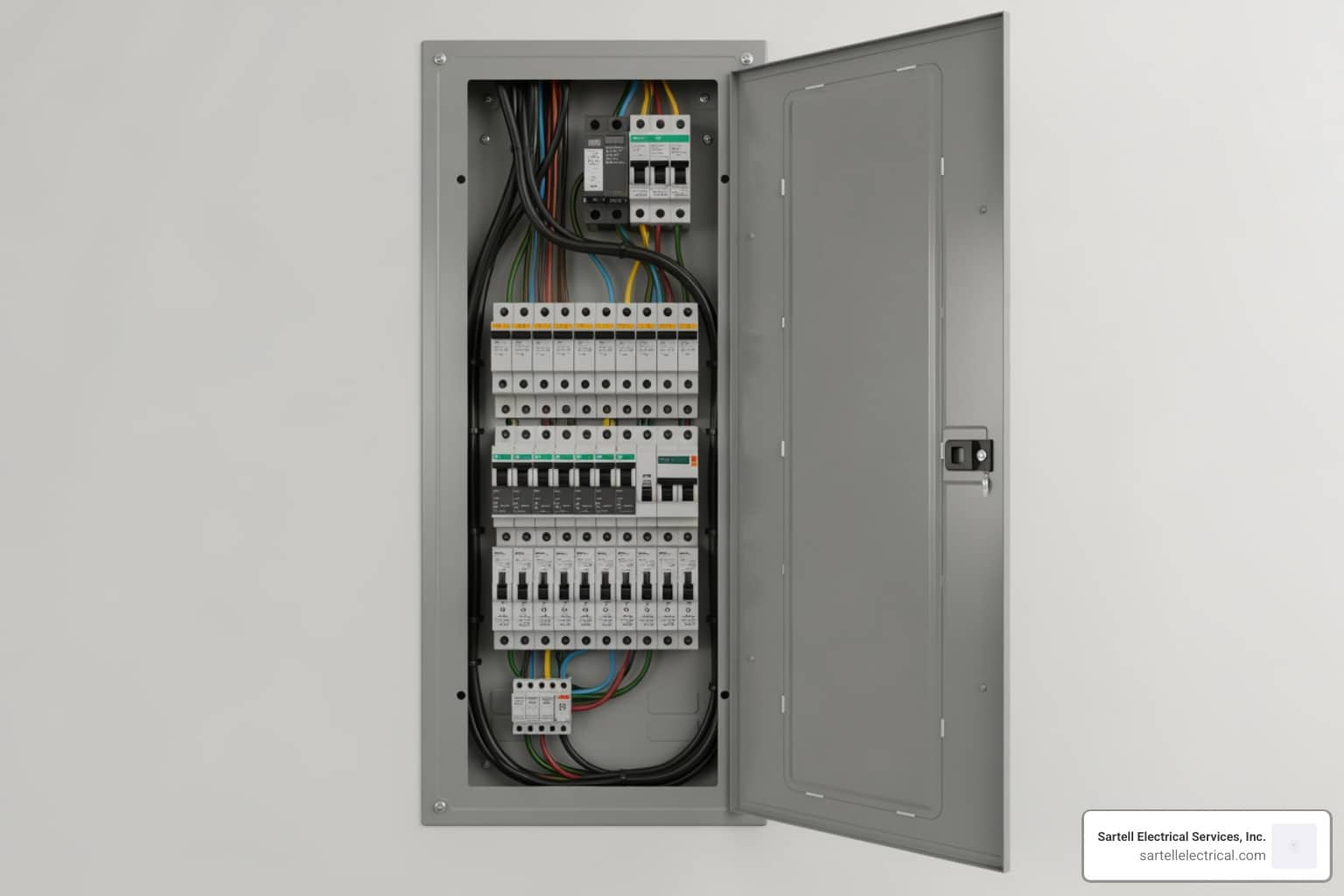
A breaker box for house use is the central hub that controls and distributes electricity to every room, outlet, and appliance in your home. Here's what you need to know at a glance:
- What it is: A metal panel housing circuit breakers that route power throughout your home
- What it does: Automatically cuts power to a circuit when something goes wrong — preventing fires and electrical damage
- Where it is: Usually found in a garage, basement, utility closet, or on an exterior wall
- Common sizes: 100-amp (older homes) or 200-amp (modern standard)
- When to act: Flickering lights, burning smells, or frequent tripped breakers are all warning signs
Most homeowners don't think about their breaker box until something goes wrong. A light suddenly goes out. An appliance stops mid-cycle. Then you're standing in front of a metal panel, unsure what to do next.
That moment of confusion is exactly why understanding your breaker box matters — before there's a problem.
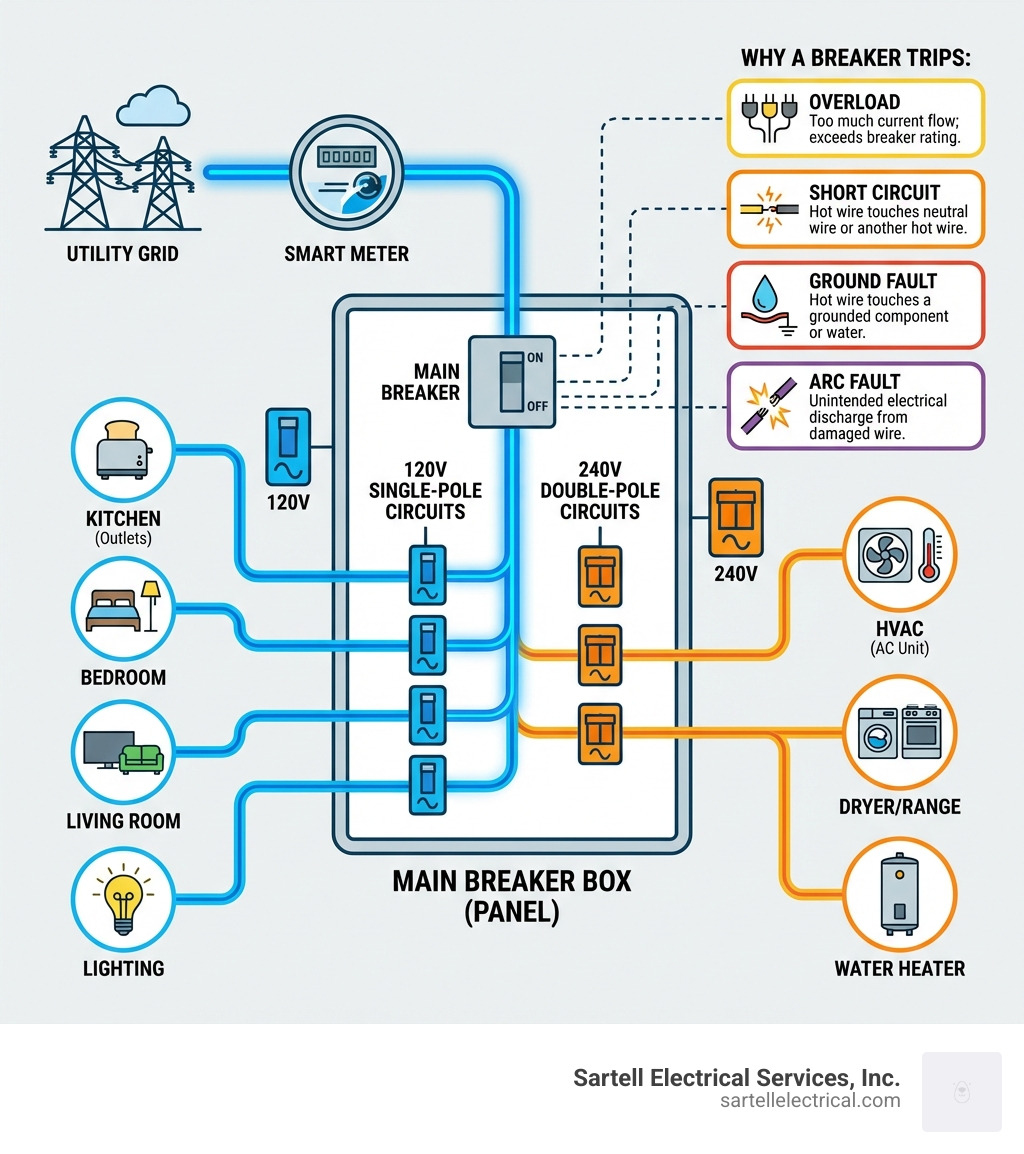
Electricity flows from the utility grid into your home through a meter, then into the breaker box, which splits it into individual circuits. Each circuit breaker acts like a safety valve. If too much current flows through a circuit, the breaker trips and stops the flow — protecting your wiring from overheating and your home from a potential fire.
Over half of all home fires in the United States are caused by electrical issues — many of which a properly functioning breaker box is designed to prevent.
I'm Ed Sartell, President of Sartell Electrical Services, Inc., and I've been working with breaker boxes and electrical panels across Massachusetts since 1985. Whether it's a straightforward breaker box for house replacement or a full-scale panel upgrade, I've seen how the right electrical setup protects homes and the people in them — and I'm here to walk you through everything you need to know.
Breaker box for house glossary:
How a Breaker Box for House Works
Think of your breaker box for house as the "brain" of your home’s electrical system. Its primary job is to take the massive amount of energy coming from the utility company and divide it into manageable "branches" or circuits. Each of these circuits is protected by a circuit breaker.
When everything is running smoothly, electricity flows through the breaker, along the standard residential electrical wiring, and powers your devices. However, breakers are designed to "trip" (flip to the off position) under specific dangerous conditions:
- Overload protection: This happens when you plug too many high-power devices into one circuit—like running a microwave and a space heater at the same time. The wire gets too hot, and the breaker snaps off to prevent a fire.
- Short circuits: This occurs when a "hot" wire touches a "neutral" wire. It creates a sudden, massive surge of electricity that could melt your wires instantly if the breaker didn't intervene.
- Grounding: Grounding is a safety path that redirects excess electricity into the earth. If electricity "leaks" from the system, a grounded circuit ensures it has a safe place to go rather than through you.
Understanding Standard, GFCI, and AFCI Breakers in a Breaker Box for House
Not all breakers are created equal. Modern Massachusetts electrical codes require specific types of protection depending on where the electricity is being used.
- Standard Breakers: These are your workhorses. They protect against overloads and short circuits. They come in "single-pole" (120V for lights and outlets) and "double-pole" (240V for heavy hitters like dryers and stoves).
- GFCI (Ground Fault Circuit Interrupter): These are mandatory in "wet" areas like kitchens, bathrooms, and garages. They detect if electricity is "leaking" (a ground fault), which often happens if water interferes with a circuit. They trip in a fraction of a second to prevent lethal shocks.
- AFCI (Arc Fault Circuit Interrupter): These are designed for fire prevention. An "arc" is essentially a spark caused by damaged or frayed wiring behind your walls. Standard breakers might not catch a small arc, but an AFCI breaker will, shutting down the circuit before the spark turns into a flame.
Meeting modern NEC code requirements often means installing a mix of these breakers to ensure your home is as safe as possible.
Amperage Ratings: 100-Amp vs. 200-Amp Breaker Box for House
The "size" of your breaker box for house is measured in amps, which tells you the total amount of electricity your home can pull at once.
- 100-Amp Panels: Common in older homes built before the digital age. While 100 amps can technically run a small house, it often struggles with modern demands like central air, electric car chargers, and high-end kitchen appliances.
- 200-Amp Panels: This is the current gold standard for residential main electrical panel installations. It provides plenty of "headroom" for modern electronics and future upgrades.
- 400-Amp Panels: Occasionally used for very large estates in areas like Weston or Wellesley that have extensive heating, cooling, and automation needs.
Determining what is the standard residential electrical service size for your specific needs depends on your square footage and how many "heavy" appliances (240V) you use.
Signs You Need a Breaker Box Repair or Upgrade
Your breaker box for house won't always fail silently. Often, it will give you "warning shots" that something is wrong behind the scenes. If you notice any of the following, it’s time to call in a pro:
- Flickering Lights: If your lights dim every time the refrigerator kicks on, your panel is likely struggling to handle the load.
- Burning Smells: This is an emergency. A "fishy" or ozone-like smell coming from the panel indicates wires are melting or arcing.
- Buzzing Sounds: A healthy breaker box is silent. If you hear humming or crackling, there is a loose connection or a failing breaker.
- Scorch Marks: If you see black or brown marks on the breakers or the panel cover, it means heat is building up dangerously.
- Corroded Bus Bars: In damp Massachusetts basements, moisture can cause the metal bars inside the panel to rust, leading to poor connections and fire risks.
Moving from Fuses to Modern Circuit Breakers
If you still have a box with screw-in glass fuses, you are likely overdue for a fuse box replacement. While fuses weren't inherently "bad" when they were invented, they aren't designed for today's electrical loads.
Many insurance companies in Greater Boston now refuse to cover homes with fuse boxes or charge significantly higher premiums. Upgrading to a modern breaker box for house not only makes your home safer but significantly increases your home's valuation and marketability.
The Cost and Process of Replacing Your Electrical Panel
Replacing a breaker box for house isn't as simple as swapping a part. It is a major project that requires coordination with the local utility (like National Grid or Eversource) and the town building department.
The process typically involves:
- Assessment: We calculate your home's "load" to see if you need a bigger service.
- Permits: We pull the necessary permits with your local Massachusetts municipality.
- Coordination: We schedule a "disconnect" with the utility company so we can work safely.
- Installation: We remove the old panel and install the new one, including new grounding rods and an exterior emergency disconnect (now required by the 2023 NEC).
- Inspection: A local inspector verifies the work meets all safety codes before the power is permanently restored.
| Feature | Panel Replacement Only | Full Home Rewiring |
|---|---|---|
| Typical Duration | 1–2 Days | 1–3 Weeks |
| Focus | The central hub (breaker box) | Every wire, outlet, and switch |
| Permits Required | Yes | Yes |
| Power Outage | 4–8 hours | Intermittent over several days |
| Average Cost | $2,500 – $6,000 | $10,000 – $30,000+ |
For a detailed breakdown of what affects these numbers, check our main panel upgrade cost guide.
Avoiding Overpriced Quotes and Finding the Right Electrician
We’ve heard stories of homeowners being quoted $8,000 or even $10,000 for a basic panel swap. While material costs for AFCI/GFCI breakers have risen—sometimes costing $50 to $100 per breaker—an $8,500 quote for a standard house is often the result of "upsell" tactics from large, franchise-style companies.
To find a fair price:
- Get 3 Bids: Try to get one from a large company and two from local, family-owned businesses.
- Check Credentials: Ensure they are licensed and insured in Massachusetts.
- Ask About Permits: If a contractor says you "don't need a permit," run the other way. Permits protect you and your insurance coverage.
- Look for Transparency: A good quote should break down labor, materials, and permit fees clearly.
We pride ourselves on staying at the forefront of the industry by researching electrical innovations and modern safety standards to provide our clients with the best value.
Frequently Asked Questions about Breaker Boxes
How do I safely reset a tripped circuit breaker?
If a circuit goes dark, follow these steps:
- Unplug: Go to the room that lost power and unplug the last thing you turned on (it likely caused the overload).
- Locate: Open your breaker box for house and look for a switch that isn't lined up with the others. It might be in the middle "tripped" position.
- Reset: Push the breaker firmly to the "OFF" position first, then flip it back to "ON." You should feel a solid click.
- Monitor: If it trips again immediately, do not try to reset it a third time. There is likely a short circuit that requires a professional.
Where is the breaker box typically located in a home?
In Massachusetts, you'll usually find the breaker box for house in the basement, garage, or a utility closet. In some older homes or apartments, it might be in a hallway or even an exterior wall. Larger estates may have a "main" panel and several "subpanels" located in additions, detached garages, or pool houses to handle localized power needs.
Can a breaker box support an EV charger or smart home devices?
Yes, but it requires a "load calculation." Adding a Level 2 EV charger is like adding another air conditioning unit to your home—it pulls a lot of power (usually 40–60 amps). If you have an old 100-amp panel, you will likely need an upgrade to a 200-amp breaker box for house to support an EV charger without tripping the main breaker every time you plug in your car.
Conclusion
Your breaker box for house is more than just a metal box in the basement—it’s the guardian of your home’s safety. Whether you’re looking to support a new EV charger, preparing for a home sale, or just want the peace of mind that comes with modern AFCI/GFCI protection, keeping your panel up to date is one of the best investments you can make.
At Sartell Electrical Services, Inc., we’ve spent over 30 years helping neighbors from Reading to Boston navigate their electrical needs. We know the local Massachusetts codes inside and out, and we believe in a safety-first approach that prioritizes your family over a quick sale.
If you’re worried about your current panel or just want an expert eye to take a look, check out our Electrical Panel Upgrade Cost Guide 2025 or give us a call. We’re here to help you keep the lights on—safely.