
What Voltage Electrical Services Actually Cover (And Why It Matters)
Voltage electrical services cover the full range of work needed to safely install, maintain, upgrade, and repair electrical systems — from the wiring in a single-family home to the high-voltage infrastructure powering an industrial facility.
Here's a quick overview of what voltage electrical services include:
- Residential: Panel upgrades, home rewiring, lighting installation, outlet and circuit work
- Commercial: Service upgrades, switchgear, three-phase power, lighting design, data cabling
- Industrial: High-voltage systems, transformers, preventative maintenance, emergency generators
- Low voltage: Security systems, telecom cabling, smart automation, AV and data wiring
- Emergency services: 24/7 fault finding, power restoration, urgent repairs
- Energy upgrades: EV charger installation, panel replacements, smart system integration
Not all electrical work is the same. A licensed contractor handles very different challenges depending on the voltage level and project type involved — and choosing the wrong provider can mean safety risks, code violations, and costly delays.
I'm Ed Sartell, President of Sartell Electrical Services, and I've been delivering voltage electrical services to homeowners, builders, and businesses across Massachusetts since 1985. In this guide, I'll walk you through everything you need to know to make smart, safe decisions about your next electrical project.
Voltage electrical services terminology:
Understanding Voltage Electrical Services across Different Sectors
Electrical power is the lifeblood of our modern world, but it doesn't look or behave the same way in a suburban living room as it does in a plastics manufacturing plant. Because electricity behaves differently depending on the volume of power and the design of the system, voltage electrical services are highly specialized.
Whether we are managing power distribution for a new commercial development or optimizing system wiring during a detailed home renovation, matching the work to the specific sector is critical. Let's break down how we approach these projects across the residential, commercial, and industrial landscape.
Residential Voltage Electrical Services
Your home is your sanctuary, but it is also a complex web of electrical currents. Over time, as we buy more gadgets, transition to electric vehicles, and install high-powered appliances, our home systems can get a little overwhelmed.
Our residential services focus on keeping your family safe while ensuring your home has the capacity to handle modern life. Some of our core residential offerings include:
- Panel Upgrades: Swapping out old, outdated fuse boxes or low-capacity panels for modern, safe breaker panels that can handle 200 amps or more.
- Home Rewiring: Replacing old, degraded wiring (such as cloth or knob-and-tube wiring) to eliminate fire hazards.
- Custom Lighting Design: Transforming spaces with energy-efficient LED lighting, recessed lighting, and elegant landscape fixtures.
- Outlet and Switch Installations: Adding modern, child-safe GFCI and AFCI outlets exactly where you need them.
- Safety Inspections: Thoroughly evaluating your home's electrical health to catch hidden dangers before they turn into emergencies.
If you want to dive deeper into how we keep local homes safe and powered up, check out our Residential Electrical Services Complete Guide.
Commercial and Industrial Power Solutions
Commercial and industrial facilities operate on an entirely different scale. While a typical home runs on single-phase power, businesses and manufacturing facilities rely on robust three-phase power systems to keep heavy machinery, complex HVAC systems, and massive computer networks running without a hitch.
In these high-stakes environments, a split-second power failure can translate to thousands of dollars in lost productivity. Our commercial and industrial voltage electrical services are designed to prevent downtime through:
- Switchgear Installation & Maintenance: Managing the central distribution points that keep high-level currents safely routed.
- System Modifications: Adjusting existing infrastructure to accommodate new machinery or office reconfigurations.
- Emergency Generators: Installing and servicing massive backup power systems that kick in automatically during a storm.
- Preventative Maintenance: Performing regular thermal imaging, equipment cleaning, and system testing to identify weak points before they fail.
For a comprehensive look at how we power local businesses, read our Commercial Electrical Services Ultimate Guide and explore our specialized Industrial Electrical Services Complete Guide. You can also learn more about our general capabilities on our Electrical Services page.
Demystifying Low, Medium, and High Voltage Electrical Services
To the untrained eye, "electricity is electricity." But in our world, the voltage level dictates everything: the tools we use, the safety gear we wear, and the specialized training required to do the job.
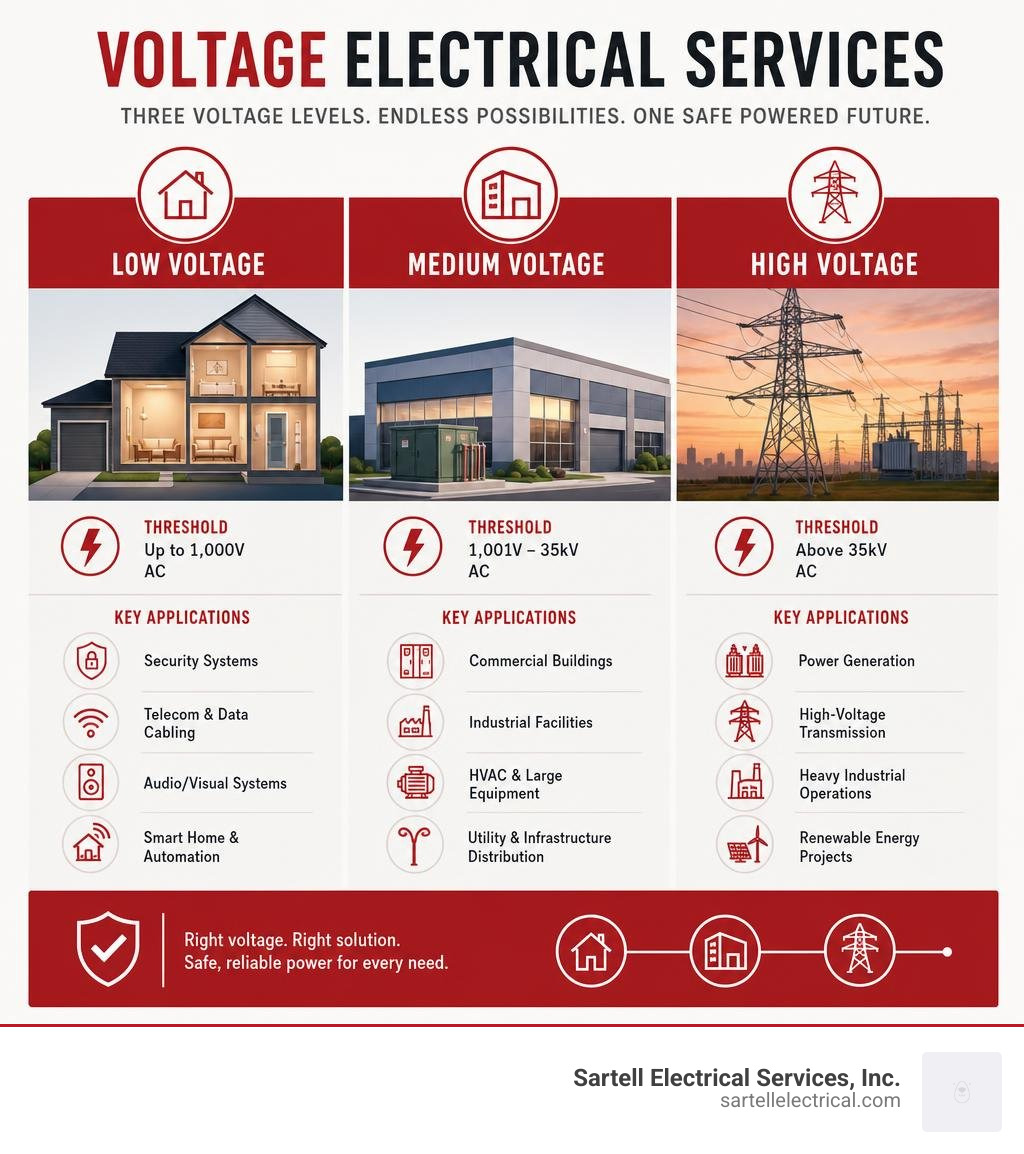
To help you visualize how these systems differ, let's look at the standard classifications:
| System Type | Voltage Range | Typical Applications | Key Requirements |
|---|---|---|---|
| Low Voltage | Under 50V AC (or up to 120V for simple control circuits) | Telecom, security, smart home automation, internet cabling | Precision wiring, signal integrity, structured cabling design |
| Medium Voltage | 600V to 69,000V (69kV) | Large commercial complexes, industrial plants, primary distribution | Specialized testing, safety gear, regular preventative maintenance |
| High Voltage | Over 69,000V (69kV) | Utility transmission lines, substations, heavy industrial grid ties | Extreme safety protocols, specialized engineering, heavy equipment |
Note: In many service sectors, electricians classify anything over 600 volts as high voltage because standard electrical equipment is not rated for these levels. In fact, many standard residential and commercial electricians will not work on systems exceeding 600 volts due to the extreme safety hazards involved.
Modern Applications of Low Voltage Electrical Services
Low-voltage systems don't carry the raw power needed to run a factory, but they carry something just as valuable: information. These systems are the brains of modern buildings.
From structured data cabling that keeps your office connected to the internet, to smart home automation systems that adjust your lighting based on the time of day, low-voltage work requires a delicate touch. We specialize in planning, engineering, and installing integrated low-voltage wiring systems that keep your technology running smoothly.
We outline our own tech-focused solutions on our Electrical Services hub.
Medium and High Voltage Infrastructure
When you cross the 600-volt threshold, safety protocols change entirely. Working with medium and high voltage requires specialized tools, heavy-duty protective gear, and technicians who have undergone years of rigorous training.
At this level, we manage critical infrastructure components such as transformers, substations, and high-voltage switchgear. Maintenance is not optional here; unexpected failures in high-voltage equipment can pose serious physical hazards to personnel and have devastating effects on facility performance and profitability.
Our high-voltage services include:
- Phase Vector Analysis: Ensuring balanced loads across complex power grids.
- Insulator Cleaning: Preventing arc-flashes and tracking by keeping vital components free of dust and debris.
- Torque Testing: Ensuring fasteners are perfectly tightened to handle thermal expansion.
To read more about managing heavy power systems safely, check out our Industrial Electrical Services Complete Guide.
Safety, Compliance, and the Value of Licensed Contractors

When it comes to electricity, there is absolutely zero room for error. A minor shortcut taken during installation can lie dormant behind a wall for years before causing a devastating electrical fire. That is why safety, strict code compliance, and proper licensing are the cornerstones of everything we do.
National Electrical Code (NEC) and Local Regulations
The National Electrical Code (NEC) is a massive, constantly evolving set of safety standards designed to protect people and property from electrical hazards. You can review the NEC standard overview through the National Fire Protection Association, which publishes NFPA 70, the National Electrical Code. In Massachusetts, these rules are taken very seriously, and local inspectors in towns from Reading to Peabody do not cut corners.
Every project we touch--whether it is a simple kitchen remodel or a massive industrial grid upgrade--is planned and executed to meet or exceed both the NEC and local Massachusetts building codes. This includes pulling the correct permits, performing precise load calculations, and preparing for official inspections. Navigating these regulations requires deep local knowledge of Massachusetts municipal guidelines to ensure seamless compliance.
Why Hire a Licensed and Insured Contractor?
It can be tempting to hire a cheap, unlicensed "handyman" to swap out an electrical panel or run a new line to your garage. But doing so is an incredibly risky gamble.
When you hire a fully licensed and insured contractor like us, you are protecting yourself in several critical ways:
- Safety Assurance: Our team has spent years studying electrical theory, undergoing rigorous field training, and passing comprehensive licensing exams.
- Liability Protection: If an unlicensed worker is injured on your property, or if their work causes a fire, your homeowner's insurance policy may deny your claim. A licensed contractor carries robust liability and worker's compensation insurance to protect you completely.
- Workmanship Guarantees: We stand behind our work. If something isn't right, we fix it.
- Property Value: Unpermitted electrical work can prevent you from selling your home or commercial building in the future. We ensure all paperwork is filed correctly so your property transitions smoothly when the time comes.
To understand more about what separates professional, licensed services from the rest, take a look at our Professional Electrical Services Guide 2025.
Supporting Energy Efficiency and Modern Technology Upgrades

As we move deeper into 2026, the way we use energy is changing rapidly. Homes and businesses across Massachusetts are looking for ways to reduce their carbon footprint, lower their utility bills, and integrate smart technologies. Our modern voltage electrical services are designed to help you make this transition seamlessly.
Electrical Panel and Service Upgrades
The first step in any modern energy upgrade is ensuring your electrical panel can actually handle the load. Many older homes in the Greater Boston area still have 100-amp panels. While 100 amps was plenty of power in the 1980s, it simply isn't enough to support a modern household equipped with heat pumps, induction cooktops, and electric vehicle chargers.
Upgrading your electrical panel increases your home's capacity, improves safety, and prepares your property for the future. Learn more about how we handle these critical upgrades in our Electrical Service Upgrades Complete Guide and our In-Depth Guide to Electrical Service Upgrades.
EV Chargers and Renewable Energy Integration
Electric vehicles are no longer a novelty; they are a standard sight on Massachusetts roads. Installing a Level 2 EV home charger allows you to charge your vehicle overnight, but it requires a dedicated 240-volt circuit and a careful load calculation to ensure your panel isn't overloaded.
We specialize in designing and installing safe, efficient EV charging setups for both residential garages and commercial parking lots. To see our own approach to future-proofing your home's power systems and integrating backup power, check out our Electrical Service Upgrades Complete Guide.
Emergency Support and Choosing the Right Service Provider
Electrical emergencies don't wait for convenient business hours. A fallen tree limb can rip your service mast off your home on a stormy Friday night, or a critical breaker can fail in your commercial kitchen right before the dinner rush. Knowing who to call before disaster strikes is key to minimizing damage and stress.
24/7 Emergency Electrical Services
When you experience an electrical emergency, you need a rapid, professional response. Our emergency services focus on quick fault finding, securing dangerous hazards, and restoring your power safely.
Whether you are dealing with a complete power outage, a burning smell coming from your breaker panel, or water dripping into your electrical box, our team is trained to handle high-stress situations with calm professionalism. For our local emergency and standard services, head over to our Electrical Services page.
Key Factors When Selecting a Provider
Choosing an electrical partner is a big decision. To ensure you are getting the best possible service, look for these key indicators of quality:
- Decades of Experience: Look for a company with a proven track record. (We have been serving Massachusetts since 1985!)
- Strong Local Reputation: Check online reviews and ask for local references to ensure you are working with a trusted partner.
- Clear Communication: Your electrician should explain the problem and the solution in plain English—no confusing jargon or hidden fees.
- Up-to-Date Licensing: Always verify that the contractor's license is active and in good standing with the state.
For more tips on choosing a reliable partner, check out our Professional Electrical Services Guide 2025.
Frequently Asked Questions about Voltage Electrical Services
What is the difference between low-voltage and high-voltage electrical services?
Low-voltage services handle systems operating under 50V (like internet cabling, security systems, and smart home thermostats). These systems focus on signal integrity and data transmission. High-voltage services (typically classified as anything over 600V in commercial settings) handle the raw power lines, transformers, and industrial switchgear that power entire facilities. High-voltage work requires specialized safety equipment, heavy-duty insulated tools, and advanced training.
Why do unexpected failures in high-voltage equipment occur?
Unexpected failures are usually caused by thermal stress, environmental contamination (like dust and moisture), and natural wear and tear on insulators. Over time, high electrical loads generate heat, which can degrade wire insulation and connections. Regular preventative maintenance, such as infrared thermal imaging and insulator cleaning, can catch these issues before they cause catastrophic failures or costly facility downtime.
How often should commercial facilities schedule preventative electrical maintenance?
We recommend that commercial and industrial facilities schedule a professional electrical inspection and preventative maintenance at least once a year. High-use environments benefit from semi-annual thermal imaging scans to detect hot spots in breaker panels, switchgear, and motor control centers before they lead to unexpected system failures.
Conclusion
Whether you are a homeowner needing a simple panel upgrade, a builder launching a new construction project, or an industrial facility manager looking to secure your high-voltage systems, having a trusted partner makes all the difference.
At Sartell Electrical Services, we bring over 30 years of hands-on experience, a deep commitment to safety, and a passion for customer service to every job we tackle across Massachusetts. We don't just pull wires; we build long-term relationships based on trust, quality workmanship, and honest pricing.
Ready to discuss your next project or schedule a safety inspection? Contact us today to learn more about our electrical contractor services and let us power your vision safely!