
Why Your Home's Electrical System Matters More Than Ever
Electrical Service Upgrades are critical improvements to your home's power system that increase safety, capacity, and efficiency. Whether you're planning a renovation, managing a commercial property, or preparing for electrification, understanding when and why to upgrade is essential.
Here's what you need to know:
- An electrical service upgrade increases the amperage your property can handle, typically from 60 or 100 amps to 200 amps.
- It involves replacing the meter socket, service entrance conductors, main panel, and grounding system—not just the breaker box.
- You likely need an upgrade if you have frequent breaker trips, flickering lights, a fuse box, or plan to add high-demand equipment like EV chargers or HVAC systems.
- Costs typically range from $2,000 to $4,000 for a panel upgrade, but can reach $5,000 to $25,000 for a full service upgrade.
- Installation takes about one day, but utility coordination and permitting can extend the timeline to several weeks.
Your electrical system is the heart of your property. An inadequate service puts your facility at risk and limits your ability to modernize. Many homes and commercial buildings built before 1970 have systems that can't meet today's power demands, leading to significant fire risks. The National Fire Protection Association attributes thousands of fires, injuries, and over a billion dollars in property damage annually to electrical failures.
Modern life, with its computers, smart devices, and the push toward electrification with heat pumps and EV chargers, requires a robust electrical infrastructure. An electrical service upgrade is about future-proofing your property, ensuring code compliance, and protecting your investment.
I'm Ed Sartell, founder of Sartell Electrical Services. Since 1985, I've overseen hundreds of Electrical Service Upgrades for clients across Massachusetts. We ensure complex projects meet strict timelines, budgets, and safety requirements, because proper electrical planning is the foundation of success.
Electrical Service Upgrades terms at a glance:
Understanding Electrical Service Upgrades: What, Why, and When
Many homeowners find electrical systems confusing, but understanding the basics is straightforward. Let's break down what you need to know.
What is the Difference Between a Panel Upgrade and a Service Upgrade?
This is a common point of confusion. The difference impacts both cost and the solution for your home.
A panel upgrade involves replacing only the breaker box—the metal cabinet on your wall. This is done when your old panel is full, outdated, or you're replacing a fuse box. It gives you a modern, safer panel but does not increase your home's total electrical capacity.
An Electrical Service Upgrade is a complete overhaul of your home's connection to the utility grid. It increases the total amount of power, or amperage, your home can draw. This upgrade replaces:
- The service drop (wires from the utility pole)
- The meter base (where the meter sits)
- The service entrance conductors (wires from the meter to the panel)
- The Main Electrical Panel itself
- The grounding system (safety components like ground rods)
Many older Massachusetts homes have 60 or 100-amp services, which is often insufficient for modern life. A 200-amp service is now the standard, providing enough power for air conditioning, electric ranges, and EV chargers without overloading your system.
Key Benefits of Upgrading Your Electrical System
An Electrical Service Upgrade is one of the smartest investments you can make in your home. While not as glamorous as a new kitchen, the benefits are critical.

- Improved Safety and Reduced Fire Risk: Outdated systems are a leading cause of house fires. An upgrade replaces old, brittle wiring and faulty components with modern, safer materials, including arc fault circuit interrupters (AFCI) that prevent electrical fires before they start.
- Increased Power Capacity: Stop worrying about tripping a breaker when you run the microwave and toaster at the same time. A 200-amp service provides the capacity for all your modern devices and appliances to run smoothly.
- Support for EVs and Heat Pumps: If you're considering an electric vehicle or an efficient heat pump, a service upgrade is often necessary. An EV charger alone can draw 40-50 amps, which can easily overwhelm an older 100-amp service.
- Improved Energy Efficiency: A modern system ensures electricity flows correctly, allowing appliances to run at the proper voltage without struggling, which can extend their lifespan.
- Increased Home Value: An updated electrical system is a major selling point. It signals to buyers that your home is well-maintained, safe, and ready for modern living.
- Code Compliance: Electrical codes are updated regularly for safety. An upgrade brings your home into compliance with current Massachusetts Clean Energy Center's guidance, which is essential for insurance, legal protection, and selling your home.
Telltale Signs You Need an Electrical Service Upgrade
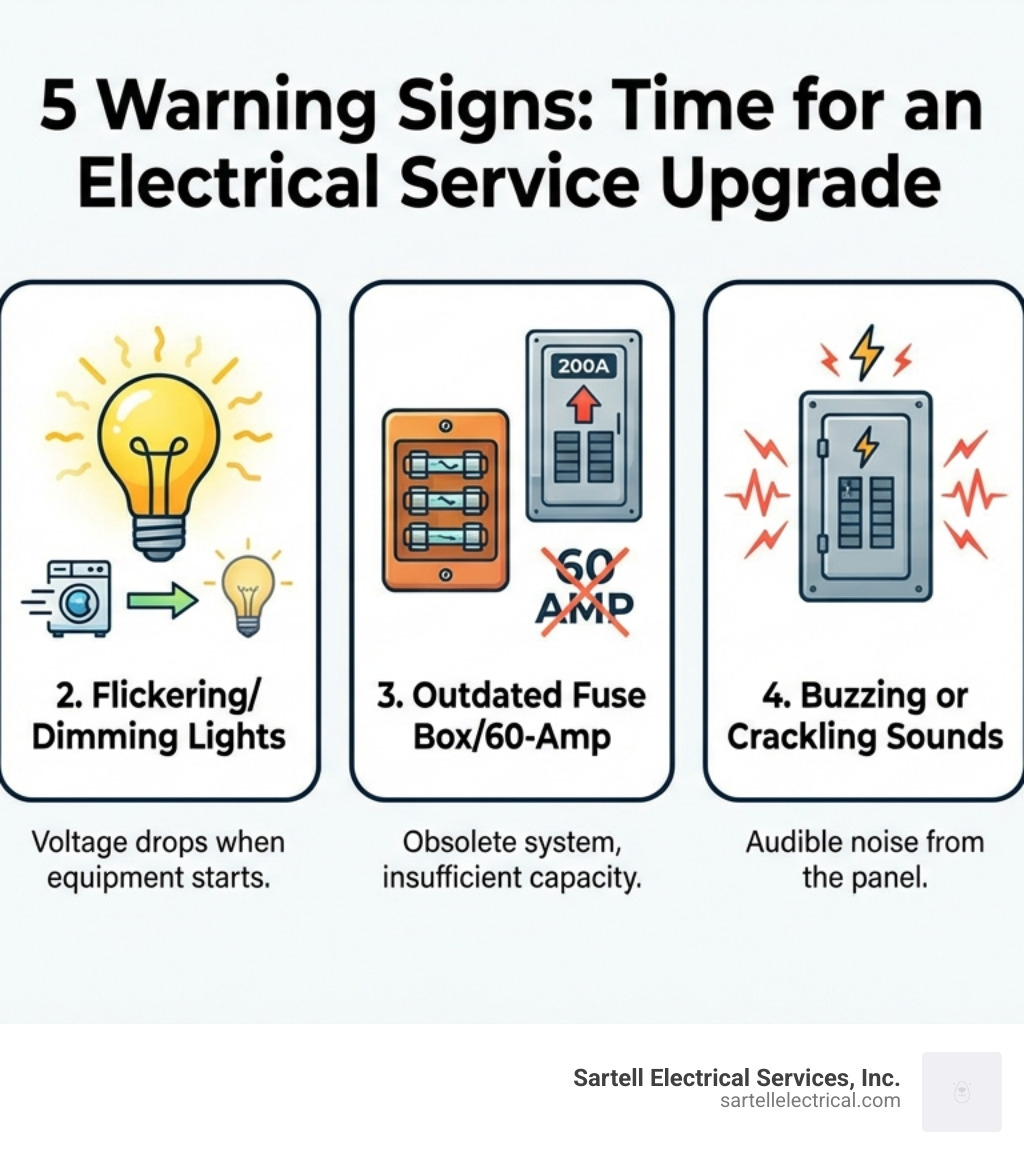
Your home often provides clear warning signs that its electrical system is struggling. Here’s what to look for:
- Frequent Circuit Breaker Trips: If you're constantly resetting breakers from normal appliance use, your system is overloaded.
- Flickering or Dimming Lights: When lights dim as a large appliance turns on, it indicates a voltage drop and an overtaxed system.
- Outdated Fuse Box: Fuses are an obsolete technology. If your home still has a fuse box, it needs a complete Fuse Box Replacement and a service upgrade.
- 60-Amp Service: Common in homes built before the 1960s, 60-amp service is no longer code-compliant and is inadequate for modern electrical loads.
- Buzzing Sounds from the Panel: Any buzzing, crackling, or humming from your panel indicates loose connections or failing components and requires immediate attention.
- Overheating Outlets: Outlets or switch plates that are warm to the touch are a serious fire hazard caused by excessive heat buildup.
- Planning Major Renovations or Additions: A kitchen remodel, finished basement, or home addition will require more power than your existing service may be able to provide.
- Adding High-Load Appliances: An EV charger, hot tub, central air, or whole-house generator all require significant power and often necessitate an upgrade.
The Process and Costs of Residential Electrical Service Upgrades
Understanding the process and costs of an Electrical Service Upgrade makes it a much more manageable project. Here’s a breakdown of what to expect.
A Step-by-Step Guide to the Upgrade Process
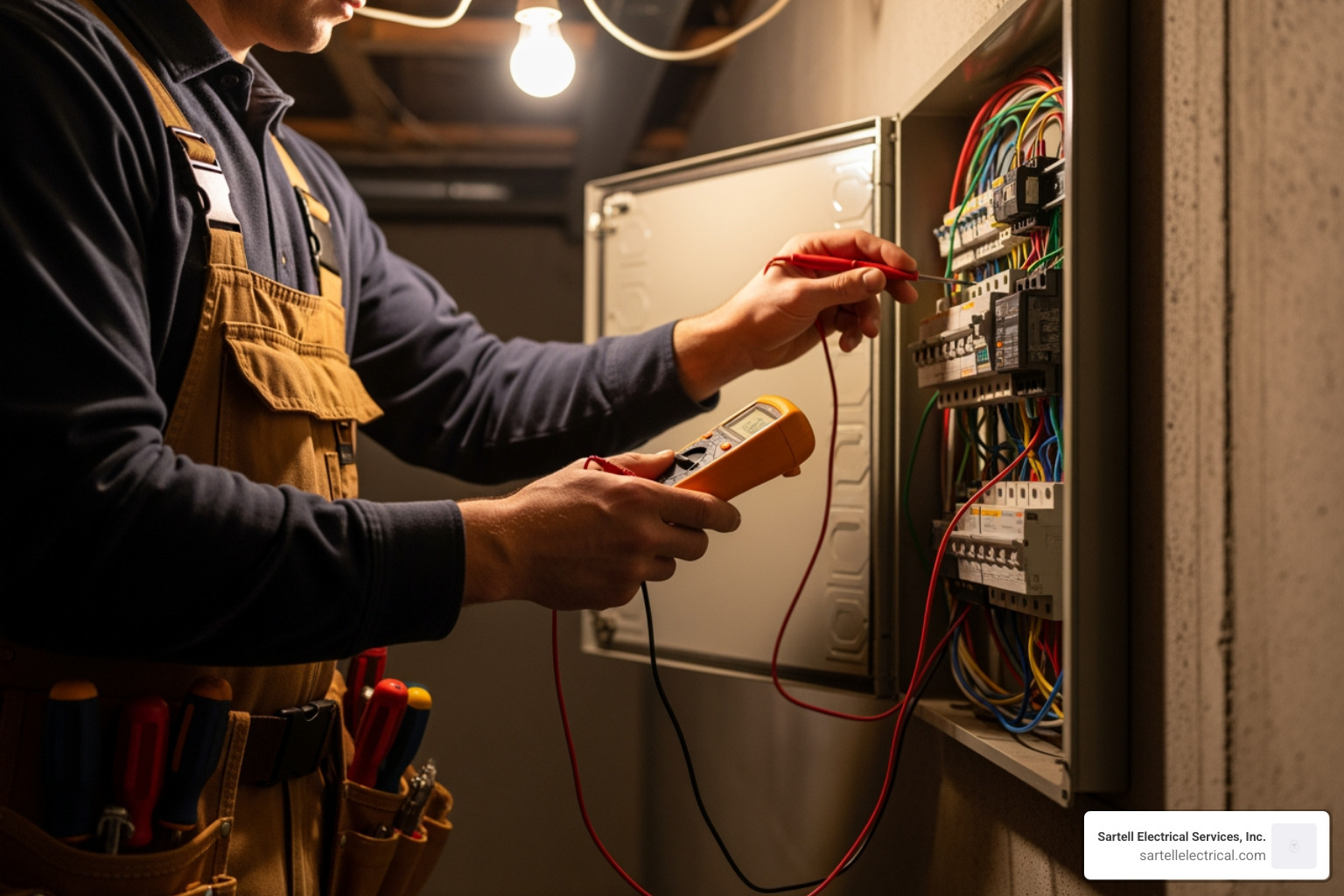
- Professional Assessment: A licensed electrician inspects your current system and discusses your future needs. We perform a detailed load calculation to determine the correct amperage for your home.
- Customized Proposal: You receive a clear proposal detailing the scope of work, materials, and an upfront cost estimate with no hidden fees.
- Utility Coordination and Permitting: We handle all the necessary paperwork, coordinating with your local Massachusetts utility provider and securing permits from your town's building department. This phase can take several weeks.
- Installation: Our team completes the installation, which typically takes one day. Your power will be off for 4 to 8 hours while we safely disconnect the old service, install the new meter base, service entrance conductors, and Main Electrical Panel, and upgrade the grounding system.
- Final Inspection: A local electrical inspector verifies that the work meets all current safety and code requirements, giving you official approval.
For more details on state-specific guidelines, you can learn more about the upgrade process in Massachusetts.
Understanding the Costs of Electrical Service Upgrades
An Electrical Service Upgrade is a valuable investment. In Massachusetts, a straightforward panel upgrade typically costs between $2,000 and $4,000. A full service upgrade, which is often required, can range from $5,000 to $25,000.
Key factors influencing the final cost include:
- Amperage Increase: Upgrading from 100 to 200 amps is a common project. See our guide on the cost to change an electrical panel from 100 to 200 amps.
- Scope of Work: A full service upgrade is more comprehensive and costly than a simple panel swap.
- Service Type: Overhead versus underground service can affect complexity and cost, as underground lines may require excavation.
- Transformer Replacement: If the utility's transformer is undersized for your new service, it may need to be replaced, adding to the cost and timeline.
For a more detailed breakdown, see our Main Panel Upgrade Cost guide.
How Homeowners Can Prepare for an Upgrade Project
A little preparation makes the upgrade process go smoothly.
- List Your Electrical Needs: Note current issues (tripping breakers) and future plans (EV charger, addition) to help us perform an accurate load calculation.
- Clear Access to the Panel: Ensure the area around your electrical panel is clear of furniture and storage so our team can work safely and efficiently.
- Protect Your Belongings: The work can create dust. Cover nearby furniture and valuables with drop cloths.
- Plan for the Power Outage: Your power will be off for several hours. Charge devices beforehand and plan for meals that don't require electricity. If you rely on powered medical equipment, please inform us well in advance.
Electrification, Modern Alternatives, and Future-Proofing Your Home
The shift toward home electrification is accelerating in Massachusetts, with more homeowners adopting heat pumps, EV chargers, and induction cooktops. But does this always require a full Electrical Service Upgrade?
Can You Electrify Without a Full Service Upgrade?
In many cases, you can electrify your home without immediately upgrading to 200-amp service, especially if you already have a 100-amp panel. The key is to manage your electrical load effectively.
Electrifying with a 100-amp panel is often achievable through strategic load management. This means being mindful of when you run high-demand appliances. For example, charging your EV overnight when other major appliances are off can prevent overloads. Our Residential Electrical Capacity Guide explores these strategies in more detail.
Choosing energy-efficient appliances also makes a big difference. Modern Energy Star-certified heat pumps and water heaters use significantly less power than older models, reducing your overall electrical demand.
However, an upgrade becomes unavoidable if your home has 60-amp service, your panel is old and worn, or you plan to add multiple high-demand appliances at once (like an EV charger, heat pump, and central AC).
Smart Panels and Circuit-Sharing Devices
Innovative technologies can help you use your existing electrical capacity more efficiently, sometimes delaying or avoiding the need for a full service upgrade.
Smart panels, like those from Span, bring intelligence to your electrical system. They allow you to monitor energy use from a smartphone app and automatically manage loads by prioritizing essential circuits (like your refrigerator) over flexible ones (like an EV charger) during peak demand. This prevents overloads without manual intervention.
Circuit splitters and pausers are more targeted solutions. A circuit splitter allows two high-power appliances, such as a dryer and an EV charger, to share a single 240-volt circuit. It automatically switches power to whichever device is in use. A circuit pauser monitors your home's total demand and temporarily pauses a non-essential load (like EV charging) to prevent an overload.
These devices are excellent for adding an EV charger without the cost of a full upgrade. Here’s how the options compare:
| Feature | Full Service Upgrade | Smart Panel | Circuit Splitter/Pauser |
|---|---|---|---|
| Purpose | Increase total home amperage & capacity | Manage/prioritize existing loads, monitor usage | Share a single circuit between two high-demand devices |
| Increases Amperage? | Yes | No | No |
| Cost (Relative) | $$$$ (Highest) | $$$ (Medium) | $$ (Lowest) |
| Complexity | High (utility coordination, permits, extensive wiring) | Medium (panel replacement, smart tech integration) | Low (device installation on specific circuit) |
| Best For | Homes with insufficient total capacity, major electrification | Homes with adequate capacity but high simultaneous demand | Specific high-demand appliance sharing (e.g., EV/dryer) |
| Future-Proofing | Excellent (provides ample headroom) | Good (adapts to changing load patterns) | Limited (solves specific sharing issues) |
| Primary Benefit | Comprehensive capacity increase, improved safety | Intelligent load management, energy insights | Cost-effective load sharing |
The right choice depends on your home, budget, and electrification goals. We can help you evaluate these options to find the best solution for your situation.
Frequently Asked Questions about Electrical Service Upgrades
We've answered thousands of questions about Electrical Service Upgrades from Massachusetts homeowners. Here are some of the most common ones.
What's the difference between a panel upgrade and a service upgrade?
A panel upgrade replaces only the main breaker box, giving you more circuit spaces but not more overall power. A service upgrade is a complete overhaul that increases your home's total amperage by replacing the panel, meter socket, wiring from the utility, and the grounding system.
How long does an electrical service upgrade typically take?
The on-site installation work is usually completed in a single day, with a power outage of about 4 to 8 hours. However, the entire process, including utility coordination and permitting in Massachusetts, can take several weeks from start to finish. It's wise to plan ahead.
Is a 100-amp service enough for a modern home?
It depends. A 100-amp service meets the minimum code but can be easily overwhelmed in larger homes or those with high-demand appliances like central AC, heat pumps, or EV chargers. For this reason, a 200 Amp Service Upgrade has become the recommended standard for modern homes, providing ample capacity for today and the future.
Conclusion
Your home's electrical system is the foundation of modern life. An Electrical Service Upgrade is a critical investment in your family's safety, your home's functionality, and its overall value.
We've covered the signs that an upgrade is needed—from frequent breaker trips to plans for electrification—and the process involved. Whether you need a full upgrade or can benefit from alternatives like smart panels, understanding your options is key. Ignoring warning signs only increases the risk to your home and family.
For homeowners in Massachusetts, working with an experienced, licensed contractor is essential. Since 1985, Sartell Electrical Services has helped families steer these important projects with professionalism and a commitment to safety. We handle everything from utility coordination to final inspection.
Your home deserves a safe, reliable electrical system. Ready to take the next step?
Get a complete overview of the process with our Main Electrical Panel Upgrade Guide and learn how we can help you power your home with confidence.