Industrial Electrical Services: Best Budget 2025
Your Guide to Cost-Effective Industrial Electrical Solutions
Industrial Electrical Services encompass specialized electrical work for manufacturing facilities, processing plants, and heavy-duty operations that require high-voltage power systems, complex machinery integration, and stringent safety protocols.
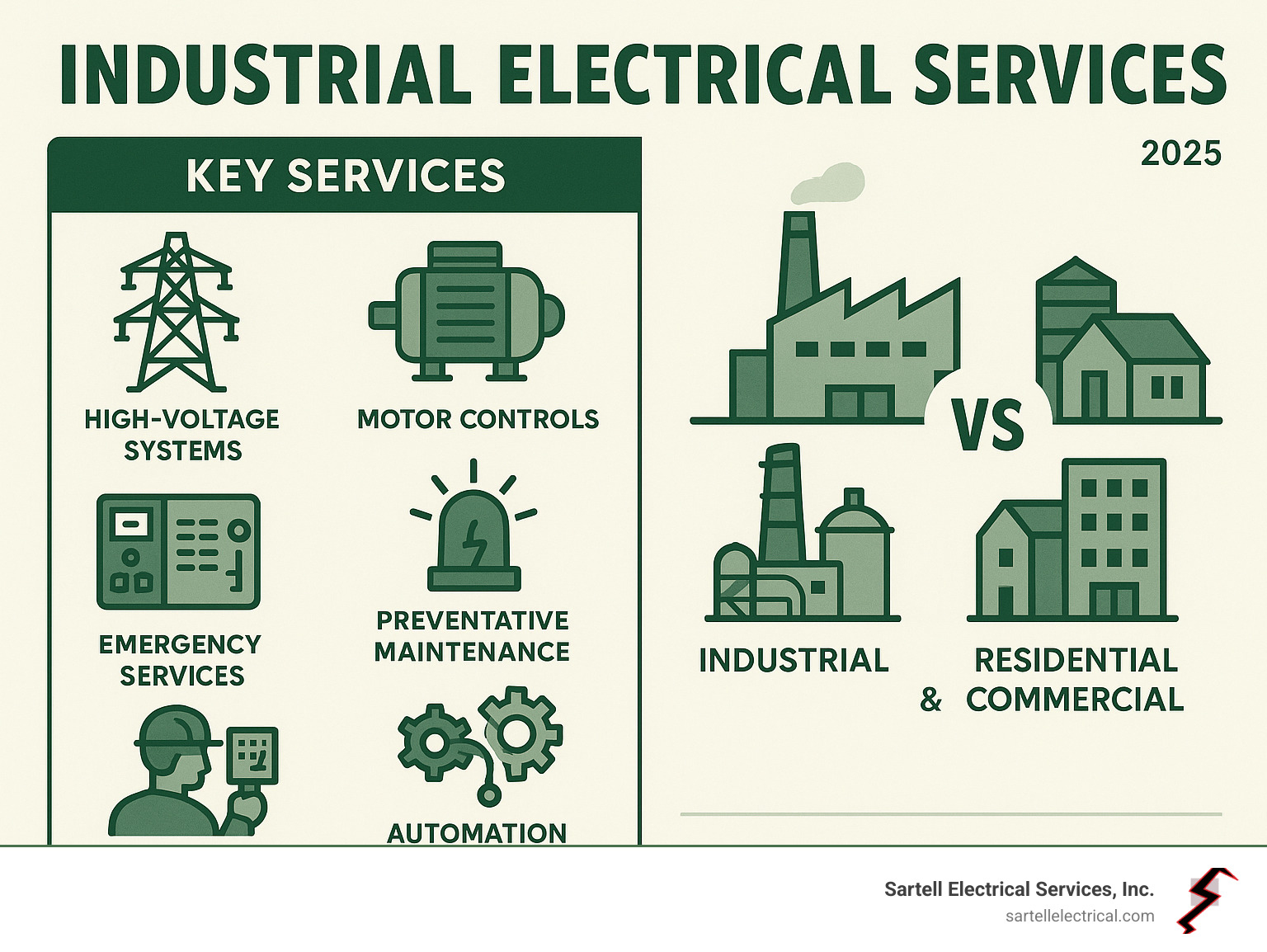
Key Industrial Electrical Services:
- High-voltage power distribution (480V, 600V, and higher)
- Motor control systems and Variable Frequency Drives (VFDs)
- Programmable Logic Controller (PLC) programming and maintenance
- Emergency power systems and generator installations
- Preventative maintenance and thermal imaging inspections
- 24/7 emergency breakdown services
- Hazardous location electrical work
- Process control and automation systems
Finding quality industrial electrical work that fits your budget doesn't mean cutting corners on safety or reliability. Many established contractors have served industrial clients for decades, offering 24/7 emergency service to minimize costly downtime.
Industrial electrical work differs significantly from residential or commercial projects. While an office might use 120V and 240V systems, industrial facilities often require 480V, 600V, or even higher voltage systems to power heavy machinery. This means working with specialized equipment, following stricter safety protocols, and hiring electricians with specific industrial training.
The stakes are higher too. When an industrial electrical system fails, it can shut down entire production lines, costing thousands of dollars per hour in lost productivity. That's why many facilities rely on contractors who provide rapid maintenance and guaranteed response times for urgent breakdowns.
Understanding the Scope: What Do Industrial Electrical Services Include?
Industrial facilities operate in a different electrical world. The complexity of interconnected systems and the scale of power requirements make
Industrial Electrical Services a specialized field demanding expertise, precision, and an understanding of modern manufacturing. If residential electrical work is tuning a guitar, industrial work is conducting an orchestra—every component must work in harmony.
The Critical Difference: Industrial vs. Commercial & Residential Work
The gap between industrial and other electrical work is defined by complexity and responsibility.
Voltage levels are a key distinction. While homes use 120V/240V, industrial facilities often operate on
480V, 600V, or even medium-voltage systems (5kV+). These power levels require specialized training and safety protocols.
Equipment scale is massive. Instead of wiring home appliances, industrial electricians power
production lines, motor control centers, and substations that can be the size of rooms.
Control systems are the facility's nervous system. Industrial plants rely on
Programmable Logic Controllers (PLCs), Distributed Control Systems, and Variable Frequency Drives to orchestrate complex processes with split-second timing.
Environmental conditions add another challenge. Electricians often work in extreme temperatures, dusty or high-vibration environments, and
hazardous locations requiring explosion-proof installations where a single spark could be catastrophic.
Regulatory standards like
OSHA and NFPA 70E are far more stringent due to the higher risks involved.
Core Industrial Electrical Services for Modern Facilities
At Sartell Electrical Services, our
Industrial Electrical Services cover every aspect of your facility's electrical needs. You can find
more info about our services on our website.
- New construction electrical services: We design and install complete electrical systems for new plants or major expansions, creating the backbone for your operations.
- Power distribution systems: We manage everything from medium-voltage substations to the final panel, ensuring smooth operations and preventing costly outages.
- Motor control centers and system upgrades: We retrofit and modernize control panels to keep your facility current with technology and safety standards.
- Preventative maintenance and emergency services: Our scheduled maintenance catches problems early, while our 24/7 emergency response ensures help is always available.
- PLC programming, VFD installation, and automation services: We program, calibrate, and integrate these systems for seamless operation.
- Data cabling and system integration: We handle the fiber optic networks and process control communications needed for Industry 4.0.
For complete details about our capabilities, visit our
Industrial Electrical Services page.
Powering Your Machinery: The Electrician's Role in Control Systems
Industrial electrical work is part science, part art, requiring precise, intelligent control.
Installation involves following complex schematics where every connection is critical to your operation.
Calibration ensures sensors, actuators, and timing are perfect. A few milliseconds off can result in expensive scrap.
Troubleshooting complex control systems requires advanced diagnostic tools and deep system knowledge to find the root cause quickly and minimize costly downtime.
System integration brings it all together. We ensure new equipment integrates flawlessly with existing
PLCs, SCADA systems, and control networks for a unified operation.
Programmable Logic Controllers (PLCs) are the brains of automation. We program, install, and maintain PLCs to orchestrate your facility's processes.
Variable Frequency Drives (VFDs) provide precise control over motor speeds while saving energy. We install and program VFDs to optimize equipment performance and reduce utility bills.
The Value Proposition: How Professional Industrial Electrical Services Boost Your Bottom Line
Partnering with skilled professionals for your
Industrial Electrical Services is a smart investment that delivers measurable returns through improved efficiency, safety, and reliability.
Enhancing Operational Efficiency and Minimizing Downtime
Unexpected downtime costs thousands per hour in lost production. Professional electrical services are a crucial investment to prevent these costly surprises.
Preventative maintenance is the backbone of efficiency. Our electricians conduct regular inspections and scheduled maintenance during planned shutdowns, catching small issues before they become expensive emergencies. It's far cheaper to replace a worn part during scheduled maintenance than to fix a catastrophic failure during peak production.
When emergencies happen, fast response is critical. We offer
24/7 emergency service with rapid response capabilities, because every minute of downtime directly impacts your bottom line.
Energy efficiency improvements offer dramatic cost savings. We conduct plant energy audits to identify opportunities like installing Variable Frequency Drives (VFDs), upgrading to LED lighting, and correcting power factor issues. These changes can slash utility bills by 20-30%.
Our
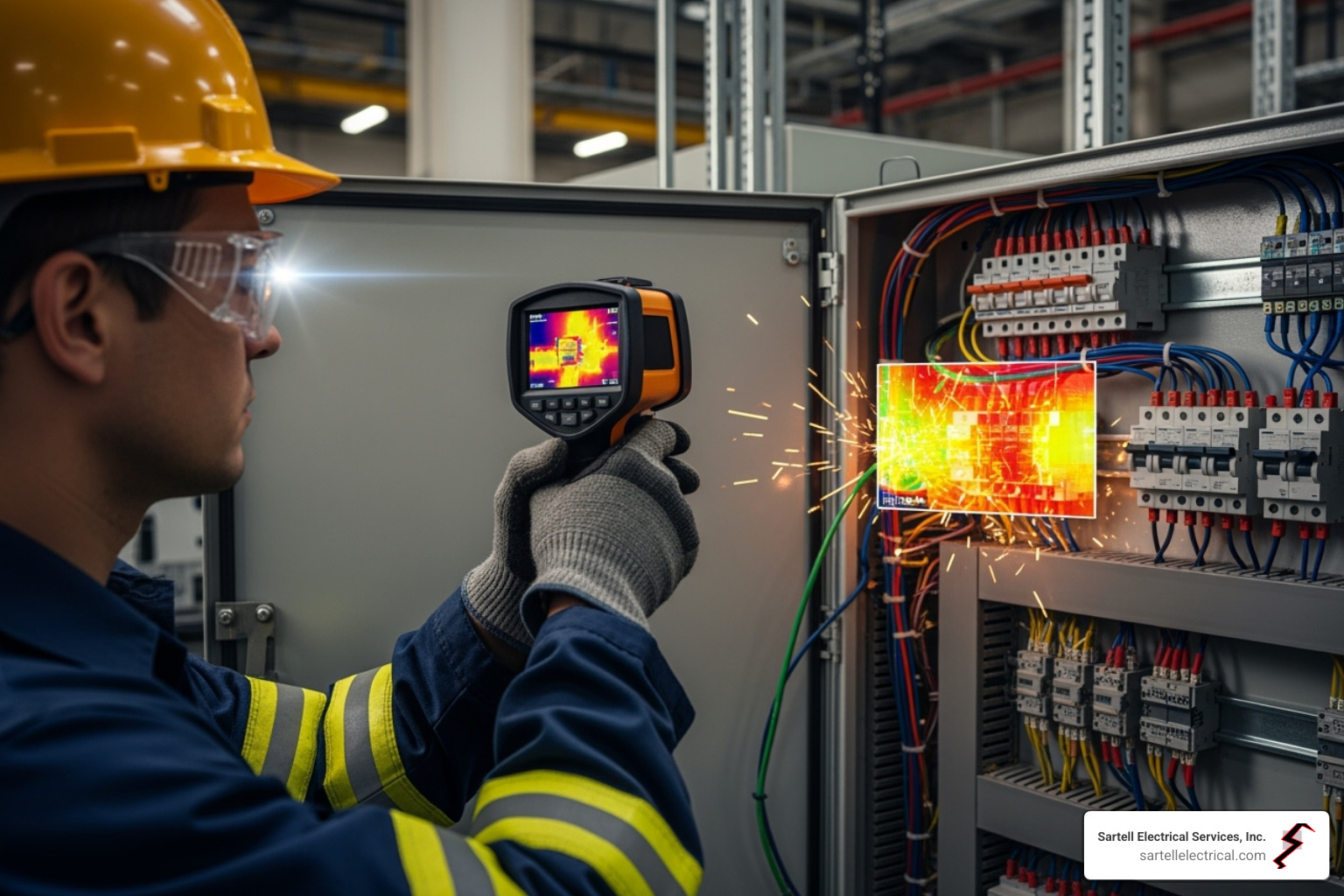
proactive repair approach uses tools like thermal imaging to spot potential failures before they happen. By addressing these hot spots early, we prevent unplanned outages that can shut down entire production lines.
Ensuring Safety and Regulatory Compliance
Industrial electrical work is about keeping people safe. The stakes are high, as incidents can cause serious injuries, fatalities, and devastating property damage, along with staggering financial impacts.
 Workplace safety
 is non-negotiable. Our electricians are Arc-flash Certified and use proper Lock-Out/Tag-Out (LOTO) procedures. We don't just follow safety rules—we help create a culture of safety at your facility.
We ensure all work meets or exceeds
OSHA standards and the
NFPA 70E standard for Electrical Safety in the Workplace. This helps you avoid hefty fines, legal issues, and creates a safer environment for everyone.
Code violations can lead to significant financial penalties and even forced shutdowns. Our meticulous approach to code compliance protects your people and your business's financial health. You can learn more about
NEC Code Compliant standards on the NFPA website.
Accident prevention is always more cost-effective than dealing with the aftermath. Proper design, installation, and maintenance dramatically reduce the risk of electrical fires, shocks, and arc flash incidents.
Industries That Rely on Specialized Electrical Expertise
The need for expert
Industrial Electrical Services spans every sector, each with unique challenges. Our expertise adapts to meet these diverse demands, as shown in our
Projects portfolio.
- Manufacturing plants depend on reliable electrical systems for everything from assembly line robotics to heavy machinery.
- Food and beverage processing facilities require systems that meet stringent hygiene and food safety regulations.
- Data centers need ultimate reliability with redundant power systems and uninterruptible power supplies to ensure 24/7 operation.
- Wastewater treatment plants operate in corrosive environments where electrical systems must be exceptionally robust.
- Chemical and pharmaceutical facilities require specialized installations for explosive or sterile environments with strict safety requirements.
- Warehouses and distribution centers rely on automated conveyor and robotic systems that demand expert electrical installation and maintenance.
The common thread is the need for reliable, safe, and efficient electrical systems. When your business depends on continuous operation, you can't compromise on quality.
Choosing the Right Partner: What to Look for in an Industrial Electrical Contractor
Finding the right industrial electrical contractor is a critical decision for your facility. The wrong choice can lead to costly downtime and safety issues, while the right partner becomes an extension of your team, trusted with your most critical systems.

Essential Qualifications for Industrial Electrical Services Providers
When vetting contractors for your
Industrial Electrical Services, look beyond a low price. Here’s what truly matters:
- State licensing: Ensure any contractor is fully licensed in Massachusetts. This is non-negotiable proof of competency.
- Insurance and bonding: A reputable contractor must carry comprehensive liability insurance, workers' compensation, and be properly bonded. This is your financial safety net.
- Experience: Look for a contractor with a proven track record in industrial settings. At Sartell Electrical Services, we bring over 30 years of experience to complex industrial projects, a testament to our reliability and expertise.
- Industry certifications: Certifications like OSHA 10/30, NFPA 70E compliance, and arc-flash certification demonstrate a serious commitment to safety and are essential for industrial work.
- Customer testimonials and references: Ask to speak with other industrial clients. A strong track record is best verified by past customers.
- Workforce and skills: Evaluate the contractor's team. A skilled workforce can handle substantial projects efficiently and meet critical deadlines.
Evaluating a Contractor's Emergency Response Capabilities
When a production line goes down at 2 AM, your contractor's emergency response can mean the difference between a minor hiccup and a catastrophic loss.
- 24/7 availability: Your electrical support should be available whenever you operate, including nights and weekends.
- Guaranteed response times: For urgent breakdowns where downtime costs thousands per hour, a commitment to be onsite within a few hours is invaluable.
- Fully-stocked service vehicles: Fast response is useless without the right parts. The best contractors arrive with vehicles loaded with common components and tools to begin repairs immediately.
- Troubleshooting expertise: Industrial problems are complex. You need electricians who can quickly diagnose multifaceted issues to save hours of downtime.
Finding Local Expertise in Massachusetts
For
Industrial Electrical Services in Massachusetts, local expertise makes a real difference. Understanding regional codes, permitting, and utility requirements streamlines projects and prevents delays.
Sartell Electrical Services is headquartered in Reading, MA, and has served industrial clients throughout Massachusetts for over 30 years. Our service area covers the Greater Boston region, including Essex, Middlesex, Norfolk, and Suffolk Counties.
Whether you need an
Industrial Electrical Contractor Boston MA, an
Industrial Electrical Contractor Cambridge MA, an
Industrial Electrical Contractor Woburn MA, an
Industrial Electrical Contractor Waltham MA, or an
Industrial Electrical Contractor Newton MA, a local team means faster response and a deeper understanding of your challenges.
Local contractors know the quirks of regional utilities and can steer permitting and inspection processes efficiently. This partnership is about more than technical skills—it's about finding a partner who understands your business and has the resources to support your operations for years to come.
Frequently Asked Questions about Industrial Electrical Services
We've compiled answers to the questions we hear most often from facility managers and plant operators about balancing safety, efficiency, and costs with
Industrial Electrical Services.
How often should my facility schedule electrical maintenance?
There is no single answer for every facility, but a good baseline is a
comprehensive annual inspection. Your specific frequency depends on several factors:
- Usage intensity: Facilities running 24/7 place more stress on electrical systems and require more frequent attention, such as quarterly or semi-annual checks for critical equipment.
- Environmental conditions: High heat, dust, humidity, or corrosive elements accelerate wear and tear, necessitating more frequent maintenance to prevent failures.
- Manufacturer recommendations: Always follow the manufacturer's maintenance schedules for your equipment to ensure optimal performance and maintain warranties.
- Thermal imaging: We recommend annual or bi-annual thermal imaging scans of electrical panels. This non-invasive technique spots hotspots from loose connections or overloads before they cause a failure.
- NFPA 70B standards: These standards provide excellent, proven guidelines for developing an effective and safe electrical maintenance program.
Preventative maintenance costs a fraction of what reactive maintenance costs in downtime and emergency repairs.
Can upgrading our industrial lighting save us money?
Yes, and likely more than you think. Facilities can cut their lighting costs by
50% to 80% with smart upgrades, and the benefits extend beyond the electric bill.
- LED retrofitting: Modern LED systems are far more energy-efficient than older fluorescent or high-intensity discharge lights. The energy savings are immediate and dramatic.
- Rebates and incentives: Utility and government programs can often reduce the upfront cost of an LED upgrade, sometimes covering 30-50% of the project.
- Safety improvements: LEDs provide brighter, more uniform light, which reduces shadows, improves visibility, and can lead to fewer accidents and better productivity.
- Lower maintenance costs: LEDs last 5 to 10 times longer than traditional bulbs, meaning less labor and disruption for replacements, especially in hard-to-reach areas.
The return on investment for an LED upgrade is typically 2 to 4 years, after which the savings continue for years.
What is the importance of power factor correction?
Power factor correction ensures you aren't paying for electricity you don't use. Poor power factor is common in industrial facilities with many motors and transformers, causing you to draw more current than is needed to do the work.
- Avoid utility penalties: Many utility companies add significant surcharges for low power factor because it strains their grid. Correction can eliminate thousands in monthly penalty fees.
- Increase system efficiency: Improving your power factor reduces current flow and voltage drops, which means less heat buildup and stress on your entire electrical infrastructure.
- Extend equipment longevity: Motors, transformers, and other equipment last longer when not operating under the stress of poor power factor, reducing premature replacement and maintenance costs.
Power factor correction is an investment that optimizes your entire electrical system for maximum efficiency and reliability, typically paying for itself within a few years.
A Strategic Investment for Your Facility's Future
When you invest in professional
Industrial Electrical Services, you're not just fixing a problem or checking off a maintenance box. You're making a smart business decision that pays dividends for years to come. Think of it as the foundation that everything else in your facility depends on – because without reliable power, even the most advanced machinery is just expensive decoration.
The long-term value of working with skilled industrial electricians becomes clear when you consider the alternative. A single unexpected breakdown can cost thousands of dollars per hour in lost production. But when you have the right electrical infrastructure in place, maintained by experts who know your systems inside and out, those costly surprises become rare exceptions rather than regular headaches.
Safety always comes first in industrial settings, and there's no room for shortcuts. When our electricians arrive wearing proper PPE and following OSHA standards and NFPA 70E protocols, they're not just protecting themselves – they're protecting your entire operation from the devastating costs of accidents, regulatory fines, and potential shutdowns. Arc-flash incidents and electrical fires don't just threaten lives; they can destroy equipment worth millions and shut down operations for weeks.
Efficiency and profitability go hand in hand with professional electrical services. Every time we optimize your motor controls, upgrade your lighting to LED, or fine-tune your power factor correction, we're directly impacting your bottom line. The energy savings alone often pay for the service, while the improved reliability keeps your production lines humming.
The complexity of today's industrial electrical systems means you can't afford to work with anyone but
specialized experts. Your facility's programmable logic controllers, variable frequency drives, and high-voltage distribution systems require electricians who speak that technical language fluently. It's the difference between a quick fix and a lasting solution.
At Sartell Electrical Services, we've spent over 30 years building relationships with industrial clients across Massachusetts because we understand something fundamental: your success is our success. When your production lines run smoothly, when your energy bills drop, when your facility passes every safety inspection – that's when we know we've done our job right.
The industrial landscape keeps evolving, with new automation technologies and stricter safety requirements emerging regularly.
Partnering with experts like us means you're not just solving today's challenges; you're preparing for tomorrow's opportunities. We stay current with the latest codes, technologies, and best practices so you can focus on what you do best – running your operation.
Ready to make that strategic investment in your facility's future?
Contact Us today to discuss how our
Comprehensive Industrial Electrical Services can keep your operation running safely, efficiently, and profitably for years to come.