

CO Detectors: Your First Line of Defense Against an Invisible Danger
Carbon monoxide detectors are devices that sense dangerous levels of CO gas in your home and sound an alarm before the gas can harm you or your family. Here's what you need to know at a glance:
- What they do: Detect CO gas and alert you before levels become dangerous
- Where to install: On every floor, outside every sleeping area, near fuel-burning appliances
- When to test: Monthly, with full unit replacement every 5-10 years
- What to do if it alarms: Evacuate immediately, get fresh air, call 911
- Certification to look for: UL 2034 standard
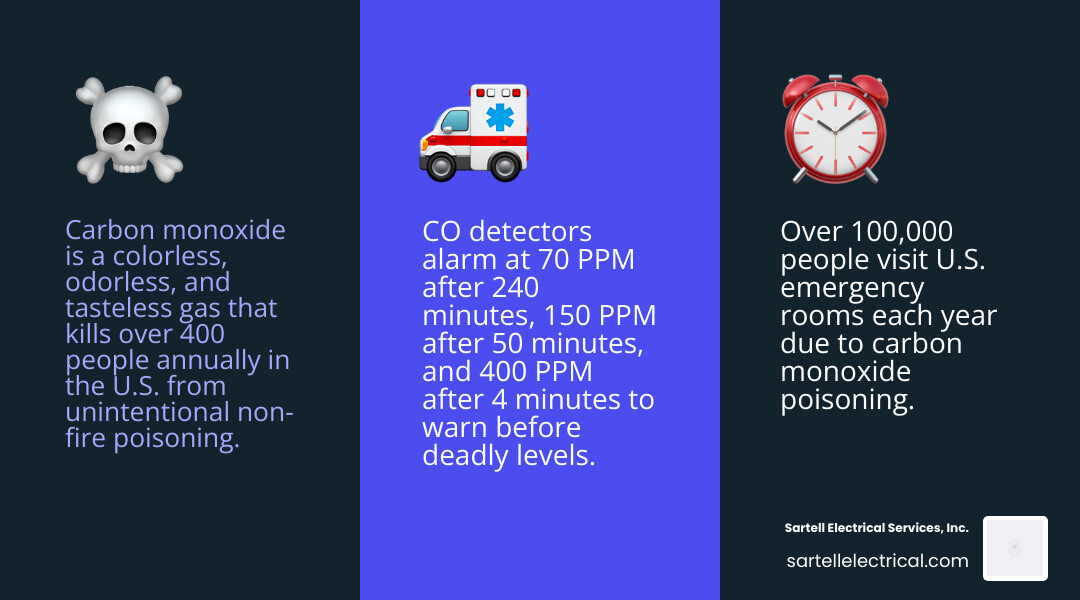
You can't see it. You can't smell it. You can't taste it. But carbon monoxide — often called the "silent killer" — can be deadly within minutes at high concentrations.
The numbers are sobering. Every year in the U.S., more than 400 people die from unintentional CO poisoning unrelated to fires. Over 100,000 more end up in emergency rooms. And perhaps most alarming? Sixty percent of Americans can't identify a single warning sign of a CO leak in their home.
That's exactly why CO detectors matter — and why understanding them could save your life.
I'm Ed Sartell, President of Sartell Electrical Services, Inc., and over nearly four decades of electrical work across Massachusetts, I've seen how proper installation of carbon monoxide detectors protects families and businesses alike. In this guide, I'll walk you through everything you need to know — from how these devices work to where to put them and when to replace them.
Important Carbon monoxide detectors terms:
- 24 hour electrician service near me
- registered electrician near me
- safe electric registered electrical contractor
Understanding Carbon Monoxide: The "Silent Killer"
At Sartell Electrical Services, we often tell our clients in Greater Boston that the most dangerous threats are the ones you can't perceive. Carbon monoxide (CO) is a byproduct of incomplete combustion. This means whenever you burn fuel—whether it's the natural gas in your furnace, the gasoline in your car, or the wood in your fireplace—CO is produced.
The science behind why it is so dangerous is quite straightforward but terrifying. When you breathe in CO, it enters your bloodstream and hitches a ride on your red blood cells, specifically bonding with hemoglobin. It forms something called carboxyhemoglobin. The problem? CO bonds to hemoglobin about 200 times more effectively than oxygen does. Essentially, it "crowds out" the oxygen your brain and heart need to function, leading to suffocation from the inside out.
In our experience serving areas like Reading, North Andover, and Woburn, we find that CO leaks often stem from:
- Malfunctioning Furnaces: A cracked heat exchanger can allow CO to bypass the flue and enter your living space.
- Portable Generators: These are massive CO producers. A single portable generator can produce as much CO as 100 idling cars.
- Blocked Chimneys: Birds' nests or debris can prevent toxic gases from escaping.
- Idling Vehicles: Running a car in an attached garage, even with the door open, can allow gas to seep into the home.
Common Symptoms of CO Poisoning
Because you can't smell or see the gas, you have to rely on your body's physical reactions—though these are often mistaken for the flu. According to CDC guidance on protecting your family, the most common symptoms include:
- Dull headache
- Weakness or dizziness
- Nausea or vomiting
- Shortness of breath
- Confusion or blurred vision
If you feel better when you leave the house and worse when you return, or if everyone in the family (including pets) feels sick at the exact same time, you likely have a CO problem.
Household Sources and Prevention
Prevention is your primary shield. While carbon monoxide detectors are your last line of defense, maintaining your appliances is the first. The EPA guide to preventing CO poisoning recommends having your heating system, water heater, and any other gas, oil, or coal-burning appliances serviced by a qualified technician every year.
At Sartell Electrical, we also strongly advise our customers in communities like Lexington and Concord to never use a charcoal grill or portable camping stove inside. Most importantly, if you use a generator during a Nor'easter, keep it at least 20 feet away from any window, door, or vent.
How Carbon Monoxide Detectors Work
You might wonder how a small plastic box can "see" a gas that you can't. Unlike smoke detectors, which look for physical particles, carbon monoxide detectors use sophisticated chemistry to measure gas concentration over time.
As explained by NIST (National Institute of Standards and Technology), these devices don't just "turn on" at a specific level; they follow a concentration-time function. This mimics the way CO builds up in the human body. For example:
- At 70 PPM (parts per million), the alarm may take 60 to 240 minutes to sound.
- At 150 PPM, it will sound within 10 to 50 minutes.
- At 400 PPM, the alarm will scream within 4 to 15 minutes.
| Sensor Type | Technology Basis | Pros | Lifespan |
|---|---|---|---|
| Electrochemical | Chemical reaction creates current | Most accurate, low power | 5-10 Years |
| Biomimetic | Gel changes color when CO absorbed | Very reliable, few false alarms | 2-3 Years (Gel) |
| Metal Oxide | Semiconductor resistance change | Fast response, durable | 5-10 Years |
Electrochemical Sensors
This is the gold standard for modern carbon monoxide detectors. Inside the sensor, a chemical reaction occurs when CO is present, creating an electrical current surge. The "brain" of the detector measures this current; the more CO in the air, the stronger the current. These are highly accurate and are what we typically install for our residential clients in Medford and Cambridge.
Biomimetic and Semiconductor Technology
Biomimetic sensors use a specialized gel that changes color as it absorbs CO, much like human hemoglobin. A light sensor inside the unit detects this color change and triggers the alarm. Semiconductor sensors use a thin film of tin dioxide on a ceramic base. When CO hits the film, it lowers the electrical resistance, allowing more current to flow and triggering the alert.
Choosing the Right Carbon monoxide detectors for Your Home
When you're shopping for protection, you'll see three main power formats. For many of our clients in the Greater Boston area, choosing between them depends on the age of the home and your local building codes.
- Hardwired Units: These are wired directly into your home's electrical system. They usually have a battery backup (often a 10-year sealed lithium battery). These are the most reliable because they can be interconnected.
- Battery-Powered: These are easy to install anywhere. Newer models feature a "10-year permanent power" battery, meaning you never have to change a battery for the life of the unit.
- Plug-In Models: These simply go into a standard wall outlet. They are convenient but take up an outlet and must have a battery backup to work during a power outage.
For a deeper dive, check out our article on installing CO detectors for home safety.
Smart Carbon monoxide detectors and Interconnection
In the modern "smart home," carbon monoxide detectors have leveled up. Smart units can send an alert to your smartphone if the alarm goes off while you're at work—or even while you're on vacation.
Interconnection is the most vital feature. If a leak starts in your basement near the furnace, an interconnected system will trigger the alarms in your upstairs bedroom simultaneously. This gives you those precious extra minutes to evacuate.
Essential Features to Look For
When browsing the Consumer Reports buying guide, keep an eye out for these "must-haves":
- Digital Display: This shows you the exact PPM level. It’s helpful because you can see if low levels are present before they reach the alarm threshold.
- Peak Level Memory: This tells you the highest CO level recorded since the unit was last reset—crucial info for emergency responders.
- End-of-Life Signal: All CO sensors degrade over time. You want a unit that will chirp specifically to tell you it's time for a brand-new detector.
Installation and Maintenance Best Practices
Placement is everything. Because CO is slightly lighter than air and tends to spread evenly through a room, the NFPA (National Fire Protection Association) provides very specific guidelines.
- Where to Install: You need a detector on every level of the home, including the basement. Most importantly, place them in the hallway outside each separate sleeping area. If you sleep with the bedroom doors closed, the NFPA recommends putting a detector inside the bedroom as well.
- Distance from Sources: Keep detectors at least 15-20 feet away from fuel-burning appliances (like the furnace or stove). If they are too close, "nuisance alarms" can occur from tiny, non-lethal amounts of CO released during startup.
Locations to Avoid
Don't put your carbon monoxide detectors just anywhere! Avoid these spots:
- The Kitchen: Steam and cooking fumes can cause false alarms.
- Garages: High levels of CO are present when you start your car, which will trigger the alarm immediately.
- Near Vents or Fans: Moving air can blow CO away from the sensor, preventing it from detecting a leak.
- Humid Bathrooms: Excessive moisture can damage the sensors.
Testing and Replacing Your Carbon monoxide detectors
Maintenance is a simple but life-saving habit. We recommend our clients in places like Peabody and Salem follow this schedule:
- Monthly: Press the "Test" button. This checks the battery and the internal circuitry. (Note: It does not test the CO sensor itself—only a specialized test gas can do that).
- Every 6 Months: If you have replaceable batteries, change them when you change your clocks for Daylight Savings.
- Every 5-10 Years: Replace the entire unit. Most sensors are only rated for 5 to 7 years. Check the manufacture date on the back of your device today!
For more detailed tips, you can view the CPSC safety tips and infographics.
Legal Requirements and Safety Standards
In Massachusetts, we have some of the strictest safety laws in the country. Since 2006, "Nicole’s Law" has required CO detectors in nearly every home that has fuel-burning equipment or an attached garage.
When buying a unit, ensure it meets the UL 2034 safety standard. This ensures the device has been rigorously tested to alarm at the correct levels without being overly sensitive to "transient" CO levels (like a puff of smoke from a toaster).
For landlords in Boston or Cambridge, there are specific requirements to ensure tenants are protected. Failure to comply can lead to heavy fines—or worse, tragedy. You can read more about state-specific CO detector statutes to see how these laws apply to your property.
Frequently Asked Questions about CO Alarms
How do CO detectors differ from smoke detectors?
They are completely different technologies. A smoke detector looks for physical particles of combustion. A CO detector looks for a specific gas molecule. Smoke usually rises quickly, while CO mixes with the air. You absolutely need both. Many modern units are "Combination Detectors" that house both sensors in one shell.
What should I do if my CO detector alarms?
- Don't ignore it. Even if you feel fine, the gas could be building up.
- Evacuate immediately. Get everyone, including pets, to fresh air.
- Call 911. Fire departments have specialized meters to find the leak.
- Do not go back inside until emergency responders tell you it is safe.
- Call a technician to repair the faulty appliance before turning it back on.
Why is my detector chirping?
If it's a single "chirp" every minute or so, it usually means the battery is low. If the unit is more than 5-7 years old, it's likely an "End-of-Life" signal, telling you the sensor is no longer reliable and the whole unit must be replaced.
Conclusion
At Sartell Electrical Services, Inc., we believe your home should be your sanctuary. Whether you live in a historic home in Salem or a modern condo in the Seaport, carbon monoxide detectors are a non-negotiable part of your safety infrastructure.
With over 30 years of experience serving Essex, Middlesex, Norfolk, and Suffolk counties, our team is ready to help you ensure your home is fully compliant with Massachusetts codes and, more importantly, safe for your family. From hardwiring interconnected systems to performing whole-home safety audits, we handle projects of all sizes with a commitment to excellence.
Don't leave your safety to chance. If you're unsure about your current protection or need professional installation, contact us today for expert electrical services for your home. We're here to be your partners in safety across the Greater Boston area.