What is the max capacity of standard residential electrical service 1
Why Understanding Your Home's Power Limits Matters
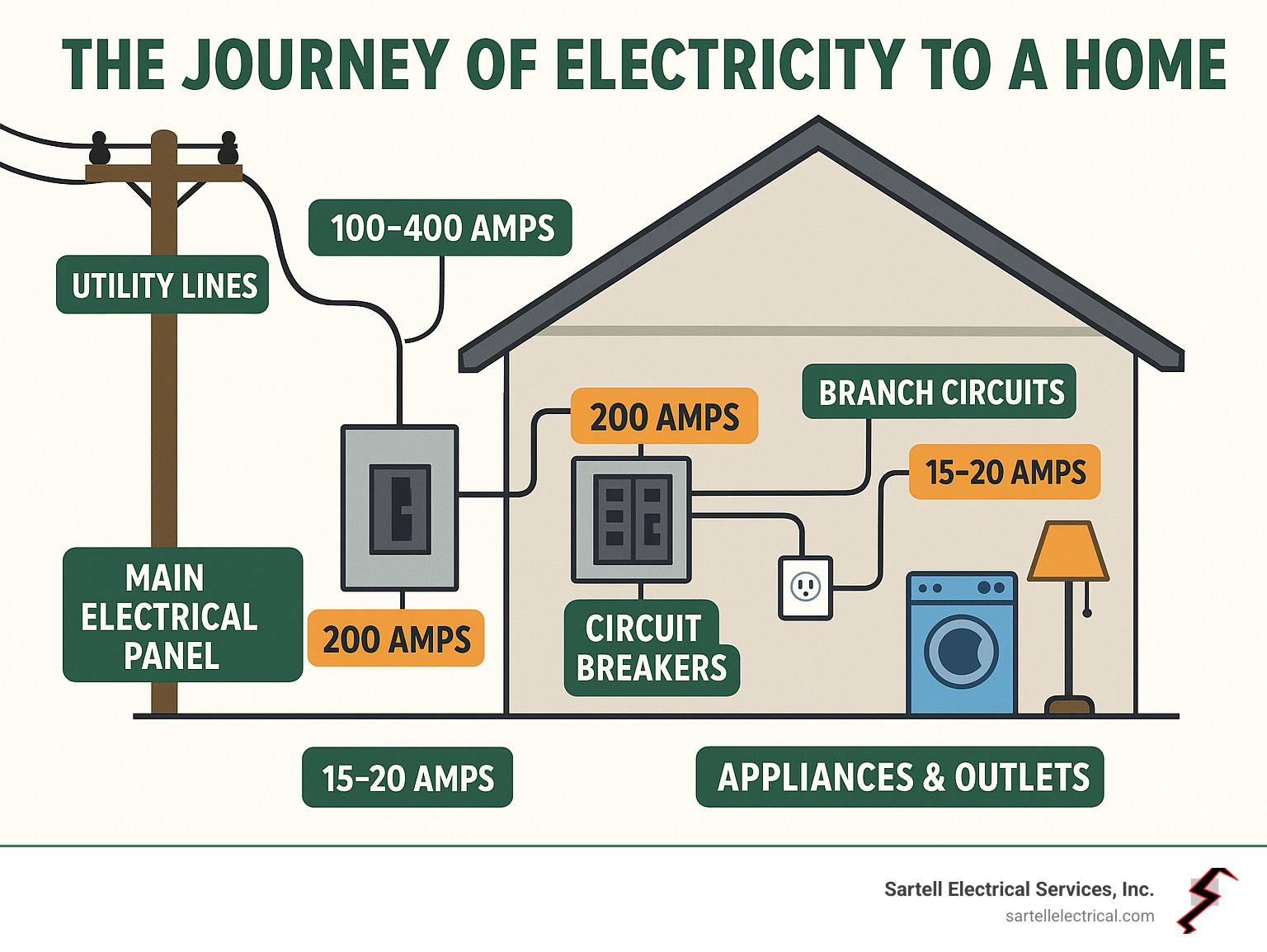
What is the max capacity of standard residential electrical service ranges from 100 to 400 amps, with 200 amps being the current standard for most modern homes. Here's the quick breakdown:
Standard Residential Service Capacities:
- 60-100 amps: Older homes (pre-1980s) - often inadequate for modern needs
- 200 amps: Current standard for new construction and renovations
- 400+ amps: Large homes with extensive electrical demands (multiple HVAC systems, EV chargers, workshops)
Most homes built today come with 200-amp service, which provides enough power for typical family needs including central air, electric appliances, and some room for growth. However, if you're planning major additions like electric vehicle charging, heat pumps, or significant home expansions, you might need to consider higher capacity.
Understanding your home's electrical capacity isn't just about convenience - it's about safety, efficiency, and future-proofing your investment.
- Safety: An undersized electrical service can lead to frequent breaker trips and flickering lights, which are often symptoms of a larger problem. Constant overloading can cause wires to overheat, creating a serious fire hazard behind your walls and potentially damaging sensitive electronics.
- Efficiency: When your electrical system is strained, it can cause a voltage drop to your appliances. This means motors in your refrigerator or HVAC system have to work harder, consuming more energy and shortening their operational lifespan.
- Future-Proofing: Knowing your limits helps you plan for the future. Beyond just adding a new appliance, you might be considering a dedicated home office, a sophisticated smart home automation system, or even an accessory dwelling unit (ADU) for family. A robust electrical service ensures you can accommodate these additions without costly, last-minute upgrades.
I'm Ed Sartell, and in my nearly four decades as President of Sartell Electrical Services, I've helped countless Massachusetts homeowners understand what is the max capacity of standard residential electrical service and determine the right sizing for their specific needs. Given the historic nature of many homes in the Greater Boston area, we frequently encounter aging 100-amp panels that are no longer sufficient. Whether you're dealing with an older system or planning a major renovation, getting your electrical capacity right is crucial for both safety and functionality.
What is the Max Capacity of Standard Residential Electrical Service?
When we talk about your home's electrical service capacity, we're really talking about amperage – not voltage. Think of your electrical system like a highway: voltage is like the speed limit (how fast the electricity moves), while amperage is like the number of lanes (how much traffic can flow at once).
Most homes in Massachusetts use standard voltages of 120 volts for everyday items like lights and small appliances, and 240 volts for heavy-duty equipment like your electric dryer or air conditioner. But what is the max capacity of standard residential electrical service comes down to how many amps your system can safely handle.
Your electrical service is essentially the main pipeline bringing power from the utility company into your home, then distributing it to every outlet, light, and appliance. Understanding your capacity helps you know what you can run simultaneously without problems.
100-amp service was the go-to standard for decades, and you'll still find it in many older homes. It works fine for smaller houses, especially if you use gas for heating, hot water, and cooking. You can run your basic appliances, lights, and even an electric stove – just not everything at peak demand simultaneously. Trying to run a window air conditioner, a microwave, and a coffee maker at the same time might be enough to trip a breaker. As we've added more gadgets, bigger TVs, and started thinking about electric cars, 100 amps can feel pretty tight.
200-amp service is today's sweet spot and the current standard for new construction. This gives you breathing room for modern life – central air conditioning, multiple large appliances running together, and space to grow. It can comfortably support an all-electric kitchen with an induction cooktop, a double wall oven, and other modern conveniences. Want to add an electric vehicle charger or upgrade to a heat pump? A 200-amp service gives you options without constantly worrying about overloading your system.
400-amp service enters the picture for homes with serious electrical appetites. We're talking large properties with multiple HVAC systems, extensive electric heating, home workshops with heavy equipment, or several EV charging stations. This capacity is also considered for homes with luxury amenities like a heated pool, sauna, or a geothermal heating and cooling system. Most typical families won't need this much power, but it exists for those special situations.
Here's how these different capacities stack up in real-world terms:
| Service Capacity | Typical Home Size/Usage | Examples of What It Can Power |
|---|---|---|
| 100-amp | Small to medium homes (under 2,000 sq ft) with gas appliances | Basic lighting, outlets, electric range, single AC unit, standard appliances (but not all at once) |
| 200-amp | Modern family homes (2,000-4,000 sq ft), mixed electric/gas systems | All standard appliances, central air, electric heat pump, Level 2 EV charger, room for expansion |
| 400-amp | Large homes (4,000+ sq ft) or high electrical demand properties | Multiple HVAC systems, several EV chargers, workshops, extensive electric heating, heated pools, saunas |
The beauty of understanding these numbers is that it takes the mystery out of your home's capabilities. No more wondering why the lights dim when you start the dryer, or whether you can safely add that hot tub you've been dreaming about.
The 3 Key Factors Determining Your Service Size
Your home's electrical capacity isn't determined by just one component – it's actually the result of three critical elements working together. Think of it like a chain: your system is only as strong as its weakest link.
Service entrance cable is the heavy-duty wire that brings power from the utility lines to your home. This cable has a specific amperage rating based on its thickness (gauge) and material (copper or aluminum). A licensed electrician can safely identify its rating, as it's often unmarked and dangerous to inspect for a homeowner.
Main electrical panel rating refers to the capacity of your breaker box itself. The panel needs to be designed to safely distribute whatever amperage comes into your home. You can typically find this rating on a sticker inside the panel door. You can't just swap in a bigger main breaker and call it a day – the panel's internal components (busbars) must be rated for the load.
Main breaker rating is the big switch that controls power to your entire home. This breaker needs to match both your service entrance cable and panel capacity. The amperage is clearly printed on the switch itself. It's your home's master shut-off and primary protection against overloads.
Here's where the weakest link principle comes into play: if your service entrance cable can handle 200 amps, but your panel is only rated for 100 amps with a 100-amp main breaker, your effective capacity is 100 amps. All three components need to be rated for the same capacity for your system to perform safely and efficiently.
Understanding the Max Capacity of Standard Residential Electrical Service in Older vs. Newer Homes
The age of your home tells a story about its electrical capacity, and understanding this history helps explain why what is the max capacity of standard residential electrical service has evolved so dramatically over the decades.
60-amp service was common in homes built before the 1960s, back when families owned fewer electrical appliances. These systems often used fuse boxes instead of circuit breakers. A major safety concern with fuse boxes is the ability for a homeowner to install an incorrectly sized fuse. If a 15-amp fuse keeps blowing, someone might be tempted to install a 20-amp or 30-amp fuse, which allows the circuit to dangerously overheat and creates a significant fire risk. These systems are seriously limited by today's standards and are uninsurable in many cases.
100-amp service became the standard through the 1970s and 1980s as homes began incorporating more electrical appliances like dishwashers and central air conditioning. This capacity worked well when most heating and cooking still relied on gas, but it's increasingly stretched thin in our modern, electronics-filled world.
200-amp service emerged as the new standard starting in the 1990s and is now required by most local codes for new construction. This shift was driven by the National Electrical Code (NEC), which is published by the National Fire Protection Association (NFPA) and provides the benchmark for safe electrical design, installation, and inspection. As our power needs have grown, the NEC's minimum requirements have increased to ensure safety and accommodate modern technology.
The difference between older and newer systems isn't just about capacity – it's about safety and functionality. Modern breaker panels offer better protection, easier maintenance, and more flexibility for future upgrades. If you're dealing with an old fuse box or undersized service, it might be time to consider an upgrade. An upgrade is also an opportunity for an electrician to identify and correct other potential issues common in older homes, such as ungrounded outlets or deteriorating wiring.
At Sartell Electrical Services, we regularly help Massachusetts homeowners transition from outdated electrical systems to modern, properly-sized service that meets today's demands and tomorrow's possibilities.