Commercial Electric Panel: Ultimate 2025 Guide
Introduction: The Command Center of Your Building's Power
A
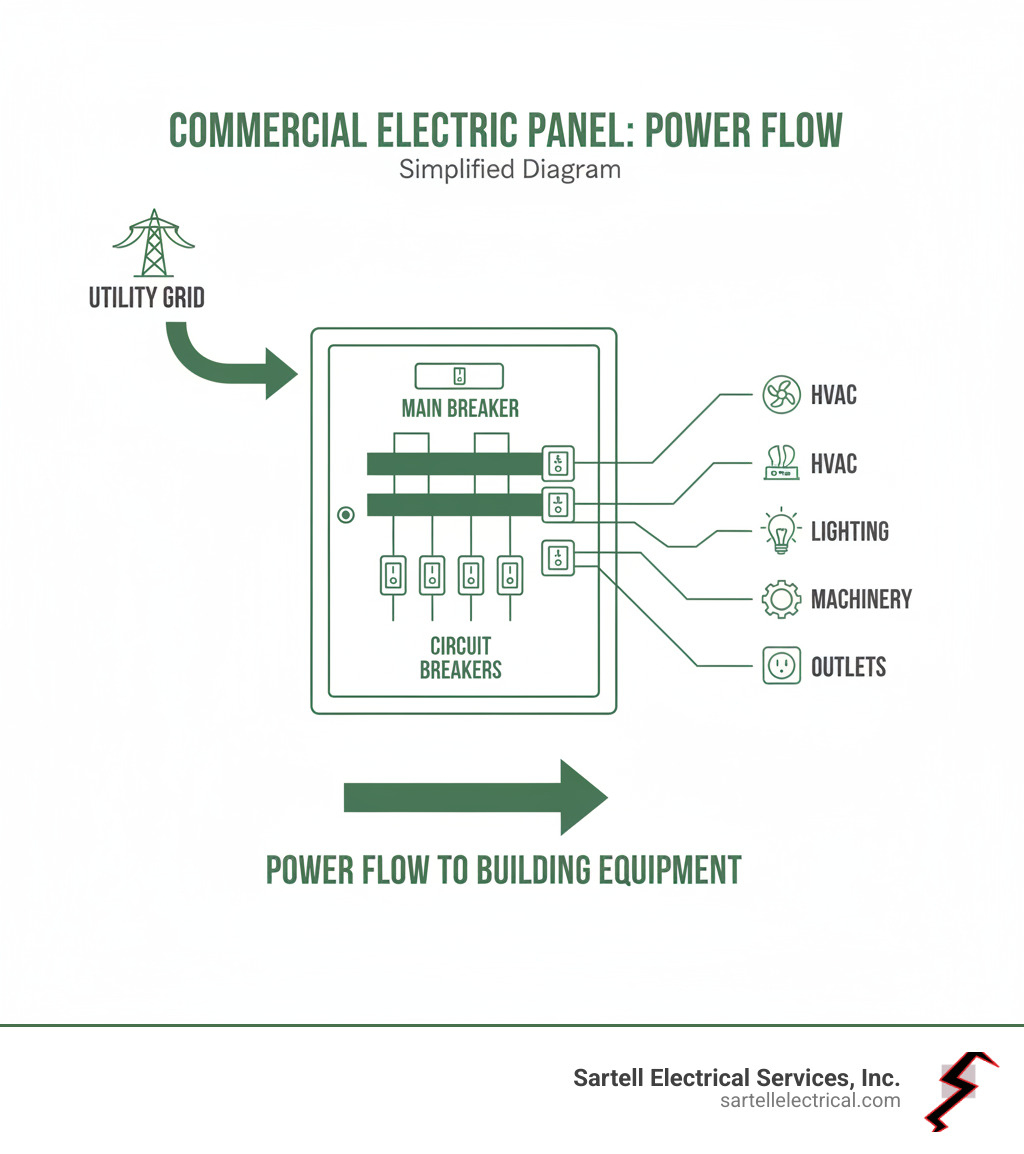
commercial electric panel is the central distribution point for all electrical power in your building. It receives electricity from the utility grid and safely routes it to every circuit, outlet, and piece of equipment throughout your facility.
Key Facts About Commercial Electric Panels:
- Function: Distributes power from utility to individual circuits; protects against overloads and faults
- Capacity: Typically ranges from 100 amps to 1200+ amps, depending on building size
- Types: Single-phase (smaller buildings) or three-phase (large facilities, heavy machinery)
- Main Components: Main breaker, bus bars, circuit breakers, neutral/ground bars, enclosure
- Lifespan: Generally 25-40 years before replacement recommended
- Code Requirement: Must comply with NEC Article 408 and local electrical codes
Commercial panels differ significantly from residential systems. They handle
higher voltages (often 208V, 480V, or more), support
three-phase power for heavy equipment, and face
stricter safety codes due to the number of occupants and critical operations they serve. While a home might use a 200-amp panel, commercial buildings often require 400 to 1200+ amps to power HVAC systems, manufacturing equipment, data centers, and hundreds of lighting circuits.
I'm Ed Sartell, and since 1985, I've led Sartell Electrical Services through thousands of
commercial electric panel installations and upgrades across Massachusetts, from small retail spaces to large industrial facilities. Whether you're evaluating your current system or planning a major expansion, understanding your panel is the first step toward a safe, reliable electrical infrastructure.
Anatomy and Types: A Look Inside the Box
Let's open up a
commercial electric panel and see what makes it tick. Understanding the internal components helps you appreciate how it keeps your business running safely and efficiently.
Essential Components of a Commercial Electric Panel
Every
commercial electric panel contains several key components working together to power and protect your building.
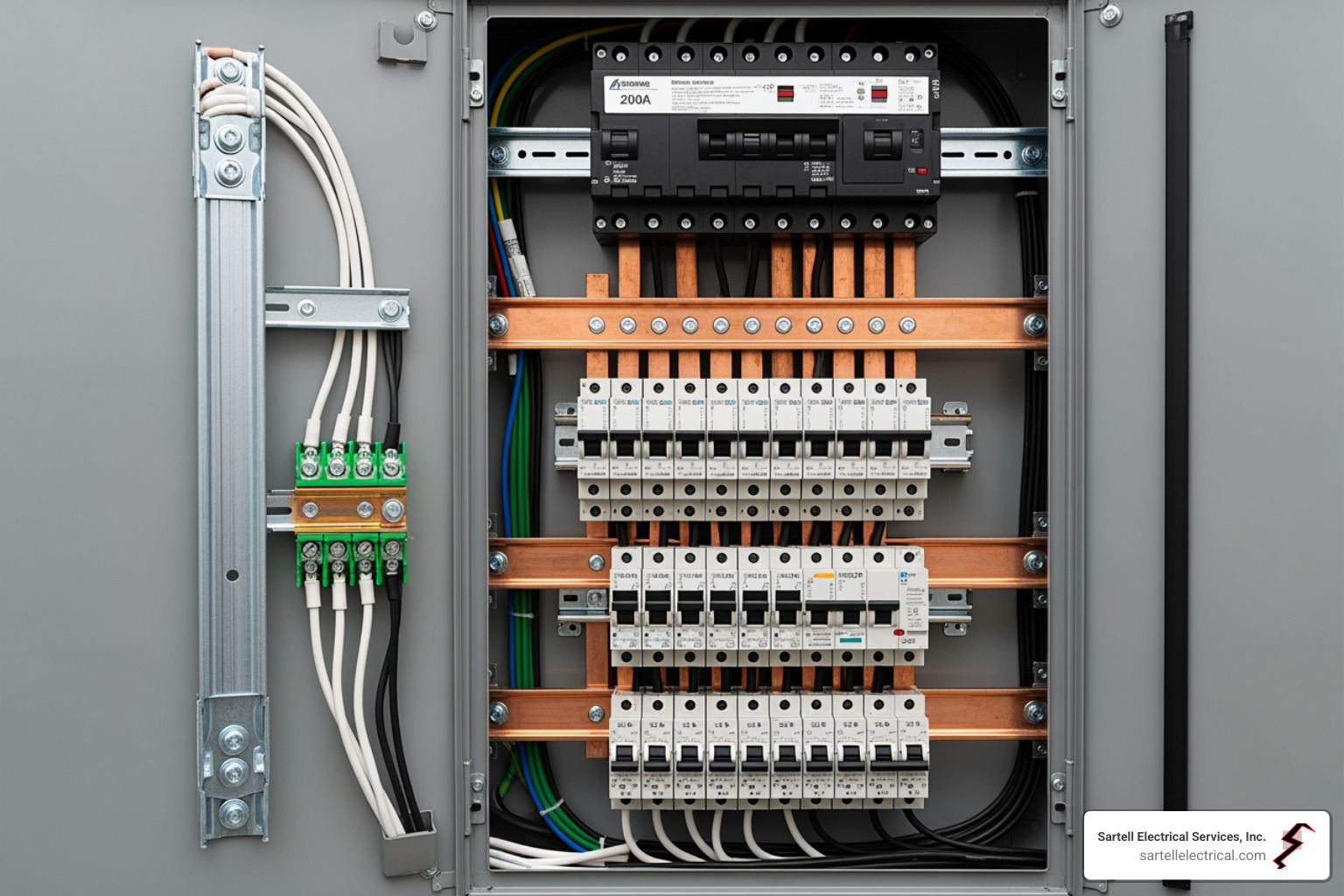
- Main Breaker: This is your panel's master switch. It controls all power from the utility, allowing for a complete shutdown for maintenance or emergencies. It also protects the entire system from dangerous overcurrents.
- Bus Bars: These thick metal strips (usually copper or aluminum) act as an electrical highway, receiving power from the main breaker and distributing it to the individual circuit breakers.
- Circuit Breakers: These are the individual safety switches for each circuit (e.g., HVAC, lighting). They automatically trip and cut power during an overload or short circuit, preventing damage and fires.
- Neutral and Ground Bars: The neutral bar connects neutral wires, providing a return path for electrical current. The ground bar connects grounding wires, creating a safe path to earth for fault currents to protect people and equipment from electrical shock.
- Panel Enclosure: This is the protective metal box housing all components. Its NEMA rating indicates where it can be installed (e.g., NEMA 1 for indoors, NEMA 3R for outdoors) to protect against dust, moisture, and physical damage.
If you're considering upgrading your panel, check out our guide on
breaker panel upgrades.
Main Types of Panels: Single-Phase vs. Three-Phase
One of the most important distinctions for a
commercial electric panel is whether it uses single-phase or three-phase power, as this determines what your electrical system can handle.
Single-phase systems deliver power through a single alternating current waveform (typically 120V/240V). They are simpler and cost-effective for smaller commercial spaces with modest power demands, like retail shops in Acton or small offices in Bedford. For more details, see
how single-phase power works.
Three-phase systems are the workhorses of commercial and industrial electricity. Using three synchronized alternating currents, they deliver power continuously and efficiently. This makes them ideal for large facilities with heavy machinery and substantial power demands, such as factories in Lawrence or large office buildings in Boston.
Here's how they compare:
| Feature |
Single-Phase Panels |
Three-Phase Panels |
| Voltage |
Typically 120V/240V |
Commonly 208V/120V, 480V/277V, 400V/230V, 415V/240V |
| Wires |
Two (one hot, one neutral) or three (two hot, one neutral) |
Four (three hot, one neutral) or three (three hot, no neutral) |
| Power |
Intermittent, fluctuating |
Constant, continuous, more efficient |
| Use Cases |
Small offices, retail, residential, light commercial |
Large commercial buildings, industrial facilities, heavy machinery, data centers |
| Pros |
Simpler, less expensive, suitable for low power needs |
More power, greater efficiency, better for motors, balanced load |
| Cons |
Less capacity, less efficient for large loads |
More complex, higher installation cost, overkill for small loads |
If you're running a small operation, single-phase may suffice. But for heavy equipment or large facilities, three-phase is essential.
Service Panels vs. Distribution Panels
Commercial electric panels also differ by their role in the building's electrical hierarchy.
The
service entrance panel is the main connection to the utility grid. It houses the main disconnect switch and is the primary control point between your facility and the utility company. This is your first line of defense, whether in a single building in Cambridge or an industrial park in Woburn.
Distribution panels (or subpanels) work downstream from the service panel. They take power from the main panel and distribute it to specific areas or floors. For example, a large office building might have subpanels for each floor, the server room, and a manufacturing area. This modular approach makes the system more manageable, safer, and easier to troubleshoot or expand.
This setup means an electrical issue in one area won't necessarily shut down the entire building. To see how these panel types fit into a broader system, look at our page on
commercial and residential electrical systems.
Selecting the Right Commercial Electric Panel for Your Needs
Choosing the right
commercial electric panel is a critical decision that impacts your safety, operations, and ability to grow. Getting it right provides a solid electrical foundation for decades; getting it wrong can lead to outages, safety hazards, and costly retrofits.
We've helped hundreds of businesses across Massachusetts, from startups in Framingham to manufacturers in Peabody, make this choice. The process requires careful consideration of several key factors.
Key Selection Criteria: Amperage, Circuits, and Sizing
The first step is determining how much power your business truly needs, which requires careful calculation and forward-thinking.
- Amperage Capacity: This is the maximum electricity your panel can handle. Commercial panels typically range from 100 amps for small operations to 400 amps or more for larger facilities. We've installed panels exceeding 1200 amps for major industrial clients. Matching amperage to your actual needs is crucial.
- Load Calculations: This is an essential engineering step. Following NEC Article 220, a professional calculates your total electrical demand by accounting for all equipment. An undersized panel is a fire hazard that causes frequent trips, while an oversized one is a waste of money.
- Number of Circuits: Your operation requires a specific number of circuits. Major equipment, server rooms, HVAC units, and lighting zones all need their own dedicated and protected pathways.
- Future Growth Planning: Your business will evolve. We recommend planning for 25% extra capacity beyond current needs. This industry best practice ensures your panel operates at no more than 75% of its total capacity, leaving a crucial buffer for growth. It's far cheaper to install a larger panel now than to replace an inadequate one later.
- Physical Dimensions: The panel must fit in its designated space with proper clearances for mounting and access, which we'll discuss next.
Safety Standards and Code Requirements
Safety codes are not suggestions; they are based on hard lessons learned from electrical fires and injuries. Every
commercial electric panel we install must meet strict safety standards without compromise.
 NEC (National Electrical Code) compliance
 is the law in Massachusetts.
Article 408 (panelboards) and
Article 250 (grounding) dictate component selection, installation methods, and safety measures. We ensure every job meets or exceeds all applicable codes.
One of the most critical requirements is
working space clearance. The NEC mandates
36 inches (3 feet) of clear, unobstructed space in front of the panel, a width of at least 30 inches (or the panel width), and
78 inches (6.5 feet) of headroom. This space is non-negotiable and ensures electricians can work safely during maintenance or emergencies. Blocked panels are a common and dangerous code violation.
Panel labeling is also critical for safety. Every panel needs a clear label indicating its specifications (amperage, voltage, phase). Each circuit breaker must be accurately labeled to identify what it controls. In an emergency, knowing exactly which breaker to flip is essential. Vague or missing labels are dangerous and can turn a simple fix into a costly, time-consuming hunt. For more on this topic, see this guide on
electrical service panel safety from InterNACHI.
At Sartell Electrical Services, we take pride in exceeding these standards, delivering a system that's safe, compliant, and ready to support your business for years to come.
Warning Signs: Is It Time for a Panel Upgrade?
Your
commercial electric panel works silently to power your business, but like any equipment, it eventually shows signs of stress. Recognizing these warning signs early can save you from dangerous situations, costly emergency repairs, and unexpected downtime. Ignoring them can have serious consequences.
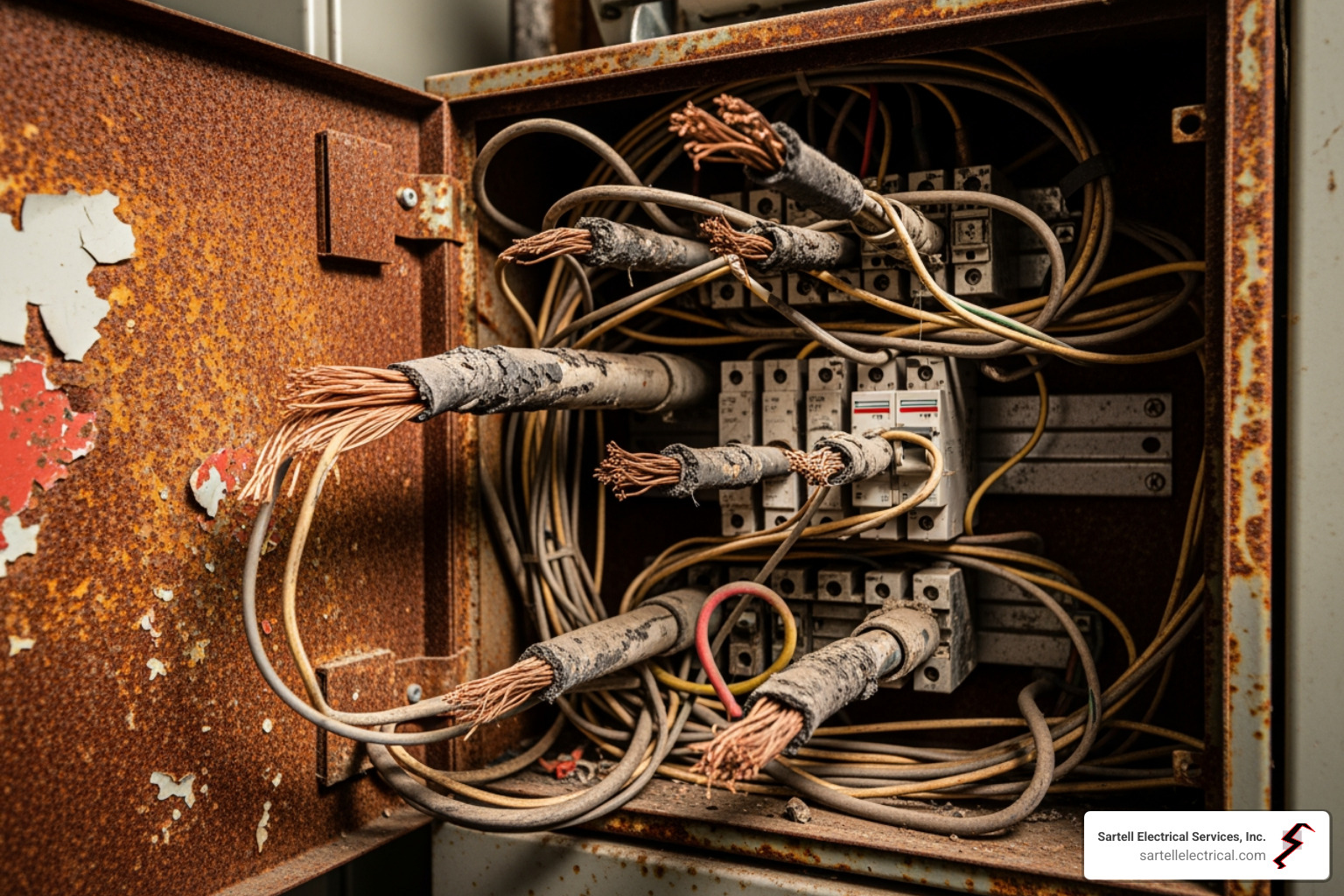
Here are the top signs your commercial panel needs a professional inspection:
- Frequently Tripping Breakers: This is a primary cry for help. If you're constantly resetting breakers, your panel is overwhelmed and operating beyond its safe limits, whether due to business growth or an initially undersized panel.
- Flickering or Dimming Lights: When lights dip or flicker, especially when large equipment like an HVAC unit turns on, it's a sign your electrical system can't deliver stable power. This can damage sensitive equipment and looks unprofessional.
- Buzzing Sounds or Burning Smells: A buzzing or humming sound from the panel indicates a problem like a loose connection or electrical arcing. An even more alarming sign is a burning smell, which signals an immediate fire hazard. If you smell this, shut off the main breaker if it's safe and call a professional immediately.
- Visible Physical Damage: A quick visual check can reveal serious issues. Rust or corrosion on the panel indicates moisture intrusion, which damages internal components. Scorch marks or discoloration are evidence of overheating. If the panel or breakers feel warm or hot to the touch, it's a serious fire risk.
- Age and Obsolete Technology: The age of your panel is a critical factor. If it's 20 years or older, it's time to plan a replacement. Components degrade, and older panels can't meet modern electrical demands. If you still have a fuse box, you're using obsolete technology that offers inferior protection compared to modern circuit breakers.
We've seen these warning signs in businesses throughout Essex, Middlesex, Norfolk, and Suffolk Counties. Catching these issues early allows for a planned upgrade on your schedule, rather than scrambling during an emergency shutdown. Don't wait for a crisis to address these warning signs.
The Professional Upgrade Process and Its Benefits
When your
commercial electric panel can't keep up, an upgrade is essential for safety and efficiency. This is serious business with high stakes, and it is absolutely not a DIY project.
Why Professional Installation is Crucial
At Sartell Electrical Services, we've seen the dangerous outcomes of amateur electrical work. Here’s why you must hire a professional.
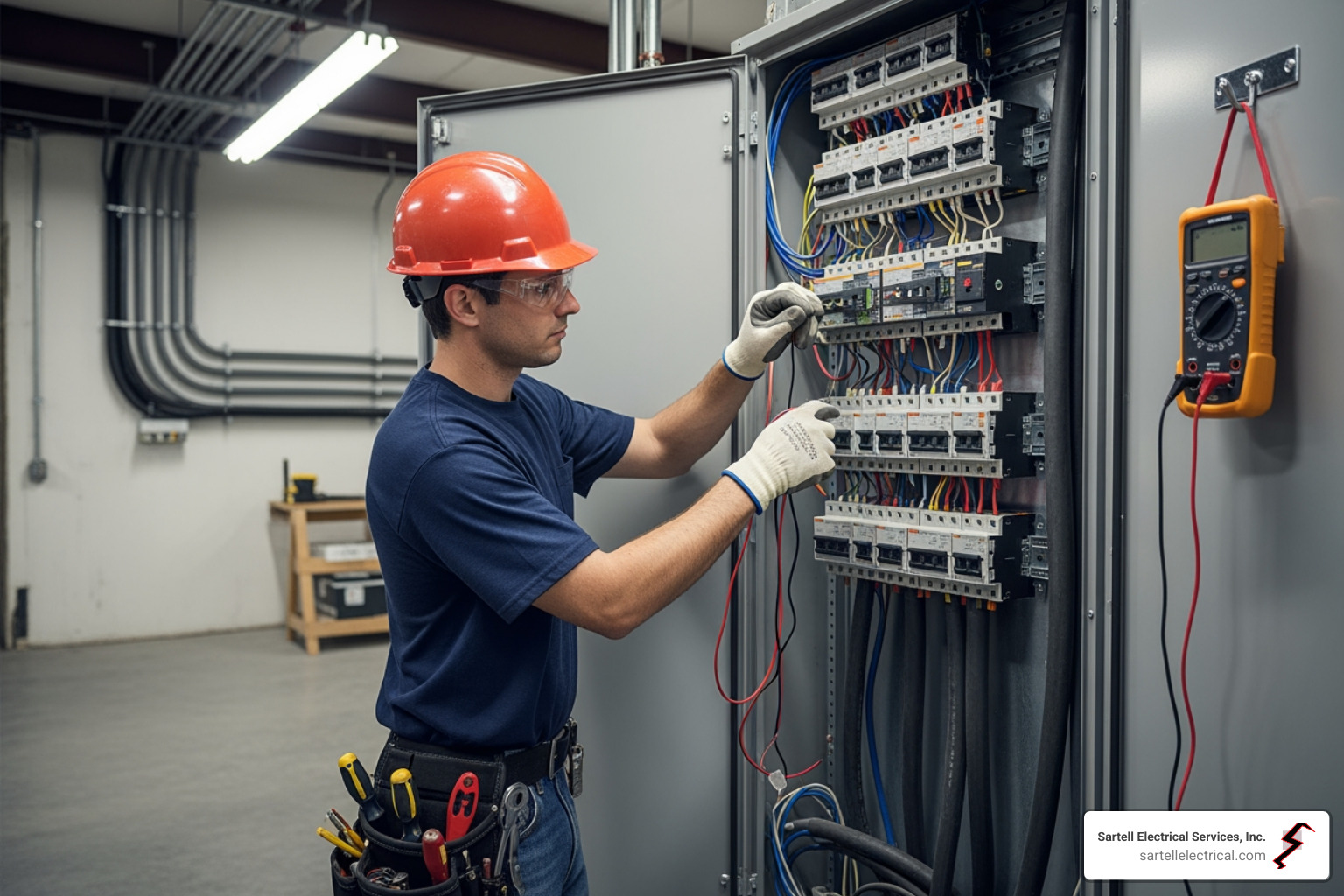
- Safety Risks: Commercial panels handle high voltages (up to 480V) and complex three-phase systems. A single mistake can lead to electrocution, fire, and destruction of your business.
- Code Compliance: Massachusetts electrical codes are legal requirements. A Licensed Commercial Electrician ensures your installation meets all current NEC and local regulations, which are constantly evolving.
- Insurance and Liability: Improper installation can void your property insurance, leaving you liable for damages from an electrical fire. It also leads to fines and failed inspections.
- Permits and Inspections: Major panel upgrades require permits. We handle this entire process, from pulling permits in towns like Reading or Woburn to scheduling inspections, ensuring your project is compliant from start to finish.
- Expertise and Efficiency: Our electricians bring over 30 years of experience, accurately calculating loads, sizing panels, and working efficiently to minimize disruption to your business.
Benefits of a Modern Commercial Electric Panel
Investing in a new
commercial electric panel is about setting your business up for future success. The benefits are significant.
- Improved Safety: Modern panels include advanced protection like Arc-Fault and Ground-Fault Circuit Interrupters (AFCIs/GFCIs), which prevent fires and electrical shock. Proper grounding and bonding protect personnel and equipment, dramatically reducing risk.
- Increased Capacity for Growth: An upgraded panel is sized with 20-25% spare capacity, giving your business room to grow. It can handle new equipment, office expansions, or technology upgrades without straining your system.
- Improved Reliability: A new panel provides stable, consistent power, eliminating issues like flickering lights and frequent trips. This prevents costly downtime, protects sensitive electronics, and keeps your operations running smoothly.
- Full Code Compliance: An upgraded panel ensures your electrical system meets current NEC and Massachusetts regulations. This is vital for insurance purposes, property sales, and avoiding fines from code violations.
- Future-Proofs Your Business: Technology and electrical demands are always increasing. A modern panel is an investment in your business's future, making it easier and more affordable to adapt to new equipment and expansions.
To understand the investment involved,
explore our electrical panel upgrade cost guide to help you budget effectively.
At Sartell Electrical Services, we help Massachusetts businesses upgrade their electrical infrastructure. Whether you're in Andover or Lowell, we'll design and install a
commercial electric panel solution that fits your needs, because when your electrical system works flawlessly, you can focus on running your business.
Conclusion: Secure Your Business's Power Foundation
Your
commercial electric panel isn't just another piece of equipment tucked away in a utility room—it's the beating heart of your entire operation. Every light that illuminates your workspace, every machine that drives your production, every computer that connects your team to the world depends on this critical asset functioning flawlessly. When it's working properly, you barely notice it. But when something goes wrong, your entire business can grind to a halt.
Throughout this guide, we've walked through the anatomy of these essential systems, from the main breaker and bus bars to the differences between single-phase and three-phase power. We've explored how to select the right panel for your needs, considering amperage capacity, load calculations, and that crucial 25% buffer for future growth. And we've highlighted the warning signs—the flickering lights, buzzing sounds, and visual damage—that tell you it's time for professional attention.
The truth is,
proactive management is key. Waiting until your panel fails isn't just inconvenient; it's risky and expensive. Regular inspections by licensed professionals can catch small issues before they become major problems, preventing dangerous situations and costly business interruptions. Whether you're running a small retail shop in Andover or managing a large manufacturing facility in Lawrence, your electrical infrastructure deserves the same attention you give to any other critical business asset.
Since 1985, we've been that expert partner for businesses throughout Massachusetts. From Boston to Reading, Woburn to Framingham, and everywhere in between, we've installed, upgraded, and maintained thousands of
commercial electric panels. We understand the unique challenges of Massachusetts buildings, the intricacies of local codes, and most importantly, we understand that your business can't afford downtime.
When you work with Sartell Electrical Services, you're not just hiring an electrician—you're partnering with a team that brings over 30 years of excellence, leadership, and unwavering commitment to customer service. We treat your business like our own, ensuring every installation meets the highest safety standards and is built to support your growth for decades to come.
Ready to evaluate your current system or planning for expansion?
Consult our Main Electrical Panel Upgrade Complete Guide for more details, and let's secure your business's power foundation together.