

Why Your Next Lighting Upgrade Should Include a 3-Way Touch Sensor Dimmer
A 3-way touch sensor dimmer is a control module that replaces a standard lamp switch or wall dimmer, letting you cycle through multiple brightness levels — or adjust light smoothly from dim to full brightness — with a simple touch of your finger or the lamp's metal body.
Quick answer: Here's what a 3-way touch sensor dimmer does and where it's used:
| Feature | What It Means |
|---|---|
| 3-way control | Three brightness levels (low, medium, high) plus off |
| Touch sensing | Detects your finger via capacitance — no mechanical switch needed |
| Applications | Touch lamps, LED mirrors, bathroom lighting, commercial zones |
| Common types | Wire-in lamp modules, integrated mirror switches, DALI commercial sensors |
| Bulb compatibility | Incandescent/halogen (legacy); dimmable LEDs (modern) |
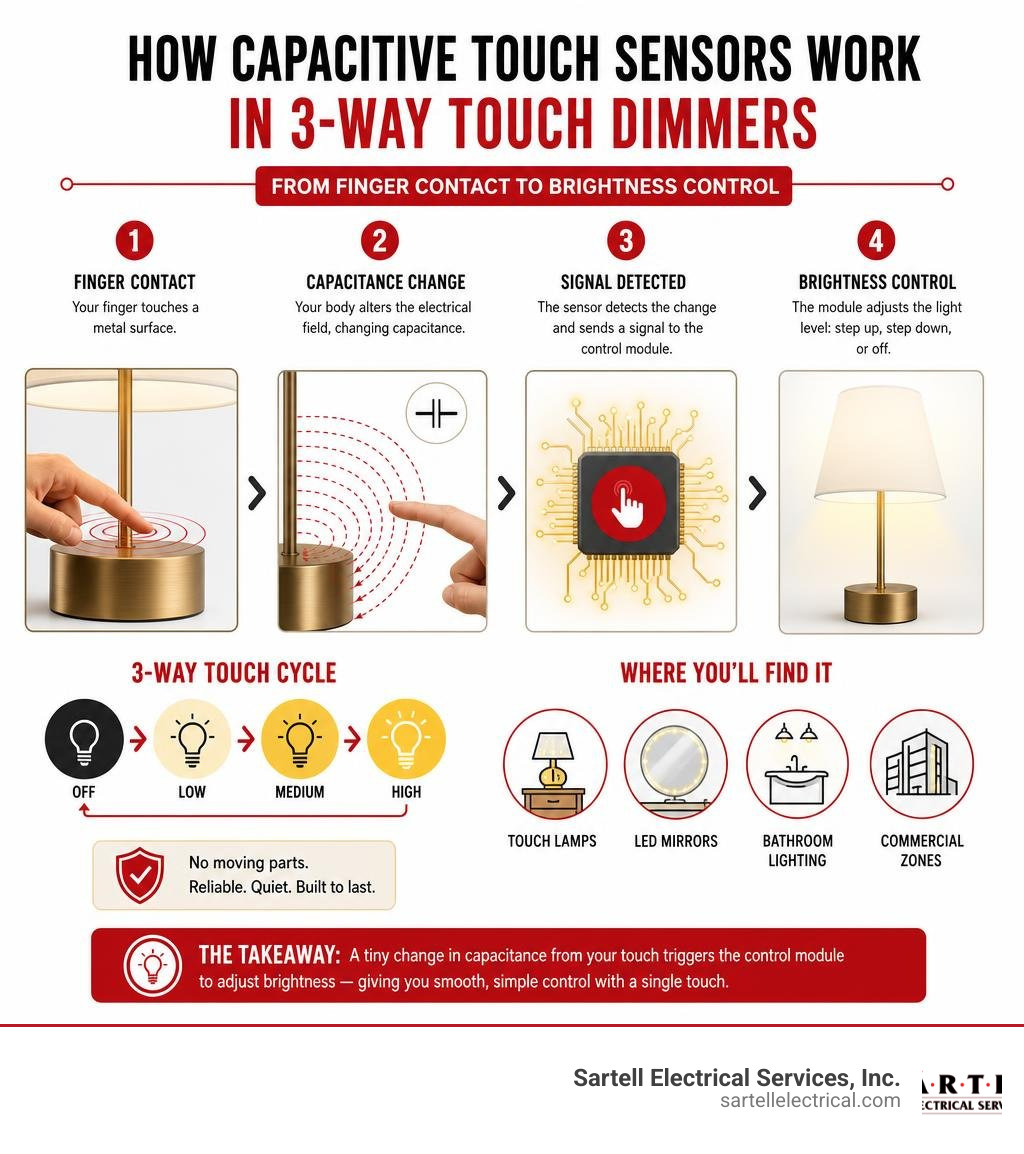
Touch dimmers work by detecting a tiny change in electrical capacitance when your hand contacts a metal surface — the lamp base, a mirror edge, or a sensor pad. That signal tells the module to step up, step down, or switch off the light. No moving parts. No fumbling in the dark.
These systems show up everywhere — from a $9 wire-in repair module for a bedside lamp to sophisticated multi-zone DALI sensors managing daylight, occupancy, and air quality across an entire office floor.
But not all touch dimmers are the same, and choosing the wrong one — or wiring it incorrectly — leads to flickering lights, unresponsive sensors, or even safety hazards.
I'm Ed Sartell, President of Sartell Electrical Services, and since 1985 I've installed and troubleshot every category of 3-way touch sensor dimmer across residential and commercial projects throughout Massachusetts. In this guide, I'll walk you through everything you need to know to choose, wire, and maintain the right touch dimmer for your application.
Easy 3 way touch sensor dimmer glossary:
What is a 3-Way Touch Sensor Dimmer and How Does It Work?
To understand how a 3-way touch sensor dimmer works, we have to look at the physics of capacitive sensing. Your body naturally carries a tiny electrostatic charge. When you touch a metal surface connected to a touch sensor, you alter the overall electrical capacitance of that metallic system.
The control module inside the light fixture continuously monitors this capacitance. When it detects a sudden, distinct change (the "touch"), it triggers an internal microchip to alter the electrical output going to the light bulb.
Historically, standard dimmers relied on rotary knobs or slide switches that physically resisted electrical flow (rheostats) or cut off parts of the AC sine wave (triac dimmers). A touch sensor eliminates these mechanical parts entirely. This lack of physical wear and tear is why touch sensors are highly reliable, though they are vulnerable to electrical surges and moisture.
If you are looking to bring this modern convenience to your home, understanding the electrical foundation is key. For a deeper dive into why upgrading makes sense, read about the bright ideas why you need a 3 pole dimmer switch in your life to see how multi-location controls enhance daily living.
Understanding the 3-Way Touch Sensor Dimmer Mechanism
Within a standard touch lamp, the metal body acts as the antenna. The 3 Way Touch Sensor dimmer, Touch lamp Repair kit Control Module, ... contains a sensor lead wire (often yellow) that connects directly to the metal chassis of the lamp.
When you touch any bare metal part of that lamp, the electrical capacitance shift travels down the sensor lead to the integrated circuit. The module then routes current through different paths or uses pulse-width modulation (PWM) to step the voltage up or down.
In a traditional 3-level touch lamp, the sequence is highly predictable:
- First touch: Low brightness (often used as a soft nightlight).
- Second touch: Medium brightness (ideal for reading or ambient light).
- Third touch: High brightness (full task lighting).
- Fourth touch: Off.
This elegant cycle bypasses the need for expensive, specialized 3-way light bulbs. Instead, the module itself regulates the power, letting you use standard, inexpensive 1-way bulbs to achieve three distinct light levels.
Multi-Location Control vs. Multi-Key Smart Interfaces
There is a common point of confusion in the electrical industry regarding the term "3-way." Depending on whether you are talking to a residential electrician or a product manufacturer, "3-way" can mean completely different things. It is crucial to distinguish between these terms before starting a project.
| Control Type | Definition | Wiring Requirement | Best Used For |
|---|---|---|---|
| 3-Way (3-Level) Dimmer | A single switch or module that cycles a single light source through three levels of brightness (Low, Medium, High). | Simple hot, neutral, and sensor lead wiring. | Bedside table lamps, accent lights, desk lamps. |
| Traditional 3-Way Circuit | A wiring configuration that allows you to control a single light fixture from two different physical wall switches. | Uses a common terminal and two traveler wires running between switches. | Hallways, stairwells, large living rooms. |
| 3-Key / 3-Channel Touch Sensor | A modern solid-state interface featuring three distinct touch-sensitive keys to control separate functions. | Low-voltage DC wiring, often requiring relays for high-voltage loads. | Smart bathroom LED mirrors (Dimming, Color Tuning, Anti-fog). |
If your goal is to wire a wall-mounted touch switch that coordinates with another switch across the room, you are dealing with a traditional 3-way circuit. If you are repairing a bedside lamp, you are dealing with a 3-level touch module. If you are upgrading a bathroom vanity, you are likely looking at a 3-key smart interface.
Types of Touch Dimmers and Technical Specifications
Whether you are designing a high-end commercial office in Boston or retrofitting a vintage brass lamp in a Middlesex County home, the hardware you select must match the specific application. Touch dimmers fall into three primary categories based on their physical design and electrical architecture.
Wire-In Replacements for Touch Lamps
These are compact, plastic-housed modules designed to fit snugly inside the hollow base of a table or floor lamp. The Westek Indoor Wire-In 3-Level Touch Dimmer Replacement (Model #6503BC) is a classic example of an affordable, consumer-grade fix. Priced at just $8.76, it is engineered primarily for traditional incandescent and halogen bulbs up to 150 watts.
Another popular choice is the Touch & Glow Touch Dimmer Replacement for 3-Way Switch-DIY-L . This UL-recognized module is highly favored by DIYers because it allows standard, inexpensive 1-way bulbs to function with three levels of brightness. These modules are perfect for helping elderly homeowners or individuals with arthritis who struggle with stiff, hard-to-turn mechanical rotary switches on older lamps.
Integrated Touch Switches for LED Mirrors and Bathrooms
If you have ever stayed in a modern hotel in Greater Boston, you have likely seen backlit LED mirrors. These mirrors do not use physical buttons; instead, they feature illuminated touch icons engraved directly into the glass.
Products like the Trumsense WS08F3-M6-BW 3 key touch sensor switch with dimming and anti-fog film on off control for LED mirror in washroom are designed specifically for these wet, high-humidity environments.
These switches mount securely behind the glass (up to 5mm thick). To install them, the mirror's reflective mercury backing must be removed—often via precise laser engraving—to create a transparent window where the capacitive sensor can detect your finger through the glass.
Concealed and DALI-Based Commercial Sensors
For minimalist interior designs, visible switches are increasingly being replaced by hidden sensors. The Concealed Touch Dimmer Switch | DC3.7-24V LED Strip Sensor can penetrate non-metallic solid surfaces like wood, stone, glass, plastic, and acrylic up to 3cm (30mm) thick. This allows you to turn a solid wood bedside table or a stone bathroom vanity splashback into a fully functional touch switch without drilling any visible holes.
On the commercial end, systems transition from simple hardware switches to complex digital networks. The Legrand Light Up 3-zone DALI sensor (Cat. No. 0 485 73) is a ceiling-mounted presence detector designed for sophisticated commercial spaces.
According to the LIGHT-UP 3-zone DALI multisensor advanced detector specifications, this unit can control three distinct lighting zones (such as window, corridor, and screen areas) using daylight harvesting. It measures natural light levels from 5 to 1275 lux and dims the connected LED drivers dynamically to maintain constant, energy-efficient illumination.
Voltage, Load Capacity, and PWM Dimming
Before purchasing any touch sensor, you must verify its electrical ratings:
- Voltage: Lamp modules typically operate on 120VAC household current. LED strip dimmers and mirror switches usually run on low-voltage DC (12V or 24V).
- Load Type: Ensure the dimmer matches your light source. Legacy dimmers designed for incandescent bulbs will fail or cause severe flickering if paired with modern LEDs.
- Dimming Method: High-quality LED touch dimmers use Pulse-Width Modulation (PWM). Devices like the Touch DIMMER for High Power LEDs (Installation Version) operate directly from mains voltage without transformers, driving high-power LEDs safely while maintaining a very low standby power consumption of just 0.4W.
- Memory Features: Modern switches like the Trumsense WS08F3-M6-BW feature built-in power-off memory. When the light is switched off and on again, it automatically restores the previously selected brightness and color temperature settings.
To learn more about matching your light bulbs to your switch, read our detailed guide on all about dimmer switch three way compatibility.
Step-by-Step Installation and Wiring Guide
Working with household electricity requires absolute caution. If you are uncomfortable handling raw wiring, please contact us at Sartell Electrical Services. We routinely handle low-voltage and high-voltage dimming integrations for homeowners across Reading, Andover, and the greater Boston area.
Choosing the Right 3-Way Touch Sensor Dimmer for Your Setup
Before starting, confirm that your dimmer's total wattage rating exceeds the cumulative wattage of the bulbs you plan to connect. For a standard lamp, a 150W-rated module is plenty. For larger multi-light installations, you may need a heavy-duty wall-mounted option.
Ensure the physical dimensions of the module will fit within your junction box or lamp base. For help planning a wall-mounted installation, check out our comprehensive guide on 3 way dimmer switch install.
Standard Wiring Configurations and Safety Protocols
Always shut off the power at the main circuit breaker before touching any wires. Use a reliable non-contact voltage tester to verify the wires are completely dead.
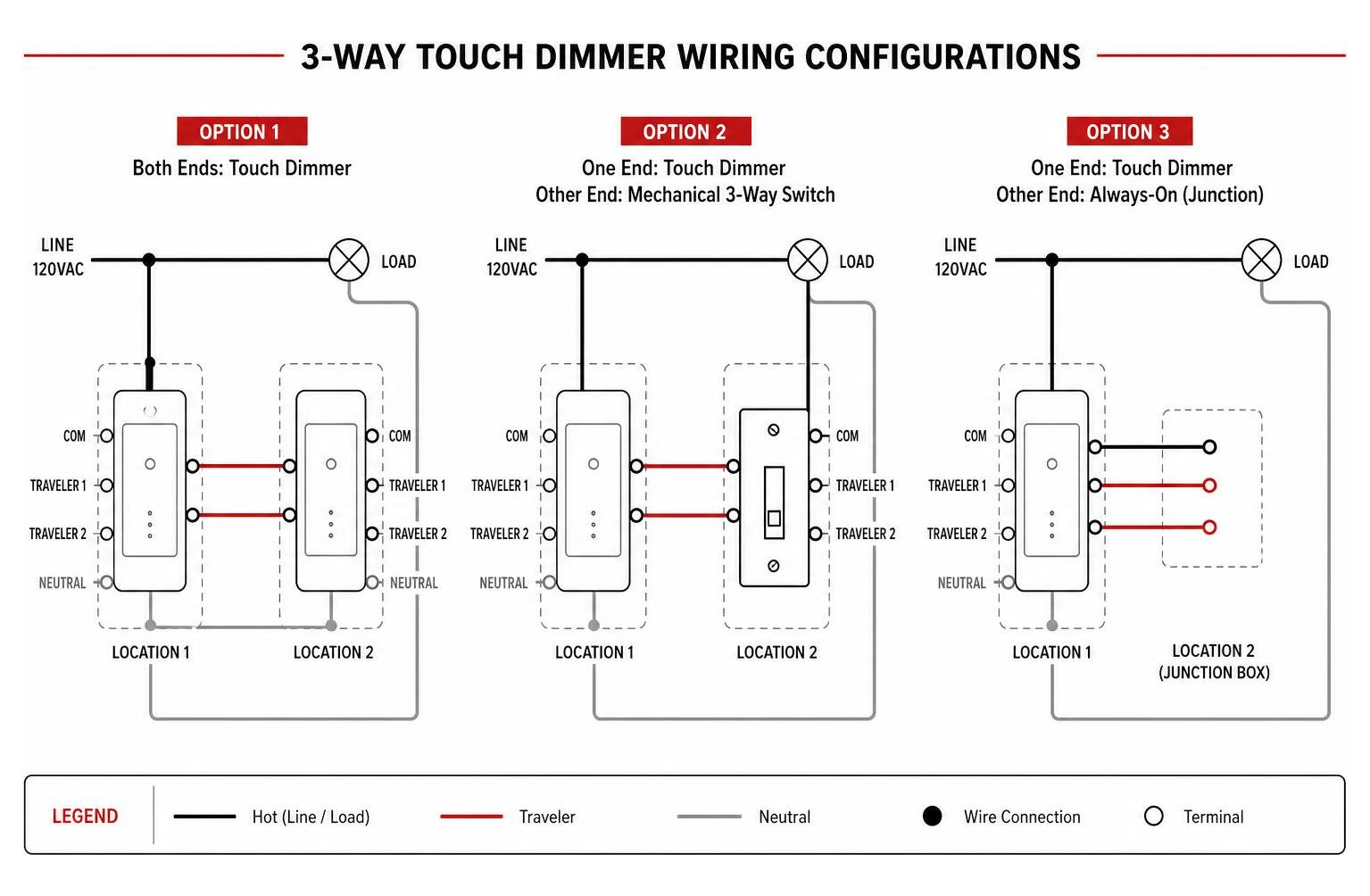
When replacing a standard 3-way wall switch with a touch-capacitive wall dimmer, you will typically find several wires in the wall box:
- Common (Hot) Wire: Usually connected to a dark-colored screw on your old switch.
- Traveler Wires: Typically two wires (often red and black) that run between the two switch locations.
- Neutral Wire: A white wire (or bundle of white wires) tucked into the back of the box. Many modern smart touch switches require a neutral wire to power their internal capacitive circuitry.
If you are dealing with a wire-in lamp module, the wiring diagram is simpler but must be executed precisely:
- Black Wire: Connects to the incoming hot wire from the power cord.
- White Wire: Connects to the neutral wire from the power cord and the neutral wire leading to the light socket.
- Red Wire: Connects to the hot terminal of the light socket.
- Yellow/Sensor Wire: Connects securely to the metal body of the lamp using a screw or spade terminal.
For a detailed look at general switch box connections, see our guide on dimmer switch wiring or identify your terminals using 3 way light switch terminals how to identify common and traveler screws. If you want to see the step-by-step process of installing a wall switch like a professional, refer to our article on wiring wonders installing your 3 way dimmer switch like a pro.
The Role of Relays in High-Voltage and Anti-Fog Systems
In bathroom LED mirror applications, you often want a single touch interface to control both low-voltage LED lights (DC 12V) and a high-voltage anti-fog heating pad (AC 110V/220V). Because low-voltage touch switches cannot handle high-voltage AC currents directly without burning out, an external relay is required.
According to the trumsense WS08F3-M6-RBL 3 key touch sensor switch with dimming and anti-fog film on off control specifications, the switch operates on DC12V with a maximum switching current limit of 5A.
To safely control a high-power anti-fog film, the touch switch sends a low-voltage signal to a relay. The relay then acts as an isolated magnetic switch, safely closing the high-voltage AC circuit to power the heating film. This completely isolates the user's touch interface from high-voltage hazards, ensuring maximum safety in wet bathroom environments.
Troubleshooting Common Touch Dimmer Issues
Touch-sensitive electronics are highly convenient, but they can occasionally behave unpredictably. If your touch dimmer is acting up, use these proven troubleshooting steps to isolate and resolve the issue.
Fixing Unresponsive Sensors and Ghost Activations
If your touch lamp turns on or off randomly (often called "ghost touching"), or if it refuses to respond when touched, the culprit is usually environmental or electrical interference.
- Line Capacitance and Wire Length: Capacitive touch sensors are highly sensitive to the length of the sensor wire. In advanced LED setups, the primary touch pad wire should be kept under 0.5 meters. If you must run a longer control wire (up to 10 meters), you must decouple the line capacitance using a high-resistance resistor (typically 40 to 80 MΩ) to prevent false triggers.
- Grounding Issues: Because capacitive sensing relies on completing a path to ground through your body, the light fixture itself must be properly grounded. If a touch lamp is plugged into an ungrounded outlet, or if the sensor lead is not making clean, metal-to-metal contact with the chassis, touch sensitivity will drop dramatically.
- Power Surges and Storms: Power surges, brown-outs, and nearby lightning strikes can introduce massive electrical noise into your home's wiring. This noise can easily fool a sensitive capacitive sensor into thinking it has been touched. To reset a glitched module after a storm, simply unplug the lamp from the wall, wait 30 seconds, and plug it back in.
If you are dealing with a wall-mounted switch that lacks a neutral connection, you might experience erratic behavior. Learn how to resolve this by reading about the no neutral solution for your 2 wire dimmer switch.
Resolving LED Flickering and Load Mismatches
If you swap out an old incandescent bulb for a new LED bulb in a touch lamp, you will often experience rapid flickering, buzzing, or a complete failure to dim.
This happens because older touch modules (like the legacy Westek or Touch & Glow units) require a minimum electrical load to operate correctly. A standard incandescent bulb draws 40 to 60 watts, whereas a highly efficient LED bulb might draw only 6 to 9 watts.
If the electrical draw falls below the touch dimmer's threshold, the internal triac cannot fire cleanly, resulting in a strobe-like flicker.
To resolve this:
- Verify Bulb Compatibility: Ensure you are using bulbs explicitly labeled as "dimmable." Non-dimmable LED bulbs cannot handle voltage or current drops and will flicker or fail immediately.
- Add a Bypass Capacitor: In some wall-mounted LED touch setups, installing a dummy load or a bypass capacitor across the load and neutral lines can stabilize the circuit and eliminate low-wattage flickering.
- Upgrade the Module: Replace the legacy touch sensor with a modern, LED-compatible touch module designed to handle ultra-low wattage loads.
For more quick tips on resolving electrical noise and wiring switches efficiently, check out our guide on how to wire dimmer switch fast by using simple steps.
Frequently Asked Questions about Touch Dimmers
Can I use standard LED bulbs with a 3-way touch dimmer?
No, you cannot use standard, non-dimmable LED bulbs. Standard LEDs are designed to run on a constant, unvarying voltage. When a touch dimmer drops the voltage or alters the duty cycle to lower the light output, a standard LED's internal driver will struggle to compensate, leading to severe flickering, buzzing, and premature bulb failure. Always look for bulbs marked "dimmable" on the packaging.
Why does my touch lamp turn on by itself during storms?
Touch lamps rely on capacitive sensing to detect the electrical charge of your hand. During lightning storms or periods of high grid activity, power surges, voltage spikes, and electromagnetic interference travel through your home's electrical lines. The sensitive microchip inside the touch module interprets this electrical noise as a physical touch, causing the lamp to turn on, off, or change brightness levels randomly. Unplugging the lamp during severe storms protects the sensitive module from burning out.
How do I wire a touch dimmer without a neutral wire?
If you live in an older home in Massachusetts (such as in historic areas of Essex or Middlesex County), your wall switch boxes may not contain a white neutral wire. While many advanced smart touch switches require a neutral wire to keep their internal electronics powered when the light is off, some manufacturers offer "no-neutral" touch switches.
These specialized switches work by allowing a tiny, imperceptible amount of current to leak through the ground wire or the light bulb itself to complete the circuit. If you are retrofitting older wiring, read our step-by-step guide on 2 way dimmer switch wiring a step by step guide for diyers to understand your options.
Conclusion
Upgrading your home with a 3-way touch sensor dimmer is a fantastic way to eliminate clunky mechanical switches, save energy, and bring a clean, modern aesthetic to your living spaces. Whether you are fixing a cherished bedside touch lamp using a simple wire-in replacement, installing a sleek backlit LED mirror in your master bath, or designing a high-end commercial space with concealed stone-penetrating sensors, matching the right hardware to your electrical system is critical for a safe, flicker-free result.
While small lamp repairs are great weekend DIY projects, modifying your home's permanent wall switches and integrating low-voltage smart sensors with high-voltage AC lines requires professional expertise. Dealing with traveler wires, identifying common terminals, and working around older wiring without neutral lines can quickly become complicated.
At Sartell Electrical Services, Inc., we have spent over 30 years providing top-tier residential, commercial, and industrial electrical services throughout Massachusetts—including Reading, Andover, Woburn, and the Greater Boston area. Our licensed electricians are experts in advanced lighting controls, custom LED integrations, and safe, code-compliant installations.
If you are ready to upgrade your home's lighting or need help troubleshooting a tricky dimming system, don't risk your safety. Contact us today to schedule a professional consultation, or read our detailed guide on 3 way dimmer switch install to start planning your next home improvement project.