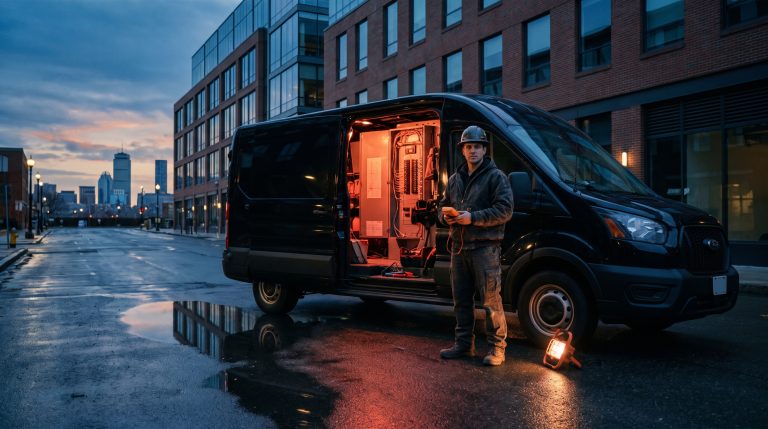
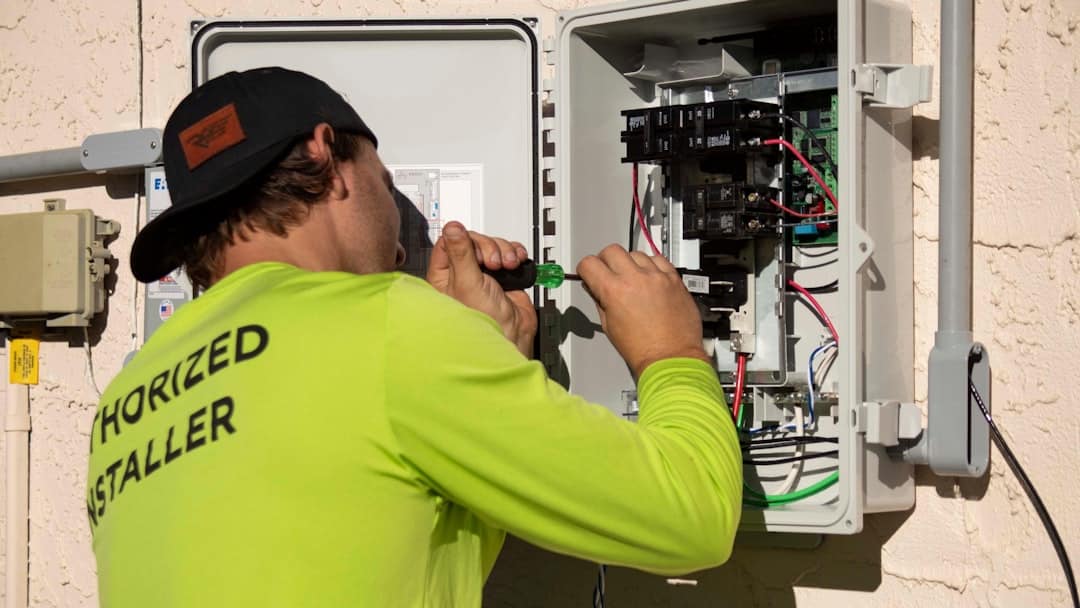
Why Professional Electrician Services Matter for Your Home and Business
Professional electrician services cover a wide range of electrical work — from simple outlet repairs to complex commercial power systems. Here's a quick overview of what they include and when you need them:
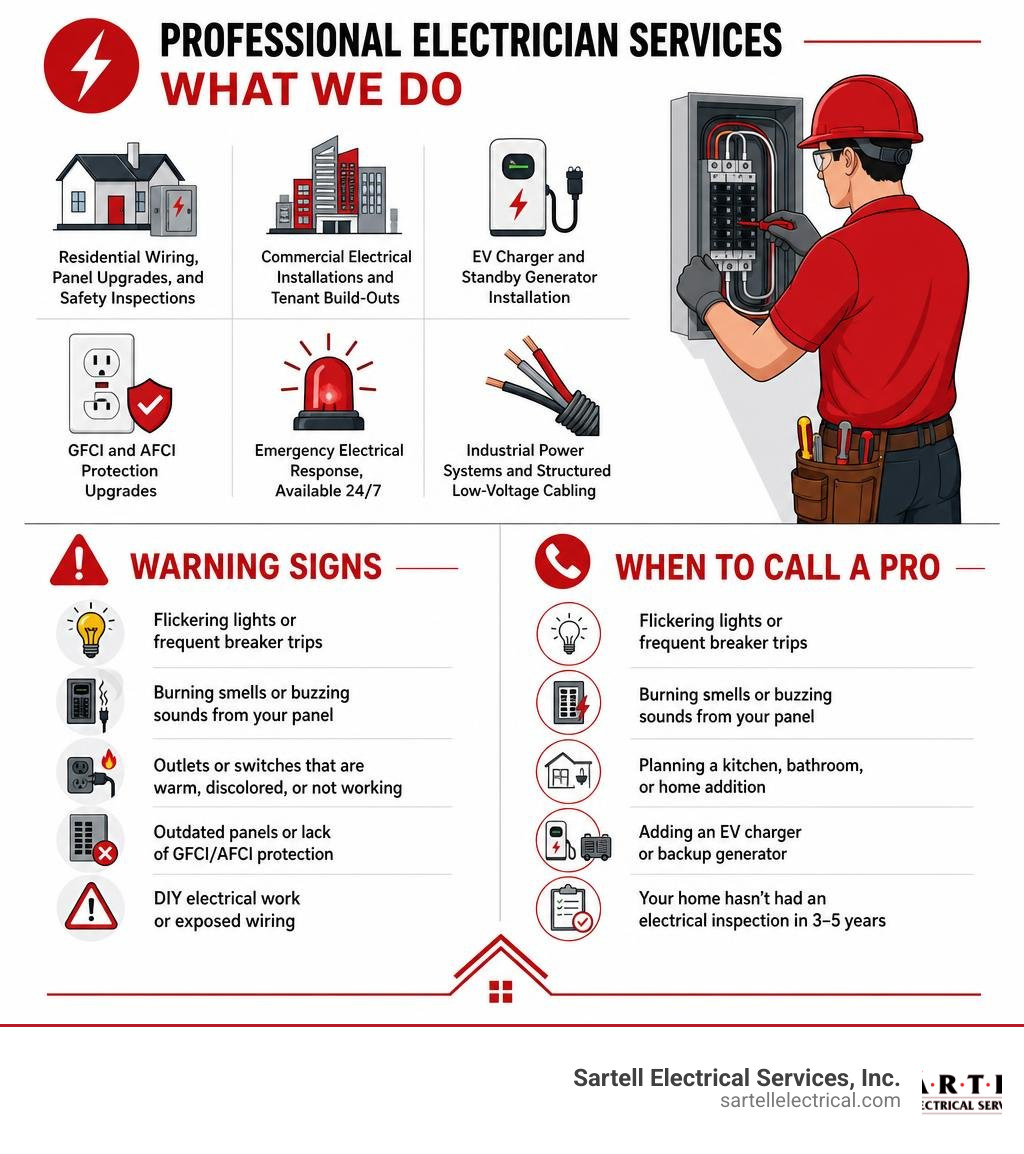
What professional electrician services typically include:
- Residential wiring, panel upgrades, and safety inspections
- Commercial electrical installations and tenant build-outs
- EV charger and standby generator installation
- GFCI and AFCI protection upgrades
- Emergency electrical response, available 24/7
- Industrial power systems and structured low-voltage cabling
When to call a licensed electrician:
- Flickering lights or frequent breaker trips
- Burning smells or buzzing sounds from your panel
- Planning a kitchen, bathroom, or home addition
- Adding an EV charger or backup generator
- Your home hasn't had an electrical inspection in 3–5 years
Electricity is one of those things most people don't think about — until something goes wrong. A burning smell near an outlet. Lights that dim every time the air conditioner kicks on. A panel that trips for no clear reason. These aren't just annoyances. They're warning signs that your electrical system may be under serious strain.
The stakes are high. Faulty wiring is one of the leading causes of house fires in the United States. And with modern homes running more high-draw devices than ever — EV chargers, smart panels, whole-home backup systems — an outdated electrical system can quickly become a safety hazard.
This guide breaks down everything you need to know about professional electrical services: what's included, when to call a pro, and how to choose a contractor you can actually trust.
I'm Ed Sartell, President of Sartell Electrical Services, Inc., and I've been delivering professional electrician services to homeowners, builders, and businesses across Massachusetts since 1985. With nearly four decades in the trade, I've seen what separates a safe, code-compliant electrical system from a dangerous one — and I'll walk you through what that means for your property.
Quick professional electrician services definitions:
Understanding the Scope of Professional Electrician Services
When you think of an electrician, you might picture someone replacing a light switch or fixing a dead outlet. While those quick fixes are a vital part of what we do, the true scope of professional electrician services is incredibly broad. Modern electrical contractors handle complex energy ecosystems that keep homes safe, businesses operational, and industrial facilities running efficiently.
To truly understand how these systems work, it helps to review a Residential Electrical Services Complete Guide. This overview highlights how residential, commercial, and industrial systems are fundamentally different, requiring distinct skill sets, tools, and regulatory compliance.
If you are managing a business or commercial property, you will want to refer to a Commercial Electrical Services Ultimate Guide to see how commercial infrastructure differs from standard household power.
Residential vs. Commercial Professional Electrician Services
Residential electrical work centers around comfort, convenience, and safety inside the home. This includes everything from routine troubleshooting to comprehensive home renovations. When searching for Licensed Residential Electricians Near Me, homeowners are typically looking for experts who can safely install interior lighting, wire new home additions, or troubleshoot complex issues like system-wide power dips.
Commercial electrical work, on the other hand, operates on a completely different scale. Commercial properties—like offices, retail stores, and mixed-use developments—require heavy-duty distribution systems. Specialized Commercial Electricians handle large-scale tenant improvements, commercial automation, emergency exit lighting, and complex fire alarm integrations.
Because we serve businesses throughout the Greater Boston area, we understand that commercial electrical work must minimize downtime. A loss of power doesn't just mean the lights are out; it directly impacts business revenue, security systems, and even plumbing infrastructure like commercial booster pumps.
We operate closely within major Massachusetts hubs, providing reliable services across Essex County, Middlesex County, Norfolk County, Suffolk County, and the Greater Boston area. Whether you need assistance in Boston, Reading, Andover, or Chelsea, our team is ready to support your residential and commercial electrical needs.
Specialized Industrial and Telecom Professional Electrician Services
Beyond homes and retail storefronts lie industrial plants and telecommunications networks. These environments demand highly technical, specialized services. According to an Industrial Electrical Services Complete Guide, industrial environments rely on massive three-phase power systems, complex motor controls, and Programmable Logic Controller (PLC) support.
At Sartell Electrical Services, our specialized Industrial Electrical Service ensures that manufacturing plants, water treatment facilities, and warehouses maintain continuous, safe operations.
In July 2026, the modern business landscape also demands seamless digital connectivity. This is where low-voltage and telecommunications services come in. Rather than carrying high-voltage power to run appliances, low-voltage technicians install structured cabling, fiber optics, network infrastructure, and security camera systems.
Whether we are wiring a commercial office in Reading, MA, or setting up data networks in Cambridge, MA, integrating high-voltage power with low-voltage telecom systems is essential for a fully functional modern facility.
Recognizing the Warning Signs of Electrical System Strain
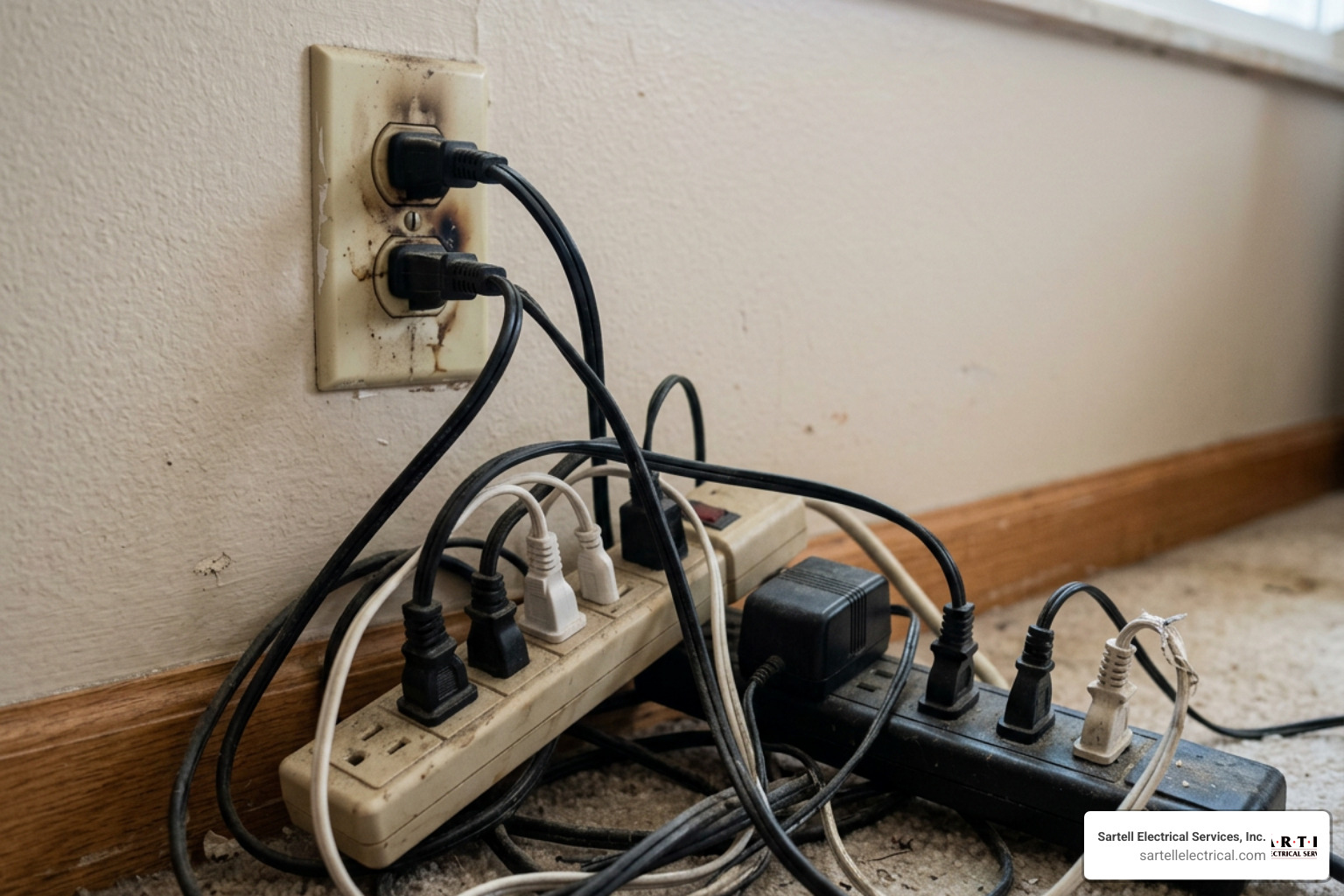
Many property owners assume that if the lights turn on, their electrical system is perfectly fine. However, electrical systems degrade slowly over time, often hiding behind walls until they reach a breaking point. Recognizing the early signs of electrical strain is the best way to prevent costly repairs or, worse, devastating electrical fires.
If you suspect your home is showing these symptoms, consulting an Electrical Home Repair Service Complete Guide can help you identify whether you need a minor fix or a system-wide overhaul.
Outdated Wiring Hazards
If your Massachusetts home was built before the late 1970s, it may contain outdated and potentially hazardous wiring materials. Two of the most common culprits we encounter in historic properties throughout Boston, Salem, and Ipswich are knob-and-tube wiring and aluminum branch wiring.
- Knob-and-Tube Wiring: This was the standard method of electrical piping from the late 1880s through the 1940s. It consists of single insulated copper conductors run through porcelain protective tubes. Because it lacks a grounding wire, it poses a severe shock hazard for modern, three-prong appliances. Over time, the protective cloth insulation becomes brittle and crumbles away, leaving bare, hot wires exposed.
- Aluminum Wiring: Commonly installed in homes built between 1965 and 1973 due to rising copper prices, aluminum wiring is now recognized as a major fire hazard. Aluminum expands and contracts much more than copper when heated by electrical currents. This thermal expansion causes connection points at outlets and switches to loosen over time, leading to electrical arcing, intense heat, and localized fires.
If you suspect your historic home still relies on these outdated systems, you should seek professional Electrical Wiring Services Boston immediately to discuss upgrading to modern, safe copper alternatives.
Frequent Breaker Trips and System Overloads
Do your lights dim slightly when your microwave, refrigerator, or air conditioner kicks on? Do you find yourself running to the basement or garage to reset a tripped circuit breaker every time you use a hair dryer? These are classic signs of system strain.
A circuit breaker is designed to trip and cut off power when the electrical current exceeds safe limits. When multiple high-draw appliances are connected to a single circuit, the system overloads. While modern homes are built with dedicated circuits to handle heavy loads, older properties often suffer from a lack of capacity.
To help you understand your home's capacity, let's look at a quick comparison between older 100-amp panels and modern 200-amp panels:
| Electrical Service Capacity | Common in Homes Built | Suitable For | Ability to Support EV Chargers / Heat Pumps |
|---|---|---|---|
| 100 Amps | Pre-1980s | Small homes with standard appliances, gas heating, and minimal electronics. | Extremely limited; often requires smart load shedding or a full panel upgrade. |
| 200 Amps | Post-1980s to Present | Modern homes with electric HVAC systems, hot tubs, and heavy electronic loads. | Excellent; easily supports Level 2 EV charging and whole-home backup systems. |
If you are constantly dealing with tripped breakers, it means your current panel is struggling to keep up with July 2026 power demands. It's time to consider a modern upgrade.
Essential Upgrades for Modern Home Energy Ecosystems
The way we use electricity has fundamentally changed over the last few decades. We no longer just power lightbulbs and basic television sets. Today, our homes are active energy ecosystems that charge electric vehicles, run smart automated systems, and generate backup power during severe New England winter storms.
To prepare your property for these modern demands, it is highly recommended to read through an Electrical Service Upgrades Complete Guide.
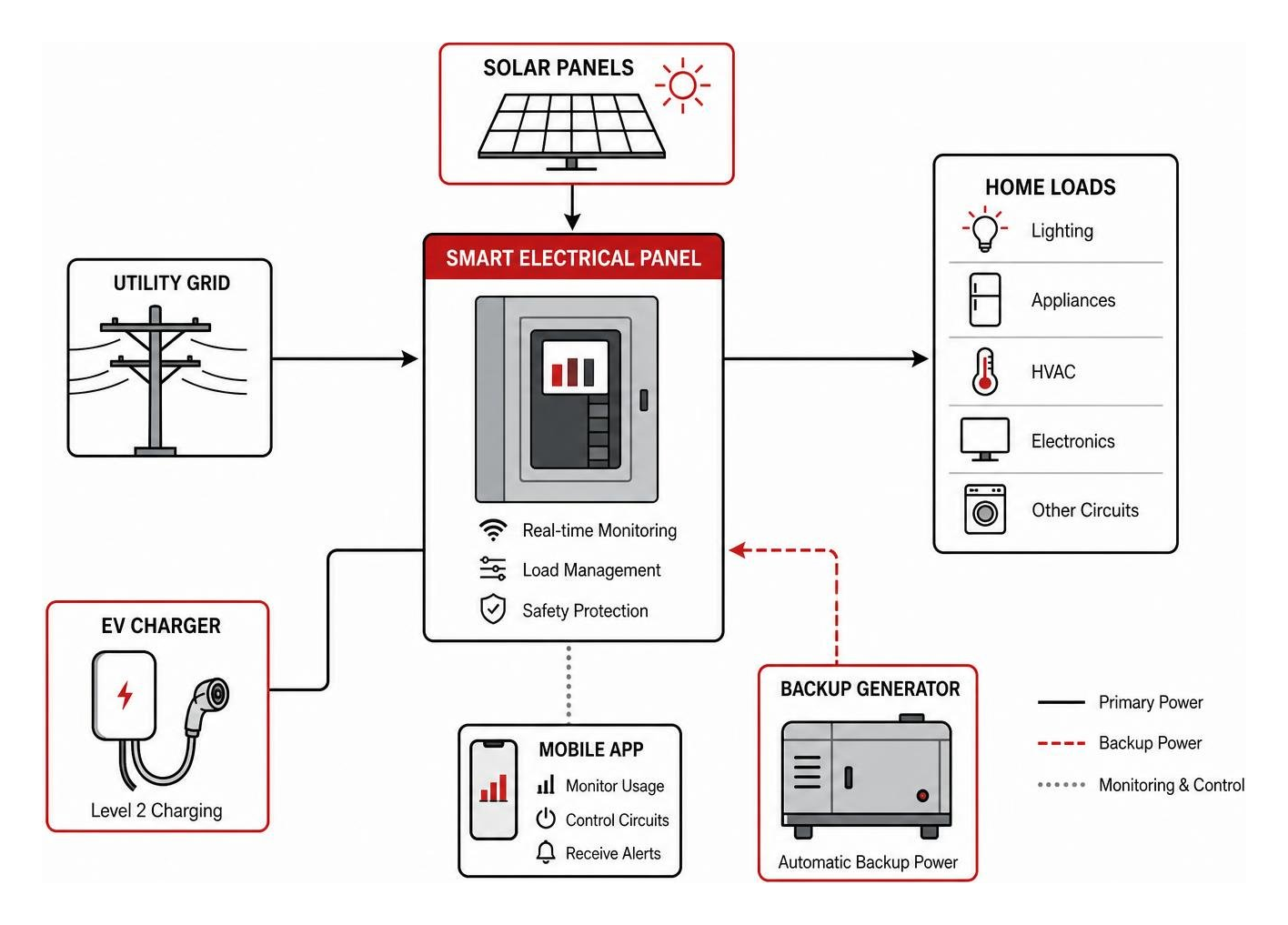
Electrical Panel Upgrades and Smart Load Balancing
Your electrical panel is the central nervous system of your home's power supply. If you are still relying on an outdated analog breaker box, or worse, a dangerous Federal Pacific or Zinsco panel (which are notorious for failing to trip during overloads), upgrading is your single most important safety investment.
When planning an upgrade, homeowners often consult an Electrical Panel Upgrade Cost Guide 2025 to budget appropriately. Modern installations often incorporate smart electrical panels, such as SPAN panels. These smart systems allow you to monitor and control your electrical usage at the individual circuit level directly from a smartphone app.
Additionally, smart load-balancing technology allows you to add high-draw appliances—like Level 2 EV chargers—without undergoing an expensive utility service upgrade. The smart panel dynamically manages the power, temporarily shifting energy away from non-essential zones to ensure your vehicle charges safely and quickly.
EV Charger and Standby Generator Installation
As electric vehicles become the standard in July 2026, relying on a standard 120V household outlet (Level 1 charging) is no longer practical. Level 1 charging only adds about 3 to 5 miles of range per hour. A professional Level 2 EV charger installation utilizes a dedicated 240V circuit, allowing you to fully charge your vehicle overnight.
Alongside EV charging, residential backup power has become a necessity. Severe weather in Massachusetts can knock out power grids for days. Installing a whole-home standby generator ensures your heating systems, refrigeration, medical equipment, and security systems remain fully functional.
These systems utilize an automatic transfer switch (ATS). The moment utility power drops, the ATS detects the failure, safely disconnects your home from the main grid to prevent dangerous backfeeding, and starts the generator—restoring power to your home in under 20 milliseconds.
For homeowners in Middlesex or Essex counties, working with a local specialist for Generator Installation MA guarantees that your backup system is properly sized, permitted, and compliant with all local building codes.
Prioritizing Safety: Inspections and Code Compliance

Electricity is an invisible force. You cannot see a loose neutral wire or a degrading connection behind a wall until it begins to arc and generate dangerous levels of heat. That is why proactive safety inspections and strict adherence to the National Electrical Code (NEC) are so critical.
If you manage specialized facilities or rely on life-saving equipment at home, ensuring safety is even more critical. You can learn more about specialized safety protocols in our guide on Electrical Safety Check on Medical Equipment. For general preventative measures, consult our Electrical Maintenance Ultimate Guide.
Recommended Electrical Inspection Frequency
Just like your car needs regular oil changes and your heating system needs annual tune-ups, your home's electrical system requires periodic checkups.
We recommend having your electrical system professionally inspected every 3 to 5 years. If you live in an older historic home in Massachusetts (such as in historic areas of Concord, Lexington, or Gloucester), or if you have recently purchased a new property, an immediate safety inspection is highly advised.
During a comprehensive safety inspection, a licensed electrician will check:
- Grounding and bonding systems
- Main service panel health and breaker connections
- Outlets and switches for proper polarity and physical wear
- The presence of functional smoke and carbon monoxide detectors
- Proper GFCI and AFCI protection in required zones
GFCI and AFCI Protection Requirements
Modern electrical codes place a heavy emphasis on two life-saving technologies: Ground Fault Circuit Interrupters (GFCIs) and Arc Fault Circuit Interrupters (AFCIs).
- GFCI Protection: GFCIs are designed to protect people from lethal electrical shocks. They constantly monitor the balance of electrical current moving through a circuit. If they detect even a tiny leakage of current (such as electricity flowing through water or a human body), the GFCI cuts off power in milliseconds. By code, GFCI outlets are strictly required in all "wet" or damp areas, including kitchens, bathrooms, garages, unfinished basements, and outdoor locations.
- AFCI Protection: While GFCIs protect people from shocks, AFCIs protect homes from fires. AFCIs detect dangerous electrical arcing - sparking that occurs when wire insulation is damaged or connections are loose. Arcing can reach temperatures hot enough to ignite nearby wood or insulation. Modern building codes require AFCI protection on nearly all residential branch circuits, especially in bedrooms, living areas, and during major kitchen or bathroom remodels.
How to Choose a Reliable Electrical Contractor
Your electrical system is too important—and too dangerous—to leave in the hands of an unlicensed handyman or an unvetted contractor. Making the wrong choice can lead to failed municipal inspections, damaged appliances, and severe safety hazards.
To guide you through this process, we have put together a comprehensive Electrical Contractor Hiring Guide, alongside a directory of Electrical Companies Near Me to help you find local, licensed professionals. If you are looking for highly rated local services with deep community roots, you can also explore options like Electricians Near Me to find trusted experts in your area.
Red Flags to Avoid When Hiring
When searching for an electrical contractor in Massachusetts, keep an eye out for these common red flags:
- Lack of Active Licensing and Insurance: Always ask for proof of a valid Massachusetts Journeyman or Master Electrician license and active liability insurance. If a contractor cannot provide these, walk away immediately.
- Vague or Unwritten Estimates: A reliable contractor will always provide a detailed, written estimate outlining material costs, labor, and permit fees. Avoid companies that offer vague over-the-phone quotes without seeing the job site.
- Heavy Reliance on Subcontractors: Some larger companies act as dispatch agencies, sending independent, unvetted subcontractors to your home. Look for companies that hire W-2, background-checked employees who are trained to the latest standards.
- No Permit Filing: If a contractor suggests doing a major job (like a panel upgrade or addition) without filing a municipal permit, they are cutting corners. Permits ensure that a local town inspector reviews the work to guarantee it is 100% safe and up to code.
Emergency Response and Warranties
Electrical emergencies don't wait for convenient business hours. A fallen tree limb crushing your service mast or a sudden burning smell from your breaker box in the middle of the night requires immediate action.
When choosing a contractor, verify that they offer genuine emergency support. If you are facing an urgent power loss, you should look for a reliable Emergency Electrical Service Near Me or a dedicated 24 Hour Electrician Service Near Me to get a technician dispatched to your location immediately.
Furthermore, look for companies that stand behind their craftsmanship. While the industry standard warranty on electrical labor is typically one year, premier contractors will offer extended warranties—sometimes up to 10 years on major installations—giving you ultimate peace of mind that the job was done right the first time.
Frequently Asked Questions about Home Electrical Systems
How often should my home's electrical system be inspected?
We recommend a professional electrical safety inspection every 3 to 5 years for standard residential properties. However, you should schedule an inspection immediately if you live in an older historic home, are planning a major renovation, are experiencing frequent breaker trips, or have recently purchased a new property. Preventative maintenance is always more cost-effective than emergency repairs.
What is the difference between a Level 1 and Level 2 EV charger?
The primary differences are voltage and charging speed:
- Level 1 Charging: Uses a standard 120V household outlet. It requires no special installation but is incredibly slow, adding only 3 to 5 miles of range per hour. It can take over 24 hours to fully charge a modern EV.
- Level 2 Charging: Operates on a dedicated 240V circuit (similar to a clothes dryer or electric stove). It must be professionally installed by a licensed electrician. Level 2 charging adds 15 to 30+ miles of range per hour, allowing most electric vehicles to fully charge in just 4 to 8 hours.
What should I do during an electrical emergency?
If you smell burning plastic, see active sparks, or hear loud buzzing coming from an outlet or your main electrical panel, follow these steps immediately:
- Safety First: If it is safe to do so, immediately turn off the main breaker in your electrical panel to cut off all power to the home.
- Evacuate if Necessary: If there is active smoke or fire, evacuate your family immediately and call 911.
- Call a Professional: Contact a licensed emergency electrician. Do not attempt to investigate or touch damaged wiring yourself, as this poses an extreme risk of electrocution.
Conclusion
Your electrical system is the backbone of your property's safety, comfort, and daily operations. Whether you are upgrading an outdated breaker panel, installing a modern Level 2 EV charger, setting up a standby generator, or requiring commercial tenant build-outs, investing in professional electrical services is the only way to guarantee safety, efficiency, and complete code compliance.
At Sartell Electrical Services, Inc., we have been proudly serving homeowners, businesses, and industrial facilities throughout Reading, MA, and the Greater Boston area for over 30 years. Our commitment to excellence, leadership, and unmatched customer service ensures that projects of all sizes are completed safely, on time, and up to the highest technical standards.
If you are ready to secure, upgrade, or troubleshoot your property's power systems, contact our expert team today to schedule an inspection or request an estimate. Explore our comprehensive Electrical Contractor Service to see how we can keep your home or business safely powered for years to come.