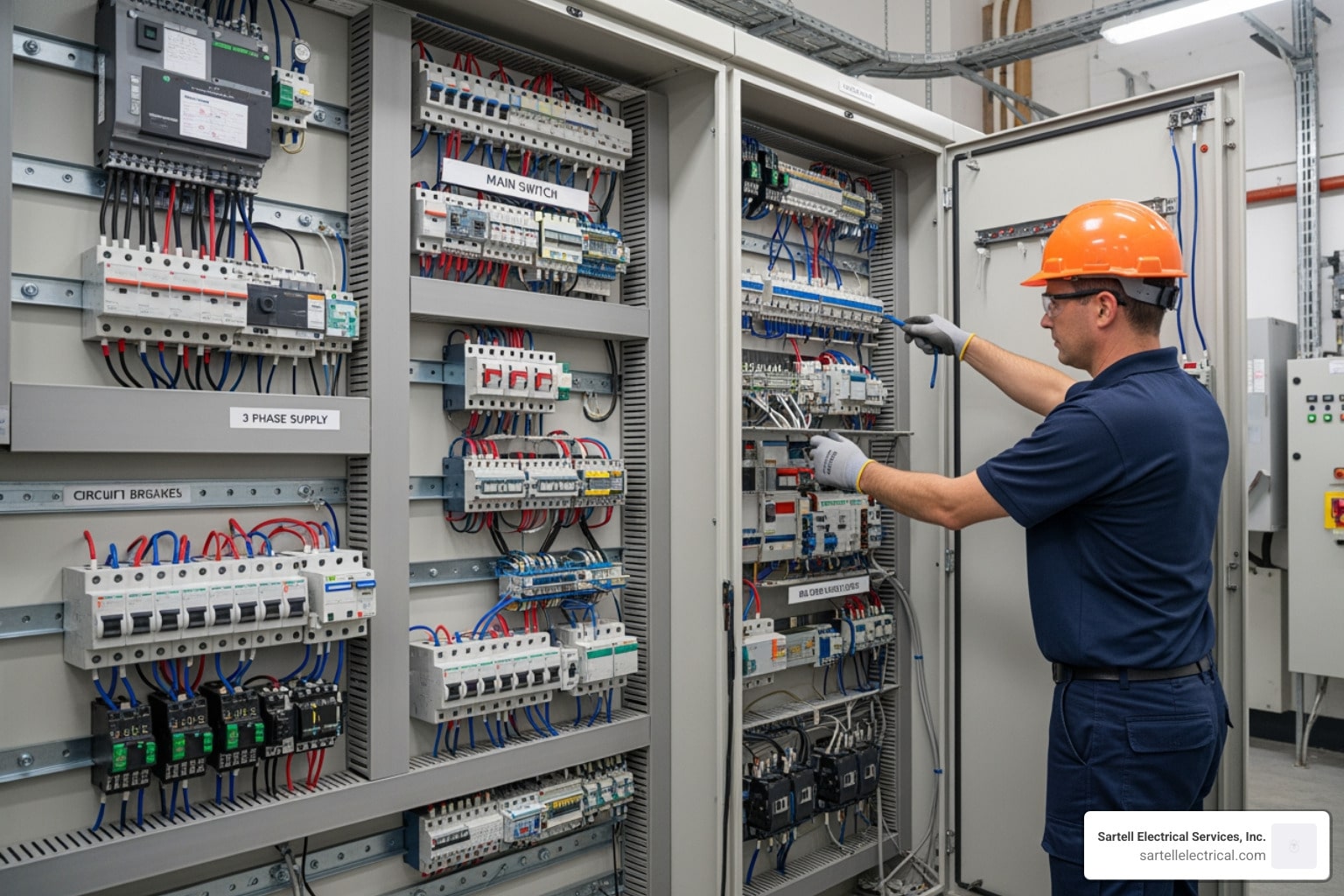
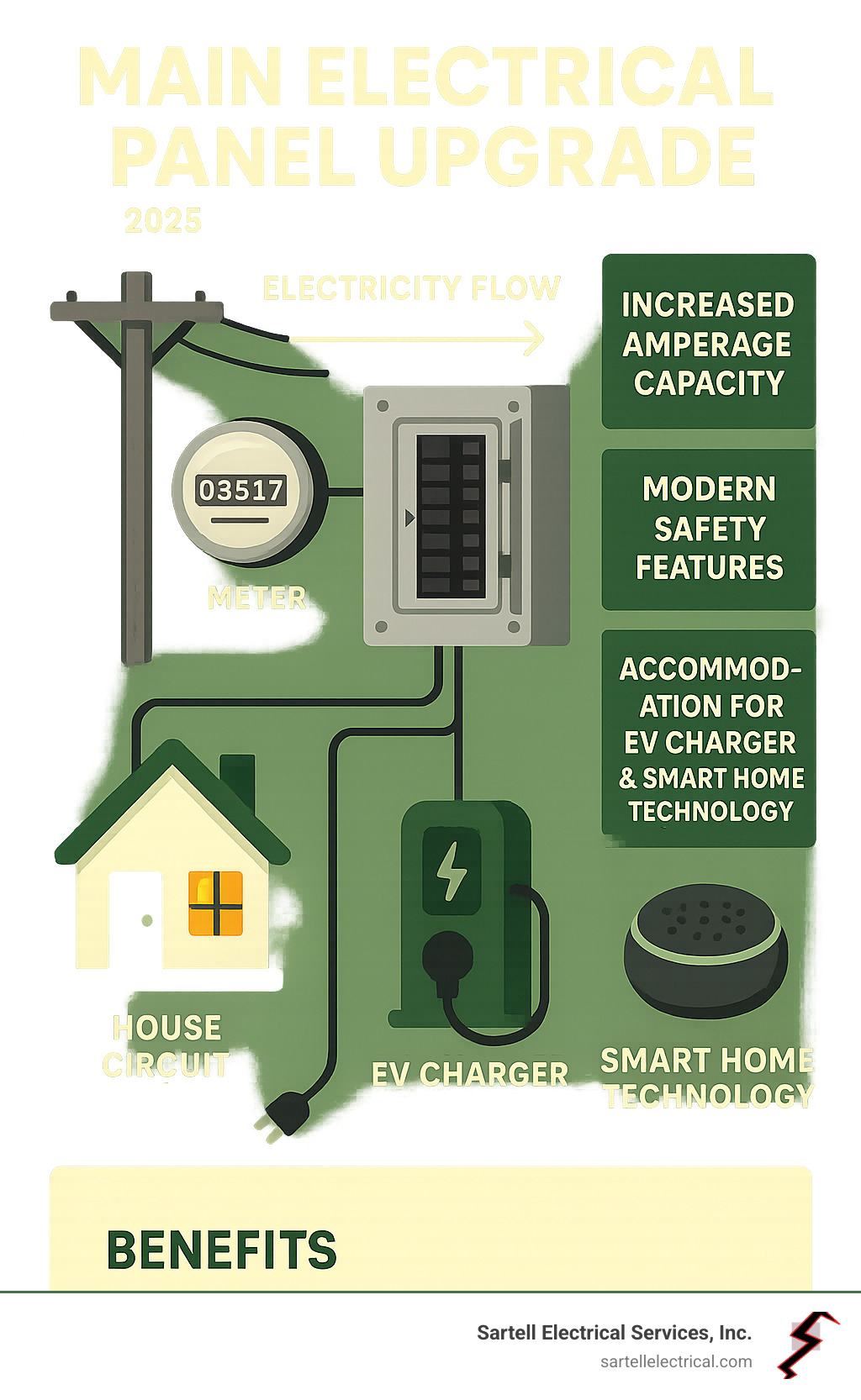
Main Electrical Panel Upgrade: 7 Shocking Benefits
Why Your Home's Electrical Heart Needs an Upgrade
A
main electrical panel upgrade is the process of replacing your home's electrical distribution center with a higher-capacity system to safely handle modern power demands and prevent electrical hazards.
Key Facts About Main Electrical Panel Upgrades:
- Cost Range: $1,300 - $3,000 for most upgrades (100 to 200 amps)
- Timeline: 1-2 days installation plus inspection time
- Lifespan: Panels should be replaced every 25-40 years
- Standard Capacity: 200 amps for modern homes (up from older 60-100 amp systems)
- Benefits: Increased safety, higher capacity, improved home value
- Professional Required: Always hire a licensed electrician - never attempt DIY
Your electrical panel is the heart of your home's power system, taking electricity from the utility line and distributing it to every outlet and appliance. When this critical component can't keep up with modern demands, you'll see warning signs like flickering lights or frequent breaker trips. Today's homes, with EV chargers, smart devices, and high-efficiency appliances, often overwhelm older panels rated for just 60 or 100 amps.
As Ed Sartell, President of Sartell Electrical Services since 1985, I've guided countless Massachusetts homeowners through
main electrical panel upgrade projects. We help them transition from outdated fuse boxes to modern 200-amp systems that can handle whatever the future brings. With nearly four decades of experience, I've seen how the right upgrade transforms a home's safety and functionality.
7 Telltale Signs You Need an Electrical Panel Upgrade
Your electrical panel will give you clear warning signs when it's struggling to keep up. Ignoring these signals can be risky. After nearly four decades in the business, I've seen them all. Here are the most common signs that your home needs a
main electrical panel upgrade.
Obvious Warning Signs
Some electrical problems demand your immediate attention.
Frequent breaker trips are a clear sign your panel is overwhelmed. If you're constantly resetting breakers, they are working to protect you from overloaded circuits overheating and potentially starting a fire.
Flickering or dimming lights when an appliance starts means your panel can't handle the simultaneous demand. It's a classic sign of an undersized system.
Panels over 20 years old weren't built for today's high-tech world. If your panel predates the internet, it's likely time for an upgrade.
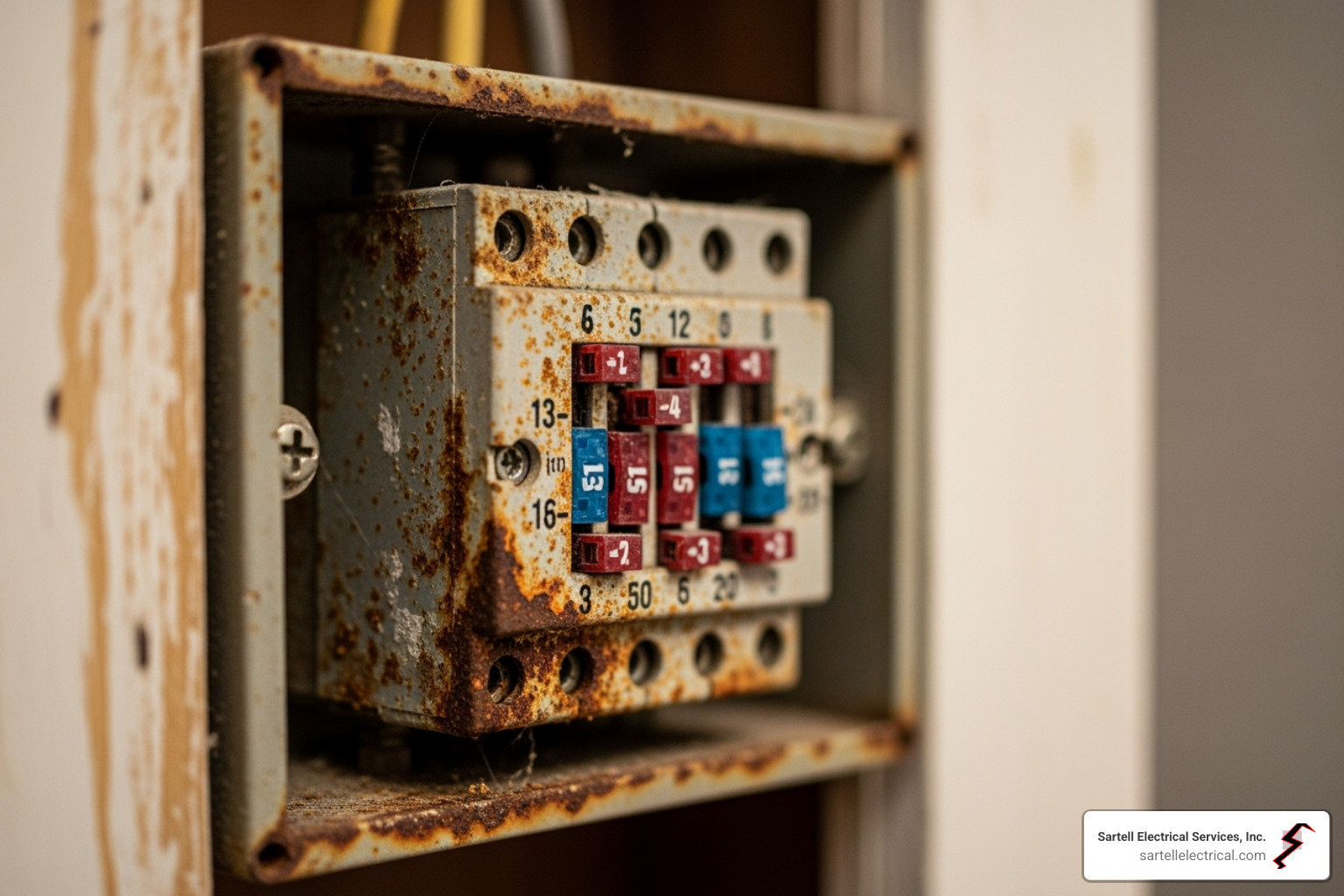
Burning smells or visible rust are serious red flags. A burning smell indicates overheating wires, while rust points to moisture damage. Both require immediate professional attention.
Buzzing or crackling sounds from your panel suggest loose connections or an overloaded circuit. It's a sign of electrical stress.
Melted wires or scorch marks are unmistakable signs of dangerous overheating and a significant fire risk. This requires immediate professional evaluation.
Living on extension cords is a risky workaround for an inadequate electrical system. Relying on power strips can overload circuits and create fire hazards.
Future-Proofing and Renovations
Sometimes you need a
main electrical panel upgrade not because of current problems, but to plan for the future.
Adding an EV charger requires a dedicated 240-volt circuit, which many older panels lack the capacity or space to support.
Kitchen remodels almost always require electrical upgrades. Modern kitchens with high-end appliances and extensive lighting are power-hungry.
Home additions increase your overall electrical load, often requiring more capacity than your current panel can provide.
Switching to electric appliances like
all-electric heat pumps is great for efficiency, but these systems need robust electrical support to operate safely.
Insufficient panel space for new circuits is a common problem. Even if your amperage is adequate, you might lack physical space for new breakers. Our
Residential Electrical Services can address this.
Your home will tell you when it needs help. If these signs sound familiar, it's time to discuss an electrical panel upgrade before a small problem becomes a dangerous one.
Decoding Amperage and Costs: Choosing the Right Panel for Your Home
Amperage is like the number of lanes on an electrical highway; more amps mean more power can flow smoothly to your appliances. An
electrical load calculation determines your home's total power needs, helping us recommend the right panel size for your current and future use, whether you're planning for an EV or a new kitchen.
Let's break down the most common panel sizes:
| Panel Amperage |
Typical Use Case |
Home Size Suitability |
Average Cost (Panel + Installation) |
| 60-Amp |
Obsolete, very small homes (pre-1960s), minimal use |
Small apartments, very old, tiny homes |
Requires full upgrade, not just panel |
| 100-Amp |
Small homes, minimal electrical devices |
Homes under 1,000 sq ft, basic needs |
$800 - $1,500 |
| 200-Amp |
Modern standard, typical family home |
Most average to large homes, modern appliances |
$1,300 - $3,000 |
| 400-Amp |
Very large homes, high electrical demand |
Large estates, homes with multiple HVAC/EVs |
$2,000 - $4,000 |
60-amp panels are obsolete and cannot handle modern electrical needs. If you have one, a
main electrical panel upgrade is essential for safety.
100-amp panels, once the standard, are now only suitable for smaller homes with modest electrical use. They are quickly outgrown when adding central air or an EV charger.
200-amp panels are the modern standard. This service provides enough capacity for a typical family to run multiple large appliances simultaneously without issues.
400-amp panels are for very large homes or properties with exceptional power needs, like multiple EV chargers or workshops with heavy machinery.
Cost Factors for a Main Electrical Panel Upgrade
Here are the key factors that influence the price of your
main electrical panel upgrade.
- Average Cost Range: Most upgrades from 100 to 200 amps cost between $1,300 and $3,000. Simpler projects can be around $800, while complex ones can reach $4,000.
- Labor Costs: Labor typically runs $50 to $120 per hour. A simple swap may take a day, while more involved upgrades can take longer.
- Panel Cost: The panel unit itself costs between $100 for a basic 100-amp model to $500+ for a 400-amp panel.
- Permit Fees: Expect to pay $50 to $300 for municipal permits, which ensure the work is inspected and up to code.
- Service Upgrade: If the main service line from the utility can't support the new panel, a service upgrade is needed. This can add $5,000 or more to the cost.
- Rewiring Needs: If existing wiring is outdated, it may need to be replaced to meet code, which will impact the budget.
100 Amps vs. 200 Amps: Making the Right Choice
For most homeowners, the choice is between 100 and 200 amps. A 100-amp panel struggles with
simultaneous appliance use in a modern home, leading to tripped breakers. Upgrading to 200 amps provides the
capacity for modern living, allowing you to run multiple appliances at once without worry. It also prepares your home for
future electrical needs like solar panels, new HVAC systems, or EV chargers.
For comprehensive information about how we can transform your home's electrical system, explore our
Residential Electrical Services. We proudly serve families throughout Essex County, Middlesex County, Norfolk County, Suffolk County, and the entire Greater Boston area.
The Anatomy of a Main Electrical Panel Upgrade: Process, Permits, and Professionals
When you're ready for a
main electrical panel upgrade, understanding the process helps set expectations. While it's a significant project, it's straightforward with experienced professionals.
The process starts with a
professional assessment of your current system and a discussion about your future power needs to determine the right upgrade for you. We then handle the crucial
permitting process, coordinating with local Massachusetts authorities to ensure your upgrade is fully compliant with building codes, which you can review on the state website.
Next, we coordinate with the
utility company to schedule a temporary power disconnection on installation day. The outage typically lasts 8-12 hours and is essential for safety. On
installation day, our licensed electricians efficiently remove the old panel, install the new system, and connect all wiring. The project concludes with a
final inspection from a city official to certify that the work meets all safety codes and is legally compliant.
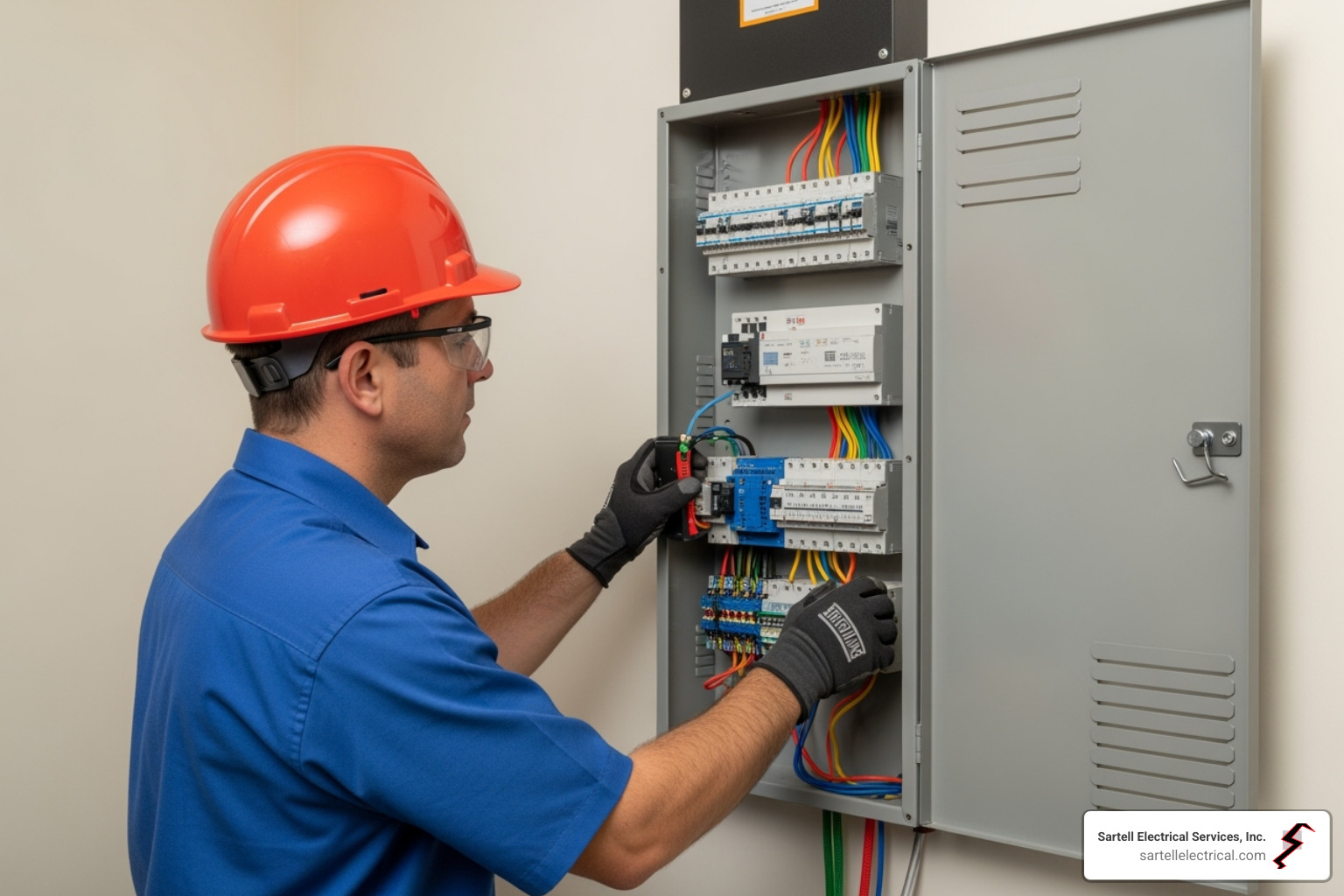
Why This is NOT a DIY Job
A
main electrical panel upgrade is never a DIY project. The risks are simply too high.
- Electrocution Hazard: You're dealing with extremely high voltage. A single mistake can be fatal.
- Fire Risk: Improper wiring is a leading cause of electrical fires. The National Fire Protection Association reports that faulty electrical wiring causes thousands of house fires annually.
- Code Violations: DIY work almost always violates strict local and national electrical codes, leading to failed inspections, fines, and costly rework.
- Insurance Issues: Your homeowner's insurance may deny claims for damage caused by unpermitted or DIY electrical work.
- Licensed and Insured Electricians: We are trained, licensed, and insured, staying current on all codes and safety protocols. Our expertise and insurance protect you and your property.
Panel Replacement vs. Upgrade and the Role of Subpanels
- Replacing with the same amperage involves swapping an old panel for a new one of the same capacity, often due to damage or a recall. Since labor costs are similar, consider upgrading capacity at the same time.
- Upgrading for more capacity is the more common choice, involving installing a panel with a higher amperage (e.g., 100 to 200 amps) to meet modern and future needs.
- Subpanels are smaller panels that branch off the main one. They are a great solution for organizing circuits in a specific area like a garage, workshop, or home addition. A subpanel simplifies wiring but still draws power from the main panel, so a main upgrade may still be necessary if your total load is too high.
Opening up the Benefits: Improved Safety, Value, and a Future-Ready Home
Investing in a
main electrical panel upgrade is an investment that makes your home safer, more efficient, and ready for the future.

Key Benefits of a Main Electrical Panel Upgrade
- Reduced Risk of Electrical Fires: This is the most critical benefit. An upgraded panel safely handles your electrical load, significantly reducing the risk of overheating and fire.
- Higher Electrical Capacity: Enjoy the freedom to use modern appliances—TVs, computers, smart home systems—without worrying about dimming lights or tripped breakers.
- Stable Power for Sensitive Electronics: An upgraded panel provides consistent power, protecting your valuable electronics from damaging surges and fluctuations.
- Ability to Add New Appliances and Circuits: Gain the capacity and space for future additions like a hot tub, EV charger, or home workshop.
- Compliance with Modern Electrical Codes: An upgrade ensures your system meets the latest safety standards, which is crucial for renovations and resale.
- Peace of Mind: Gain invaluable security knowing your home's electrical system is safe, modern, and reliable.
Impact on Home Value and Insurability
- Increased Home Resale Value: An upgraded panel is an attractive selling point that increases home value. It signals to buyers in the competitive Massachusetts market that they won't face an immediate, costly electrical overhaul.
- Lower Risk for Insurance Companies: Insurers view updated electrical systems as lower risk, which can lead to better coverage options and potentially lower premiums.
- Avoiding Issues During a Home Inspection: A modern panel helps ensure a smooth home inspection when you sell, avoiding last-minute repair demands or price reductions.
- A Sign of a Well-Maintained Home: This upgrade shows prospective buyers you've cared for the property's critical infrastructure, which can positively influence their offer.
An electrical panel upgrade is an investment in your home's future, ensuring it remains safe, functional, and valuable for years to come. Electrical panels typically last anywhere from 25–40 years, so an upgrade today means decades of reliable service.
Frequently Asked Questions about Electrical Panel Upgrades
Here are answers to the most common questions we hear from Massachusetts homeowners about
main electrical panel upgrade projects.
Are there tax credits or incentives for an electrical panel upgrade?
Yes, the Inflation Reduction Act (IRA) offers the
Energy Efficient Home Improvement Credit. This can cover 30% of your project costs, up to a $600 maximum for the panel upgrade itself. This credit is particularly useful if the upgrade supports other energy-efficiency projects like a heat pump or solar installation. For full details on eligibility for
electrical panel upgrades, consult a tax professional and official energy websites.
What is the difference between a fuse box and a circuit breaker panel?
A
fuse box is an outdated system that uses a one-time-use fuse that melts (or "blows") during an overload, requiring replacement. A modern
circuit breaker panel is far safer and more convenient. Its breakers simply "trip" (switch off) during an overload and can be easily reset. More importantly, modern breakers incorporate advanced safety features like Arc Fault (AFCI) and Ground Fault (GFCI) protection against fire and shock, which fuse boxes lack. Upgrading from a fuse box is a critical safety investment for any older home.
How long does the upgrade process take?
The physical installation typically takes
one to two days. On installation day, you should plan for a
power outage of 8 to 12 hours for safety. The entire project, from initial consultation to final inspection, usually takes
one to two weeks. This timeline accounts for coordinating with the utility company and scheduling the required municipal inspection, which varies by town in Massachusetts. We handle all the logistics and paperwork to ensure the process is as smooth as possible.
Conclusion
A
main electrical panel upgrade is a fundamental investment in your family's safety and your home's future. Ignoring warning signs like flickering lights, buzzing sounds, or frequent breaker trips puts your property at risk. Upgrading to a modern
200-amp service is the gold standard for handling today's electrical demands.
The benefits are clear:
reduced fire risk, stable power for all your devices, increased home value, and priceless peace of mind. This is a job for licensed professionals, never a DIY project.
For over three decades, Ed Sartell and the team at Sartell Electrical Services have helped Massachusetts families upgrade their homes for modern living. From our base in Reading, MA, we serve homeowners across Essex, Middlesex, Norfolk, and Suffolk Counties, ensuring their electrical systems are safe, reliable, and ready for the future.
Don't let an outdated panel compromise your home's safety. Reach out to our expert electricians for all your
residential electrical needs. We bring the same commitment to excellence to every job, from residential upgrades to services as an
Industrial Electrical Contractor in Reading, MA. Your home's electrical future is too important to leave to chance.