Healthcare Electrical Contractors: 3 Essential Services
Why Healthcare Facilities Need Specialized Electrical Contractors
Healthcare electrical contractors are specialized professionals who design, install, and maintain the complex electrical systems powering hospitals and medical facilities. Unlike standard commercial electricians, they understand the unique requirements of medical environments, including:
- Essential Electrical Systems (EES) for life safety, critical care, and equipment.
- Emergency Power from generators and UPS systems that restore power within 10 seconds.
- Regulatory Compliance with NFPA 99, NFPA 70 (NEC), and Joint Commission standards.
- Infection Control (ICRA) protocols to protect patients during construction.
- Specialized Wiring for MRI machines, CT scanners, and life-support systems.
- 24/7 Reliability for continuous patient care.
The stakes are exceptionally high. As one industry expert notes, "In mission-critical environments, energy is information. Energy is life. Energy is security." A power failure in a hospital isn't an inconvenience—it can be a matter of life and death.
I'm Ed Sartell, President of Sartell Electrical Services. Since 1985, my team has worked on medical facilities across Massachusetts, delivering the highest standards of safety and reliability. We understand that hospital electrical systems demand technical expertise and an unwavering commitment to patient safety and operational continuity.
The Unique Electrical Landscape of Healthcare Facilities
Imagine a power outage at your office. Your computer shuts down, the lights go dark, and you lose a few minutes of work. Frustrating, but not life-threatening. Now, imagine that same power loss during open-heart surgery or in an ICU where patients depend on ventilators. The stakes are infinitely higher.
This is why healthcare facilities operate in a different electrical universe. The
24/7, life-sustaining nature of hospital operations demands that every electrical system functions flawlessly and continuously. There's no room for error when lives hang in the balance. Hospitals require exceptional
power quality to protect sensitive diagnostic equipment, multiple layers of
redundancy, and a complex power distribution network that prioritizes critical systems during an emergency.
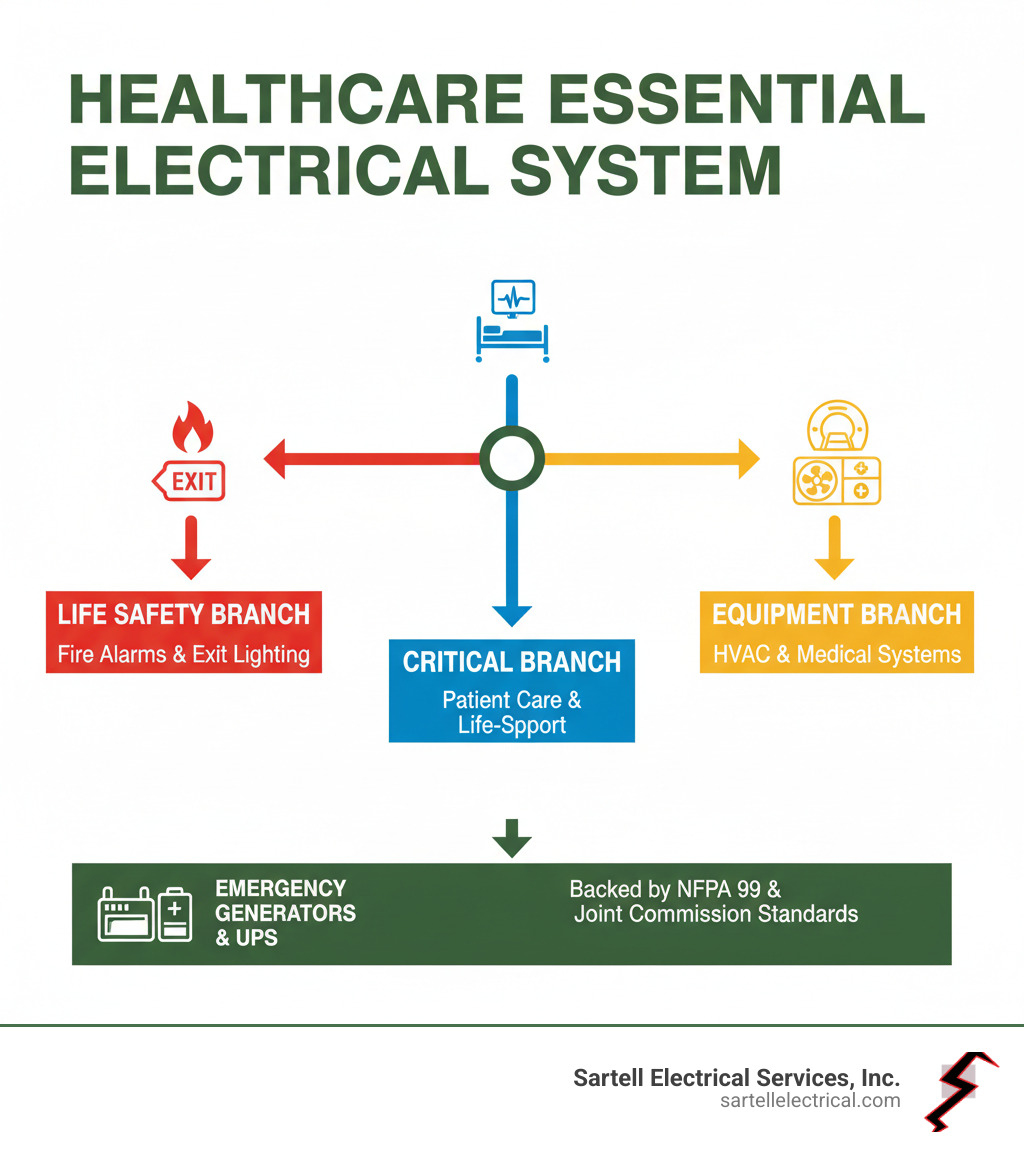
At the center of this ecosystem is the
Essential Electrical System (EES). Mandated by NFPA standards and The Joint Commission, the EES is a facility's electrical insurance policy, ensuring critical functions keep running when the main power grid fails. As
healthcare electrical contractors in Massachusetts, we know that building these systems is a commitment to patient safety. We're not just pulling wire; we're building the invisible infrastructure that allows doctors to save lives.
The Three-Tiered Essential Electrical System (EES)
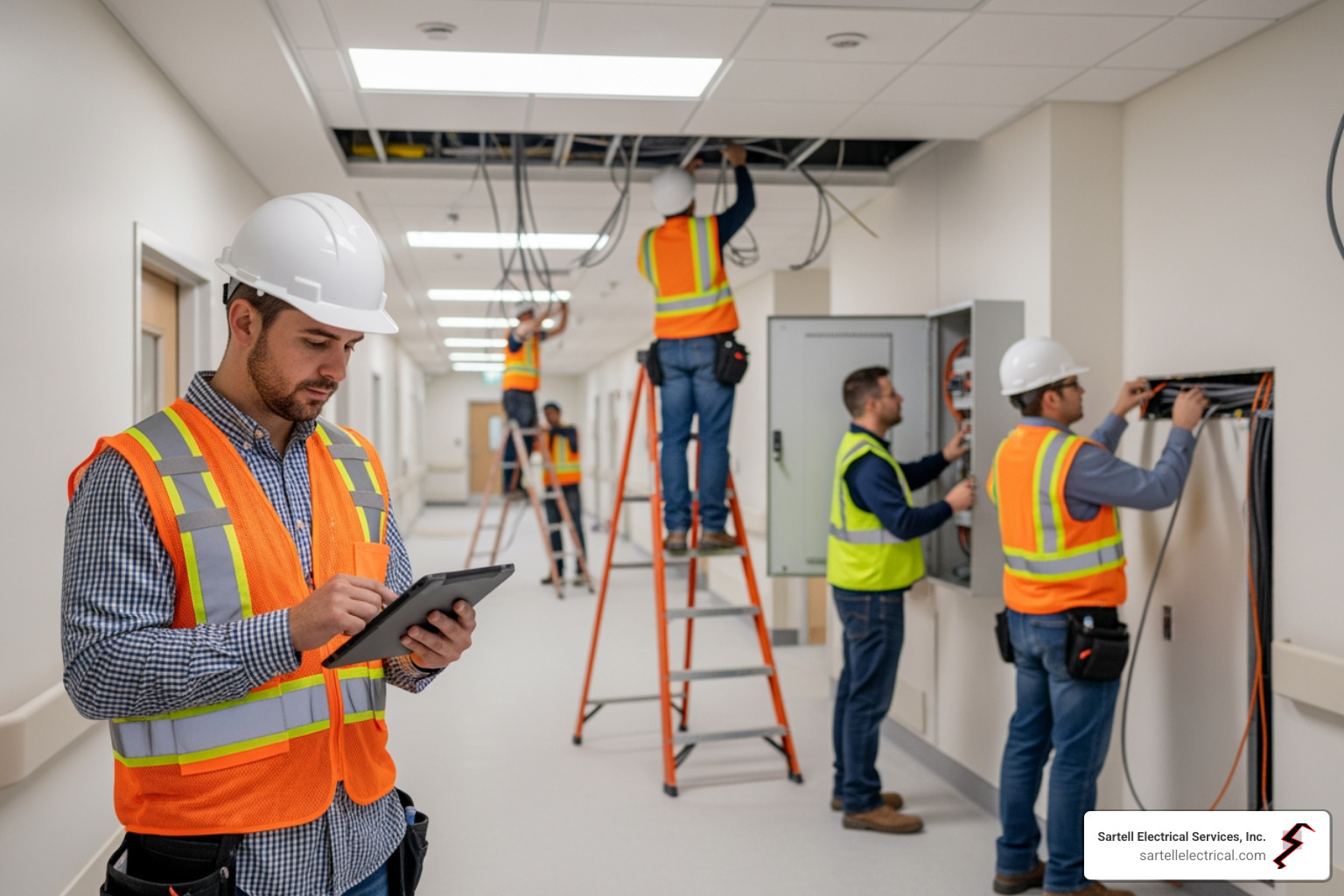
The EES is three separate, prioritized systems that work together during a power failure.
The Life Safety Branch is the first responder. Within 10 seconds of a power loss, it switches to emergency power to protect occupants. This branch powers
fire alarms, emergency corridor lighting, exit signs, and critical
alarm and communication systems. It ensures a safe evacuation path if needed.
The Critical Branch directly powers equipment that keeps patients alive. This includes
task lighting in operating rooms, ventilators, life support equipment, ICU monitoring systems, and
blood bank refrigerators. A loose connection here isn't just a code violation—it's a potential threat to patient survival. Our work providing
Medically Essential Electric Service requires meticulous attention to detail.
The Equipment Branch keeps the facility itself operational. It supplies power to
HVAC systems in critical areas, medical vacuum systems, sterilization equipment, and
select elevators. This branch typically transfers to emergency power after the other two, helping manage the load on backup generators.
This three-tiered system prioritizes power distribution, ensuring that when the lights go out everywhere else, the hospital keeps running.
Core Services and Specialized Expertise of Healthcare Electrical Contractors
Behind the walls of any hospital lies an electrical infrastructure so complex that it requires specialized expertise. As
healthcare electrical contractors in Massachusetts, our work goes far beyond keeping the lights on; we create and maintain the electrical nervous system that powers everything from patient room outlets to million-dollar diagnostic equipment.
Our core services include:
- Power distribution systems: Designing and installing the network of panels, transformers, and wiring for new installations, service upgrades, and metering.
- Lighting solutions: Installing everything from adjustable patient room lighting to brilliant surgical lights, energy-efficient LED upgrades, and exterior safety lighting.
- Low-voltage systems: Wiring for nurse call systems, data and communications, fire alarms, and security systems that are critical to patient safety and care coordination.
- Technology integration: Ensuring smart building systems, advanced medical devices, and monitoring platforms work together seamlessly.
- 24/7 emergency service and maintenance: Providing ongoing support because a hospital can't wait until Monday morning for a repair.
On every job, we follow
Hospital Electrical Systems Best Practices to ensure your facility exceeds every regulatory requirement.
Wiring for Advanced Medical and Diagnostic Equipment
You can't just plug an MRI machine into a regular outlet. Modern medical equipment demands electrical power that is clean, stable, and interference-free.
MRI machines, CT scanners, and X-ray equipment require massive amounts of dedicated power, specialized shielding, and high-capacity supplies that can handle sudden electrical surges.
Robotic surgery suites and
laboratory equipment need incredibly stable power, as any fluctuation could affect delicate procedures or compromise test results.
Our expertise in
Medical Equipment Installation involves designing complete power systems with surge protection and power quality management. We stay ahead of rapid technological changes to ensure cutting-edge equipment has the power it needs to save lives.
Emergency Power: The Ultimate Lifeline
In healthcare, continuous power is non-negotiable. Emergency power systems are governed by strict regulations that leave no room for error.
Backup generators are the workhorses, automatically starting when utility power fails.
Automatic Transfer Switches (ATS) detect the failure and switch critical loads to generator power within the ten-second timeframe mandated by
NFPA 110 standards.
For equipment that cannot wait even ten seconds, we install
Uninterruptible Power Supply (UPS) systems. These battery-powered units provide seamless, instantaneous power until the generators take over. Our work with
Hospital UPS Systems ensures there is never a microsecond of power loss to critical equipment.
We also use
Power Plant Monitoring System technology to watch over these systems, alerting us to potential issues before they become problems. In healthcare, emergency power must work every single time.
Navigating Stringent Regulations, Safety, and Compliance
Working as a
healthcare electrical contractor means navigating one of the most complex regulatory environments in any industry. It's not enough to be a skilled electrician; you must be a code expert and safety officer dedicated to protecting vulnerable patients.
These regulations exist because there is no margin for error. A miswired circuit could impact life-saving equipment. That's why organizations like
The Joint Commission (TJC) set rigorous standards for accreditation, inspecting everything from emergency power tests to documentation.
NFPA 99, the Health Care Facilities Code, is our bible. It dictates
why different areas of a hospital require different levels of electrical protection. We also follow
NFPA 70 (the National Electrical Code) and
NFPA 110 for emergency power systems. It's like building to code, then to a higher code, and then adding another layer of safety protocols.
Perhaps the most critical protocol is the
Infection Control Risk Assessment (ICRA). This is about protecting patients from infection during construction. Every time we open a ceiling or wall, we risk releasing airborne pathogens. Our teams train constantly on these evolving standards, as detailed in resources like this
Understanding healthcare electrical systems video. Compliance isn't a box to check—it's woven into everything we do to keep patients safe.
Patient Safety and Infection Control During Electrical Work
How do we balance necessary electrical upgrades with the absolute priority of patient safety? The answer is
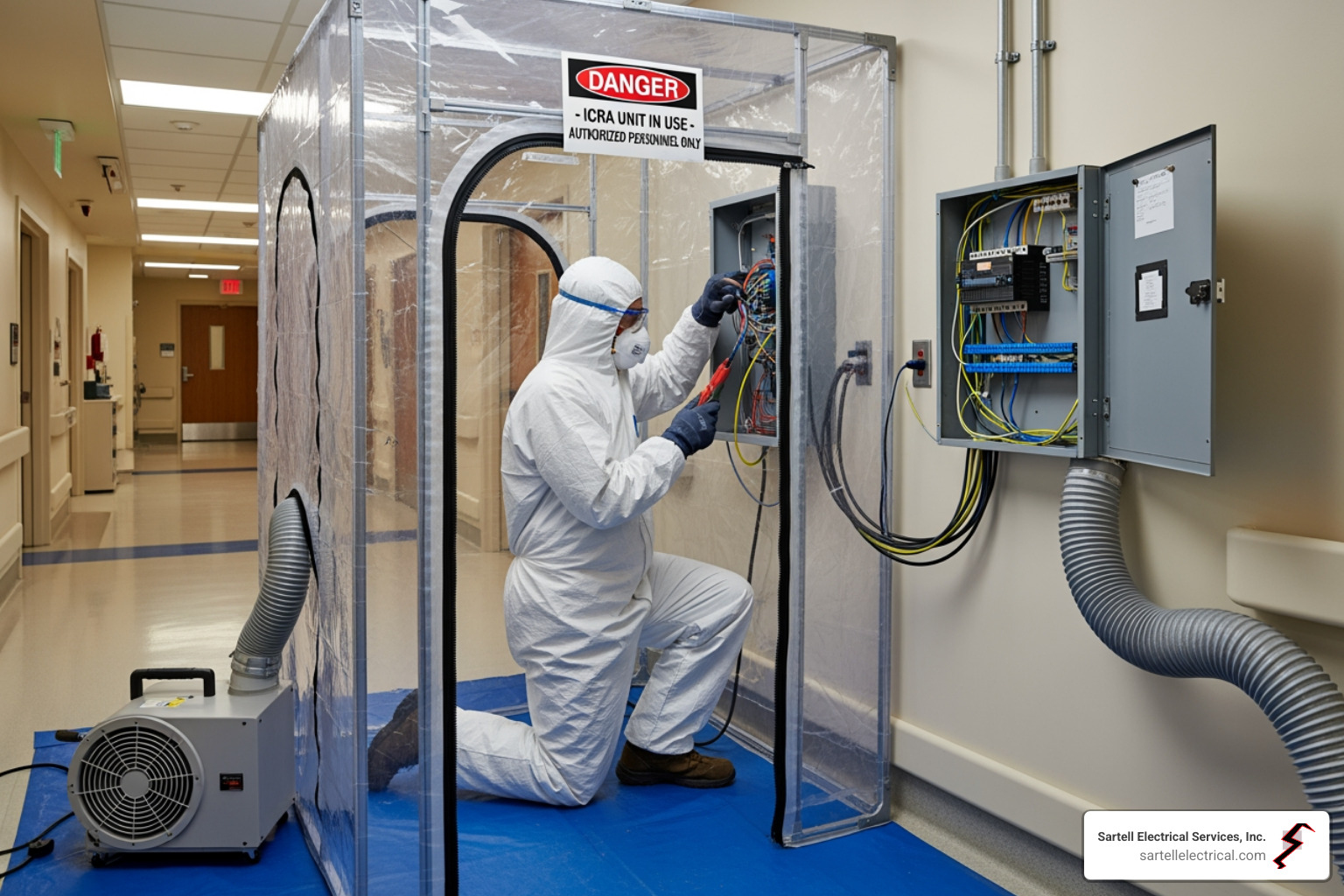
ICRA protocols. Before any project, we assess the risk level based on the work and location.
For high-risk work, we create sealed containment units with
HEPA filtration and
negative air pressure to capture microscopic particles and prevent them from escaping into patient areas. We also focus on
dust and noise mitigation, using specialized tools and scheduling noisy work during off-peak hours in coordination with hospital staff.
Working in active patient areas requires a special mindset. Our electricians understand they are in a healing space. We work quietly and coordinate closely with infection control coordinators and facility managers to ensure our presence never compromises patient care. This often involves
phased project execution, upgrading one wing at a time so the hospital operates normally.
After every project, we conduct thorough assessments and perform an
Electrical Safety Check on Medical Equipment to verify the space and equipment are safe for patients. We're not just installing electrical systems—we're protecting the most vulnerable people.
The Benefits of Partnering with Experienced Healthcare Electrical Contractors
When it comes to your healthcare facility's electrical infrastructure, experience is essential. The difference between a specialized
healthcare electrical contractor and a general commercial electrician can be the difference between seamless operations and costly disruptions that put patients at risk.
Partnering with an experienced contractor provides several key benefits:
- Risk mitigation: Our deep knowledge of NFPA 99, 70, and 110 standards helps us anticipate problems before they happen. This foresight protects your facility from costly violations, equipment failures, and liability concerns.
- Guaranteed code compliance: We ensure every installation meets or exceeds the requirements of The Joint Commission and other regulatory bodies, making accreditation straightforward, not stressful.
- Project efficiency: We have extensive experience working in active hospitals without disrupting operations. Through careful planning, ICRA protocols, and phased construction, we ensure your facility never misses a beat. Our value engineering also helps reduce project costs without sacrificing safety.
- Long-term reliability: We build infrastructure designed to serve patients reliably for decades. Our focus on quality components and thorough testing means your essential systems will perform when it matters most—every moment of every day.
- Future-proofing your facility: We help you plan for future expansions, integrate new medical technologies, and implement energy efficiency initiatives. Whether it's a new Medical Office Construction or an upgrade, we ensure your infrastructure can adapt.

Key Questions to Ask a Potential Contractor
Choosing the right
healthcare electrical contractors requires careful vetting. Ask these questions to determine if a contractor is a true specialist:
- What is your specific healthcare experience? Ask for examples of similar projects in hospitals or clinics, as general commercial experience doesn't translate.
- How familiar are you with critical standards? They should be able to explain NFPA 99, 70, and 110, and the different branches of the Essential Electrical System.
- How do you handle ICRA protocols? Ask for concrete examples of how they contain dust and work safely in occupied patient care areas.
- What is your emergency service availability? Power problems don't wait for business hours. Do they offer 24/7 emergency service and what is their response time?
- What is your experience with specialized medical equipment? Have they installed power systems for MRI, CT, or robotic surgery suites? Our experience with Medical Equipment Installation shows each device has unique needs.
- What is your approach to value engineering and budgeting? The best contractors act as advisors, balancing cost-effectiveness with safety and quality.
- Can you provide references from other healthcare facilities? Speaking with other facility managers provides invaluable insight into a contractor's performance.
Your facility deserves a partner who views patient safety as seriously as you do. For comprehensive support, explore our
Healthcare Electrical Services to see our commitment to excellence.
Frequently Asked Questions about Healthcare Electrical Contractors
Over my years leading Sartell Electrical Services, facility managers and hospital administrators often ask what makes electrical work in their environments so different. These common questions get to the heart of why specialized
healthcare electrical contractors are essential.
What makes electrical work in a hospital different from a regular commercial building?
The simple answer: when power fails in an office, it's an inconvenience. In a hospital, it can be a catastrophe. The key differences are:
- The Essential Electrical System (EES): A legally mandated, three-tiered power system (life safety, critical, and equipment branches) that doesn't exist in commercial buildings. It ensures power is prioritized for life-sustaining functions.
- Infection Control (ICRA): We must use sealed containment zones with HEPA filtration and negative air pressure to prevent construction dust from causing hospital-acquired infections in vulnerable patients.
- Zero Downtime Requirement: Hospitals operate 24/7. We must perform work without disrupting patient care, requiring meticulous planning and coordination that is unnecessary in most commercial settings.
- Patient Safety Focus: Every decision, from wiring choices to equipment placement, is filtered through the lens of patient safety, a standard far beyond typical commercial work.
What is the role of an emergency power system in a healthcare facility?
Its role is to provide
uninterrupted power to life-sustaining systems when the main utility grid fails. The system is complex and includes:
- Backup Generators: These automatically start during an outage to supply electricity.
- Automatic Transfer Switches (ATS): These devices detect the outage and switch the facility's critical loads to generator power. Per NFPA 110 compliance, this must happen within 10 seconds.
- Hospital UPS Systems: For equipment that cannot tolerate a 10-second delay, these battery systems provide instantaneous, seamless power until the generators take over.
This system ensures ventilators, surgical equipment, and monitoring systems continue to function without interruption, protecting patient lives.
Why is ICRA so important for healthcare electrical contractors?
ICRA (Infection Control Risk Assessment) is critical because our work—drilling, opening walls, moving ceiling tiles—releases dust and debris that can carry dangerous pathogens. For patients with compromised immune systems, these pathogens can cause life-threatening
hospital-acquired infections.
As
healthcare electrical contractors, we follow strict ICRA protocols to protect patients. This involves:
- Dust and Pathogen Containment: We build sealed work zones with HEPA filtration and negative air pressure to trap contaminants.
- Protecting Vulnerable Patients: We coordinate with hospital staff to schedule work and implement safety measures that prevent exposure.
ICRA is not bureaucratic red tape; it's a fundamental part of patient safety. When we perform an
Electrical Safety Check on Medical Equipment, we ensure the entire process, from installation to testing, protects the patients who depend on that equipment.
Conclusion: Powering the Future of Patient Care
It's clear that
healthcare electrical contractors operate in a world unlike any other. It's a domain where technical mastery must be paired with an unwavering dedication to patient safety, and where "uptime" is a matter of life and death.
We've covered the intricacies of the Essential Electrical System, the critical role of emergency power, the expertise needed for advanced medical equipment, and the meticulous infection control protocols required by codes like NFPA 99 and standards from The Joint Commission. These elements represent a deep commitment to the patients and medical professionals who rely on these systems.
At Sartell Electrical Services, we have spent over three decades earning the trust of healthcare facilities throughout Massachusetts. We understand you're not just hiring a contractor; you're choosing a partner who will respect the environment and deliver reliable, safe systems. We approach every project—from a new
Medical Office Construction to a complex hospital expansion—with the patient's best interest at heart.
As healthcare evolves, your electrical infrastructure must keep pace. Choosing the right partner is about future-proofing your facility for tomorrow's challenges.
If you're planning an upgrade or new construction, we invite you to explore our comprehensive
Healthcare Electrical Services. Let's work together to ensure your facility's electrical systems are safe, compliant, and ready to support exceptional patient care.