Power plant monitoring system 2025: Optimize
Why Power Plant Monitoring Systems Are Critical for Modern Energy Production
A
power plant monitoring system is a network of sensors, software, and control devices that continuously tracks the performance, safety, and efficiency of power generation equipment. Acting as the plant's "nervous system," it collects real-time data from thousands of points and presents it to operators in an actionable format.
These systems are essential for all types of power generation—from fossil fuels and nuclear to renewables—to ensure safe, reliable, and efficient operation. Their primary functions include:
- Real-time performance monitoring and optimization
- Early fault detection and predictive maintenance
- Environmental compliance and emissions tracking
- Grid stability and load balancing
- Safety system oversight and emergency response
The value of these systems is clear. Advanced condition monitoring has led to a 40% reduction in downtime, a 40% increase in production, and a 70% reduction in machine breakdowns.
I'm Ed Sartell, and with nearly four decades of experience in electrical systems, I've seen how critical proper electrical infrastructure is for supporting these advanced installations. My team at Sartell Electrical Services has worked on complex industrial projects where reliable electrical systems form the backbone of sophisticated monitoring and control networks.

The Core Architecture: Key Components and How They Work Together
A
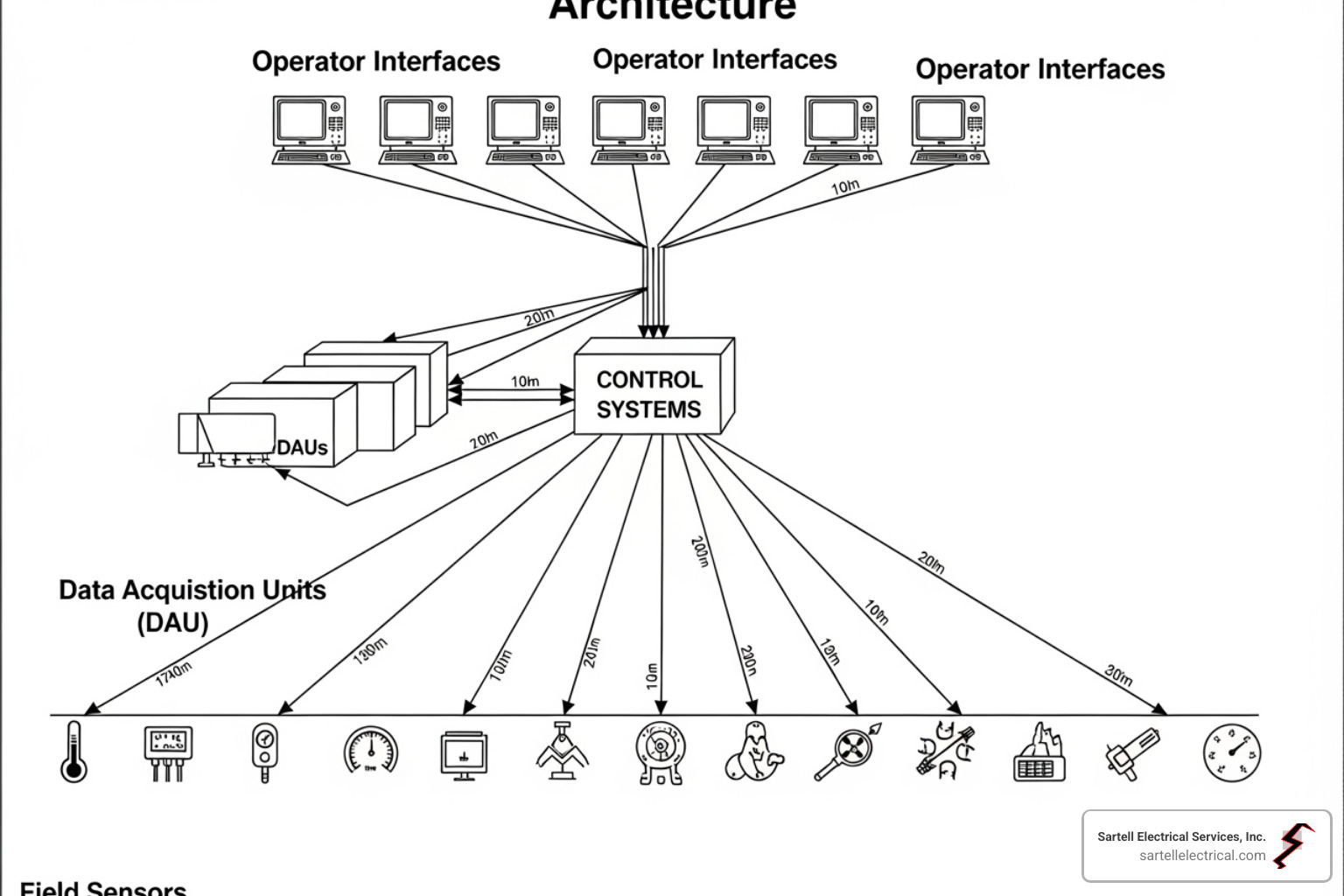
power plant monitoring system coordinates thousands of components to ensure reliable electricity generation. At Sartell Electrical Services, we know the electrical infrastructure supporting these systems is foundational to their success. The system architecture is layered, with each layer having a distinct role.
Data Acquisition: The System's Senses
The system's senses are thousands of sensors and transmitters throughout the facility. Sensors convert physical conditions into digital signals, detecting changes in temperature, pressure, and more. Transmitters amplify these signals for the control systems.
- Pressure monitoring is vital for safety and efficiency in boilers and turbines.
- Temperature monitoring tracks heat in bearings, cooling water, and exhaust gases to prevent damage and optimize combustion.
- Flow monitoring ensures fuel, water, and steam move at the correct rates.
- Vibration analysis acts like a stethoscope for machinery, detecting wear and imbalance in rotating equipment before it causes a breakdown.
Power plants monitor dozens of critical parameters, including pressure, temperature, flow, vibration, electrical current, emissions, rotational speed, valve positions, and motor status.
The Central Nervous System: SCADA, DCS, and PLCs
Once data is collected, a trio of technologies processes it:
- Supervisory Control and Data Acquisition (SCADA) systems provide a high-level overview of the entire plant and remote assets like substations. They are used for supervisory control rather than direct, real-time process control.
- Distributed Control Systems (DCS) are process specialists, managing complex, continuous processes like a boiler or turbine system with high precision.
- Programmable Logic Controllers (PLCs) are rugged devices that handle specific, repetitive tasks, such as starting a pump or opening a valve based on set conditions.
Human-Machine Interfaces (HMI) translate this complex data into intuitive graphical displays, charts, and alarms, allowing operators to manage the plant effectively.
| Feature |
SCADA |
DCS |
| Primary Focus |
Remote monitoring and supervisory control |
Integrated control of continuous, complex processes |
| Scope |
Geographically dispersed assets (substations, renewable farms) |
Centralized control of single plant or process area |
| Control Level |
High-level, supervisory commands |
Low-level, real-time, closed-loop control |
| Architecture |
Centralized master station with remote units |
Distributed controllers in local network |
| Data Handling |
Collects data for system visibility |
Manages vast amounts of process data for precise control |
| Typical Use |
Grid management, renewable monitoring |
Thermal plant control, nuclear operations |
Ensuring Safety, Grid Compliance, and Data Integrity
A
power plant monitoring system is crucial for safety and grid stability.
Safety Instrumented Systems (SIS) act as an independent emergency shutdown system, providing a final line of defense against accidents.
Real-time data logging and
historian systems capture and store every operational detail, creating a permanent record for troubleshooting, compliance, and analysis. Finally, the system helps with
grid stability control, ensuring the plant's output meets the grid's strict voltage and frequency requirements.
After nearly four decades in the electrical industry, I've seen how critical proper electrical infrastructure is for these sophisticated systems. At Sartell Electrical Services, we understand that even the most advanced monitoring system is only as good as the electrical foundation supporting it.
More info about industrial electrical services.
A
power plant monitoring system allows facilities to anticipate problems, moving from reactive fixes to predictive strategies. This shift boosts efficiency and profitability. Smart monitoring enables predictive maintenance, improves operational efficiency by maximizing output from fuel, automates emission control for compliance, and improves asset management to extend equipment life.

Tailoring Monitoring to Different Generation Types
Monitoring needs vary by the type of power plant:
- Thermal Plants (Fossil Fuel/Nuclear): Focus on boiler performance, turbine efficiency, steam chemistry, and fuel consumption. Nuclear plants add critical reactor safety monitoring.
- Hydroelectric Facilities: Emphasize turbine/generator health, water flow, and dam integrity. Acoustic monitoring is key for early detection of mechanical issues.
- Solar and Wind Farms: Solar requires tracking panel performance, sunlight levels, and inverter efficiency. Wind involves monitoring blade integrity, gearbox health, and generator performance.
- Battery Energy Storage Systems (BESS): Require careful tracking of charge states, temperature, and overall battery health for grid integration.
- Combined Cycle Plants: Involve coordinating gas and steam turbines to optimize heat recovery and power output.
From Reactive to Predictive: The Power of Condition Monitoring
The greatest advantage of a modern
power plant monitoring system is the shift to predictive maintenance.
Condition monitoring continuously checks equipment health for subtle changes that indicate future problems.
- Vibration analysis is a powerful tool for detecting wear, imbalance, or misalignment in rotating machinery. It has achieved a 40% reduction in downtime, a 40% increase in production, and a 70% reduction in machine breakdowns.
- Acoustic monitoring uses sensitive microphones to listen for abnormal sounds that signal issues like bearing damage or leaks.
- Thermal imaging uses infrared cameras to spot overheating components and electrical faults before they cause shutdowns.
Performance Monitoring Systems for Power Plants: General Features and Application Models.
Using Data to Drive Decisions and Efficiency
The vast data collected by monitoring systems is a goldmine for operational improvements.
- Performance optimization: Continuous data analysis identifies inefficiencies and fine-tunes processes in real-time.
- Fuel consumption analysis: Optimizing combustion in fossil-fuel plants leads to significant cost savings.
- Automated reporting: Systems generate reports on production, emissions, and equipment health, freeing up staff and ensuring compliance.
- Environmental compliance: Continuous Emissions Monitoring Systems (CEMS) help plants meet strict environmental regulations.
- Load balancing: Real-time data enables plants to adjust output smoothly to match grid demand, ensuring stability.
At Sartell Electrical Services, we know this technology relies on a solid electrical infrastructure to ensure reliable data collection and uninterrupted operation.
Advanced Technologies and Future Trends
The
power plant monitoring system is evolving, driven by smart, connected, and predictive technologies. The Industrial Internet of Things (IIoT), Artificial Intelligence (AI), Digital Twins, and cloud computing are revolutionizing how plants operate. At Sartell Electrical Services, we understand these advanced systems require robust electrical infrastructure to function successfully.

The Wireless Revolution in Plant Monitoring
Wireless technology is a game-changer, eliminating the need for extensive and costly wiring.
Wireless sensors can be deployed quickly and easily, especially when retrofitting older plants or monitoring hard-to-reach areas. The
WirelessHART protocol is the industry standard, ensuring reliable data transmission in harsh industrial environments.
The benefits are significant: wireless instruments can
reduce installation costs by 50% or more and cut installation time by 75%. This faster deployment and the ability for
remote monitoring allow plants to see benefits sooner and improve operational oversight.
Wireless Monitoring Improves Power Plant Operations.
The Future is Smart: AI, Machine Learning, and Analytics
Combining connectivity with AI and machine learning gives the
power plant monitoring system a brain that constantly learns and improves.
- Anomaly detection: AI algorithms analyze data streams to spot subtle deviations from normal operations, providing early warnings of potential equipment failure.
- AI-driven diagnostics: Once an anomaly is found, AI can help pinpoint the root cause and suggest corrective actions.
- Machine learning models: These systems learn from historical data to continuously improve their ability to predict failures and optimize performance.
- Cloud-based analytics: The cloud provides immense processing power to run complex analyses on vast datasets, delivering deeper insights.
The ultimate goal is
predictive failure analysis, which uses this technology to forecast exactly when a component will fail. This allows maintenance to be scheduled precisely when needed, minimizing downtime and maximizing equipment lifespan. These technologies are making power plants safer, more efficient, and more reliable than ever.
Implementation: Challenges and Solutions
Implementing a sophisticated
power plant monitoring system is a complex project with unique challenges. Based on over 30 years of experience, I know that success depends on anticipating these problems and having solid strategies to overcome them.
Common Problems in System Implementation
Key challenges often arise during implementation:
- Integrating new and old equipment: Many plants have legacy systems that don't easily communicate with modern digital equipment, creating "isolated" systems that must be bridged.
- Cybersecurity: Connecting critical infrastructure to networks introduces vulnerabilities that must be rigorously defended against cyber attacks.
- Data overload: Modern systems produce vast amounts of data. The challenge is to present this information effectively so it empowers, rather than overwhelms, operators.
- High initial investment: The upfront costs for hardware, software, and installation can be substantial, though the long-term ROI is typically very high.
- Change management: Overcoming staff resistance to new technology and workflows requires clear communication and comprehensive training.
Strategies for a Successful and Secure Rollout
At Sartell Electrical Services, we advocate for a methodical approach to ensure a smooth rollout.
A
phased implementation is often best, breaking the project into manageable stages to minimize disruption and allow for testing.
Robust cybersecurity protocols are mandatory, not optional. This includes network segmentation, firewalls, secure remote access, regular security audits, and data encryption. For critical systems, one-way data diodes provide physical security. Crucially, comprehensive employee training on cybersecurity best practices is essential, as human error is often the weakest link.
Designing a
scalable architecture ensures the system can grow with the plant's future needs.
Comprehensive operator training is also vital; a system is only effective if the team knows how to use it.
The electrical infrastructure is the foundation. Our expertise at Sartell Electrical Services ensures proper grounding, reliable power, and clean connections to prevent data interference. A
power plant monitoring system is only as good as the electrical system it's built on.
Frequently Asked Questions about Power Plant Monitoring
What is the difference between a monitoring system and a control system?
Think of a
power plant monitoring system as the plant's eyes and ears, while a control system is its hands and reflexes. A monitoring system
gathers information—it measures temperature, pressure, vibration, and other parameters, analyzes trends, and alerts operators to anomalies. A control system
takes action based on that information, making adjustments like opening a valve or changing a fuel feed to keep processes running safely and efficiently. In modern plants, these systems are tightly integrated, with monitoring data directly informing automated control decisions.
Can monitoring systems be retrofitted onto older power plants?
Yes, and it's a common and highly effective upgrade. Many older plants have isolated legacy systems. Modern technology, especially
wireless sensors, makes retrofitting much easier and more cost-effective than in the past. Instead of running miles of new cable, wireless instruments can be installed quickly to monitor everything from control valves to calibration gas pressures. This allows older facilities to gain the safety and efficiency benefits of a modern
power plant monitoring system without a complete overhaul. At Sartell Electrical Services, we often upgrade electrical infrastructure to support these new capabilities during retrofit projects.
How does a power plant monitoring system improve safety?
Safety is a primary benefit. These systems provide multiple layers of protection. First,
early fault detection spots subtle changes in equipment performance—like a minor temperature increase or an unusual vibration—that signal developing problems long before they become critical. Second, dedicated
Safety Instrumented Systems (SIS) act as an automated emergency response, shutting down equipment to prevent accidents if safety limits are breached. Finally, real-time visibility from a central control room and historical data logging allow operators to make faster, more informed decisions during emergencies and analyze past incidents to prevent future ones.
Conclusion: Powering the Future with Intelligent Monitoring
After nearly four decades in the electrical industry, I've seen how a
power plant monitoring system has become the intelligent heartbeat of modern energy generation. These systems are the difference between a plant that simply runs and one that operates safely, efficiently, and profitably.
The benefits are undeniable:
- Increased reliability reduces outages.
- Improved safety protects workers and communities.
- Improved profitability keeps energy affordable and funds future innovation.
The future is even brighter, with AI, machine learning, and wireless technologies making these systems smarter and more predictive. However, one thing remains constant:
the critical role of expert electrical installation for system integrity. A sophisticated monitoring system is only as reliable as the electrical foundation it's built on.
At Sartell Electrical Services, we've seen how cutting corners on electrical work leads to system failures. That's why we are committed to getting it right the first time, ensuring proper grounding, redundant power, and clean connections. From our base in Reading, MA, we support facilities throughout Greater Boston, Middlesex County, and Essex County, building the foundation for systems that power our world.
Ensure your facility's electrical infrastructure can support advanced monitoring by exploring our industrial electrical services.