Hospital UPS systems: Critical Lifeline 2025
Why Hospital UPS Systems Are Critical for Patient Safety
Hospital UPS systems are the invisible lifelines that keep critical medical equipment running when the power goes out. These specialized power backup systems provide instant, uninterrupted electricity to life-saving devices, ensuring patient care never stops - not even for a second.
Key Functions of Hospital UPS Systems:
- Instant Power Transfer - Takes over in milliseconds when utility power fails
- Bridge to Generator Power - Provides seamless power during the 10-second generator startup delay
- Medical Equipment Protection - Shields sensitive devices from power surges and electrical noise
- Regulatory Compliance - Meets strict UL 60601-1 safety standards for patient care areas
- Critical System Support - Powers ventilators, monitors, surgical equipment, and IT systems
In healthcare facilities, every second matters. Between 2018 and 2020, over 231,000 power outages lasting more than an hour occurred across the United States, with nearly 17,500 stretching for eight or more hours. For hospitals, these statistics represent potential life-and-death situations where UPS systems serve as the crucial first line of defense.
Modern hospitals depend on a constant flow of clean, reliable electricity for everything from ventilators keeping patients alive to the electronic health records that guide treatment decisions. Unlike backup generators that can take up to 10 seconds to start, UPS systems provide instantaneous power transfer using battery backup, ensuring no interruption to critical equipment during those vital first moments of an outage.
As President of Sartell Electrical Services with nearly four decades of experience, I've seen how Hospital UPS systems can mean the difference between life and death in healthcare facilities. Our team has installed and maintained these critical power protection systems across Massachusetts, understanding that when it comes to patient safety, there's no room for compromise.
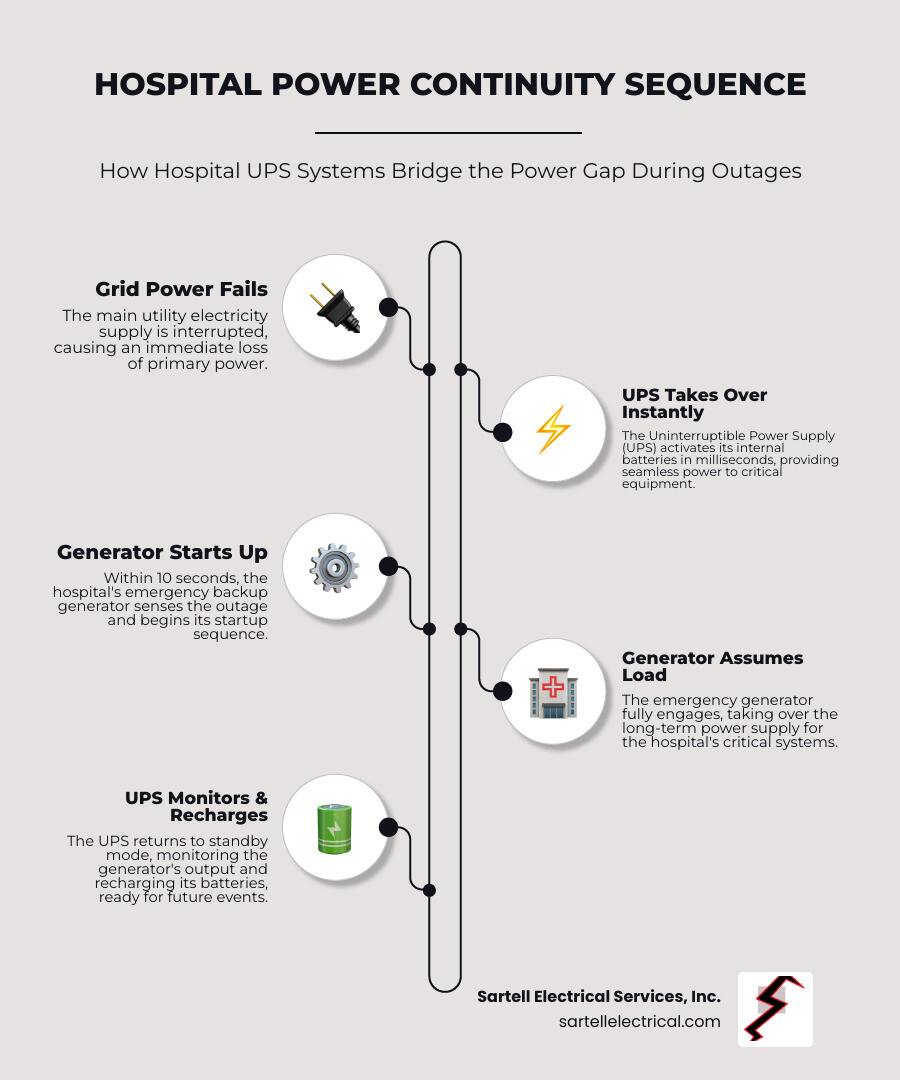
In a healthcare setting, a constant, reliable flow of electricity isn't a luxury—it's a lifeline. With power outages on the rise, a momentary flicker can have dire consequences, jeopardizing patient safety and the continuity of care. This guide explores the critical role of hospital-grade Uninterruptible Power Supply (UPS) systems, the unsung heroes that ensure the power never stops, even for a second.
The Unseen Guardian: Why Uninterrupted Power is Non-Negotiable in Healthcare
Picture this: you're in a hospital room when suddenly the lights flicker and go out. While that might just be an inconvenience in your living room, in a healthcare setting, it could mean the difference between life and death. This is exactly why Hospital UPS systems serve as the invisible guardians that never sleep, never fail, and never compromise on patient safety.
In healthcare facilities, power isn't just about keeping the lights on—it's about keeping people alive. Every piece of medical equipment, every monitor beep, and every digital record depends on a steady flow of clean, reliable electricity. When that power wavers, even for a split second, the consequences can be devastating.
Hospital UPS systems go far beyond your typical battery backup. These sophisticated guardians are specifically engineered for the demanding world of healthcare, where there's absolutely no margin for error. They don't just provide power—they provide patient safety and continuity of care by ensuring that life-sustaining treatments continue without the slightest interruption.
But power outages aren't the only threat lurking in hospital electrical systems. Power quality protection is equally critical because medical equipment faces constant bombardment from electrical noise, surge protection issues, and voltage fluctuations that can wreak havoc on sensitive electronics. Think of a UPS system as a bodyguard for your equipment—it filters out the bad stuff and delivers only clean, stable power.
The financial impact of preventing equipment damage cannot be overstated. A single power surge can destroy a million-dollar MRI machine or corrupt weeks of patient data. Hospital UPS systems act as an insurance policy, protecting these massive investments while ensuring they're always ready to serve patients.
Perhaps one of the most critical yet overlooked roles of UPS systems is protecting temperature-sensitive supplies. Modern hospitals store everything from life-saving medications to vaccines stored at subzero temperatures. When you consider that some COVID-19 vaccines must be kept at ultra-low temperatures according to CDC storage guidelines, you realize that a power outage doesn't just affect patients in beds—it can compromise the entire supply chain of medical care.
Critical Medical Devices Reliant on UPS Power
Walk through any hospital floor, and you'll see the heartbeat of modern medicine: dozens of devices that absolutely cannot afford to lose power, not even for a heartbeat. Ventilators keep patients breathing, defibrillators restart hearts, and anesthesia machines ensure surgeries proceed safely. These aren't just machines—they're lifelines.
In operating rooms, surgical lights must never dim during a critical procedure, while cardiac monitors continuously track every heartbeat. Infusion pumps deliver precise medication doses, and any interruption could have serious consequences for patient recovery.
The diagnostic world depends equally on uninterrupted power. MRI and CT scanners require enormous amounts of stable electricity to produce the clear images doctors need for accurate diagnoses. A power disruption during a scan doesn't just mean starting over—it can mean delayed treatment and extended patient anxiety.
Laboratory analyzers work around the clock, processing blood tests and other critical samples. When these machines lose power unexpectedly, it can compromise test results and delay important medical decisions.
As a trusted Healthcare Electrical Contractor Services in Burlington, MA, we've seen how these critical devices depend on reliable UPS protection to function properly and serve patients effectively.
Beyond the Bedside: Protecting Hospital IT and Data
Modern healthcare runs on data, and that data lives in a complex digital ecosystem that's just as critical as any ventilator or heart monitor. Electronic Health Records contain every patient's medical history, current medications, and treatment plans. Lose power to these systems, and doctors lose access to the information they need to make life-saving decisions.
Hospital data centers are the beating heart of modern medical facilities. These rooms full of servers don't just store information—they process it, share it, and make it available instantly to healthcare providers throughout the facility. Data integrity isn't just about avoiding inconvenience; it's about ensuring that patient care decisions are based on accurate, accessible information.
Communication systems keep hospitals running smoothly. When nurses need to contact doctors, when emergency alerts need to reach the entire staff, or when departments need to coordinate patient transfers, these systems must work flawlessly. UPS protection ensures that critical communications never fail when they're needed most.
The rise of telemedicine platforms has added another layer of complexity to hospital IT infrastructure. Patients receiving remote consultations or monitoring depend on these digital connections for their care. Network infrastructure supported by UPS systems ensures these vital services remain available even when the power grid fails.
Our experience as a leading Healthcare Electrical Contractor Services in Boston, MA has shown us that protecting hospital IT systems is just as important as protecting the medical devices themselves. After all, in today's connected healthcare world, data and patient care are inseparably linked.
How Hospital UPS Systems Bridge the Power Gap
Think about this for a moment: when the lights go out in your home, you might fumble around for a flashlight or wait a few seconds for things to come back on. But in a hospital? Those few seconds could mean the difference between life and death.
Most hospitals do have emergency generators - those big, powerful machines that can keep an entire facility running during extended outages. But here's the catch: even the fastest generators need up to 10 seconds to start up and stabilize. In a hospital setting, 10 seconds might as well be 10 minutes when you're talking about a patient on life support.
This is exactly where Hospital UPS systems become absolute heroes. They don't just provide backup power - they provide instantaneous power, bridging that critical gap between when the utility power fails and the generators kick in.
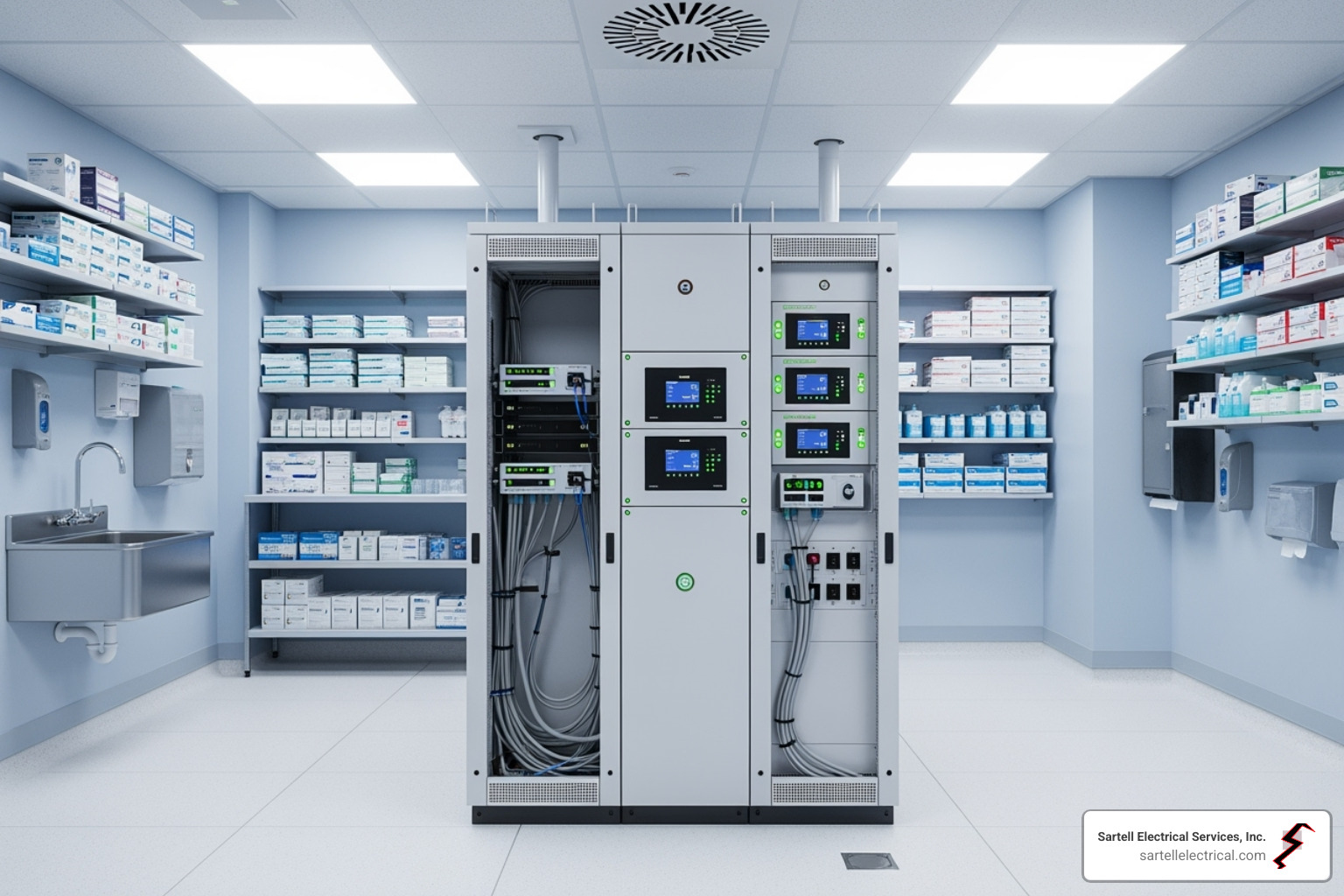
Here's how it works in real time: The power grid fails. Within milliseconds - not seconds, but milliseconds - the UPS system seamlessly takes over using its battery power. The ventilator keeps breathing for the patient. The heart monitor keeps beeping. The surgical lights stay on. Meanwhile, the emergency generator is starting up. Once it's running smoothly, the UPS hands off the power load to the generator and goes back into standby mode, ready to jump in again if needed.
It's like having a relay race where the baton never touches the ground. The UPS is that reliable first runner who never drops the baton, ensuring the race continues without missing a beat.
But Hospital UPS systems do more than just keep the big medical machines running. They also power emergency lighting systems throughout the facility. When you're trying to steer a sprawling hospital complex during a power outage - especially when you might be moving patients who can't walk on their own - those UPS-backed emergency lights and exit signs become lifelines themselves.
Having worked as a Healthcare Electrical Contractor Services in Somerville, MA for decades, I've seen how these integrated lighting systems can make the difference between chaos and calm during an emergency. The hallways stay lit, the exit routes remain clear, and staff can continue providing care without literally being left in the dark.
Anatomy of a UPS: Key Components and Their Function
You don't need an engineering degree to understand how a Hospital UPS system works - it's actually pretty neat in its simplicity. Think of it as a smart power manager with four main parts working together like a well-orchestrated team.
The battery is the star of the show - it's where all that life-saving power gets stored. But here's something interesting: your hospital runs on AC power (the same alternating current that powers your home), while batteries store DC power (direct current, like what's in your car). This difference is why the other components are so important.
The rectifier is like a translator working the day shift. When everything's normal and power is flowing from the grid, the rectifier converts that incoming AC power into DC power to keep the battery charged and ready. It's constantly topping off the battery, making sure it's at full strength for when it's needed.
When the power goes out, the inverter takes over like the night shift translator. Its job is to convert that stored DC battery power back into the AC power that all the hospital equipment needs. This conversion happens so fast that the equipment never even knows the power source changed.
The static bypass switch might be the unsung hero of the whole system. Think of it as an emergency escape route. If something goes wrong with the UPS itself, or if we need to do maintenance work, this switch can route power directly from the utility (or generator) to the equipment without going through the rectifier and inverter. It means we can fix or replace UPS components without ever cutting power to critical equipment.
This whole power conversion process happens seamlessly, creating a continuous flow of clean, reliable electricity that medical equipment can count on, no matter what's happening with the outside power grid.
Choosing the Right UPS Topology for Hospital Environments
Not every area of a hospital needs the same level of power protection. It's like choosing the right tool for the job - you wouldn't use a surgical scalpel to cut cardboard, and you wouldn't use office scissors in an operating room.
Standby UPS systems are the basic model - they're cost-effective and work fine for non-critical areas like administrative offices or general lighting in areas where patients aren't receiving direct care. They have a transfer time of 2-10 milliseconds, which sounds fast but isn't quite fast enough for life-critical equipment.
Line-interactive UPS systems step it up a notch with faster transfer times of 2-4 milliseconds and some built-in voltage regulation. These work well for nursing stations, some lab equipment, and monitoring devices that are important but not immediately life-threatening if they flicker for a few milliseconds.
For the most critical areas - intensive care units, operating rooms, and data centers - only online double-conversion UPS systems will do. These are the premium option with zero transfer time. Literally zero. They're constantly converting power from AC to DC and back to AC, creating what we call a pure sine wave output that's completely isolated from any problems with the incoming power.
When utility power fails with an online double-conversion system, there's no transfer at all because the equipment was already running on the inverter. It's like having a professional driver who never takes their hands off the wheel - the ride stays smooth no matter what's happening on the road.
The higher cost of online systems is absolutely worth it when you're talking about equipment that keeps people alive. In these environments, even the briefest power interruption isn't just inconvenient - it could be catastrophic.
Ensuring Compliance and Reliability for Hospital UPS Systems
Healthcare facilities operate in one of the most regulated environments imaginable, and for good reason—lives depend on it. When it comes to Hospital UPS systems, compliance isn't just about checking boxes; it's about ensuring every system meets the highest standards for patient safety and operational reliability.
Regulatory bodies like The Joint Commission and the Centers for Medicare & Medicaid Services (CMS) have established clear expectations for power continuity in healthcare facilities. These aren't suggestions—they're requirements that directly impact a hospital's accreditation and ability to receive Medicare and Medicaid reimbursements.
Our team at Healthcare Electrical Contractor Services in Cambridge, MA has spent decades navigating these complex regulations. We've learned that successful compliance starts with understanding that every UPS installation is ultimately about protecting patients, not just meeting code requirements.
Navigating Safety Standards and Regulations
The world of medical electrical safety can feel overwhelming, but there's one standard that stands above all others for Hospital UPS systems: the UL 60601-1 Medical Grade Safety Standard. This isn't just another certification—it's the gold standard that ensures UPS systems are truly safe for patient care areas.
What makes this standard so critical? It all comes down to leakage current—essentially, how much stray electrical current could potentially flow through a patient or healthcare worker. In a regular office building, a small amount of leakage current isn't dangerous. But in a hospital's patient care vicinity, where someone might be connected to multiple medical devices or have compromised skin integrity, even tiny amounts of stray current can be life-threatening.
UL 60601-1 compliant UPS systems are designed with incredibly low leakage current specifications, making them safe for use directly at the bedside or in operating rooms. A standard commercial UPS simply can't provide this level of protection, no matter how well it's built.
Beyond medical-grade requirements, these systems must also comply with broader electrical codes. The National Electrical Code (NEC) establishes the foundation for safe electrical installations nationwide, including specific provisions for emergency power systems in healthcare facilities. Here in Massachusetts, our Massachusetts Electrical Code builds upon these national standards with additional state-specific requirements.
Our electricians at Healthcare Electrical Contractor Services in Reading, MA stay current with these evolving codes because we know that compliance isn't just about passing inspections—it's about ensuring every system we install protects the people who depend on it.
Critical Considerations for Selecting and Implementing Hospital UPS Systems
Choosing the right Hospital UPS system is like designing a custom safety net—one size definitely doesn't fit all. Every healthcare facility has unique needs, and getting the selection wrong can mean the difference between reliable protection and catastrophic failure when it matters most.
Capacity planning forms the foundation of any successful UPS installation. We start by calculating both the VA (Volt-Amperes) and wattage requirements for all connected equipment. This isn't just about adding up nameplate ratings—we consider startup surges, future equipment additions, and the reality that medical devices don't always operate at their rated efficiency. Getting this wrong means either paying for unnecessary capacity or, worse, having an overloaded system that fails during an emergency.
Scalability has become increasingly important as healthcare technology evolves rapidly. The MRI scanner you install today might be joined by additional imaging equipment next year. Modular UPS systems offer an neat solution, allowing hospitals to add capacity incrementally as needs grow, protecting their initial investment while maintaining optimal efficiency.
Runtime calculation requires understanding how long each system needs to operate on battery power. While most hospital UPS systems are designed to bridge the gap until generators start (typically 10 seconds), some applications need longer runtimes. Critical IT systems might need several minutes to perform graceful shutdowns, while certain research equipment might require extended battery support.
Redundancy planning, particularly N+1 configurations, eliminates single points of failure. This means having one more UPS module than strictly necessary to handle the load. If one unit fails, the redundant unit instantly takes over without any interruption to critical equipment. It's like having a backup for your backup—essential when patient lives are at stake.
The choice between lead-acid and lithium-ion batteries significantly impacts long-term performance and costs. Traditional lead-acid batteries offer lower upfront costs but require more frequent replacement and maintenance. Lithium-ion batteries, while more expensive initially, provide longer lifespans, faster charging, smaller footprints, and reduced maintenance requirements—increasingly attractive benefits for busy healthcare facilities.
Our team at Healthcare Electrical Contractor Services in Newton, MA works closely with facility managers to balance these considerations, creating custom solutions that meet both current needs and future growth plans.
Proactive Maintenance and Monitoring for Optimal Performance
A Hospital UPS system sitting in a utility room might look like it's just quietly doing its job, but behind that calm exterior, it needs regular attention to stay ready for action. Think of it like a fire extinguisher—you hope you never need it, but when you do, it absolutely must work perfectly.
Routine testing forms the backbone of any maintenance program. Monthly functional tests verify that the UPS can actually transfer to battery power and support its intended load. These aren't just checkbox exercises—they're opportunities to catch small problems before they become big emergencies.
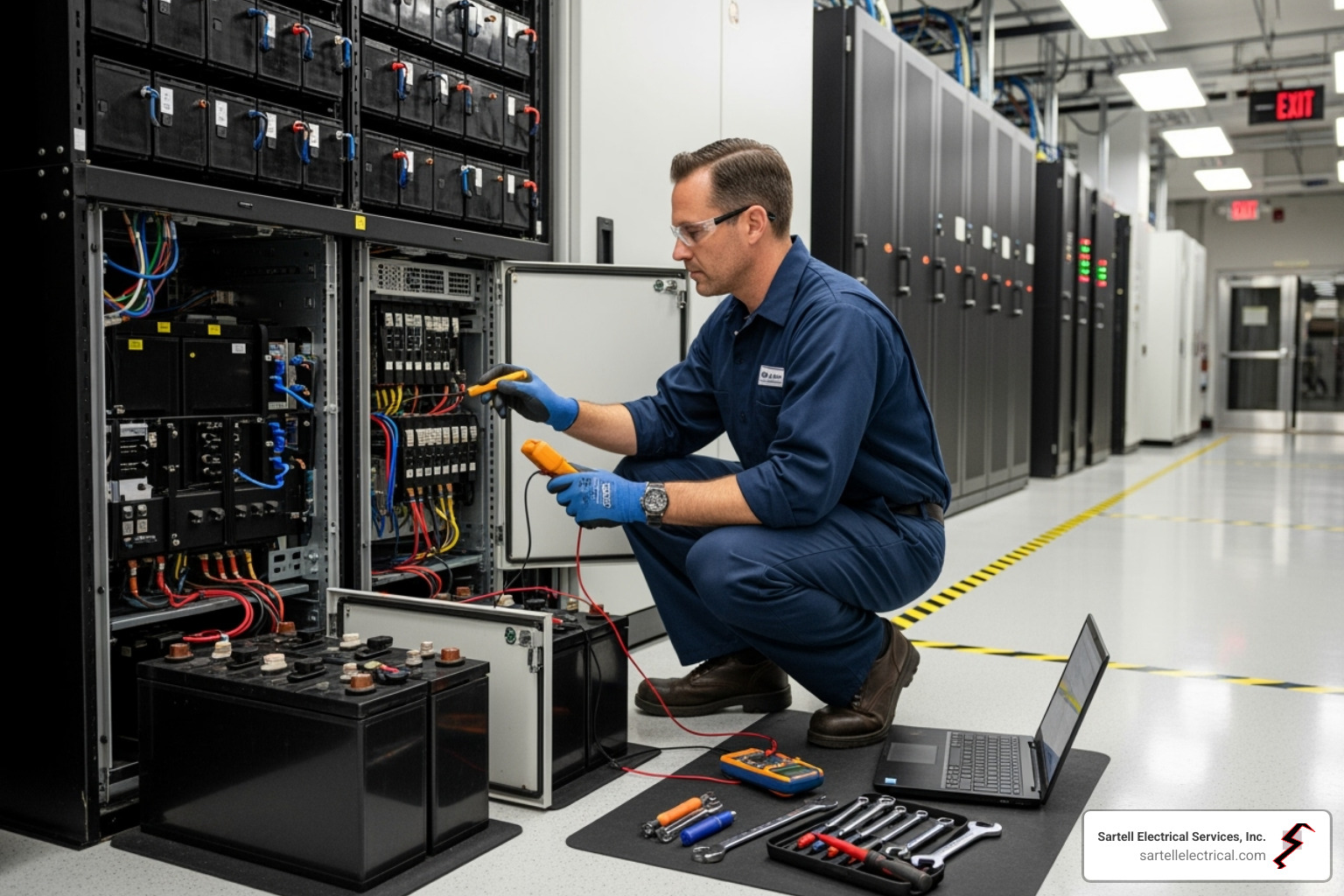
Battery health monitoring deserves special attention since batteries are the most common failure point in UPS systems. Regular visual inspections catch obvious problems like swelling or corrosion, while impedance testing can predict battery failures months before they occur. This proactive approach prevents the nightmare scenario of finding dead batteries during an actual power outage.
Annual load bank testing provides the ultimate verification that your UPS system is ready for real-world conditions. By connecting temporary load equipment and running the UPS at full capacity on battery power, this testing simulates an actual emergency. It's comprehensive, thorough, and absolutely essential for maintaining confidence in your power protection systems.
Modern remote monitoring capabilities have revolutionized UPS maintenance. These systems provide real-time alerts for battery degradation, power quality issues, and system faults, allowing facility managers to address problems proactively. Predictive maintenance takes this further, using data analysis to anticipate potential failures and schedule maintenance interventions before problems occur.
The maintenance technicians at Healthcare Electrical Contractor Services in Woburn, MA understand that maintaining hospital UPS systems isn't just about keeping equipment running—it's about maintaining the trust that patients and healthcare workers place in these critical safety systems every single day.
The Future of Power Resiliency in Healthcare
Healthcare is changing faster than ever, and the power systems that keep hospitals running are evolving right alongside it. Think about it - modern hospitals are essentially high-tech cities that never sleep. They're packed with more advanced equipment, rely heavily on digital everything, and face growing threats from storms and climate-related power disruptions that seem to get worse each year.
The future of power resiliency isn't just about having backup power anymore. It's about smart, sustainable systems that can adapt, predict problems before they happen, and keep getting better over time. For healthcare facilities, this means Hospital UPS systems that are more reliable, more efficient, and better integrated with the hospital's overall energy strategy.
What's really exciting is how these innovations are making hospitals more resilient while also being kinder to the environment. We're seeing facilities that can weather any storm while reducing their carbon footprint - something that seemed impossible just a few years ago.
Emerging Technologies in Hospital UPS Systems
The next generation of Hospital UPS systems is pretty remarkable, and I've been fortunate to see these technologies in our installations across Massachusetts. Here's what's changing the game for healthcare power protection:
Lithium-ion batteries are becoming the clear winners over traditional lead-acid batteries. Yes, they cost more upfront, but they're game-changers for hospitals. These batteries last much longer, charge faster, take up less space, and need far less babysitting. For a busy hospital where space is precious and maintenance windows are tight, that's huge.
Modular UPS designs are revolutionizing how hospitals think about power protection. Instead of one massive UPS that's either working or not, modular systems let you build exactly what you need and add more capacity as your facility grows. Even better, if one module has issues, the others keep running. It's like having a team instead of relying on one star player.
AI-driven predictive maintenance sounds futuristic, but it's happening now. These smart systems analyze how your UPS is performing and can actually predict when something might fail - sometimes weeks in advance. Instead of waiting for something to break at the worst possible moment, you can schedule maintenance when it's convenient. Pretty neat, right?
Integration with renewable energy is where things get really interesting. Hospitals are adding solar panels and other clean energy sources, and the newest UPS systems work seamlessly with them. This means hospitals can reduce their energy costs, lower their environmental impact, and still maintain rock-solid power protection.
Battery Energy Storage Systems (BESS) are like UPS systems on steroids. While a traditional UPS might give you 15-30 minutes of backup power, BESS can provide hours or even support entire hospital campuses. They're perfect for bridging longer gaps or even creating microgrids that can operate independently when needed.
Improved efficiency might not sound exciting, but it adds up fast. The latest UPS systems waste much less energy, which translates to lower electricity bills and reduced heat generation. For a hospital running 24/7, those savings really matter.
These aren't just fancy gadgets - they're practical solutions that make hospitals safer, more reliable, and better prepared for whatever comes next. The future is looking pretty bright for healthcare power resiliency, and we're excited to help Massachusetts healthcare facilities take advantage of these innovations.
Frequently Asked Questions about Hospital UPS Systems
When it comes to Hospital UPS systems, healthcare facility managers often have questions about specifications, requirements, and capabilities. After nearly four decades in the electrical industry, I've heard these questions countless times. Let me share the answers that matter most for keeping your facility safe and compliant.
What is the main difference between a regular UPS and a hospital-grade UPS?
The difference between a regular UPS and a hospital-grade UPS comes down to patient safety - and it's a critical distinction that could literally be a matter of life and death.
A hospital-grade UPS must be rigorously tested to meet the UL 60601-1 safety standard, which sets incredibly strict requirements for electrical equipment used in patient care areas. The most important requirement is extremely low leakage current - essentially, the amount of stray electrical current that could potentially flow through a patient or healthcare worker.
Think about it this way: when a patient is connected to sensitive medical devices, their body becomes part of the electrical circuit. Any excess electrical current, no matter how small, could interfere with their heart rhythm or other vital functions. Regular UPS systems simply aren't designed with these safety margins in mind.
Hospital-grade UPS systems undergo extensive testing to ensure they won't pose any electrical hazard to patients, even in the most sensitive care situations. This testing and certification process is why these systems cost more than standard units - but when patient lives are on the line, this investment in safety is absolutely non-negotiable.
How long does a hospital UPS need to run?
This is one of the most misunderstood aspects of Hospital UPS systems. Many people think a UPS needs to power equipment for hours, but that's actually not its primary job.
The main role of a hospital UPS is to provide instantaneous, seamless power during the brief transition period while your backup generator starts up and stabilizes. Most emergency generators take anywhere from a few seconds to about 10 seconds to come online and reach stable output.
During those critical seconds, patients on ventilators can't wait. Surgical procedures can't pause. Heart monitors must keep functioning. That's where the UPS steps in, providing uninterrupted power until the generator takes over the long-term backup duties.
Now, depending on your specific needs, UPS runtime can certainly be extended. Some facilities choose longer runtimes for critical IT systems to allow for graceful shutdowns, or for certain specialized equipment that needs extra time to safely transition. But the core function remains the same: bridge that crucial gap when every second counts.
Can a UPS power an entire hospital?
No, and here's why that's actually a good thing. A UPS isn't designed to power an entire hospital for extended periods - that's the job of your large emergency generators. Instead, Hospital UPS systems are strategically deployed like a network of safety nets throughout your facility.
Think of it this way: rather than putting all your eggs in one massive basket, UPS systems protect specific critical loads where instant power transfer is absolutely essential. This includes life-support equipment in the ICU, surgical instruments in operating rooms, vital patient monitoring systems, and IT data centers that house your electronic health records.
This targeted approach is actually more reliable and cost-effective than trying to run everything through one giant UPS. It allows you to customize protection levels based on the criticality of different areas. Your administrative offices might not need the same level of power protection as your cardiac care unit, and your electrical system can reflect those priorities.
The beauty of this approach is that if one UPS system needs maintenance or experiences an issue, it only affects a specific area rather than your entire facility. It's a smarter, safer way to ensure that the most critical aspects of patient care are always protected.
Your Partner in Healthcare Electrical Safety and Reliability
When lives hang in the balance, there's simply no room for electrical failures in your healthcare facility. Every Hospital UPS system, every circuit, and every connection must work flawlessly when patients need them most. That's the reality we face every day as electrical contractors in the healthcare industry.
Over nearly four decades in business, we've learned that hospital electrical work isn't just another job—it's a calling. When you're installing a UPS system that might keep someone's grandfather alive during surgery, or wiring the backup power for a NICU where premature babies depend on incubators, the weight of responsibility is profound. This is why we approach every healthcare project with the precision and care it deserves.
Robust UPS systems form the cornerstone of modern patient safety, working hand-in-hand with operational continuity and regulatory compliance. But here's what many facility managers don't realize: the quality of your electrical infrastructure is only as strong as the team behind it. From that initial design meeting where we calculate your exact power needs, through the careful installation process, and into the ongoing maintenance that keeps everything running smoothly—every step matters.
The complexity of healthcare electrical systems can be overwhelming. Between UL 60601-1 compliance, Massachusetts Electrical Code requirements, Joint Commission standards, and the endless array of critical medical devices that need protection, it's easy to feel lost in the technical details. That's where our experience becomes invaluable. We've steerd these challenges countless times, and we know how to translate complex regulations into practical, reliable solutions.
What sets us apart isn't just our technical expertise—though after three decades, we know our way around a hospital's electrical needs pretty well. It's our understanding that behind every UPS system we install, there are real people depending on that equipment to work perfectly. The cardiac monitor in the ICU. The ventilator in the emergency room. The refrigeration units storing life-saving medications. These aren't just electrical loads to us—they're lifelines.
Our team takes pride in being the electrical contractors that healthcare facilities can count on, whether it's a routine maintenance call or an emergency installation that needs to happen overnight. We've seen how a well-designed electrical system can make the difference between chaos and calm during a crisis, and we're committed to ensuring your facility is always prepared.
For expert guidance on designing and implementing robust electrical solutions for your healthcare facility in Massachusetts, explore our Healthcare Electrical Services. Because when it comes to protecting the power that protects your patients, experience and dedication aren't just nice to have—they're essential.