
What Is Electrical & Instrumentation — and Why Does It Matter for Industrial Facilities?
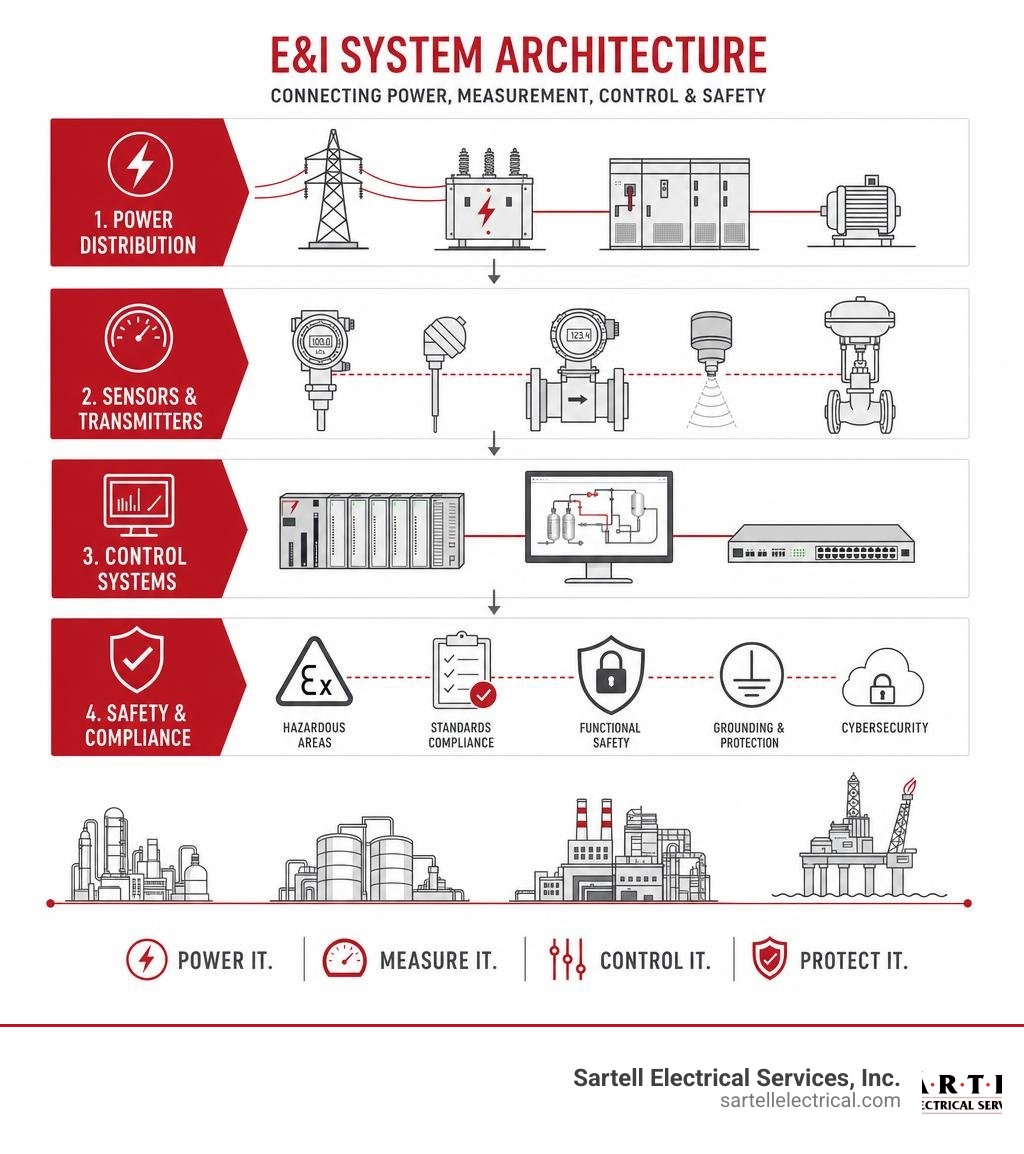
Electrical & instrumentation (E&I) is the discipline that combines power distribution, process measurement, and automated control to keep industrial facilities running safely and efficiently.
Here's a quick breakdown of what E&I covers:
| Area | What It Includes |
|---|---|
| Electrical | Power distribution, wiring, motor control centers, grounding, lighting |
| Instrumentation | Sensors, transmitters, analyzers, control valves, signal loops |
| Control Systems | DCS, PLC, SCADA, HART communication, process automation |
| Safety & Compliance | Hazardous area classification, IEC/NEC standards, EMC, IP ratings |
| Project Services | Installation, calibration, loop testing, commissioning, maintenance |
Whether you're running a chemical plant, a power generation facility, or an oil and gas operation, E&I systems are what connect the physical process to the people and software controlling it. Without them, there's no reliable way to measure, manage, or automate what's happening inside your equipment and pipelines.
Industries from food production and automotive manufacturing to nuclear power plants and petroleum processing all depend on skilled E&I teams to keep critical systems online — and compliant.
I'm Ed Sartell, President of Sartell Electrical Services, Inc., and over nearly four decades leading electrical projects across Massachusetts, I've seen how electrical & instrumentation work forms the backbone of any serious industrial or commercial operation. Understanding how these systems are designed, installed, and maintained is the first step toward making smarter decisions for your facility.
Electrical & instrumentation terms made easy:
- electrical condition monitoring
- electrical safety for industrial facilities
- industrial power monitoring system
The Core Principles of Electrical & Instrumentation Engineering
At its heart, electrical & instrumentation engineering is about bridging the gap between raw electrical power and precise process control. While electrical engineering focuses on routing high-voltage power safely to heavy machinery, instrumentation engineering is all about data. It measures physical variables—like temperature, pressure, flow, and level—and translates them into readable electrical signals.
When these two disciplines work in harmony, they create a cohesive, automated system. Understanding why your project needs electrical and instrumentation experts comes down to integration. An E&I team doesn't just install components; they design and deploy complete systems where power distribution directly supports process automation.
If your facility is transitioning from manual monitoring to a highly automated setup, you quickly realize why your plant needs expert electrical and instrumentation services. Modern E&I engineering focuses on the active deployment and troubleshooting of technology. Instead of looking at a single component, we look at the entire lifecycle of the signal—from the sensor in the field, through the conduit and cable tray, to the control room, and back to the final control element.
Core Capabilities in Industrial and Offshore Environments
In demanding industrial environments—such as marine terminals, water treatment facilities, and manufacturing plants—E&I contractors must deliver a wide range of services. These include:
- Capital Project Construction: Installing major electrical infrastructure, control panels, and instrument networks for brand-new facilities.
- Turnarounds and Outages: Executing rapid-fire maintenance, calibration, and hardware upgrades during planned plant shutdowns.
- Equipment Upgrades: Retrofitting legacy machinery with modern, energy-efficient control systems and smart transmitters.
To deliver these capabilities successfully, a contractor needs a proven track record. Across the global industrial sector, leading engineering groups have completed hundreds of complex process control projects, proving that structured project execution is key to minimizing downtime. Whether we are working on a local municipal water plant or a highly regulated manufacturing facility, having specialized Industrial Instrumentation and Control Solutions ensures that every device is mounted, wired, and calibrated to exact specifications.
The Role of Electrical & Instrumentation in Process Control
How does process control actually work? It relies on a continuous feedback loop managed by three primary technologies:
- DCS (Distributed Control System): The "brain" of a large-scale plant, which distributes control functions throughout the facility to ensure that a single component failure won't shut down the entire operation.
- PLC (Programmable Logic Controller): Robust, industrial computers designed for high-speed, localized control of specific machinery and processes.
- SCADA (Supervisory Control and Data Acquisition): Software systems that gather real-time data from remote sensors and send control commands to physical devices, providing operators with a high-level visual overview of the plant.
These systems maintain a state of "closed-loop control." For example, if a temperature sensor in a chemical reactor detects a spike, it sends a real-time signal to a PLC. The PLC processes this feedback against the defined parameters and immediately commands a pneumatic control valve to open, increasing the flow of cooling water. This entire cycle occurs in milliseconds, preventing runaway reactions and protecting both personnel and equipment.
Key Instrumentation Types and Process Control Elements
To control a process, you must first measure it. Instrumentation is the sensory nervous system of your facility.

The table below highlights the most common sensor types and where they are typically deployed:
| Sensor Type | Operating Principle | Common Applications |
|---|---|---|
| Resistance Temperature Detectors (RTDs) | Measures electrical resistance changes in metal | High-accuracy temperature monitoring in clean processes |
| Thermocouples | Measures voltage generated by joining two dissimilar metals | High-temperature applications like boilers and furnaces |
| Radar Level Transmitters | Uses microwave pulses to measure distance to liquid surface | Non-contact level measurement in storage tanks and silos |
| Electromagnetic Flowmeters | Uses Faraday's Law of induction to measure conductive fluids | Water treatment, chemical dosing, and slurry lines |
Sensors and Transmitters for Process Variables
In addition to these standard sensors, modern facilities rely on a wide range of specialized transmitters. For temperature monitoring, RTDs are favored for their extreme stability and accuracy, while thermocouples handle the heavy-duty, high-heat zones. For level control, non-contact radar transmitters provide reliable readings even in turbulent, corrosive, or dusty environments.
For complex chemical analysis, online analytical instruments and gas chromatographs measure product purity and detect trace contaminants in real time. To see how these technologies are integrated into comprehensive plant architectures, you can explore the advanced Instrumentation & Process Control Solutions in Pakistan | IESPK | IESPK - Industrial Engineering Solutions page, which showcases how field sensors connect directly to high-level automation systems across diverse industrial sectors.
Control Valves, Regulators, and Final Control Elements
Once a sensor measures a variable and the control system processes the data, a physical change must be made to the process. This is the job of the final control elements:
- Control Valves: Regulate the flow of fluids by modulating the valve opening via pneumatic or electric actuators.
- Pneumatic Positioners: Ensure the valve stem moves to the exact position commanded by the control system.
- Pressure Safety Valves (PSVs) & Rupture Disks: Provide emergency overpressure protection by venting excess pressure safely.
- Solenoid Valves: Act as quick-acting, on/off switches for pneumatic and hydraulic control lines.
Technical Standards, Hazardous Areas, and Safety Compliance
Industrial facilities can be dangerous places. When flammable gases, combustible dusts, or high voltages are present, safety cannot be left to chance. This is why E&I work is governed by some of the strictest standards in the engineering world.
Every project we design and execute must be built on a foundation of safety. To understand how electrical safety, preventive maintenance, and system design intersect, check out our Industrial Electrical Services Complete Guide. We focus on building a safety-driven culture that begins with detailed risk analysis and hazard assessments before a single wire is pulled.
Furthermore, keeping these systems running safely over their operational lifespan requires structured, proactive care, which is detailed in our guide to Industrial Electrical Maintenance.
Navigating NEC, IEC, and API Standards in Classified Ex Zones
In areas where explosive atmospheres may occur—known as hazardous or classified locations—E&I systems must be carefully designed to prevent ignition. These areas are classified into "Ex zones" or "Divisions" based on the frequency and duration of the explosive hazard:
- IEC 60079: The international standard governing electrical equipment for explosive atmospheres.
- API RP 554: Recommended practices for the design and installation of process instrumentation and control systems.
- NEC 2026: The National Electrical Code, which includes critical updates for hazardous area wiring, intrinsic safety, and equipment grounding.
To prevent devastating industrial accidents, E&I teams use several protection methods. Intrinsic safety limits the electrical and thermal energy in a circuit to levels that cannot ignite a surrounding explosive atmosphere. Explosion-proof enclosures are designed to contain any internal explosion and cool the escaping gases so they don't ignite the external environment.
For a deep dive into how these rigorous standards are applied to engineering specifications, you can review the technical guidelines in the General Criteria for Instrumentation Projects document, which details the strict materials and testing requirements used in heavy industrial and offshore installations.
Grounding, Electromagnetic Compatibility (EMC), and Ingress Protection
Beyond explosive hazards, E&I systems must be protected from electrical noise and environmental elements:
- Grounding and Bonding: Creating a low-resistance path to the earth to protect personnel from shock hazards and stabilize signal voltages.
- EMC Shielding: Protecting sensitive instrumentation cables from electromagnetic interference (EMI) generated by high-power motors and variable frequency drives (VFDs).
- Ingress Protection (IP Ratings): Specifying how well an enclosure seals out dust and moisture. For instance, an IP65 rating ensures the enclosure is completely dust-tight and protected against water jets.
- Type-Tested Enclosures: Using panels that have undergone rigorous testing—such as verifying 50 kA short-circuit resistance—to ensure they can withstand catastrophic electrical faults without failing.
Installation, Power Supply, and Communication Networks
How do you ensure that an E&I system remains reliable for years to come? It all comes down to proper installation practices, clean power, and robust communication networks.
To maintain this level of reliability, you need continuous visibility into your electrical infrastructure. Implementing a modern Industrial Power Monitoring System allows you to track power quality, identify voltage sags, and prevent equipment damage. For a broader look at managing electrical health across your entire facility, our Electrical Network Monitoring Complete Guide outlines how to integrate power monitoring with your overall control network, helping you optimize energy efficiency and deploy power factor controllers to reduce utility surcharges.
Best Practices for Instrument Installation and Process Connections
When mounting instruments to process piping or vessels, attention to detail is everything:
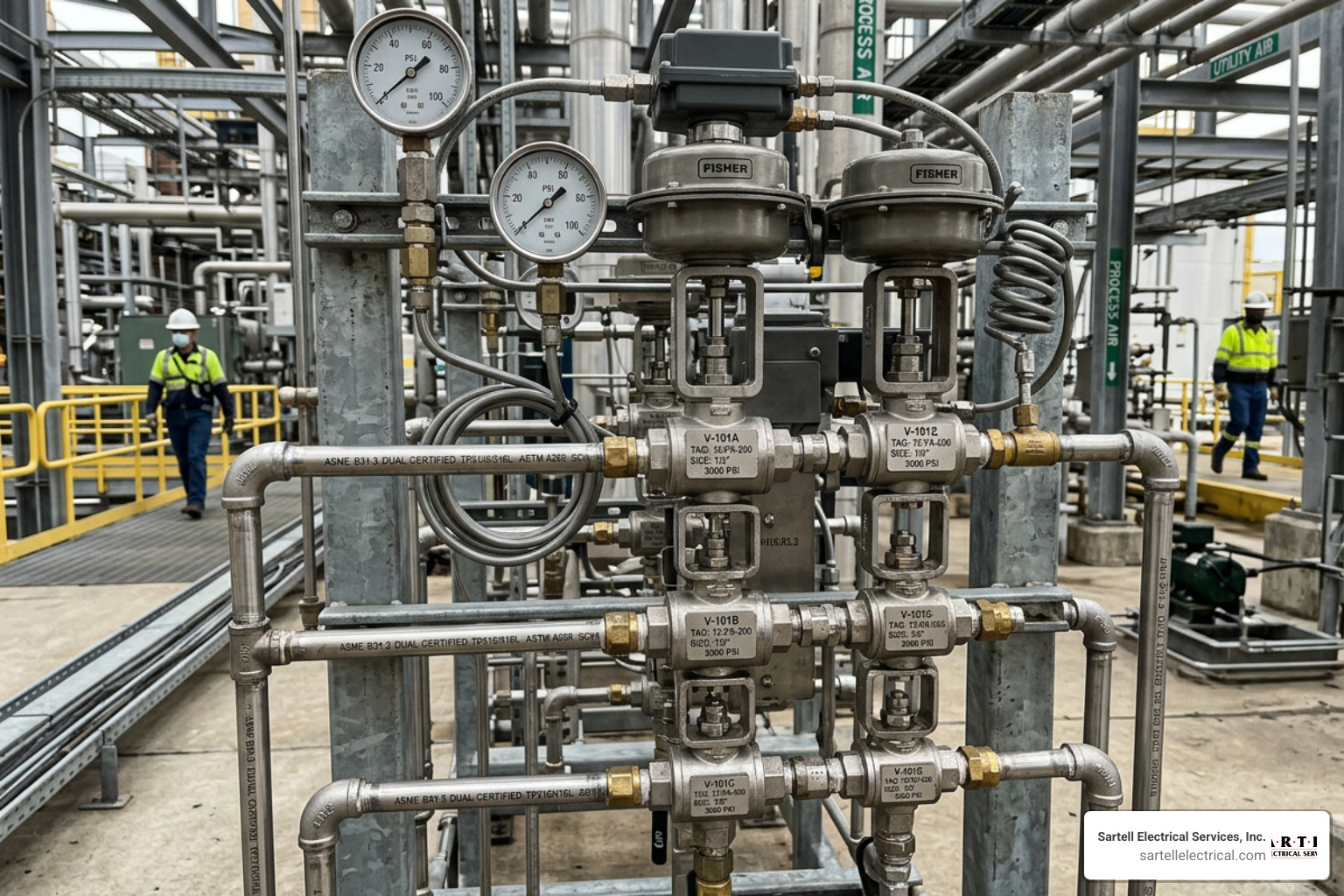
- Impulse Lines: Small-bore pipes or tubes that transmit process pressure from the main pipe to a transmitter. They must be sloped correctly to prevent gas bubbles or liquid pockets from distorting the reading.
- Remote Seals: Used to isolate transmitters from hot, corrosive, or highly viscous process fluids, transferring pressure via a capillary tube filled with silicone or synthetic oil.
- Thermowells: Heavy-duty metal sleeves that protect temperature sensors from high velocity, pressure, and corrosion inside process piping, allowing sensors to be replaced without shutting down the process.
- AISI 316/316L Stainless Steel: The industry standard material for tubing, fittings, and manifolds due to its superior corrosion resistance.
- Stainless Steel Tag Plates: Every instrument must be clearly identified. Industry best practices require using minimum 50mm x 20mm x 0.5mm stainless steel tag plates with 3mm engraved letters, secured with 1mm² stainless steel wire.
Power Distribution, Instrument Air Quality, and Control Networks
To keep instruments communicating with control systems, we rely on standardized signals and networks:
- 4-20mA & HART Protocol: The classic analog standard is the 4-20 milliamp loop. By overlaying a digital signal on top of this analog loop using the HART (Highway Addressable Remote Transducer) protocol, technicians can read diagnostic data from "smart" instruments without running extra wires.
- Instrument Air Quality: Pneumatic control valves require clean, dry air. Under ISO 8573-1 Class 3 standards, instrument air must be strictly filtered to remove oil, water, and particulates. To account for future expansions and normal system leakage, air distribution systems are typically designed with 43% extra capacity (30% for future growth and 13% for purge/leakage compensation).
- Uninterruptible Power Supplies (UPS): Critical control systems must never lose power. Industrial-grade UPS systems ensure that PLCs, DCS controllers, and safety systems remain fully operational even during a total plant power outage.
Project Delivery, Commissioning, and Workforce Competency
Designing a system is one thing; bringing it to life safely, on time, and on budget is another.
Successful project delivery requires a long-term view of your assets. By leveraging our Electrical Asset Management Complete Guide, facilities can transition from reactive troubleshooting to structured, long-term lifecycle planning. This proactive approach is enhanced by deploying Condition Based Asset Monitoring for Electrical Systems, which uses real-time diagnostics to detect equipment degradation before a critical failure occurs.
Loop Testing, Calibration, and Startup Support
Before a plant can safely start up, every E&I system must undergo rigorous testing:
- Cold Testing & Pre-Commissioning: Verifying that all cables are routed correctly, insulation resistance is high (megger testing), and piping is leak-tested.
- Calibration: Testing sensors and transmitters to ensure they read accurately. Technicians perform three-point or five-point calibration checks (testing at 0%, 25%, 50%, 75%, and 100% of the instrument's span) to verify linearity and hysteresis.
- Custody Transfer Calibration: For instruments measuring valuable products changing hands (like gas or oil pipelines), specialized custody transfer certifications are required to meet legal trade standards.
- Loop Testing: Simulating a process variable at the sensor and verifying that the correct reading appears on the operator's screen in the control room, and that the control room commands drive the control valves to the correct positions.
Developing Skilled Electrical & Instrumentation Technicians
Because E&I work combines multiple complex disciplines, technicians must undergo extensive training. The industry gold standard in the United States is the NCCER (National Center for Construction Education and Research) curriculum.
The four-level Industrial Maintenance Electrical & Instrumentation curriculum comprises 705 total recommended hours of classroom and hands-on training, covering everything from basic electrical theory and conduit bending to advanced PLC programming, loop tuning, and hazardous area compliance. This structured framework ensures that apprentice and journey-level technicians possess the practical competencies required to work safely in heavy industrial environments.
Frequently Asked Questions about E&I Systems
What is the difference between electrical and instrumentation?
While they are closely integrated, they focus on different parts of a facility. Electrical systems handle power generation, transmission, and distribution—dealing with high-voltage systems, switchgear, motor control centers (MCCs), and lighting. Instrumentation systems focus on measurement and control—dealing with low-voltage signals, sensors, transmitters, control loops, and process automation software.
Why is instrument air quality so critical in E&I systems?
Pneumatic instruments and control valve actuators have extremely tight tolerances. If instrument air contains moisture, oil, or particulates (violating ISO 8573-1 Class 3 standards), it can cause internal corrosion, clog orifices, freeze in cold weather, and lead to catastrophic valve failures. Clean, dry air is vital for system reliability.
How do E&I services integrate with mechanical and piping disciplines?
E&I systems do not exist in a vacuum. They must interface directly with mechanical and piping systems. This requires close coordination during design and construction:
- P&IDs (Piping and Instrumentation Diagrams): The primary drawings showing how process lines, vessels, and instruments connect.
- Isometric Drawings: Used to plan physical instrument locations and routing for electrical conduits and tubing.
- Thermowell Sizing: Ensuring that temperature sleeves are long enough to reach the center of the pipe but strong enough to withstand fluid velocity.
- Control Valve Installation: Coordinating with piping teams to ensure proper space and straight pipe runs are available for accurate valve operation.
Conclusion
Electrical & instrumentation is the invisible force that drives modern industrial automation. From the high-voltage power lines running into a facility to the tiny millivolt signals sent by field sensors, E&I systems ensure that your plant runs safely, efficiently, and in compliance with strict regulatory standards.
If you are looking to upgrade, maintain, or build out your industrial systems in Massachusetts, you need a partner with deep local roots and decades of technical expertise.
At Sartell Electrical Services, Inc., we are a family-owned, Massachusetts-based electrical contractor headquartered in Reading, MA. With over 30 years of experience, we proudly serve commercial, industrial, telecom, healthcare, and residential clients across the Greater Boston area, Middlesex County, Essex County, Norfolk County, and Suffolk County. Our commitment to excellence, leadership, and customer service means we have the skills and resources to handle projects of all sizes.
Ready to take your facility's automation and reliability to the next level? Explore Sartell Electrical Services' Industrial Electrical Services or contact our team today to discuss your next project.