

What Electrical and Instrumentation Companies Actually Do (And Why It Matters)
Electrical and instrumentation companies are specialized contractors that design, install, maintain, and upgrade the power and measurement systems that keep industrial facilities running safely and efficiently.
Here's a quick breakdown of what they cover:
- Electrical services - Power distribution, wiring, switchgear, motor control centers, substations, and lighting
- Instrumentation services - Sensors, transmitters, and control systems that measure pressure, temperature, flow, and level
- Integrated services - SCADA systems, PLCs, DCS integration, calibration, and process automation
- Industries served - Oil and gas, power generation, chemical processing, manufacturing, water/wastewater, and more
These companies are not just electricians. They are technical partners who help facilities monitor production, manage energy use, and maintain safe operating conditions — around the clock.
Think about what it takes to run a complex industrial plant. As Saulsbury Industries puts it, operating a complex facility requires constant surveillance of production targets — tracking production quantity and quality, managing power use, and keeping the environment safe. That's exactly the problem E&I companies exist to solve.
I'm Ed Sartell, President of Sartell Electrical Services since 1985, with nearly four decades of hands-on experience delivering electrical solutions to commercial and industrial clients across Massachusetts — the same core work that defines what electrical and instrumentation companies do every day. That experience is what I'm drawing on throughout this guide.
Quick electrical and instrumentation companies definitions:
Understanding the Role of Electrical and Instrumentation Companies
When you look at a large-scale facility in Greater Boston or across Middlesex County, you see more than just a building; you see a living, breathing organism of power and data. The role of electrical and instrumentation companies is to provide the "nervous system" (instrumentation) and the "circulatory system" (electrical power) that allow these facilities to function.
System integration is at the heart of what we do. It isn't enough to just have a motor that turns; you need a sensor that tells you how fast it's turning, a controller that decides if that speed is correct, and a communication line that sends that data to a central hub. This requires a level of Process Instrumentation & Equipment knowledge that goes far beyond standard commercial wiring.
Technical expertise in this field involves a deep understanding of how physical properties—like the pressure in a steam pipe or the temperature in a chemical vat—are converted into electrical signals. Electrical and instrumentation companies manage these complex interfaces through rigorous project management. Whether it's a new build in Cambridge or an upgrade to a facility in Worcester, the goal is total facility surveillance. This means monitoring production targets constantly to ensure that every kilowatt of power and every gallon of flow is accounted for.

Core Services and Technical Expertise
The bread and butter of Industrial Electrical Solutions involves high-stakes power distribution. We aren't just talking about light switches; we’re talking about high-voltage substations, massive switchyards, and the intricate wiring that feeds heavy machinery.
To understand how these two halves of the industry work together, it helps to look at their distinct but overlapping functions:
| Function | Electrical Services | Instrumentation Services |
|---|---|---|
| Primary Goal | Delivering Power | Delivering Data/Control |
| Components | Transformers, MCCs, Switchgear | Sensors, Transmitters, Valves |
| Key Systems | Power Distribution, Lighting | SCADA, PLC, DCS |
| Safety Focus | Grounding, Arc Flash Prevention | Safety Interlocks, Hazard Monitoring |
A major part of modern E&I work involves SCADA (Supervisory Control and Data Acquisition) systems and PLC (Programmable Logic Controller) programming. These systems act as the "brain" of the operation. By implementing DCS (Distributed Control System) integration, we allow different parts of a plant to "talk" to each other, ensuring that if a pump fails in one section, the rest of the system reacts appropriately to prevent damage or safety hazards. This level of automation is a cornerstone of Industrial Electrical Maintenance, as it allows for real-time adjustments that keep the plant running smoothly.
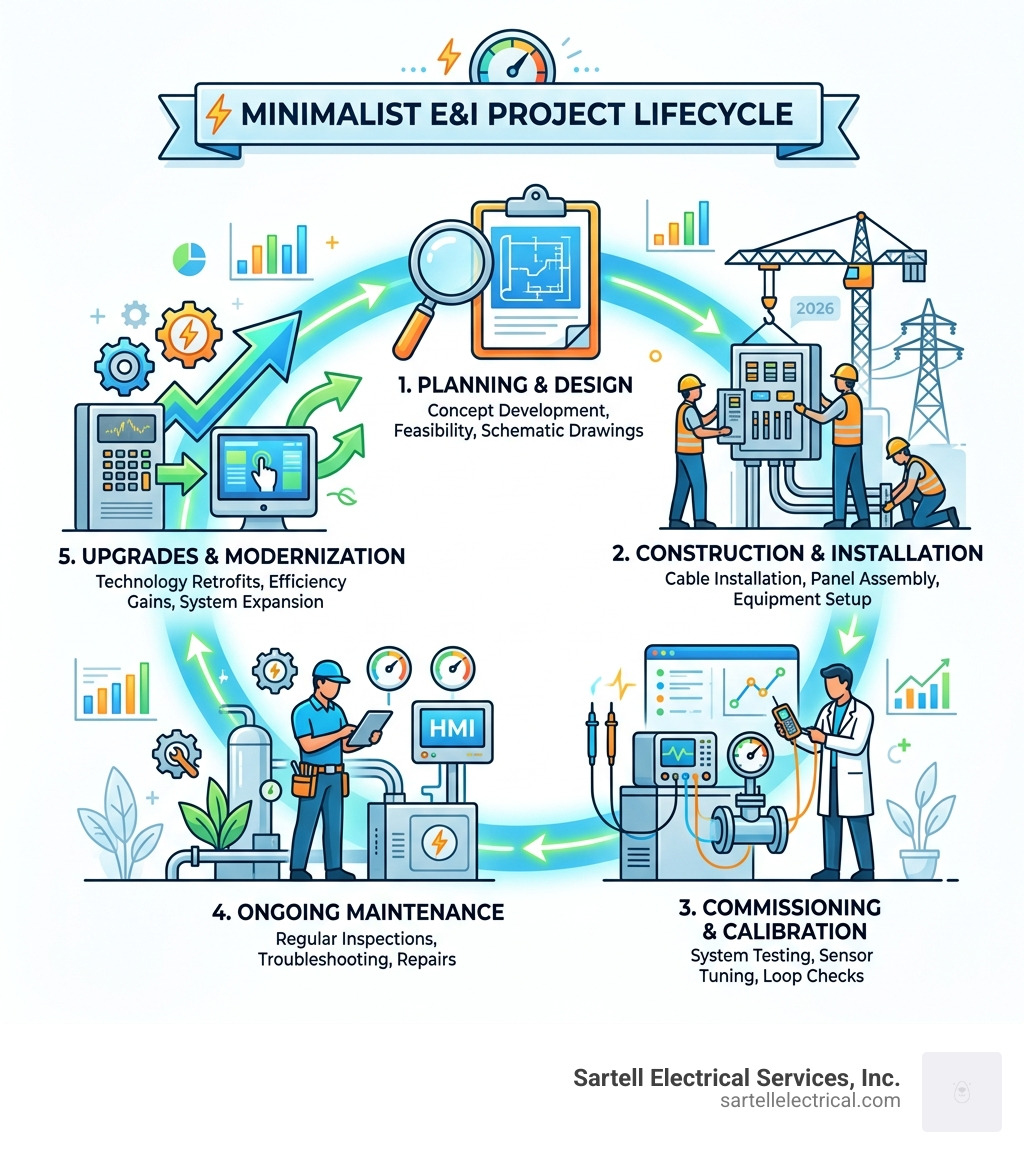
Installation and Maintenance by Electrical and Instrumentation Companies
Installation is where the heavy lifting happens. It involves miles of conduit, precision wiring, and the setting of massive switchgear and motor control centers (MCCs). In industrial environments, the environment is often harsh—think of the humidity in a wastewater plant in Quincy or the chemical exposure in a lab in Lexington. The installation must be robust enough to handle these conditions while remaining accessible for future service.
Once the hardware is in place, we perform "loop checking." This is the process of verifying that the signal sent from a field instrument (like a flow meter) actually reaches the control room accurately. It sounds simple, but in a plant with thousands of points, it requires meticulous attention to detail.
Ongoing reliability is maintained through Industrial Electrical Equipment Repair and preventative maintenance. By catching a loose connection or a failing relay before it causes a shutdown, we save our clients in Massachusetts thousands of dollars in lost productivity.
Calibration and System Upgrades in Electrical and Instrumentation Companies
Accuracy is the difference between a successful batch and a wasted one. Using high-end tools like Rosemount Instrumentation, we ensure that sensor accuracy is maintained through regular calibration. If a pressure transmitter is off by even a fraction of a percentage, it can lead to dangerous overpressure situations or inefficient fuel consumption.
Temperature monitoring and flow measurement are equally critical. We often implement Condition Based Asset Monitoring for Electrical Systems to track the health of equipment in real-time. Instead of waiting for a scheduled maintenance date, we use data to tell us exactly when a component is nearing the end of its life.
System retrofits are also a major part of our work. Many facilities in the Northeast are decades old. We help them transition from legacy pneumatic systems to modern digital controls, significantly improving their ability to manage data and meet modern environmental standards.
Industry Applications and High-Stakes Environments
Electrical and instrumentation companies operate in environments where there is zero room for error. In power generation and chemical processing, a single faulty reading can have catastrophic consequences. This is why we rely on precision-built Pressure & Temperature Instruments that are designed to withstand extreme vibrations and corrosive atmospheres.
In the manufacturing sector—from food and beverage plants to pharmaceutical labs in the Greater Boston area—consistency is key. We install Industrial Power Monitoring System setups that track energy usage and identify power quality issues that could damage sensitive electronics.
Wastewater treatment is another area where E&I expertise is vital. These facilities rely on complex sequences of pumps, aerators, and chemical feeds, all of which must be perfectly synchronized. Whether it's a massive plant or a specialized manufacturing facility, the E&I team ensures that every motor turns and every valve opens exactly when it should.
Safety, Compliance, and Emerging Technologies
Safety isn't just a buzzword; it's a regulatory requirement. We utilize Electrical Condition Monitoring to stay ahead of potential hazards. Compliance with standards like NFPA 70B (for electrical equipment maintenance) and OSHA regulations is non-negotiable.
One of the most effective tools in our safety arsenal is infrared thermography.
By performing a thermal scan, we can see "hot spots" in a circuit breaker or transformer that aren't visible to the naked eye. These hot spots often indicate a loose connection or an overloaded circuit that could lead to an arc flash—a dangerous explosion of electrical energy.
The future of the industry lies in emerging technologies. We are seeing a shift toward wireless instrumentation, which allows us to gather data from remote or hazardous locations without the cost and complexity of running miles of cable. Advanced analytics and "digital twins"—virtual models of physical assets—allow us to simulate "what-if" scenarios, optimizing a Power Plant Monitoring System before we even make a physical change.
Frequently Asked Questions about E&I Services
What is the difference between electrical and instrumentation services?
Electrical services focus on the delivery and management of power (the "muscle"), while instrumentation focuses on measurement and control (the "senses"). Electrical work involves high-voltage systems and power distribution, whereas instrumentation involves low-voltage signals, sensors, and data processing.
Why is regular calibration essential for industrial instrumentation?
Over time, all sensors experience "drift" due to environmental factors, vibration, or simple wear and tear. Regular calibration ensures the instrument's output matches a known standard. Without it, your facility could be operating based on false data, leading to safety risks, poor product quality, and wasted energy.
How do E&I companies ensure safety in hazardous environments?
We use specialized equipment designed for "classified" areas where explosive gases or dust may be present. This includes explosion-proof enclosures, intrinsically safe wiring (which limits electrical energy so it can't ignite a spark), and rigorous adherence to the National Electrical Code (NEC).
Conclusion
Choosing the right partner among electrical and instrumentation companies is one of the most important decisions a facility manager can make. At Sartell Electrical Services, we bring over 30 years of experience to every project, from the smallest repair in Reading to major industrial installations across Massachusetts. Our commitment to excellence, leadership, and customer service ensures that your project is handled with the technical precision it deserves.
Whether you need a full-scale system integration or a targeted Industrial Electrical Services solution, we have the expertise to keep your operations running safely and efficiently. We don't just "do the wiring"—we build the systems that power your vision.