Industrial Power Monitoring System: Boost Profits 2025
Why Energy Costs Are Eating Your Profits
An
industrial power monitoring system is a comprehensive solution that tracks electricity usage, power quality, and equipment performance in real-time to help businesses reduce energy costs and prevent costly downtime. These systems typically include power meters, current sensors, data acquisition software, and communication protocols that work together to provide actionable insights into your facility's electrical consumption.
Key Components of Industrial Power Monitoring Systems:
- Hardware: Power meters, current transformers (CTs), Rogowski coils, voltage sensors
- Software: Data acquisition platforms, dashboards, reporting tools, alarm systems
- Communication: Modbus, BACnet, IEC 61850 protocols for system integration
- Benefits: 10-30% energy cost reduction, predictive maintenance capabilities, improved power quality
Energy costs are traditionally one of the biggest operational costs in any organization, yet many businesses lack the tools to manage their energy efficiently. As one industry expert noted, "The desire to use less energy increases as the cost of electrical power increases, and the need to measure power consumption becomes a necessity."
Modern facilities generate enormous amounts of electrical data, but without proper monitoring, this valuable information goes to waste. Power monitoring systems convert billions of data points into actionable insights that help you identify energy-hungry equipment, detect potential failures before they happen, and optimize your facility's electrical performance.
I'm Ed Sartell, and I've been helping Massachusetts businesses optimize their electrical systems since 1985 through my company, Sartell Electrical Services. Over nearly four decades, I've seen how implementing the right
industrial power monitoring system can transform a facility's operational efficiency and bottom line.
Why Invest in Power Monitoring? Open uping Key Benefits
When I first started installing
industrial power monitoring systems in the 1980s, many saw them as an expense. After nearly four decades working with facilities across Massachusetts, I can tell you they're one of the smartest investments you can make. Think of it as a 24/7 health checkup for your electrical systems. The benefits go beyond numbers on a screen to include
cost reduction,
increased profitability,
improved safety, and
predictive maintenance. These systems also help with
ISO 50001 compliance and maintaining optimal
power quality for sensitive equipment.
The Financial Payback: Slashing Energy Costs
Most businesses don't know where their energy dollars are going. An
industrial power monitoring system illuminates every watt flowing through your facility.
Energy audits become far more detailed with continuous data. We analyze your
load profiling over long periods to get a complete picture of energy use and find savings opportunities.
Peak demand management offers immediate savings. By seeing demand in real-time, you can shift processes to off-peak times. I've seen clients cut their demand charges by 20-30% this way.
We also start
identifying energy hogs—equipment that quietly drains your budget, like an old compressor or inefficient heating system. Detailed monitoring exposes these issues.
Utility bill verification saves thousands. With your own verified data, you can catch billing errors and negotiate better rates.
The
ROI is typically fantastic, with payback within 1-3 years, followed by decades of savings. Combining reduced energy costs with longer equipment life and fewer emergency repairs makes the investment highly profitable.
Beyond Savings: Improving Operational Uptime and Safety
While saving money is great, keeping your facility running safely and reliably is even more important. This is where
industrial power monitoring systems really prove their worth beyond the balance sheet.
Power quality monitoring has become critical as equipment gets more sophisticated. Issues like
voltage sags and swells can wreak havoc on sensitive machinery, while
Total Harmonic Distortion (THD) can cause premature equipment failure. These problems are often invisible until they cause expensive damage, but continuous monitoring spots them early.
Equipment protection is like having a guardian angel for your machinery. By detecting electrical anomalies before they cause damage, we help
maximize plant availability and prevent those heart-stopping moments when critical equipment suddenly fails. The peace of mind alone is worth the investment.
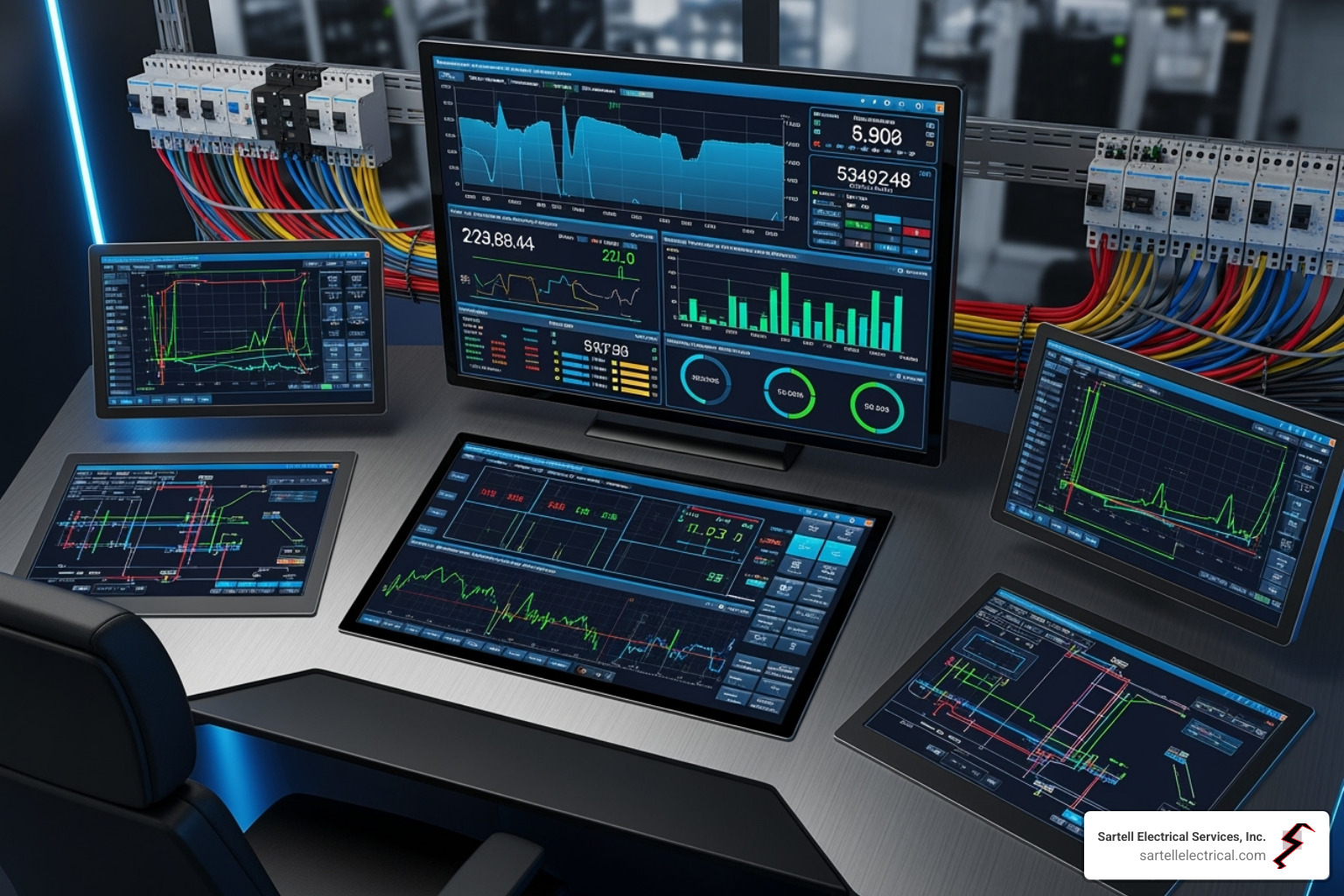
If you want to see how all this data comes together in an easy-to-understand format, take a look at this
interactive power monitoring dashboard. It really shows how complex electrical data can be presented in a way that makes sense for day-to-day operations.
The Role of an Industrial Power Monitoring System in Predictive Maintenance
This is where things get really exciting. Imagine being able to predict equipment failures weeks or even months before they happen. It sounds like science fiction, but it's exactly what modern
industrial power monitoring systems make possible.
Detecting equipment wear starts with understanding that electrical signatures change as machinery ages or develops problems. A pump with a clogged intake will draw different current than a clean one. A motor with worn bearings will show subtle changes in power consumption patterns. These electrical fingerprints tell us stories about what's happening inside your equipment.
Monitoring motor performance gives us incredible insights into mechanical health. Changes in current draw, power factor, or voltage patterns often signal developing problems long before they cause visible symptoms. We've helped clients catch bearing failures, alignment issues, and even cooling problems just by watching electrical patterns.
Preventing unexpected failures is the holy grail of maintenance. Instead of waiting for something to break and then scrambling to fix it, you can schedule repairs during planned downtime. This approach saves money, reduces stress, and keeps your operations running smoothly.
Vibration analysis correlation takes things to the next level. When we combine electrical monitoring with other diagnostic techniques, we get an even clearer picture of equipment health. Electrical changes often happen before mechanical symptoms become obvious.
The result is
plannable service activities instead of emergency repairs. You can order parts in advance, schedule work during convenient times, and avoid the premium costs that come with urgent repairs. For more details on how we implement these strategies, check out our
industrial electrical services in Boston MA.
Core Components of a Modern Industrial Power Monitoring System

An
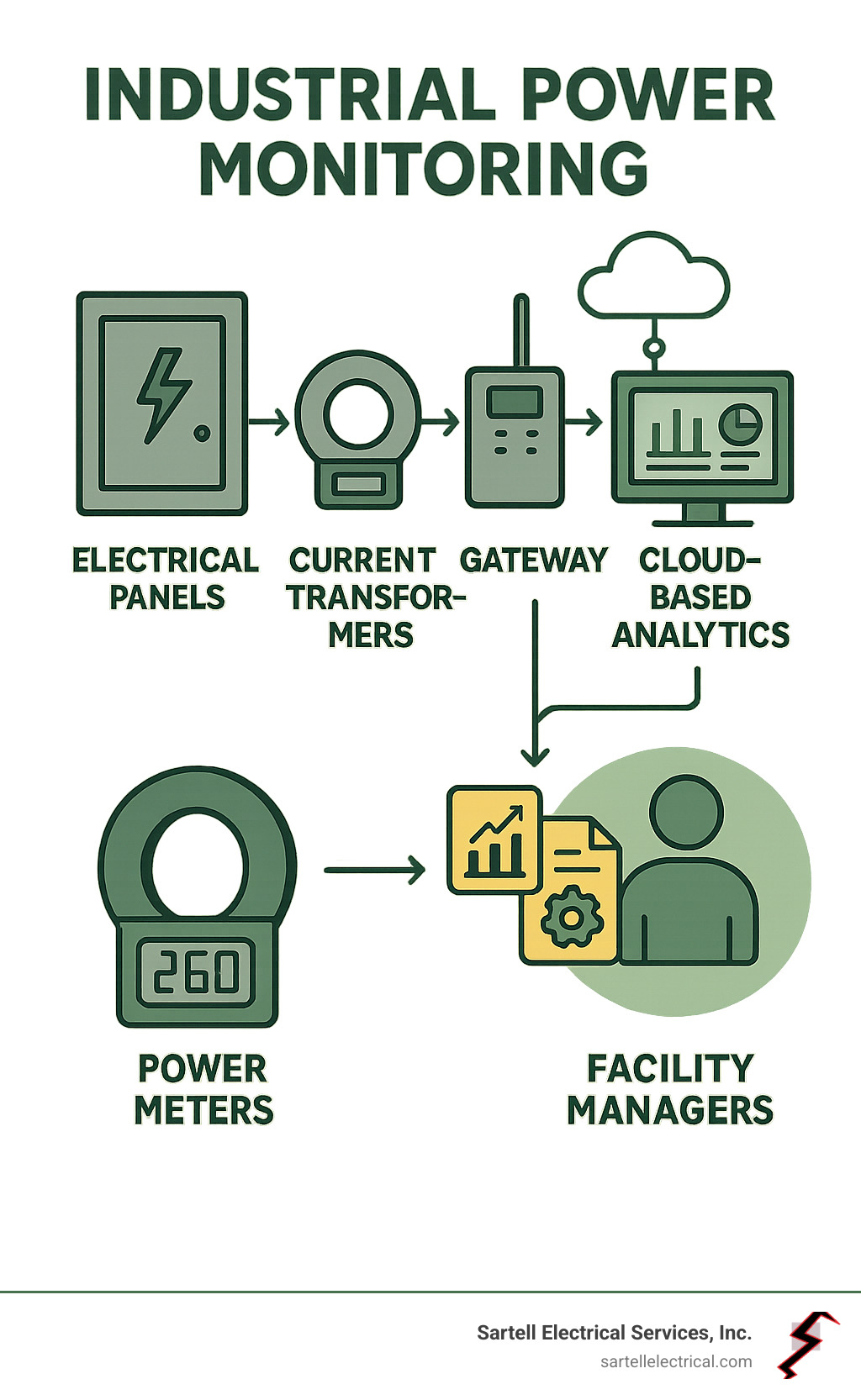
industrial power monitoring system works like an orchestra, with each component playing a role to create actionable insights that save money and prevent downtime. A system has two main parts: hardware to collect data and software to make it useful. Communication protocols tie everything together, creating a seamless information flow from your electrical panels to decision-makers.
Hardware: The Eyes and Ears of Your System
Hardware components are the front-line soldiers measuring, collecting, and transmitting electrical data 24/7.
Power meters are the workhorses, measuring voltage, current, power factor, and power quality. Advanced models can monitor dozens of circuits from a single device, providing comprehensive visibility.
Current transformers (CTs) measure high currents without rewiring. Split-core CTs are especially useful as they clamp onto existing cables with no downtime, offering accurate measurement over a wide range.
For larger currents or tight spaces, flexible
Rogowski coils are a great choice, wrapping around conductors of almost any size.
Voltage sensors measure electrical potential and can detect power quality events in real-time. They may connect directly or use potential transformers for higher voltages.
Gateways and data loggers collect data from meters and sensors, packaging it for the software platform. Many have integrated networking to simplify data transfer.
Wireless sensors are a game-changer for retrofits, providing real-time data without new cabling and connecting to existing analog sensors to centralize data.
Communication protocols are the languages these devices use to communicate.
Modbus is a robust, universal standard.
BACnet is common in building automation, and
IEC 61850 is used for utility-grade applications. Ethernet, Wi-Fi, and RS485 offer further flexibility.
Software: Turning Data into Dollars
Here's where the real magic happens. The software platform takes all that raw electrical data and transforms it into insights that directly impact your bottom line.
Data acquisition and storage is the foundation. Your software continuously collects every data point from all connected devices, storing it in high-performance databases that can handle massive amounts of time-series data. Every voltage fluctuation, every amp of current, every power quality event gets captured and preserved.
Centralized dashboards give you your mission control center. Imagine walking into your office and seeing, at a glance, exactly how much power you're using, which equipment is drawing the most energy, and when your peak usage times occur. Modern platforms make this data accessible from plant floor screens or even your mobile device, so you're never out of touch with your facility's performance.
Historical data analysis is where the real detective work happens. By examining trends over weeks, months, or years, we can spot subtle patterns that indicate equipment wear or energy waste. Maybe that pump motor is gradually drawing more current, signaling impending failure. Or perhaps your compressed air system is cycling more frequently, indicating a leak somewhere in the system.
Custom reports keep everyone informed and demonstrate the value of your monitoring investment. The software can automatically generate and distribute detailed reports via email, showing energy savings, equipment performance, and maintenance recommendations. These reports are invaluable for tracking progress and justifying continued investment in efficiency improvements.
Alarm notifications are your early warning system. When something goes wrong – a power quality issue, equipment malfunction, or unusual energy consumption – the system can instantly alert you via email, SMS, or phone call. This rapid response capability helps protect your business from avoidable downtime and asset damage.
Some advanced systems go beyond monitoring to include
automation and control capabilities. They can manage equipment on/off schedules, make automatic adjustments to optimize performance, and even provide remote management capabilities to reduce energy costs while maintaining production.
The choice between
cloud-based and on-premise platforms depends on your specific needs and security requirements. Cloud solutions offer the advantage of leveraging machine learning and advanced analytics to convert billions of data points into actionable insights, while on-premise systems give you complete control over your data. Many modern platforms offer flexible architectures that support hybrid approaches, giving you the best of both worlds.
Choosing and Implementing Your System: A Practical Guide
Selecting the right
industrial power monitoring system is like choosing the perfect tool: it must fit your needs, integrate with existing systems, and scale with your business. After nearly four decades in the industry, I know successful installations begin with understanding a facility's unique requirements. Every facility has a story in its electrical patterns, and our job is to help you listen. The system we design should feel like a natural extension of your operations.
Key Considerations for Your Industrial Power Monitoring System
When designing your system, we start with your facility's needs.
Facility size and complexity are key; a small workshop's needs differ from a large manufacturing plant's.
Most industrial facilities use
three-phase power, so your system must accurately measure all phases to prevent inefficiencies and equipment damage from unbalanced currents. We ensure your system can monitor multiple loads across single and three-phase systems.
Revenue-grade accuracy (ANSI C12.20-2010 Class 0.2) is critical for submetering or cost allocation, ensuring precise measurements for billing.
Scalability for future growth is vital. We choose modular systems that easily expand with your operations, planning for tomorrow's needs.
For
budget considerations, we focus on ROI. The upfront investment is typically recovered in a few years through energy savings and avoided downtime. We find solutions within your budget that deliver the best return.
For facilities in the Cambridge area looking for custom industrial solutions, you can find
More info about industrial electrical services in Cambridge MA.
Integrating with Existing Infrastructure (SCADA & IIoT)
One of the most exciting aspects of modern
industrial power monitoring systems is how seamlessly they can work with your existing technology. If you've already invested in automation systems, we can make your power monitoring data part of that bigger picture.
SCADA integration is often a game-changer for our clients. Instead of having power consumption data isolated in its own system, we can feed it directly into your existing SCADA setup. This means your operators can see energy usage right alongside process parameters, temperature readings, and production metrics. Platforms like Ignition excel at this kind of integration, acting as a central hub that connects devices from multiple manufacturers into one unified dashboard.
The
Industrial Internet of Things (IIoT) is changing how facilities operate, and power monitoring systems are perfectly positioned to be part of this revolution. These systems generate enormous amounts of valuable data that can feed advanced analytics and machine learning algorithms. We help you build IIoT solutions that turn this data into predictive insights about everything from equipment health to optimal production scheduling.
Creating a single source of truth means bringing together data streams from across your facility. Power consumption, environmental parameters like temperature and humidity, and process parameters such as compressed air pressure or fluid levels all tell parts of the same story. When we integrate these data streams, you get a complete picture that enables better decision-making at every level.
Data interoperability ensures your investment stays valuable as technology evolves. Modern systems provide APIs that allow other software applications to access and use your monitoring data. This flexibility means you're not locked into one vendor's ecosystem – your system can adapt and grow with new technologies.
Don't worry if you're running
legacy equipment that seems incompatible with modern monitoring. Wireless universal analog sensor adapters can connect to existing sensors, bringing their data into modern cloud platforms. This means you can gain comprehensive monitoring capabilities without replacing perfectly functional older machinery.
Deployment Best Practices and Cybersecurity
Correct installation is where planning pays off. Cutting corners leads to problems, so we stick to best practices for day-one reliability.
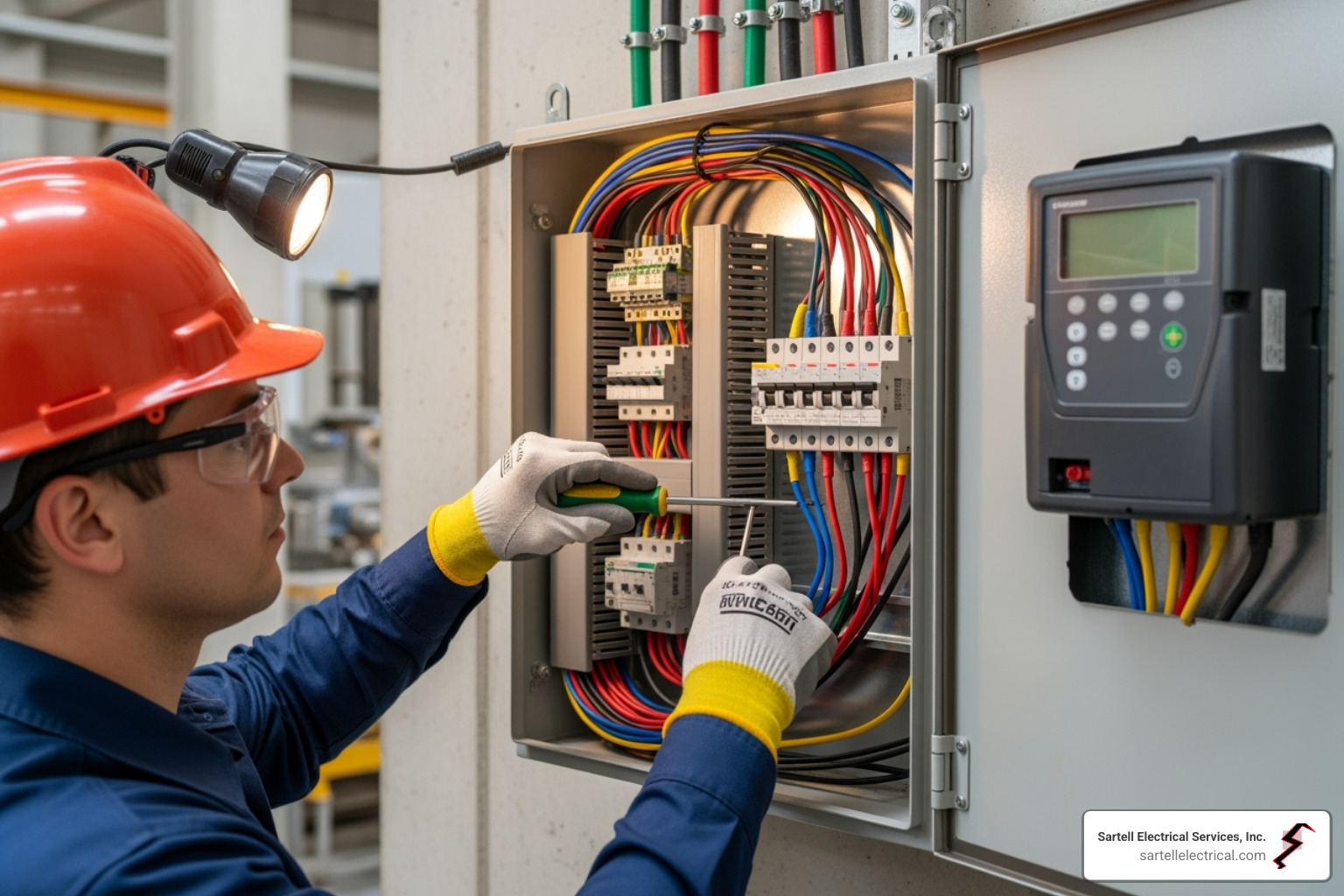
Professional installation is essential. Our certified technicians ensure safe, code-compliant installation. Proper sensor placement is critical for accurate, actionable data, and we position each sensor optimally.
Network configuration demands attention to detail. The network must reliably carry data from all devices to the software platform. We configure protocols like Modbus RTU or BACnet for smooth data flow.
Cybersecurity is not an afterthought. We implement robust security, including data-stream encryption and integration with identity services. Modern platforms support two-factor authentication and SSL to protect your data.
Securing connected devices involves treating every component as a potential cyber threat. We follow strict protocols to minimize vulnerabilities in smart meters, gateways, and other devices.
Regular maintenance and updates ensure long-term performance and security. We provide the support to keep your system current and functional, protecting your investment.
Frequently Asked Questions about Industrial Power Monitoring
Facility managers and business owners often have questions about
industrial power monitoring systems. Here are answers to the most common concerns I hear during our consultations.
How quickly can I expect to see a return on investment?
The return on investment for an
industrial power monitoring system is surprisingly fast, typically 1 to 3 years. The ROI speed depends on several factors.
Energy savings are the biggest contributor, with clients often seeing bill reductions of 10-30%. For industrial-scale consumption, this means thousands in monthly savings.
Reduced downtime is another major factor. Preventing a single unexpected equipment failure can save more than the system's cost. We've seen clients avoid incidents costing over $50,000 in lost production and repairs.
Maintenance cost avoidance completes the picture. Planned maintenance during scheduled downtime is far cheaper than emergency repairs after a breakdown.
Larger, more energy-intensive facilities see faster returns, but even smaller operations usually see a payback within the 1-3 year window.
Can a power monitoring system be installed in an older facility?
Absolutely, and this is something we do all the time here in Massachusetts. Some of our most successful installations have been in facilities that were built decades ago. Modern monitoring technology is specifically designed with retrofitting in mind.
Retrofit solutions make installation straightforward. Split-core current transformers, for example, can be clamped around existing cables without disconnecting anything. We literally snap them into place while your equipment keeps running.
Wireless sensors have been a game-changer for older facilities. Instead of running new conduit and wiring through concrete walls and tight spaces, we can deploy wireless monitoring points that communicate back to a central gateway. This technology has made installations much less disruptive and more cost-effective.
Minimal disruption is something we take seriously. We understand that your production schedule doesn't stop for electrical upgrades. Our team plans installations during maintenance windows or off-shifts, and we work efficiently to minimize any impact on your operations.
Whether you're in an old mill building or a facility that's been expanded over the years, we can design a monitoring solution that works with your existing infrastructure. For more details about how we handle these installations in the Woburn area, check out
More info about industrial electrical services in Woburn MA.
What is the difference between energy monitoring and power quality monitoring?
This is a great question, as these terms are often confused but are equally important.
Energy monitoring tracks consumption: how much electricity you use and when (measured in kWh). It answers questions like: Which machines use the most energy? When is our peak demand? The goal is cost reduction and efficiency. By seeing where energy dollars go, you can make informed decisions about upgrades and operations.
Power quality monitoring focuses on the health of the power itself—whether it's clean and stable. Poor power quality can damage sensitive equipment, cause shutdowns, and shorten machinery life. It tracks issues like
voltage sags and swells,
Total Harmonic Distortion (THD), and
power factor. This is like monitoring your facility's electrical vital signs.
Both are crucial.
Energy monitoring saves money on utility bills, while
power quality monitoring protects equipment and prevents downtime. Most modern
industrial power monitoring systems combine both, giving you a complete picture of your electrical system's health and performance. In short, energy monitoring tracks how much you use, while power quality ensures what you use is safe.
Partner with the Experts for a Seamless Integration
Implementing an
industrial power monitoring system is like learning to drive a sophisticated piece of machinery – you could probably figure it out on your own, but wouldn't you rather have an experienced guide showing you the ropes? That's where we come in.
At Sartell Electrical Services, we've been helping Massachusetts businesses master their electrical systems for over three decades. We've seen every type of facility, from small workshops in Reading to sprawling manufacturing plants across Essex County and Middlesex County. This experience has taught us that
expert consultation isn't just helpful – it's essential for getting the most out of your investment.
Our
system design process starts with understanding your unique challenges. Are you dealing with mysterious energy spikes? Equipment that seems to fail at the worst possible times? Or maybe you're just tired of utility bills that make you wince every month? We listen first, then design a solution that fits your facility like a custom suit.
Professional installation is where our 30+ years of experience really shine. We've learned that systems not properly fitted to a facility's needs don't just underperform – they can cause breakdowns and loss of revenue. Our certified team knows how to steer the complexities of industrial environments, ensuring your monitoring system integrates seamlessly with your existing infrastructure without disrupting your daily operations.
But here's where we go beyond typical electrical contractors: we provide ongoing
data analysis support. Raw data is like having a conversation in a foreign language – you know something important is being said, but you need help understanding what it means. We help you interpret those insights, turning numbers on a dashboard into actionable strategies that
maximize system benefits.
Our goal isn't just to install equipment and walk away. We want to
empower you with the tools and knowledge to take control of your energy usage, optimize your operations, and
future-proof your facility against rising energy costs and unexpected downtime. Think of us as your long-term partners in electrical efficiency.
Don't let hidden energy costs continue eating into your profits. The longer you wait, the more money walks out the door with every inefficient process and undetected equipment issue.
Take control of your facility's power with our industrial electrical services and find what it feels like to have complete visibility into your electrical systems.
We're here to help you power up your profits – and we promise to make the journey as smooth as possible.