Condition-based asset monitoring for electrical systems: #1
Why Condition-Based Asset Monitoring is Critical for Modern Electrical Systems
Condition-based asset monitoring for electrical systems uses real-time sensor data and analytics to track equipment health and predict maintenance needs. Instead of following rigid schedules or waiting for failures, this proactive approach monitors actual conditions to optimize maintenance and prevent costly downtime.
Key Components of CBM for Electrical Assets:
- Real-time data collection - Sensors monitor temperature, vibration, and electrical parameters.
- Data analysis - Algorithms identify trends and anomalies that signal potential issues.
- Predictive alerts - Systems generate warnings before failures occur, enabling planned maintenance.
- Asset prioritization - Critical equipment like transformers and switchgear receive focused monitoring.
- Cost optimization - Maintenance is performed only when necessary, reducing expenses.
When electrical systems fail, operations stop. Condition monitoring can reduce maintenance costs by up to 25% and cut unplanned outages by 50%. This shift from reactive to proactive maintenance is a significant advance in electrical system management, moving beyond scheduled inspections that can lead to unnecessary work or missed problems.
As Ed Sartell, President of Sartell Electrical Services, I've seen how
condition-based asset monitoring for electrical systems transforms facility operations by preventing failures and maximizing equipment lifespan. It's essential for any business that relies on dependable power.
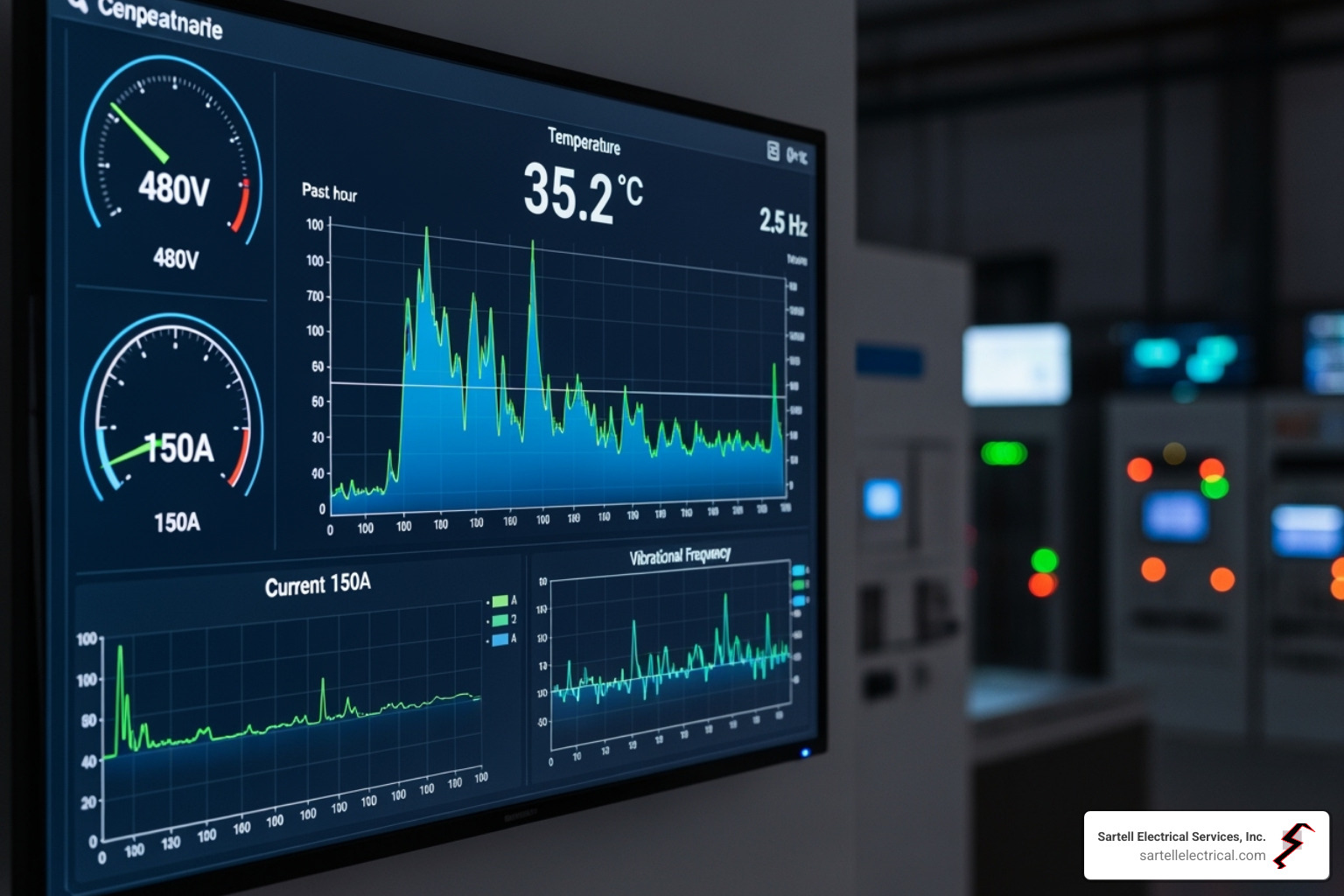
What is Condition-Based Monitoring for Electrical Systems?
Condition-based asset monitoring for electrical systems is like having a skilled electrician who never sleeps, constantly checking your equipment's health. Instead of waiting for a power outage, this approach uses real-time sensor data to watch over your electrical infrastructure.
Think of it like a modern car's dashboard that tells you exactly when maintenance is needed, rather than going to the mechanic every 3,000 miles regardless. You perform maintenance precisely when it's required.
This data-driven method transforms maintenance decisions. We use actual asset health information to determine the perfect time for service, spotting developing issues weeks or months before they become expensive problems. At Sartell Electrical Services, our
Building Electrical Maintenance services use these principles to prevent costly emergency calls and keep your systems running smoothly.
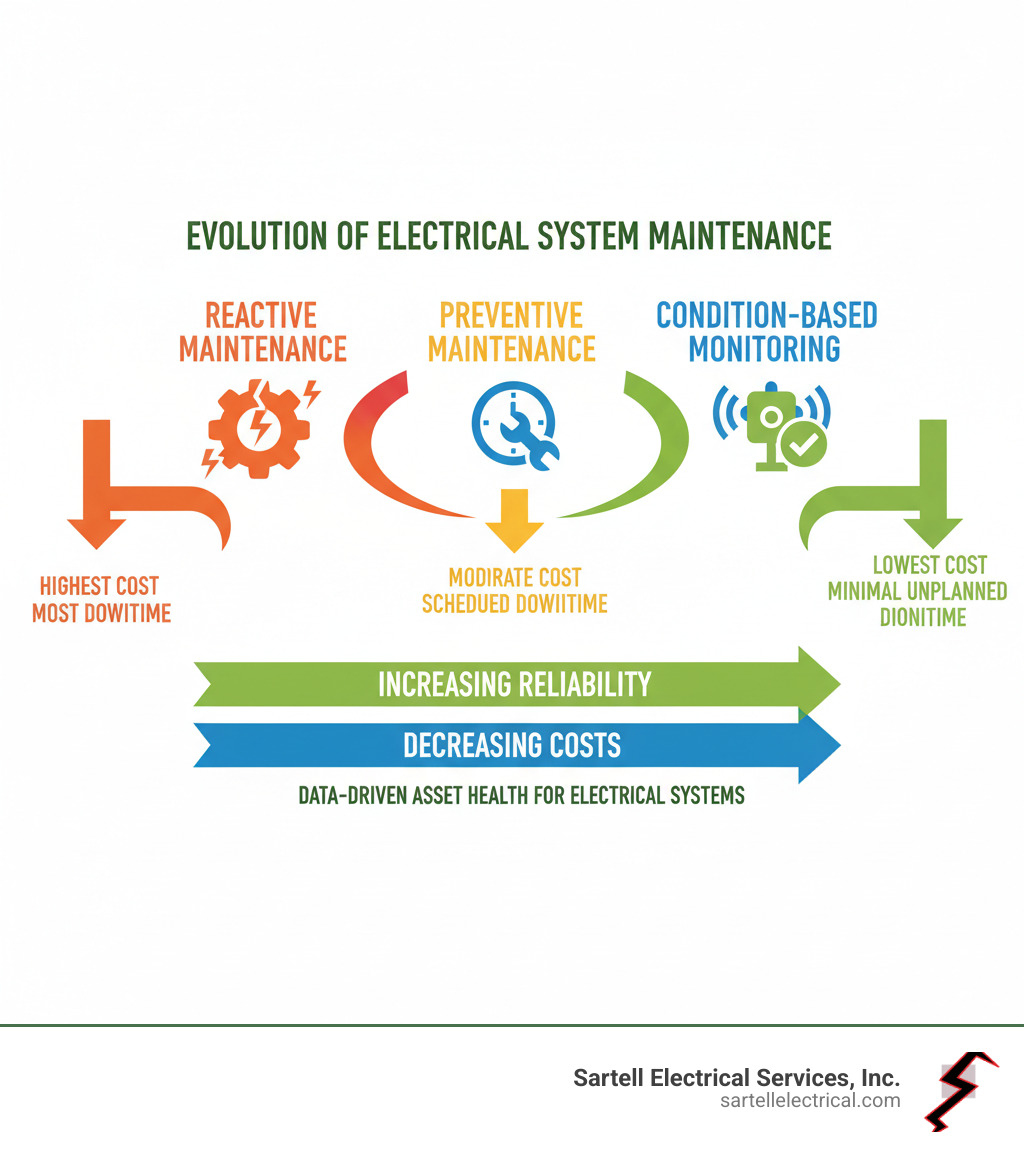
CBM vs. Traditional Maintenance: A Quick Comparison
For decades, electrical maintenance was either reactive (fix it when it breaks) or preventive (follow a strict schedule). Reactive maintenance leads to costly emergency repairs and downtime. Time-based preventive maintenance is better but often results in replacing perfectly good parts or missing early warning signs.
| Feature |
Reactive Maintenance (Run-to-failure) |
Preventive Maintenance (Time-based) |
Condition-Based Maintenance (Condition-based) |
| Cost |
High (due to unplanned downtime, emergency repairs, secondary damage) |
Moderate (scheduled downtime, unnecessary part replacements) |
Lowest (optimized maintenance, extended asset life, reduced unplanned downtime) |
| Labor |
Unpredictable, often overtime for emergency repairs |
Scheduled, potentially performing unnecessary tasks |
Optimized, focused on actual needs, less manual inspection |
| Downtime |
Unplanned, often lengthy, catastrophic |
Scheduled, but can be unnecessary if components are still healthy |
Minimal unplanned, scheduled precisely when needed, shorter duration |
| Asset Life |
Shortened (due to operating until failure) |
Potentially extended, but not optimized (parts replaced too early) |
Maximized (maintenance performed at the optimal time, preventing early failures) |
Condition-based monitoring offers the cost efficiency of performing maintenance only when needed, combined with the reliability of catching problems before they cause failures.
The Goal: From Scheduled Guesses to Precise Actions
The real value of
condition-based asset monitoring for electrical systems is its predictive capability. Instead of guessing, you get data-driven insights into your equipment's health.
This allows for true maintenance optimization. Technicians focus on equipment that needs attention, eliminating unnecessary work. Resource allocation becomes smarter, as you can plan maintenance, order parts in advance, and schedule work during convenient times. This proactive approach means catching a loose connection generating heat before it causes an arc flash that shuts down your facility. You gain the confidence of knowing your electrical system's true health.
The Core Benefits: Why CBM is a Game-Changer for Electrical Infrastructure
Implementing
condition-based asset monitoring for electrical systems is a strategic shift in how you protect and manage your electrical infrastructure. This approach fundamentally improves your bottom line and the safety of your people.
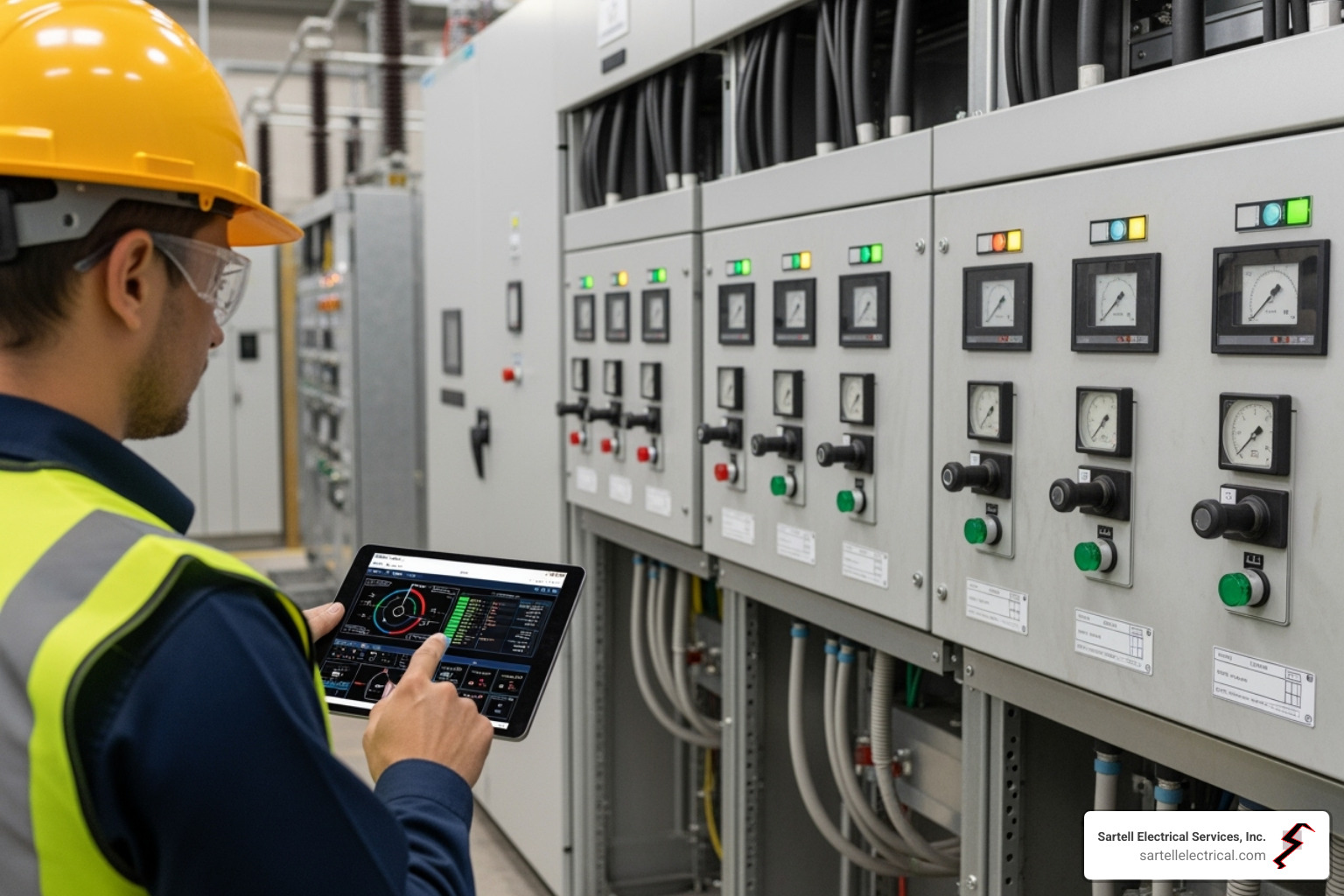
Maximizing Uptime and System Reliability
Unplanned downtime is the enemy of every business. Condition-based monitoring is the solution, helping to
cut unplanned outages by up to 50%. By continuously watching your equipment's vital signs, CBM provides advance warning when something deviates from normal operation. This allows you to schedule maintenance during planned downtime, avoiding disruptive emergencies. As The World Bank notes,
investing in automated systems to identify network faults is crucial for reliable infrastructure, contributing to
improved grid stability and power loss prevention.
Driving Significant Cost Savings
While CBM requires an initial investment, the
cost reduction benefits are substantial. Studies show it can
reduce maintenance costs by up to 25%. This is achieved by:
- Eliminating unnecessary maintenance: You only service equipment when it actually needs it, not based on a rigid schedule.
- Avoiding emergency repairs: Catching problems early prevents the high costs of emergency labor, rush parts, and operational losses from downtime.
- Extending asset lifespan: Proper, timely maintenance allows equipment to operate effectively for years longer, delaying major capital expenditures.
The result is lower operational costs and protection from budget-breaking emergency repairs.
Enhancing Personnel and Facility Safety
CBM is about more than money; it's about protecting your team. Electrical systems pose significant risks, including
arc flash incidents and fires. Traditional maintenance often requires technicians to work on or near energized equipment.
Condition-based asset monitoring for electrical systems changes this.
Remote monitoring allows for equipment health assessment without putting people in harm's way. When a problem is detected, it can be addressed during a planned, controlled shutdown. This
minimizes human intervention in hazardous environments and reduces exposure to energized equipment. Catching electrical problems early through monitoring prevents them from becoming safety hazards, improving your safety culture and compliance.
Key Techniques for Condition-Based Asset Monitoring for Electrical Systems
Effective
condition-based asset monitoring for electrical systems relies on a toolkit of monitoring techniques. These methods use IIoT (Industrial Internet of Things) sensors to collect data around the clock, providing the foundation for an effective
Industrial Power Monitoring System.
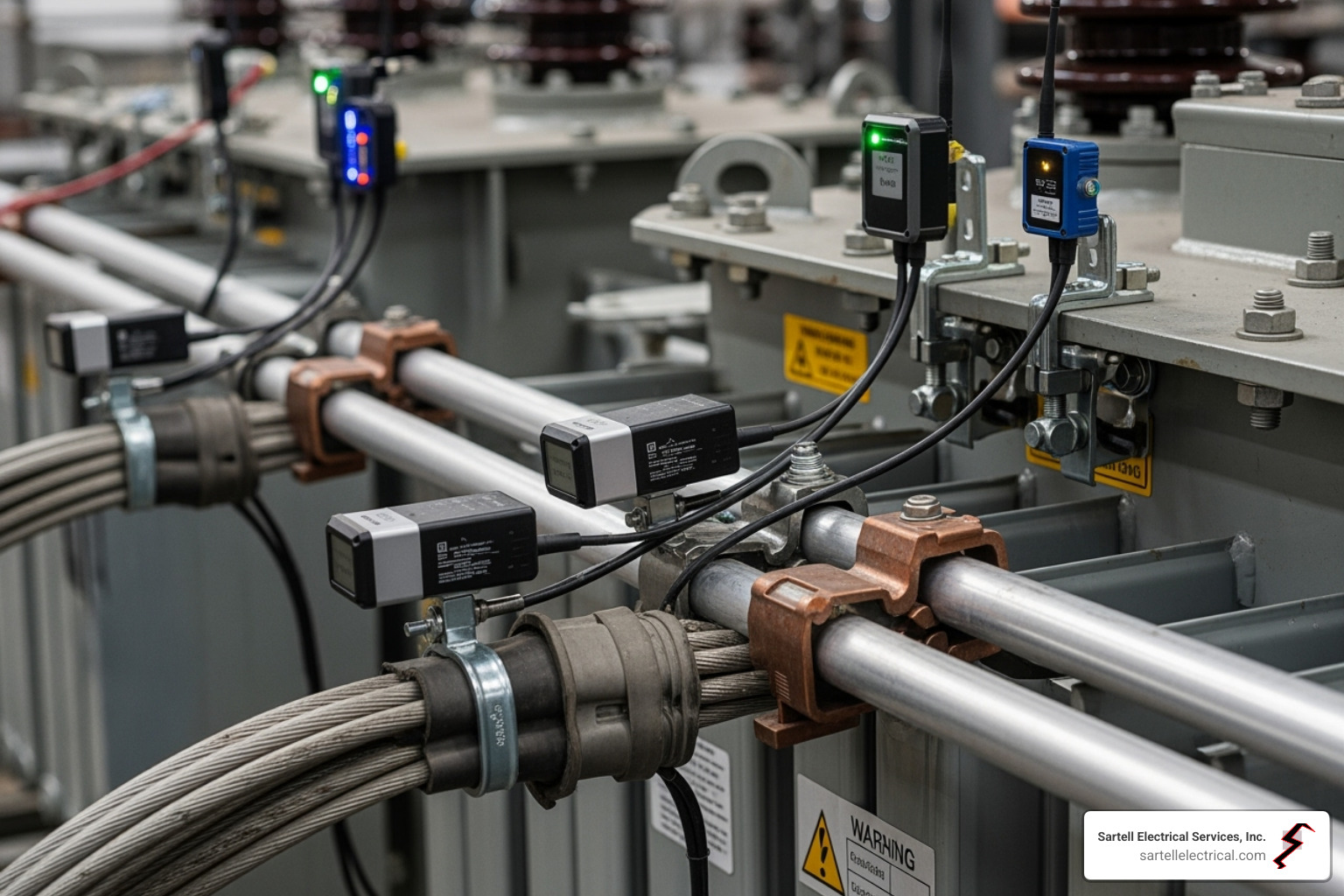
Thermal Monitoring: Seeing Heat Before It Becomes a Problem
Heat is often the first sign of an electrical problem.
Infrared thermography and
Continuous Thermal Monitoring (CTM) systems detect
electrical hotspots caused by issues like
loose connections and
overloaded circuits. These permanent sensors watch 24/7, monitoring temperature rises above ambient levels. This early
detection of fault symptoms allows for planned repairs, avoiding emergency shutdowns.
Electrical Analysis: Listening to the Heartbeat of Your Assets
Electrical analysis techniques diagnose asset health by examining their electrical signatures.
- Partial Discharge (PD) analysis: Crucial for high-voltage equipment, PD analysis detects tiny electrical arcs that signal weakening insulation in cables, transformers, and switchgear. AI-powered systems can identify defect types with high accuracy.
- Motor Current Signature Analysis (MCSA): By analyzing small variations in current, MCSA detects motor issues like rotor bar cracks and bearing wear before they cause failure.
- Voltage and current monitoring: Continuous monitoring reveals electrical imbalances, harmonics, and power quality issues that degrade equipment over time.
Mechanical Analysis: Detecting Physical Signs of Wear
Physical clues can indicate the condition of mechanical components within electrical assets, especially those with moving parts.
- Vibration analysis: Uses accelerometers to measure vibrations in rotating machinery. Changes from a healthy "vibration fingerprint" can reveal bearing wear or shaft misalignment.
- Airborne ultrasonic testing: Detects high-frequency sounds from arcing and tracking, partial discharge, or air leaks that are inaudible to the human ear, providing a very early warning.
Electrical Equipment That Benefits Most from CBM
While most assets benefit from CBM, monitoring is especially critical for:
- Switchgear (MV/LV): The heart of power distribution; monitoring prevents facility-wide shutdowns.
- Transformers: CBM protects these expensive assets from thermal issues and insulation breakdown.
- Motors and generators: A combination of vibration, current, and thermal analysis prevents costly failures.
- Motor Control Centers (MCCs) & Uninterruptible Power Supplies (UPS): Require thermal, electrical, and battery health monitoring.
- Busbars, VFDs, and Cables: Monitoring detects hotspots, harmonics, and hidden insulation defects.
Matching the right technique to each asset creates a comprehensive safety net.
How to Implement a Successful CBM Program
Implementing a successful
condition-based asset monitoring for electrical systems program requires a clear roadmap. A well-executed CBM program transforms your maintenance approach from reactive guessing to informed, data-driven decisions. Our team at Sartell Electrical Services uses our
Electrical Project Management expertise to guide clients through this process.
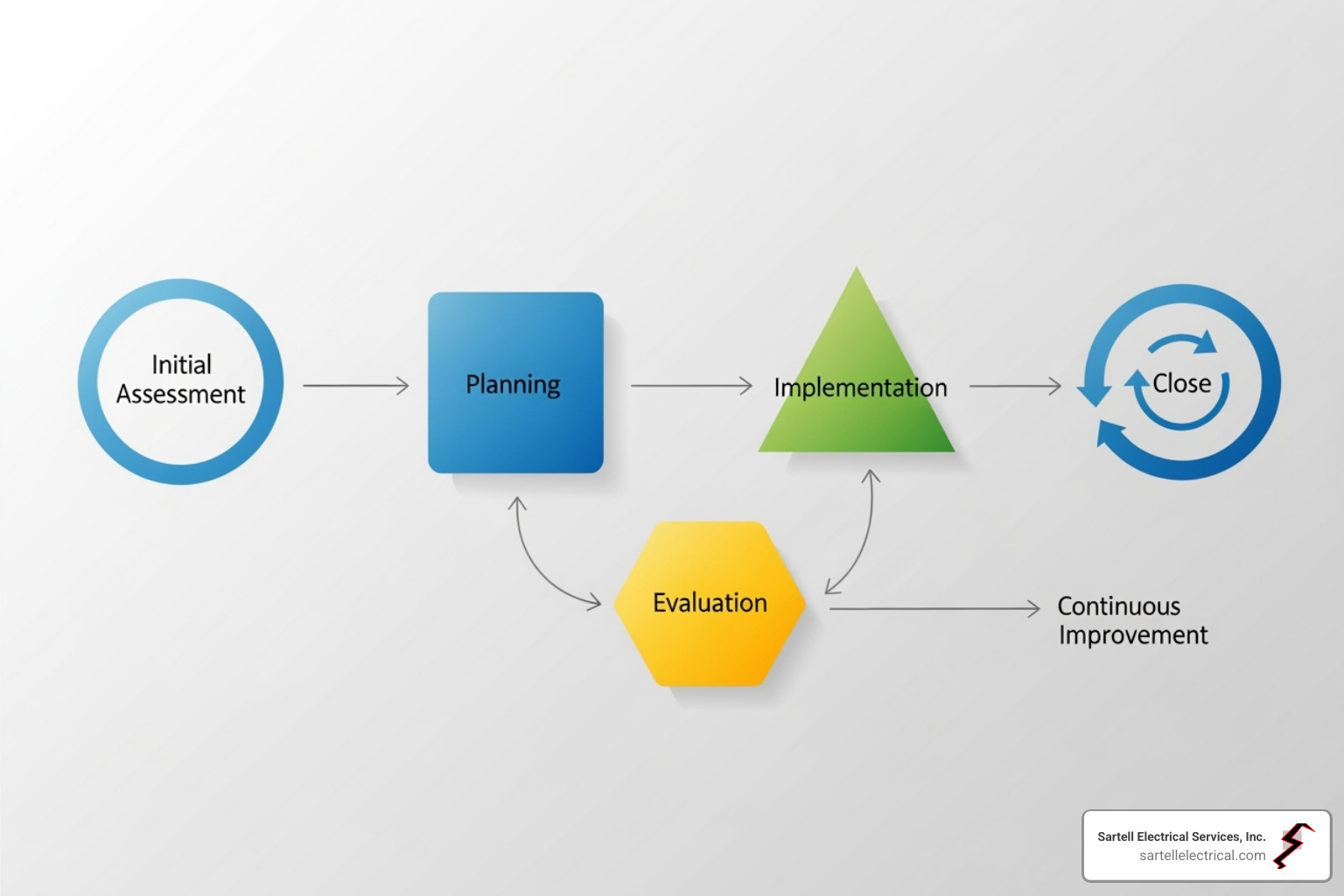
Step 1: Assess and Prioritize Your Critical Assets
The first step is to identify which equipment failure would cause the most significant operational or financial impact. This
asset criticality ranking focuses resources where they matter most. A
Failure Mode and Effects Analysis (FMEA) helps map potential failure points for your most critical assets to design the right monitoring strategy. Priorities vary by industry; for example,
data centers focus on UPS systems, while
manufacturing facilities prioritize production line power. This collaborative assessment, involving maintenance and operations staff, is a key part of our
Industrial Electrical Solutions.
Step 2: Deploy the Right Technology for Condition-Based Asset Monitoring for Electrical Systems
With priorities set, the next step is choosing the right tools.
Sensor selection is critical and depends on the asset and its potential failure modes. Modern
IIoT devices can measure temperature, current, vibration, and partial discharge. We use industrial-grade sensors built for harsh environments, such as
current transformers,
Rogowski coils,
temperature sensors, and
ultrasonic sensors. Data can be collected via
cloud platforms for remote access or
on-premise solutions for security. Seamless
integration with SCADA or CMMS systems provides maintenance teams with a complete operational picture.
Step 3: Analyze Data and Automate Action
The real value of CBM comes from turning raw data into actionable insights.
- AI and machine learning algorithms detect subtle patterns that signal developing problems by learning what "normal" operation looks like for each asset.
- Smart alarm thresholds are set to balance sensitivity with practicality, avoiding false alarms while catching real issues.
- Automated alerts notify the right personnel immediately via text or email, and can even generate work orders automatically.
- Data visualization dashboards present complex data in clear, color-coded displays, showing at a glance which equipment needs attention.
The goal is to use data to make better decisions, leading to safer, more reliable, and more efficient electrical systems.
Frequently Asked Questions about Electrical CBM
Here are answers to common questions about
condition-based asset monitoring for electrical systems, based on our decades of experience.
How does condition-based monitoring differ from predictive maintenance?
Though often used interchangeably, these terms have key differences.
- Condition-based monitoring (CBM) is about the present. It uses real-time data to identify and react to problems as they happen. For example, an alert is triggered when a transformer is currently overheating.
- Predictive maintenance (PdM) is about the future. It uses CBM data, historical trends, and AI to forecast failures. For example, it might predict an asset will fail in six weeks, allowing for proactive scheduling.
Essentially,
CBM is a crucial component of a PdM strategy. You need to understand the present to predict the future. Many clients start with CBM for its immediate value and expand to PdM later.
What is the first step to get started with CBM?
The first step is a
critical asset assessment. You can't monitor everything, so we identify the equipment whose failure would cause the most significant operational or financial impact. We ask: what failure would shut down your business? Once these assets are identified, we recommend
starting with a pilot project on a few key assets. This allows you to see the value of CBM, learn the technology in your environment, and build confidence before a facility-wide rollout. This strategic approach ensures your investment delivers immediate results.
Is CBM only for large industrial plants?
No. While large plants benefit greatly,
condition-based asset monitoring for electrical systems is scalable and provides a strong ROI for facilities of all sizes. We have implemented successful CBM programs for
commercial buildings,
data centers, and
healthcare facilities. Even smaller operations can achieve significant savings by monitoring critical infrastructure like switchgear, transformers, and UPS systems. Modern CBM technology scales to fit your needs and budget. If an electrical failure would disrupt your business, CBM is a smart investment.
Conclusion
When every business depends on reliable power,
condition-based asset monitoring for electrical systems is essential for smart facility management. This data-driven approach transforms electrical maintenance from reactive guesswork to proactive, informed action.
The benefits are clear:
improved reliability (cutting outages by up to 50%),
improved safety for your personnel, and
cost efficiencies that can reduce maintenance expenses by up to 25%. The return on investment is compelling.
CBM puts you in control, preventing surprise failures and costly emergency repairs. It provides the peace of mind that comes from knowing your electrical system's health at all times.
For over three decades, Sartell Electrical Services has helped Massachusetts businesses ensure reliable power. We design custom CBM programs for facilities of all sizes, from commercial buildings to industrial plants. The technology is proven, and the time to act is now.
Don't wait for a costly failure.
Take control of your electrical system's health with Electrical Condition Monitoring and adopt a maintenance strategy that prevents problems before they start.