

Why Every Industrial Plant Depends on Electrical and Instrumentation Services
Electrical and instrumentation services are the backbone of safe, efficient industrial operations — covering everything from power distribution and control systems to precision sensors and process automation.
Here's a quick overview of what E&I services include:
- Electrical services — power systems, switchgear, motor controls, substations, cabling, and lighting
- Instrumentation services — sensors, transmitters, control loops, calibration, and SCADA/DCS systems
- Integration services — PLC programming, fiber optics, remote monitoring, and commissioning
- Maintenance services — predictive diagnostics, arc flash studies, breaker testing, and infrared thermography
When these systems fail — even partially — the consequences hit fast. Voltage spikes, sensor drift, and control-loop lag can quietly cripple throughput long before a major breakdown occurs. For plants running critical processes, that's not just an inconvenience. It's lost revenue, safety risk, and compliance exposure.
Getting E&I right from the start — and keeping it maintained — is what separates facilities that run smoothly from those that don't.
I'm Ed Sartell, President of Sartell Electrical Services, Inc., and with nearly four decades leading electrical projects across Massachusetts, I've seen how proper electrical and instrumentation services can make or break a facility's performance. In this guide, I'll walk you through everything you need to know to make smart decisions for your plant.
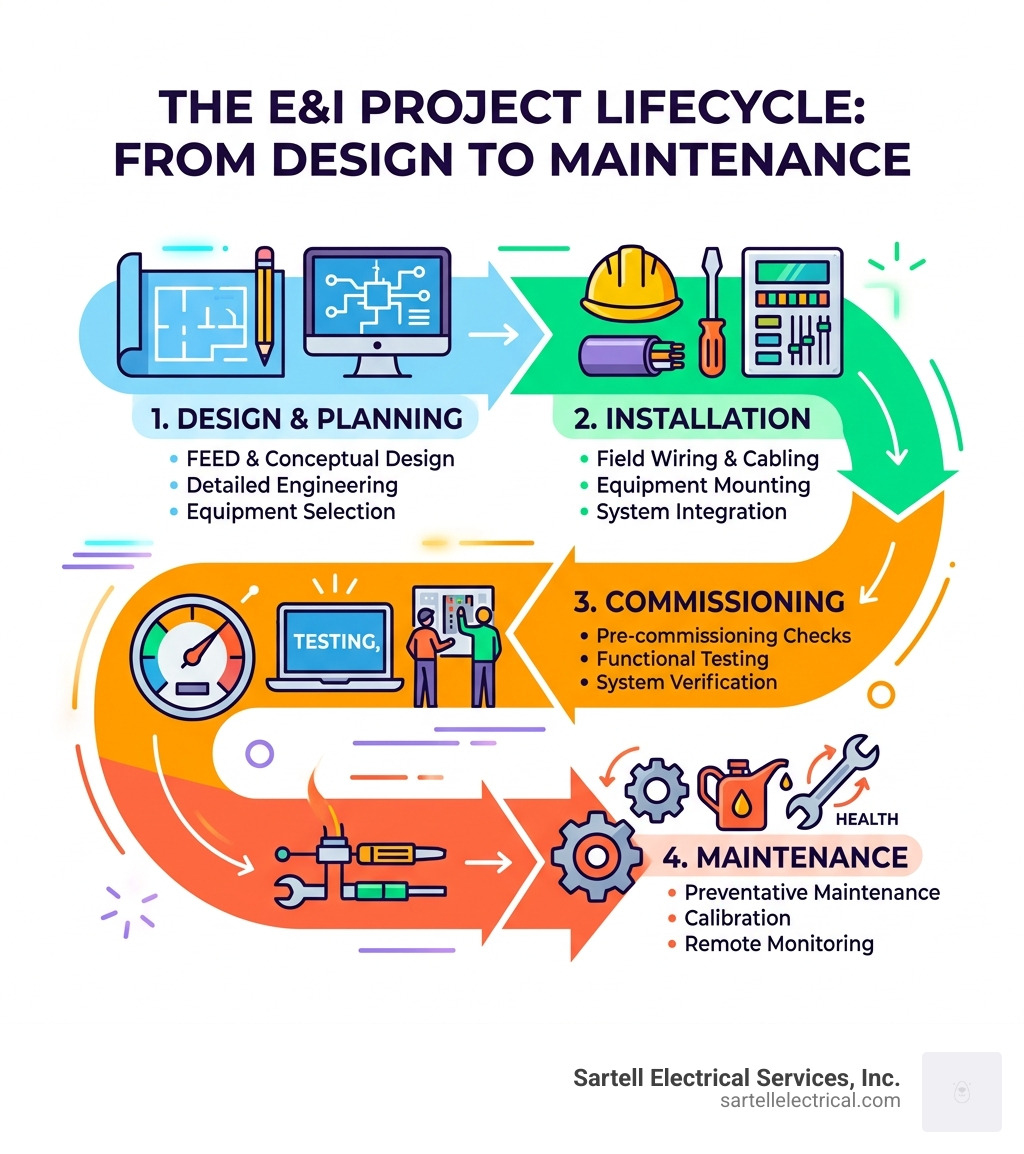
Simple guide to electrical and instrumentation services terms:
What are Electrical and Instrumentation Services?
At its simplest, electrical and instrumentation services (E&I) combine the "muscle" of a facility - the high-voltage power that runs machines - with the "brain" and "nervous system" - the sensors and controllers that tell those machines what to do. In the industrial world of 2026, these two disciplines are inseparable. You cannot have a high-performing motor without a precisely calibrated drive to control it, and you cannot have accurate data without a stable power supply.
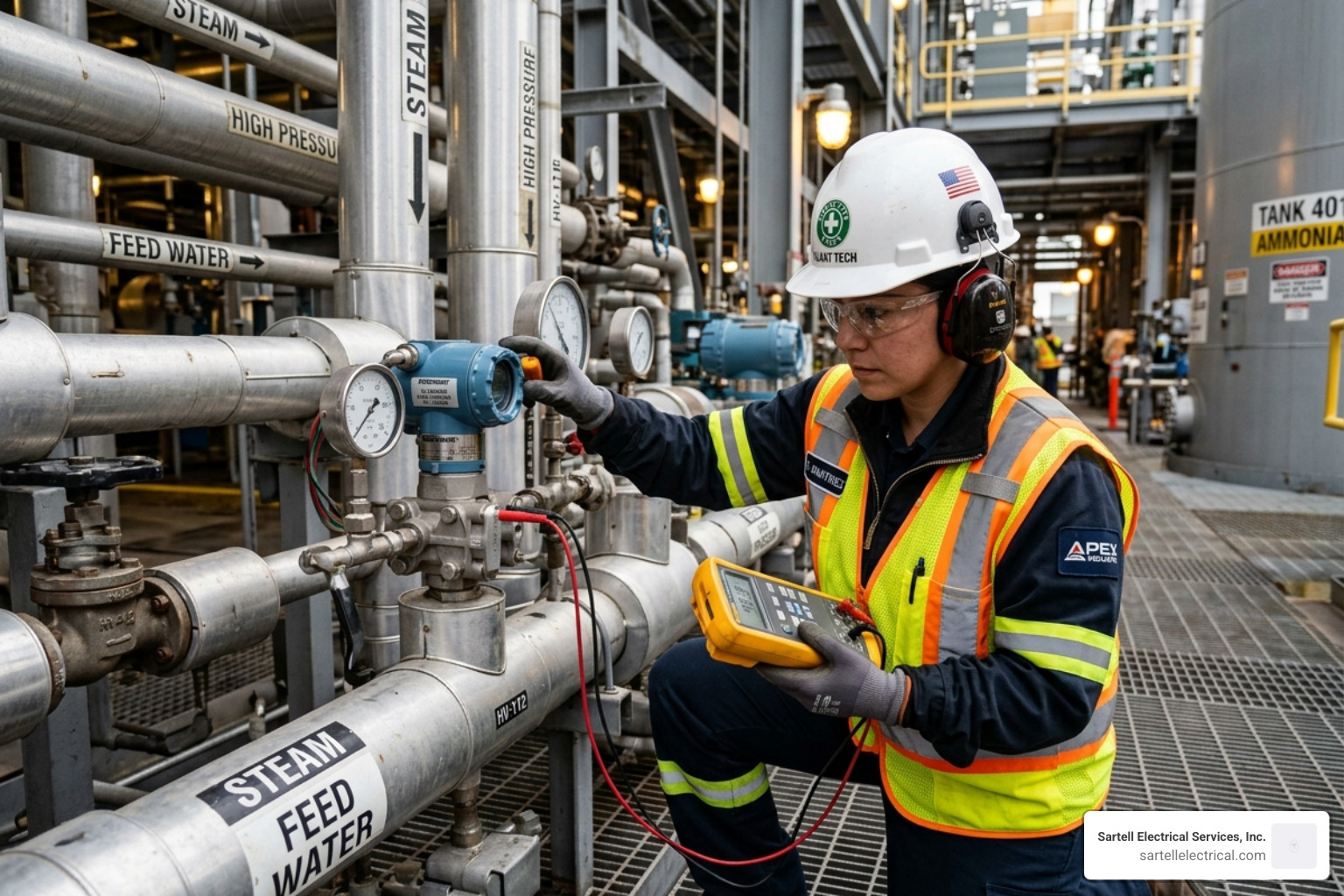
When we talk about power systems, we are referring to the infrastructure required to move electricity from the utility grid to your equipment. This includes substations, transformers, and switchgear. On the flip side, process control involves the technologies that monitor variables like temperature, pressure, and flow. Systems like SCADA (Supervisory Control and Data Acquisition) allow operators to visualize this data in real time, ensuring the plant stays within safe operating parameters.
To manage these complex systems effectively, many facilities rely on an Electrical Asset Management Complete Guide to track the health of their hardware. Without integrated Industrial Electrical Solutions, a plant is essentially flying blind, reacting to failures rather than preventing them.
The Scope of Electrical and Instrumentation Services
The scope of E&I work is vast, but it usually centers on ensuring accuracy and uptime. One of the most critical tasks is instrumentation calibration. Over time, sensors "drift." A thermometer that used to be accurate to within a tenth of a degree might start reading two degrees high. In a chemical or pharmaceutical plant, that drift can ruin an entire batch of product.
Professional E&I providers perform loop checks to ensure that the signal sent from a field sensor actually reaches the control room accurately. Leading industrial facilities aim for 99.2% control-loop availability. Achieving this level of uptime requires dedicated Industrial Electrical Maintenance to identify "rogue milliamps" or signal interference before they cause a nuisance trip that shuts down a production line.
Hardware and Software Integration
In 2026, E&I services aren't just about pulling wire; they are about data. Modern facilities utilize Programmable Logic Controllers (PLCs) and Distributed Control Systems (DCS) to automate complex tasks. As technology evolves, many plants in the Greater Boston area are undergoing DCS migration - moving from legacy pneumatic or outdated electronic systems to modern, high-speed digital platforms.
This integration often relies on fiber optics for lightning-fast, interference-free communication across large facilities. By implementing an Industrial Power Monitoring System, plant managers can now enjoy secure remote access. This means an engineer in Reading, MA, can monitor real-time data and perform troubleshooting for a facility in Lawrence or Lowell without having to be physically on-site for every minor adjustment. This level of data trending allows for "smart" decision-making that saves thousands in energy costs and prevented downtime.
Core Components of Industrial E&I Solutions
The foundation of any industrial facility is its electrical core. This is where the heavy lifting happens. From the moment power enters a 20 MVA substation to the moment it reaches a small sensor on a conveyor belt, every component must be engineered for reliability.

Core E&I solutions include the installation of switchgear and motor controls that act as the gatekeepers for your facility's power. We often help clients navigate the complexities of Electrical Network Monitoring Complete Guide to ensure their systems are balanced and efficient. Furthermore, using UL-listed panels is non-negotiable for safety and compliance. When things do go wrong, having a partner for Industrial Electrical Equipment Repair ensures that critical components are restored to factory specifications quickly.
Power Distribution and Infrastructure
Power distribution is about more than just cables; it’s about the intelligent management of high-voltage assets. Substation automation has become a standard for modern plants, allowing for automated switching and fault detection. Whether you are dealing with medium-voltage cabling or the installation of pole lines for large industrial campuses, the goal is a resilient "grid" within your walls.
A robust Power Plant Monitoring System provides visibility into how power is being consumed, identifying bottlenecks or potential failure points in transformers and grounding systems. Proper grounding is particularly vital in the lightning-prone regions of New England to protect sensitive electronics from surges.
Precision Instrumentation and Control
While the electrical side provides the power, the instrumentation side provides the precision. In many industrial environments, such as chemical processing or fuel storage, E&I services must account for hazardous-area classifications. This involves ATEX installations and explosion-proof equipment designed to operate safely in volatile atmospheres.
Precision control also includes:
- Valve Positioning: Ensuring flow control is exact to prevent waste.
- Heat Tracing: Using electric or steam systems to maintain pipe temperatures, preventing freezing or product solidification.
- Machine Electrical Repair: Keeping the specialized motors and actuators that drive production in peak condition through expert Machine Electrical Repair.
Safety, Compliance, and Risk Mitigation
Safety isn't just a buzzword in E&I it is a measurable metric. Leading contractors maintain a 0.00 TRIR (Total Recordable Incident Rate), meaning thousands of man-hours are completed without a single injury. This is achieved through rigorous adherence to standards like NFPA 70B (for electrical equipment maintenance) and OSHA 1910.272 (for grain and industrial handling safety).
One of the most important safety evaluations we perform is the arc flash study. This identifies the potential energy release during a fault and dictates the level of Personal Protective Equipment (PPE) required for workers. Without this, your team is at risk of catastrophic injury.
| Feature | Preventative Maintenance | Predictive Maintenance |
|---|---|---|
| Strategy | Schedule-based (e.g., every 6 months) | Condition-based (based on real-time data) |
| Goal | Replace parts before they likely fail | Replace parts only when they show signs of failure |
| Cost | Moderate (includes some unnecessary labor) | Lower long-term (optimizes part life) |
| Risk | Can miss "infant mortality" failures | Requires higher upfront sensor investment |
| Best For | Standard lighting, basic motors | Critical turbines, high-value transformers |
For more on keeping your team safe, see our guide on Electrical Safety for Industrial Facilities.
Ensuring Regulatory Adherence in 2026
As we move through 2026, regulatory bodies are becoming stricter about documentation. Whether it is ISO 9001 quality standards or NETA testing requirements, your E&I partner must provide audit-ready documentation. This starts with Factory Acceptance Testing (FAT), where systems are tested at the shop before they ever reach your site, and continues through Site Acceptance Testing (SAT).
Our Industrial Electrical Services ensure that every installation is validated to the standards of relevant authorities. This not only keeps you compliant but also provides peace of mind that your facility is built to the highest global standards of engineering.
Maximizing Reliability Through Maintenance and Predictive Services
The ultimate goal of electrical and instrumentation services is to prevent the "unscheduled shutdown." Every hour your plant is dark, you are losing money. Traditional "fix it when it breaks" mentalities are being replaced by Electrical Condition Monitoring.
By using tools like infrared thermography, we can see "hot spots" in a breaker or transformer that are invisible to the naked eye. These hot spots indicate loose connections or failing components that will eventually cause a fire or a blowout. Similarly, Condition Based Asset Monitoring for Electrical Systems uses vibration analysis and oil testing to predict when a motor or transformer is nearing the end of its life.
Selecting a Partner for Electrical and Instrumentation Services
Choosing an E&I contractor is a high-stakes decision. You aren't just hiring someone to change lightbulbs; you are hiring a partner to protect your most valuable assets. Here is what you should look for:
- Technical Expertise: Do they understand the specific needs of your industry (e.g., healthcare vs. manufacturing)?
- Experience: Look for a management team with 20+ years of experience and a deep bench of skilled craftsmen.
- Turnkey Solutions: Can they handle the project from initial design and UL-panel fabrication to final commissioning?
- Emergency Support: Do they offer 24-hour response? If a main breaker trips at 2:00 AM on a Sunday in Chelsea or Everett, you need someone who answers the phone.
Frequently Asked Questions about E&I
What is the difference between electrical and instrumentation services?
Electrical services focus on the high-power infrastructure — the "muscles" — like wiring, panels, and motors. Instrumentation services focus on the "senses" — the devices that measure and control variables like pressure and temperature to ensure the electrical equipment is doing exactly what it should.
Why is regular instrument calibration necessary for industrial plants?
Instruments naturally lose accuracy over time due to environmental factors, vibration, and wear. Regular calibration ensures that your readings are accurate, which is vital for product quality, safety, and regulatory compliance.
How do E&I services help in reducing operational downtime?
By implementing predictive maintenance (like IR scanning) and ensuring all control loops are optimized, E&I services identify potential failures before they happen. This allows for planned maintenance during scheduled shutdowns rather than emergency repairs during peak production.
Conclusion
In the demanding industrial landscape of Massachusetts, from the tech hubs of Cambridge to the manufacturing centers of Lawrence and Lowell, your facility’s success depends on the invisible threads of power and data. Electrical and instrumentation services are not just a line item in your budget; they are an investment in the reliability and safety of your entire operation.
At Sartell Electrical Services, Inc., we bring over 30 years of experience to every project. As a family-owned business based in Reading, MA, we pride ourselves on a customer-centric leadership style that treats every facility — whether it’s a local hospital in Norfolk County or a large-scale refinery in Suffolk County — with the same commitment to excellence. From small capital projects to massive multi-discipline expansions, we have the scalability and expertise to keep your plant running at peak precision.
Don't wait for a sensor drift or a voltage spike to derail your production. Contact our expert electrical contractors today to schedule an E&I audit and ensure your facility is ready for the future.
Sartell Electrical Services, Inc. Serving Massachusetts, Greater Boston, and the surrounding counties with excellence since 1991.