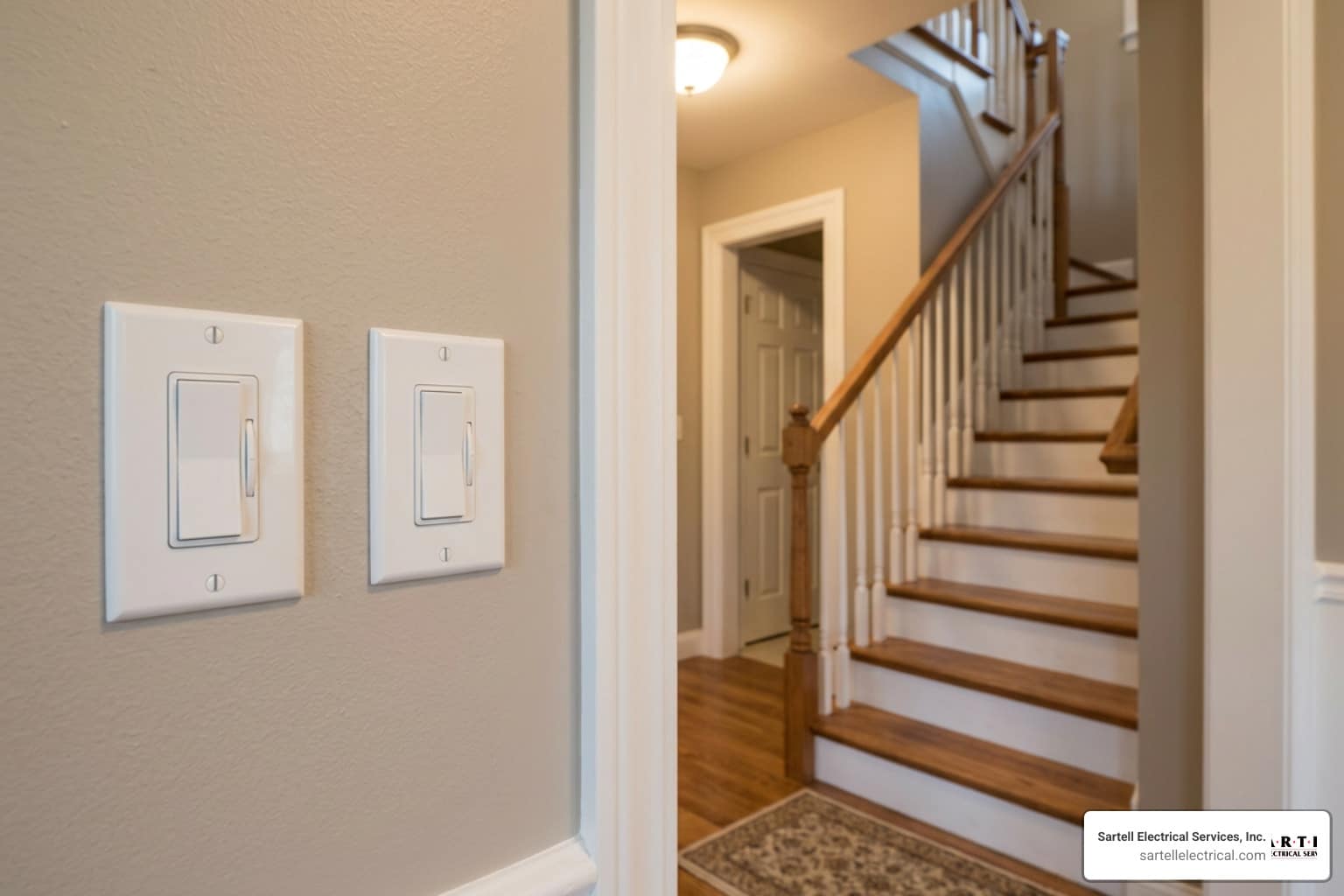
What Is a 3 Pole Dimmer Switch — and Why Does It Matter?
A 3 pole dimmer switch (also called a 3-way dimmer) lets you control the same light fixture from two different locations — and adjust the brightness from either one.
Here's a quick breakdown:
| Feature | What It Means |
|---|---|
| Controls lights from | 2 separate locations (e.g., top and bottom of stairs) |
| Works with | LED, CFL, incandescent, and halogen bulbs |
| Requires neutral wire? | Not always — many models work without one |
| Smart options available? | Yes — Alexa, Google Assistant, SmartThings compatible |
| DIY-friendly? | Often yes, but always turn off power first |
Think staircases, hallways, large living rooms, or any space where you walk in from more than one entry point. A standard single-pole dimmer just won't cut it in those situations.
Upgrading to a 3-way dimmer gives you both convenience and control — from wherever you happen to be standing.
I'm Ed Sartell, President of Sartell Electrical Services, and I've been installing and troubleshooting 3 pole dimmer switch setups across Massachusetts since 1985. In this guide, I'll walk you through everything you need to know — from how they work to how to install one safely.
Demystifying the 3 Pole Dimmer Switch: How It Works
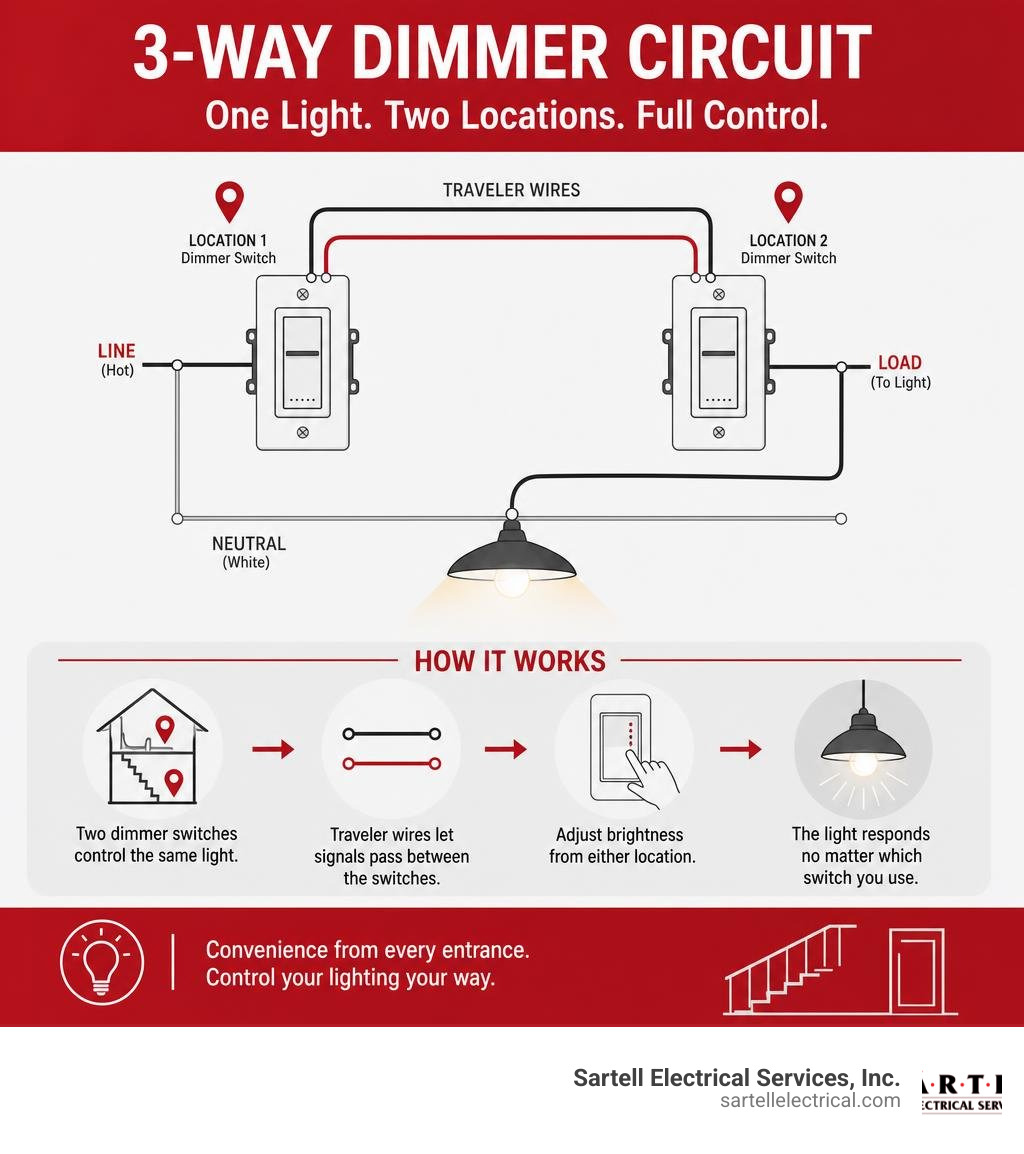
To understand a 3 pole dimmer switch, we first need to look at how electricity travels through your walls. In standard household wiring, a basic switch is like a simple drawbridge: it either connects the circuit (lights on) or breaks it (lights off).
A 3-way circuit is more like a train track with a switching station. It allows you to redirect the flow of electricity so that toggling either switch in the circuit will change the state of the light.
When we introduce a dimmer to this setup, we aren't just turning the power on and off; we are slicing the electrical current to reduce the amount of energy reaching the bulb. This rapid chopping of the electrical wave (happening up to 120 times per second!) is what creates the dimming effect.
To explore the fundamentals of how these systems are laid out, you can check out our detailed guide on Dimmer Switch Wiring and review an AC Dimmer Circuit Diagram to visualize the current flow.
Single-Pole vs. 3 Pole Dimmer Switch: Key Differences
The most common point of confusion for homeowners is choosing between a single-pole dimmer and a 3 pole dimmer switch. The difference comes down to the number of control points:
- Single-Pole Dimmer Switch: This is designed for single-point control. If your room has only one doorway and one switch that controls the overhead light, you need a single-pole dimmer. You can learn more about these in The Ultimate 1-Way Dimmer Switch Connection Manual.
- 3-Way (3-Pole) Dimmer Switch: This is engineered for dual-point control. If you have a staircase with a switch at the bottom and another at the top, or a long hallway with switches at both ends, you need a 3-way setup.
Fortunately, most modern dimmers sold on the market today are labeled as "Single-Pole/3-Way" universal models. This means they can be wired to work in either configuration, giving you great flexibility during installation.
The Role of Travelers and Common Wires
If you open up a standard single-pole switch box, you will typically find two main insulated wires (plus a bare ground wire). But a 3-way electrical box is a bit more crowded. It contains:
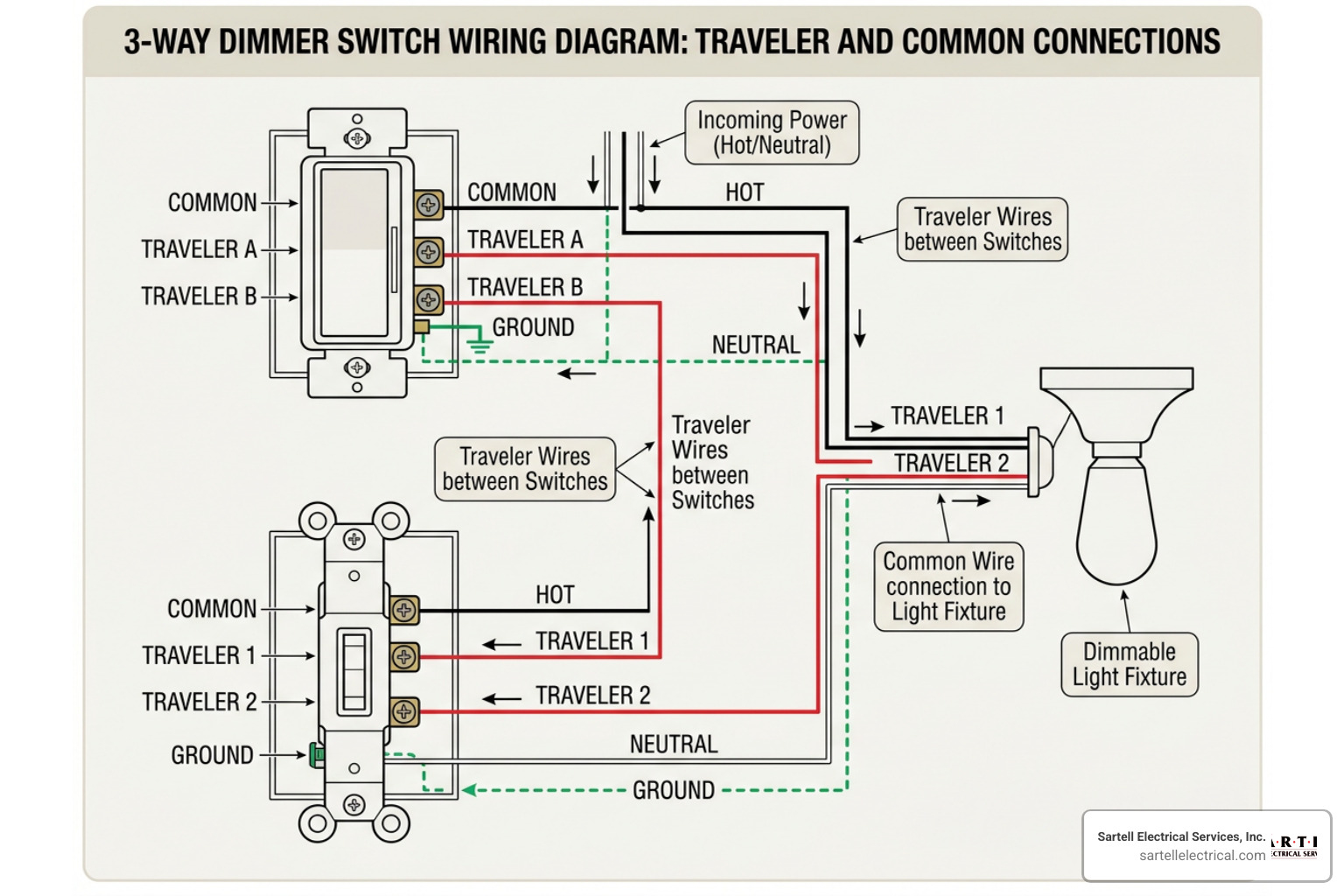
- The Common Terminal (and Wire): On one of the switches, this black screw connects to the hot wire coming directly from your electrical panel. On the other switch, the common terminal connects to the load wire going to the light fixture.
- Traveler Wires: These are two dedicated wires (usually red and black, running within the same Romex cable) that link the two switches together. They act as the alternate pathways for the electricity. When you flip switch A, it sends power down Traveler 1. If switch B is set to receive from Traveler 1, the light turns on. Flip switch B, and it switches its connection to Traveler 2, turning the light off.
Understanding this relationship is crucial when you are Wiring Wonders: Connecting Two Light Switches for Seamless Control to ensure the switches communicate properly without short-circuiting.
Choosing the Right Dimmer: Compatibility and Features
Not all dimmers are created equal, and choosing the wrong one can lead to buzzing, flickering, or even damaged bulbs. When shopping for a 3 Way Dimmer Switch - Amazon.com, you will find over 4,000 results. To narrow down your choices, you must understand bulb compatibility, wattage ratings, and safety certifications.
Here is a quick reference table to help you compare compatibility across different bulb types:
| Bulb Type | Dimming Technology Needed | Wattage Considerations | Common Issues |
|---|---|---|---|
| LED | Forward or Reverse Phase (LED+) | Very low (typically 150W max per dimmer) | Flickering, buzzing, narrow dimming range |
| CFL | Specifically rated dimmable CFL | Low wattage limits | Slow start-up, limited dimming span |
| Incandescent | Standard Triac / Forward Phase | High capacity (600W - 1000W) | Generates heat, uses more energy |
| Halogen | Standard Triac / Forward Phase | High capacity (600W - 1000W) | Runs very hot, shortens bulb life if dimmed too low |
Bulb Compatibility and Preventing Flicker
The transition to energy-efficient lighting has made dimmer selection slightly more complex. Older incandescent bulbs dimmed beautifully on simple analog switches. However, modern LEDs rely on internal drivers to manage power.
If you pair an older dimmer with a modern LED bulb, you will likely experience annoying flickering or buzzing. To prevent this, look for dimmers designed with advanced microprocessor controls.
For instance, the radiant Tru-Universal Dimmer Switch | Legrand and the TradeMaster® Tru-Universal Single Pole/3-Way Toggle Slide Dimmer, Preset, White | Dimmers | Light Switches and Dimmers | Wiring Devices are engineered to auto-calibrate. They detect the type of load connected (whether it is forward-phase or reverse-phase/ELV) and automatically adjust their minimum voltage levels to eliminate flicker entirely.
Additionally, pay attention to derating and heat sinks. When you install multiple dimmers side-by-side in a multi-gang wallbox, you often have to break off the metal side tabs (the heat sinks) to make them fit. Doing this reduces the switch's ability to dissipate heat, meaning you must lower (derate) the maximum wattage the switch can safely handle.
Do You Need a Neutral Wire?
One of the biggest hurdles in DIY electrical work is the presence—or absence—of a neutral wire.
Historically, light switches only needed to interrupt the hot wire, so older homes (built before the mid-1980s) often do not have neutral wires running to the switch boxes. However, modern smart dimmers require constant power to stay connected to your Wi-Fi network, which means they usually require a neutral wire to complete their own internal circuit.
If you live in an older Massachusetts home, don't panic. There are plenty of mechanical and specialized smart dimmers that do not require a neutral wire. You can read more about your options in The No-Neutral Solution for Your 2-Wire Dimmer Switch.
Top-Rated 3-Way Dimmer Switches on the Market
Upgrading your home's lighting doesn't have to break the bank. Depending on your goals—whether you want a budget-friendly swap, a smart home upgrade, or a high-end designer look—there is a perfect 3 pole dimmer switch for your project.
Smart Dimmers and Voice Assistant Integration
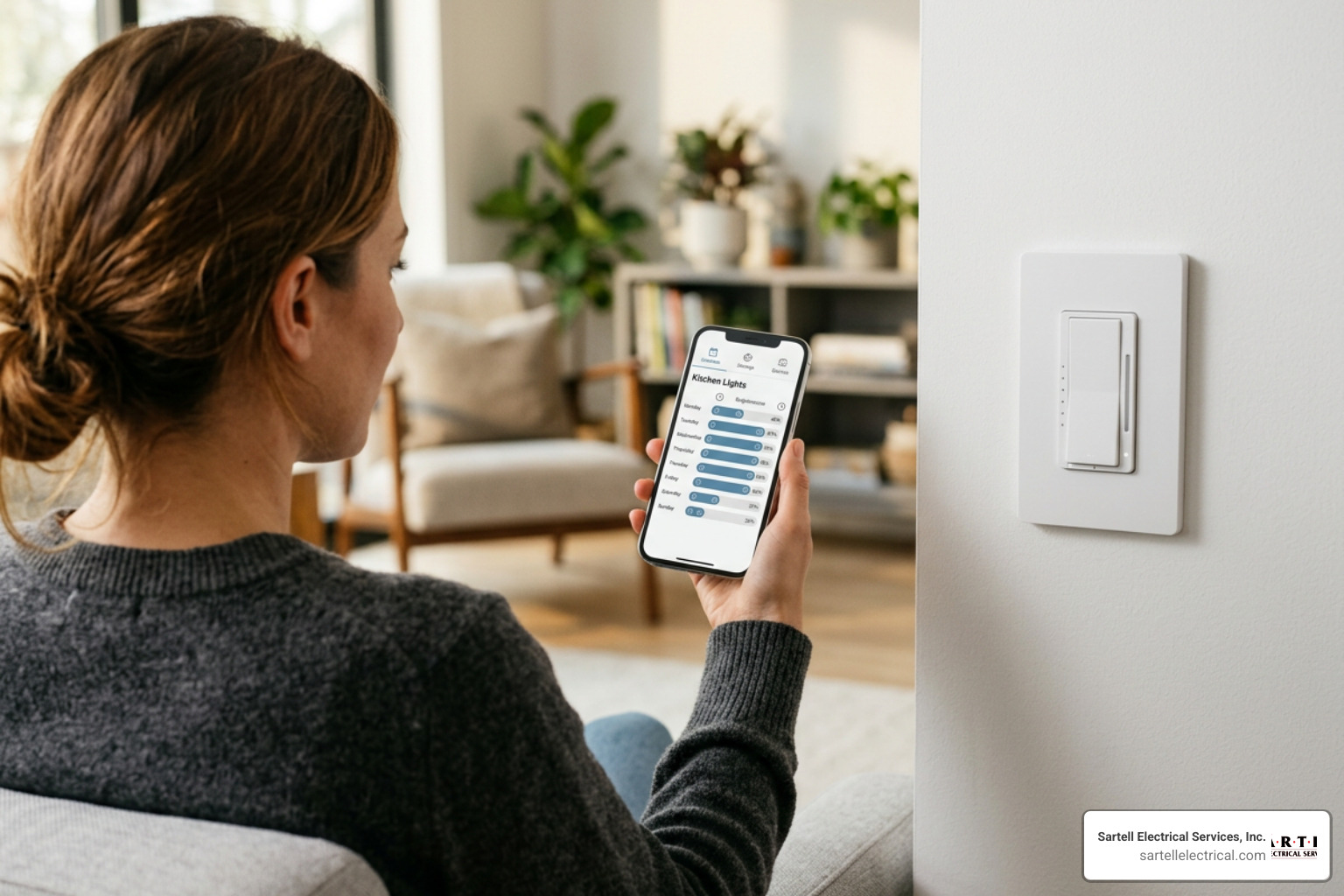
For those looking to step into home automation, smart 3-way dimmers are incredibly popular. Brands like Kasa Smart offer kits that make multi-location smart dimming seamless. Their 3-Way Dimmer Switch Kit is highly rated on Amazon, with thousands of units bought every month. These switches connect directly to your 2.4GHz Wi-Fi network and integrate beautifully with Alexa, Google Assistant, and SmartThings.
Another excellent heavy-duty option is the Lutron Maestro Dimmer Switch for Incandescent and Halogen, 1000 ... , which provides multi-location dimming using companion controllers. This allows you to smoothly adjust the lights from up to ten different locations in a single circuit!
Premium and Aesthetic Dimmer Options
If you are renovating a historic home in Boston or simply want a tactile, luxurious feel on your walls, standard plastic switches might not cut it. Premium design collections offer stunning alternatives:
- Polished Nickel and Antique Brass: The Kew Triple 3x Dimmer Switch Polished Nickel | Switches & Dimmers provides an elegant, warm metallic finish that is far more versatile than standard chrome. For a more traditional look, you can opt for the Kew Triple 3x Dimmer Switch Antique Brass | Switches & Dimmers , which features a "living finish" that beautifully patinates over time.
- Minimalist Flush Designs: If you want your controls to blend seamlessly into your plaster or brick walls, options like the Kew Triple 3x Vertical Dimmer Switch Clear Polished Nickel | Switches & Dimmers feature transparent polycarbonate plates that let your wallpaper or paint color show through.
- Touch and Multi-Way Systems: For a ultra-modern touch interface, the Varilight Value Polar White 3 Gang 0-100W Multi-Way Touch Master LED Dimmer with Polished Chrome Buttons | UKES combines sophisticated micro-touch buttons with companion controllers to give you precise dimming across multi-gang setups.
How to Install a 3-Way Dimmer Safely
Working with electricity can feel intimidating, but with the right preparation and safety precautions, installing a 3 pole dimmer switch is a highly achievable weekend project.
Before you begin, watch this quick visual demonstration on How to Install a 3-Way Dimmer Switch (In Under 6 Minutes!) - YouTube to familiarize yourself with the physical process.
Step-by-Step Guide to Installing a 3 Pole Dimmer Switch
If you are ready to tackle the installation, follow these clear steps:
- Shut Off the Power: Go to your main electrical panel and switch off the breaker controlling the circuit.
- Verify the Power is Off: Use a non-contact voltage tester inside the switch box. Test all wires to ensure there is absolutely no active electrical current before touching anything.
- Document the Existing Setup: Unscrew the old switch from the wall and pull it out gently. Before disconnecting any wires, take a clear photo of the connections on your phone.
- Identify and Label the Common Wire: Look closely at your old switch. One of the screw terminals will be a different color than the others (usually black or labeled "COM"). Label the wire connected to this screw with a piece of electrical tape—this is your common wire.
- Disconnect the Old Switch: Loosen the terminal screws and remove the wires.
- Connect the New Dimmer:
- Connect the green or bare copper wire to the ground screw or ground wire in the box.
- Connect your labeled Common Wire to the common terminal (usually black) on your new dimmer.
- Connect the remaining two traveler wires to the traveler terminals (usually brass or colored). It does not matter which traveler wire goes to which brass screw.
- Secure and Test: Carefully tuck the wires back into the electrical box, screw the dimmer into place, and attach the wall plate. Turn the breaker back on and test your new dimming controls!
For a more comprehensive look at this process, check out our guides on How to Wire a Dimmer Switch Fast by Using Simple Steps and Wiring Wonders: Installing Your 3-Way Dimmer Switch Like a Pro.
Safety First: Electrical Codes and Common Mistakes
While DIY electrical work is common, safety must always come first. The National Electrical Code (NEC) and the Massachusetts Electrical Code place strict rules on residential wiring.
In Massachusetts, major electrical modifications require a permit and must be completed or inspected by a licensed professional. Common DIY mistakes include:
- Failing to properly secure wire nuts, which can lead to loose connections and arcing (a major fire hazard).
- Overcrowding the electrical box, which can pinch wires and cause short circuits.
- Mixing up the common wire and traveler wires, resulting in a circuit that only works when one of the switches is in a specific position.
If you open up your wallbox and see a confusing web of wires, or if your home still features outdated knob-and-tube or aluminum wiring, it is always safest to call in a professional.
Frequently Asked Questions about 3-Way Dimmers
Can you use two dimmers on a single 3-way circuit?
In a standard mechanical 3-way circuit, no, you cannot use two standard dimmer switches. If you install two analog dimmers on the same circuit, they will interfere with each other’s electrical waveforms, causing severe flickering, buzzing, and potential damage to the switches.
However, you can achieve dimming from both locations by using a specialized smart dimmer system or a master/companion switch setup (like the Lutron Maestro series). Learn more about how to navigate this in Dimmer Duos: Can You Really Use Two Dimmers on One 3-Way Switch?.
Why is my LED light flickering on a dimmer switch?
LED flickering is almost always caused by a mismatch between the bulb and the dimmer switch. If your dimmer is an older model designed for incandescent bulbs, it cannot handle the low wattage draw of LEDs.
Other causes include using non-dimmable LED bulbs, having a total circuit load that falls below the dimmer's minimum wattage requirement, or voltage fluctuations on the circuit when large appliances (like a dryer or AC unit) kick on.
Do all 3-way dimmer switches require a neutral wire?
No. Standard mechanical 3-way dimmers do not require a neutral wire because they only interrupt the hot line. Many modern smart dimmers do require a neutral wire to power their smart transmitters, but there are several excellent "no-neutral" smart switches on the market that bypass this requirement by utilizing a ground wire or a specialized hub.
Conclusion
Upgrading to a 3 pole dimmer switch is one of the easiest and most cost-effective ways to elevate your home's comfort, save on energy bills, and set the perfect mood in any room. Whether you are lighting a grand entryway in Andover or updating a cozy living space in Reading, having dual-point dimming control makes a world of difference.
While many homeowners successfully tackle this as a weekend DIY project, electrical safety should never be compromised. If you run into unexpected wiring, older electrical boxes, or simply want the peace of mind that comes with professional craftsmanship, we are here to help.
At Sartell Electrical Services, Inc., we have spent over 30 years providing top-tier residential, commercial, and industrial electrical solutions throughout Greater Boston and Middlesex County. Our licensed team is fully versed in the latest Massachusetts electrical codes, ensuring your project is completed safely and to the highest standards.
Ready to transform your home's lighting? Contact us today or visit our dedicated 3-Way Dimmer Switch Install page to schedule your professional installation!