
Why Multi-Location Dimming Creates Electrical Conflicts
Can you use 2 dimmers one switch setup? Here's the quick answer:
- No – You cannot use two standard dimmers on the same light fixture in a 3-way configuration
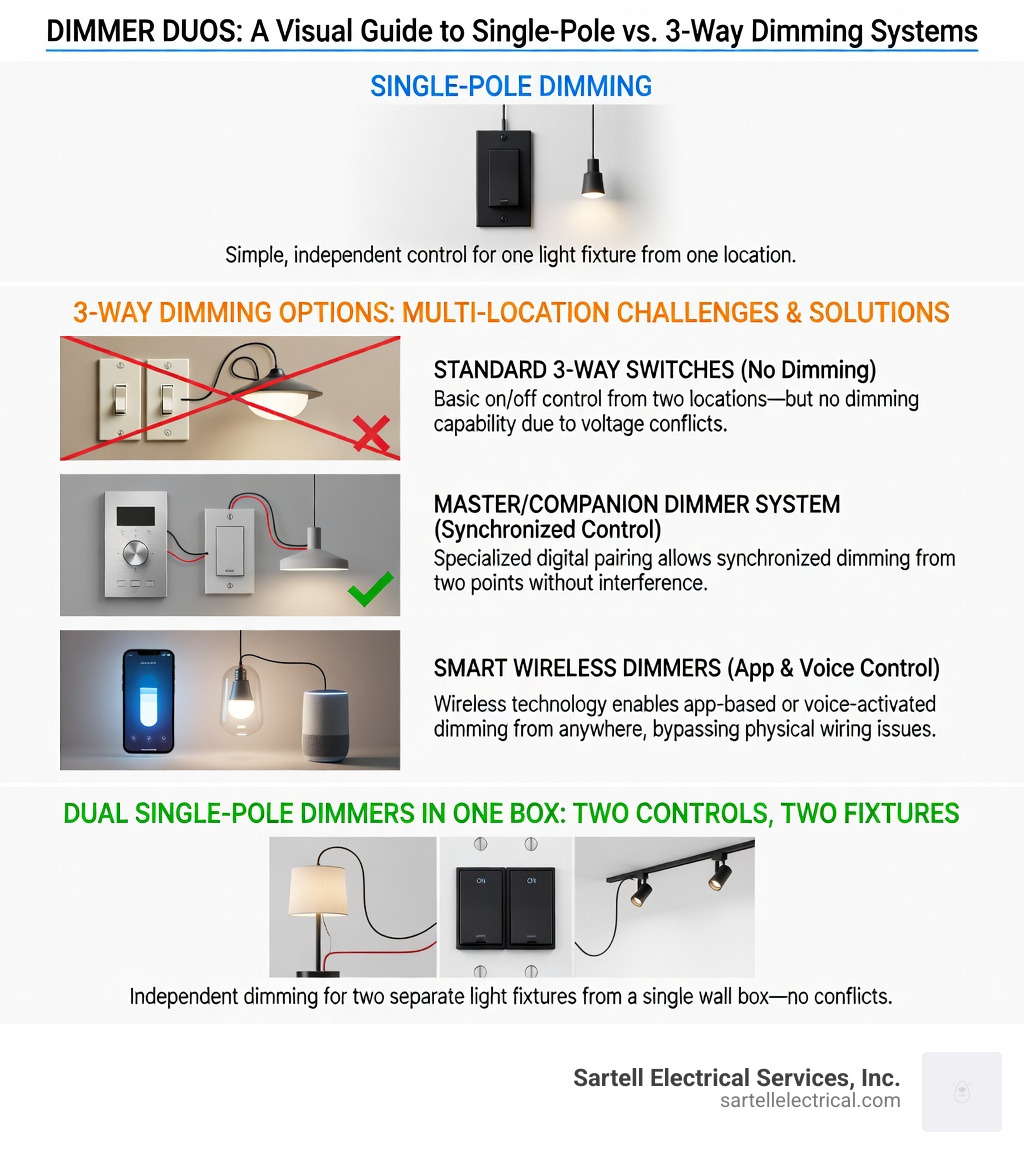
- Yes – You can use specialized master/companion dimmer pairs designed for 3-way circuits
- Yes – You can use smart wireless dimmers that communicate digitally
- Yes – You can install 2 dimmers one switch box to control two separate light fixtures
The confusion around 2 dimmers one switch scenarios is one of the most common electrical questions we encounter. When someone searches for this, they're usually asking one of two things: Can I dim a single light from two different locations? Or can I install two dimmer switches in the same electrical box?
The short answer is that standard dimmer switches conflict with each other when wired in a traditional 3-way setup. The electronic components inside each dimmer create voltage interference that prevents proper operation—often resulting in lights that won't turn on, flicker constantly, or fail to dim at all.
However, specialized systems exist that solve this problem. Master/companion dimmer pairs use digital communication to synchronize control. Smart dimmers bypass the issue entirely through wireless technology. And if you're trying to control two separate fixtures from one box, standard dimmers work perfectly fine.
I'm Ed Sartell, and I've been solving complex electrical challenges like 2 dimmers one switch configurations since founding Sartell Electrical Services in 1985. Whether it's coordinating multi-location lighting controls for commercial facilities or troubleshooting dimmer conflicts in institutional settings, proper system design prevents costly callbacks and ensures reliable operation.
Important 2 dimmers one switch terms:
The Technical Conflict of 2 Dimmers One Switch
When you try to wire two standard, off-the-shelf dimmers to control a single light fixture, you aren't just doubling the convenience—you're creating a technical tug-of-war. Traditional dimmers work by "chopping" the electrical waveform. They literally turn the power on and off hundreds of times per second to reduce the total energy reaching the bulb.
If you put two of these devices in a series (which is how a 3-way circuit essentially functions), the second dimmer tries to chop a signal that has already been chopped by the first. This results in massive voltage interference and waveform distortion.
For a deeper look at how these currents interact, you can view an ac dimmer circuit diagram to see why the path of electricity becomes so unstable in these setups.
Why Standard Dimmers Fail in a 3-Way Setup
In a standard 3-way switch setup, you have "traveler" wires that pass the current back and forth between two locations. Standard dimmers are designed to receive a clean, full 120V signal. When one dimmer is turned down, the voltage traveling through those wires drops. The second dimmer, receiving this weakened signal, produces electronic noise and significant voltage drops.
Some manufacturers, like Varilight, have addressed this by creating master/slave technical combinations where the "slave" unit doesn't actually dim the power itself, but rather sends a signal to the "master" unit to tell it what to do. Without this specialized communication, the two dimmers will simply fight each other until the light flickers or the switches fail.
The Risks of Improper Installation
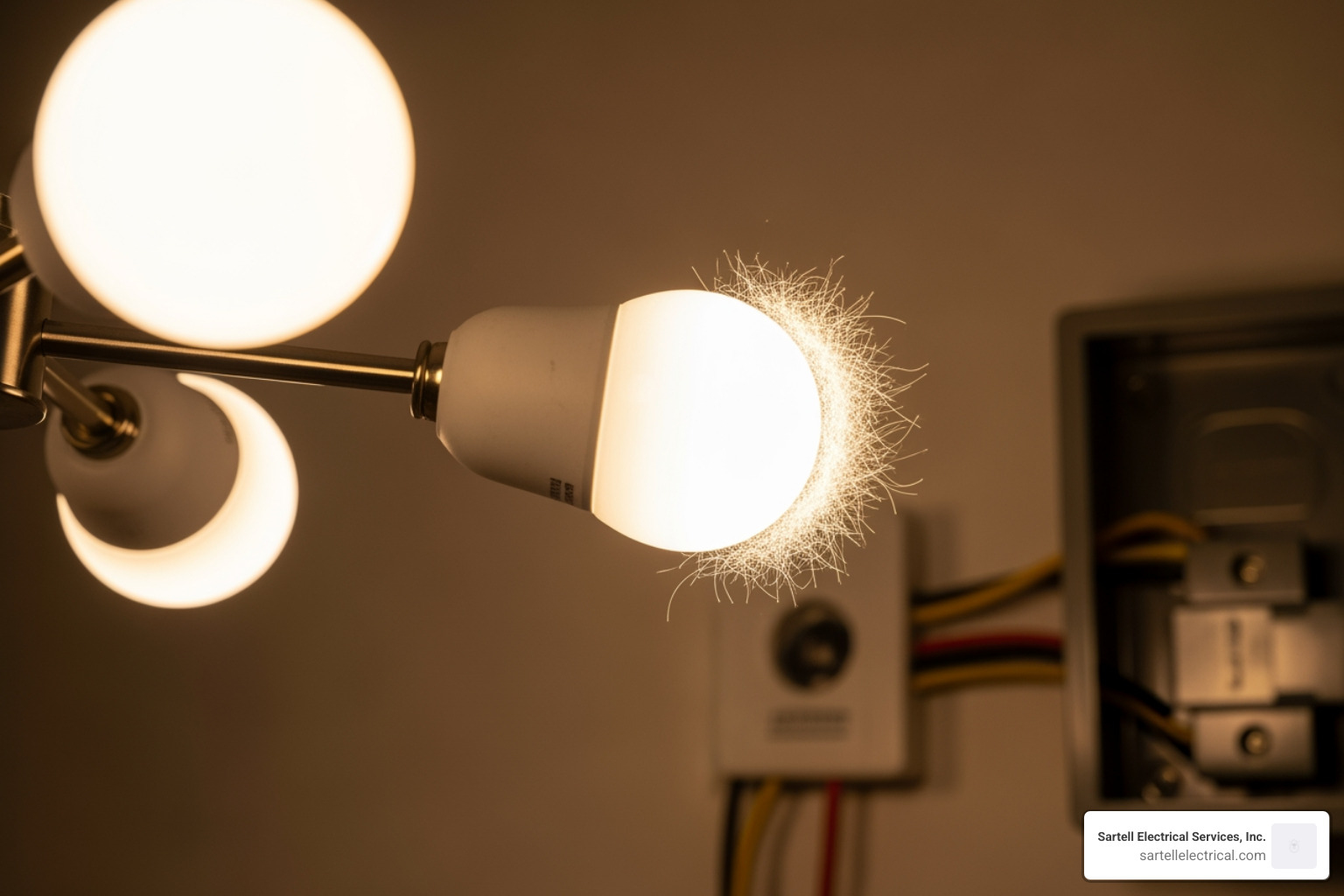
Attempting to force 2 dimmers one switch to work with incompatible hardware isn't just frustrating; it can be dangerous. Overheating is a primary concern. When electronic components are forced to handle distorted waveforms, they generate excess heat, which can become a fire hazard inside your wall box.
Furthermore, improper dimming significantly shortens the lifespan of your LED bulbs. If you've ever heard a buzzing sound coming from your ceiling, that's the internal components of the bulb vibrating under electrical stress. For safe practices, always review dimmer switch wiring guidelines before starting a project.
Specialized Systems for Multi-Location Dimming
If your goal is to have full dimming control at the bottom of the stairs AND the top of the stairs, you need a system designed for "multi-location dimming." This is where digital technology replaces simple mechanical chopping.
These systems often use a "Master" unit that handles the heavy lifting and one or more "Companion" or "Slave" units that act as remote controls. They are often used when wiring multiple lights from a single power supply to ensure the load is managed correctly across all control points.
Master and Companion Dimmer Systems
Digital dimmers communicate via a "traveler" wire, but instead of carrying the actual load of the light, they carry a low-voltage digital signal. When you tap the companion dimmer to brighten the room, it sends a data packet to the master unit. The master unit then adjusts the voltage output to the fixture. This ensures that the electrical waveform remains consistent, no matter which switch you touch.
Smart Dimmers and Wireless Solutions
The modern solution to the 2 dimmers one switch dilemma is smart technology. Devices like the Shelly Dimmer 2 or Lutron Caseta systems allow you to have one "wired" dimmer and several "wireless" remotes.
According to Shelly Dimmer 2 technical specifications, these devices can operate with a wireless range of up to 50 meters outdoors and 30 meters indoors. They are particularly useful for older homes in Massachusetts—like those in Reading or Andover—where the original wiring might lack a neutral wire. The Shelly Dimmer 2 can even work without a neutral line, provided the load is at least 20W.
Step-by-Step: Installing a 3-Way Dimmer Duo
Before you touch a single wire, safety is paramount. Always turn off the circuit breaker and use a multimeter to verify that the power is truly off.
Wiring 2 Dimmers One Switch for Separate Fixtures
Sometimes, when people ask about 2 dimmers one switch, they actually mean they have two separate light fixtures (like a set of pendants and some recessed cans) and they want to control both from a single double-gang box.
In this scenario, you are essentially performing two single-pole installations side-by-side. You will often find a "shared hot" wire coming into the box. You'll pigtail this hot wire to both dimmers, then connect the separate "switched hot" (usually red or black) wires from each light fixture to the respective dimmer. For a visual guide, check out our resource on how to connect multiple light switches.
Neutral Wire Requirements and Modern Code
If you are installing modern smart dimmers or master/companion sets, you must pay attention to the National Electrical Code (NEC). Modern standards generally require a neutral wire (usually white) at every switch location, even if the current switch doesn't use it. This ensures that future smart home upgrades have the power they need to operate.
When working with 3-way circuits, you'll typically use 14/3 cable, which includes a black, white, red, and bare copper ground wire. Following wiring wonders installing your 3 way dimmer switch like a pro will help you stay code-compliant and safe.
Troubleshooting and LED Compatibility
LED bulbs have made dimming more complex. Unlike incandescent bulbs, which are simple resistors, LEDs have internal drivers that can be very picky about the type of power they receive.
| Feature | Single Dimmer + 3-Way Switch | Master/Companion Set | Smart/Wireless Dimmer |
|---|---|---|---|
| Dim from both ends? | No (Only one location) | Yes | Yes |
| Wiring Complexity | Standard 14/3 | Specific (requires travelers) | Low (can be wireless) |
| LED Compatibility | High (if LED rated) | High | Very High |
| Cost | Lowest | Moderate | Highest |
| Wattage Range | 150W - 600W | 150W - 1000W | 10W - 200W+ |
Solving LED Flickering and Buzzing
If you experience flickering, it is often because the load is too low. Many dimmers require a minimum load to stay stable. For example, the Shelly Dimmer 2 requires at least 10W for dimmable LEDs. If your single high-efficiency bulb only draws 8W, the dimmer might "ghost" or flicker.
Additionally, you must match the dimmer type to the bulb:
- Leading Edge: Best for traditional incandescent bulbs.
- Trailing Edge: Generally better for LEDs and electronic transformers to prevent buzzing.
Pros and Cons of Multi-Location Dimming
The biggest "pro" is convenience. Being able to dim the lights from the comfort of your bed or the entrance of a large room adds a touch of luxury and energy efficiency. The "con" is usually the hardware cost and the installation complexity. In older homes across Middlesex and Essex counties, the existing wiring may not always support these advanced systems without a professional upgrade.
Frequently Asked Questions about 2 Dimmers One Switch
Can I use two standard dimmers on the same light?
No. Using two standard dimmers on a single 3-way circuit will cause them to interfere with each other. This results in flickering, buzzing, or the lights failing to turn on entirely. You must use one dimmer and one standard 3-way switch, or a specialized master/companion pair.
What is a companion dimmer switch?
A companion dimmer (sometimes called a slave dimmer) is a remote control unit that looks like a dimmer but doesn't actually regulate the power itself. It sends a signal to a "master" dimmer located elsewhere in the circuit, allowing you to adjust brightness from multiple locations safely.
Do I need special bulbs for 3-way dimming?
You don't need "3-way bulbs" (those are for old-fashioned 3-way lamps), but you DO need bulbs labeled as "Dimmable." This is especially true for LEDs. If you use a non-dimmable LED on a dimmer circuit, the bulb's internal driver will likely burn out or flicker violently.
Conclusion
Navigating 2 dimmers one switch configurations doesn't have to be a headache. Whether you're looking to upgrade your home in Reading, MA, or managing a large commercial project in Boston, the key is choosing the right technology for the job. While standard dimmers can't share a circuit, modern master/companion systems and smart wireless solutions offer seamless, flicker-free control from anywhere in the room.
At Sartell Electrical Services, Inc., we bring over 30 years of experience to every project, ensuring your lighting is not only beautiful but safe and code-compliant. From simple residential upgrades to complex industrial installations throughout Massachusetts, our commitment to excellence remains the same.
If you're ready to upgrade your home’s lighting or need a professional to troubleshoot a conflicting dimmer setup, we're here to help. More info about residential electrical services is available on our website, or you can contact us directly to schedule a consultation with our expert team. Let us help you find the perfect "dimmer duo" for your space.