AC Dimmer Circuit Diagram: Safe & Smart 2025
Why Understanding AC Dimmer Circuits Matters for Your Projects
An
ac dimmer circuit diagram is your roadmap to controlling AC power to lights, motors, and other devices by adjusting the voltage delivered to the load. Here's what you need to know:
Quick Answer: What an AC Dimmer Circuit Diagram Shows
- Main Components: TRIAC (bidirectional switch), DIAC (trigger device), resistors, capacitors, and a potentiometer for adjustment
- How It Works: The circuit "chops" the AC sine wave using phase control, delivering only a portion of each cycle to the load
- Key Function: The potentiometer adjusts when the TRIAC fires during each AC cycle, controlling how much power reaches your bulb or motor
- Safety Feature: Optocouplers provide galvanic isolation between low-voltage control circuits and dangerous mains voltage
- Output: Variable AC voltage from near-zero to full mains power (120V or 220V depending on your region)
Whether you're installing lighting controls in a commercial building, troubleshooting a dimming system in a healthcare facility, or planning electrical upgrades for an industrial project, understanding how these circuits work is essential. The principle is simple: by controlling
when the TRIAC switches on during each AC cycle, you control
how much power flows to your load.
Dimmer circuits come in many forms—from basic TRIAC/DIAC designs for incandescent bulbs to sophisticated microcontroller-based systems for complex loads. The basic circuit uses an RC timing network with a potentiometer to charge a capacitor until it reaches the DIAC's breakover voltage, which then triggers the TRIAC to conduct. More advanced designs incorporate zero-crossing detection and digital control for precise, flicker-free dimming.
The catch? Not all dimmers work with all loads. Standard TRIAC dimmers excel with resistive loads like incandescent bulbs but can struggle with inductive loads (motors, transformers) or electronic loads (most LEDs and CFLs). Triac dimmer circuits also generate RF interference that requires proper filtering, and working with mains voltage demands strict safety precautions.
As Ed Sartell, I've overseen countless electrical installations since founding Sartell Electrical Services in 1985, and I've seen how understanding an
ac dimmer circuit diagram helps facility managers and contractors make informed decisions about lighting control systems. My goal here is to break down these circuits in plain language so you can confidently discuss dimming solutions with your electrical contractor or evaluate system specifications for your next project.
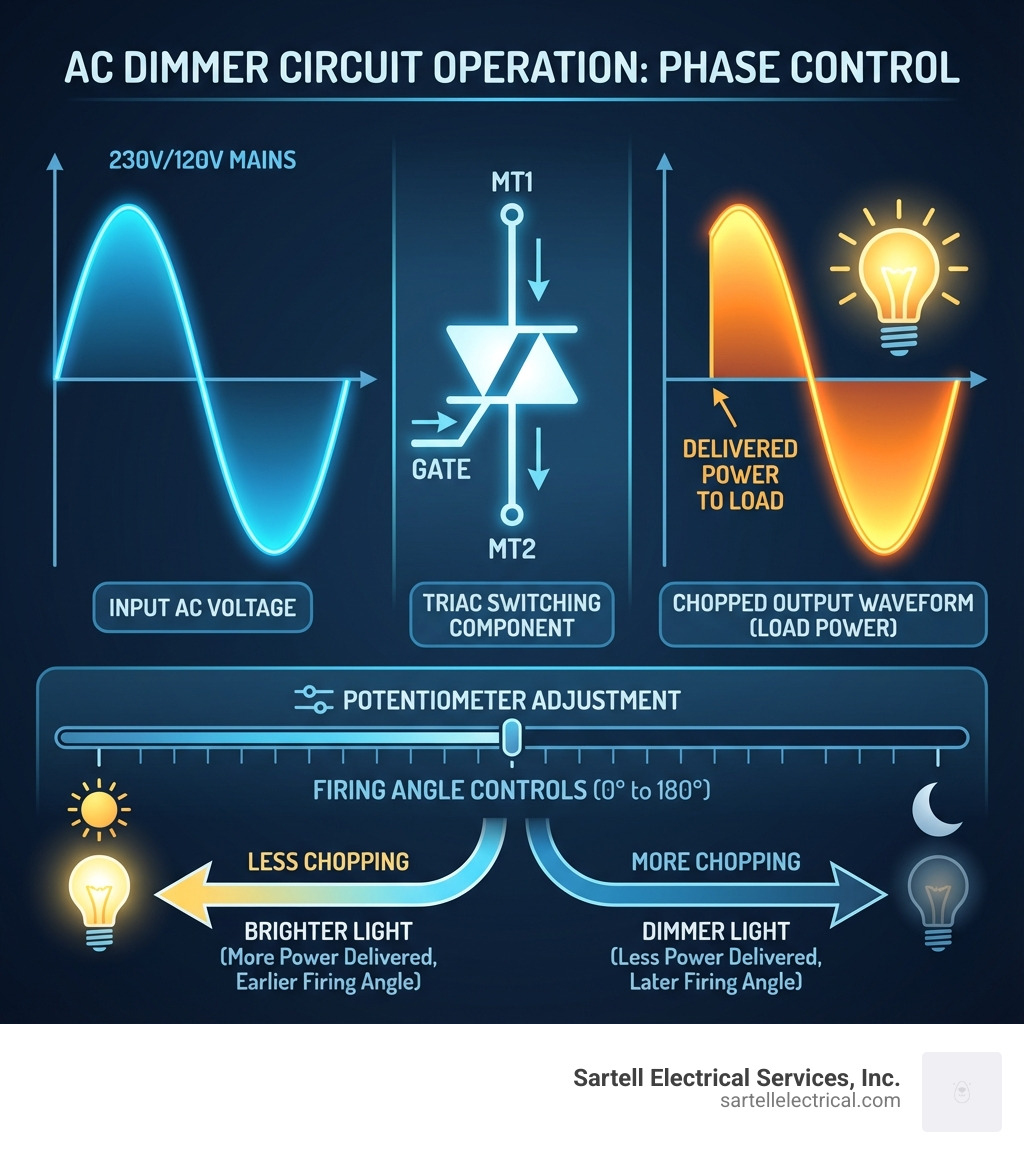
Dissecting the AC Dimmer Circuit Diagram: Key Components
When we look at an
ac dimmer circuit diagram, we're essentially looking at a clever arrangement of electronic components designed to manipulate the alternating current (AC) waveform. These components work in harmony to control the power delivered to a load, like a light bulb or a motor. Let's shine a light on the main players.
The Heart of the Dimmer: The TRIAC
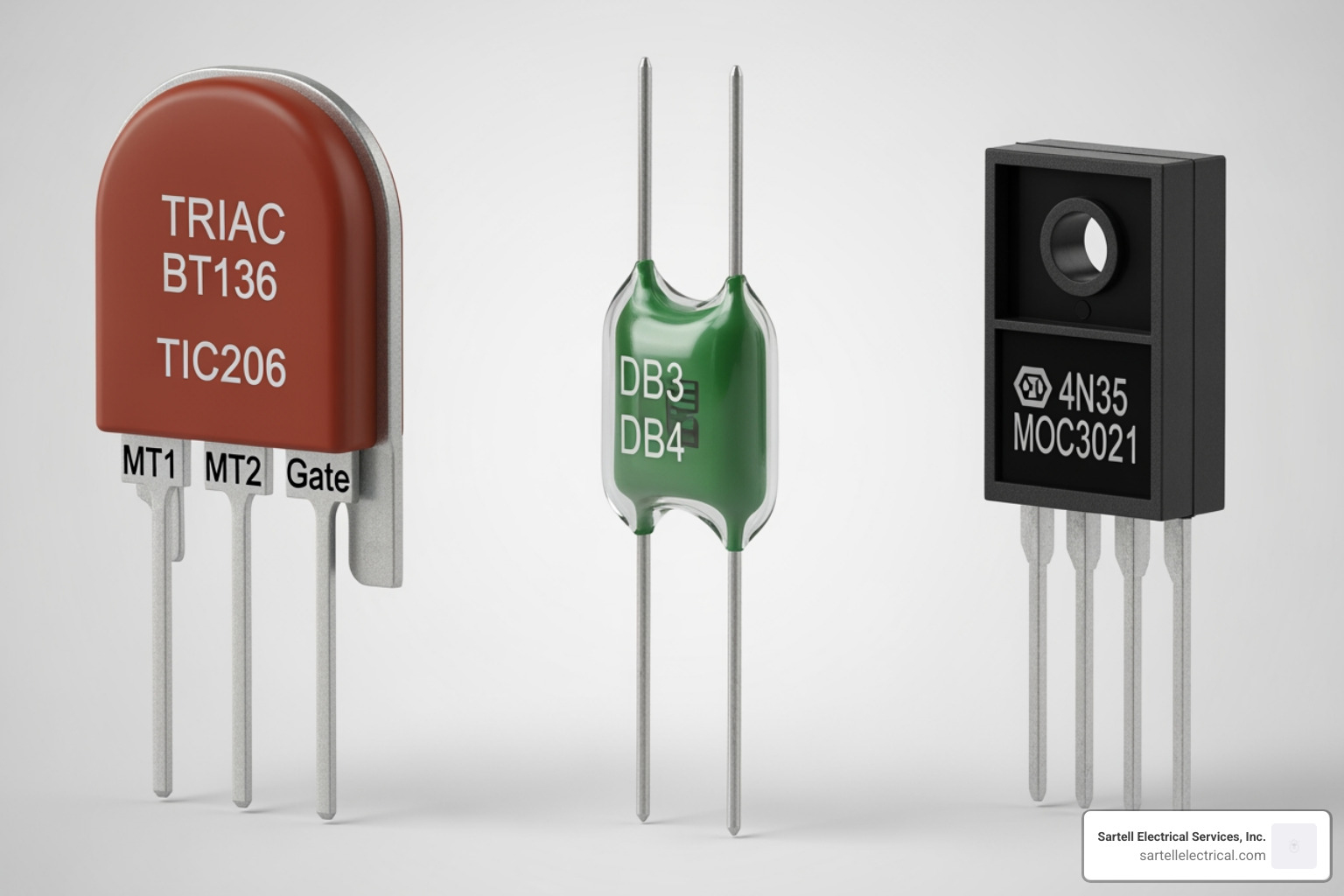
At the core of most AC dimmer circuits, we find the TRIAC (Triode for Alternating Current). Think of the TRIAC as the main gatekeeper, a semiconductor device capable of switching AC loads ON and OFF in response to an external trigger. What makes it so popular for dimming is its ability to conduct current in both directions, making it ideal for AC circuits.
Here's how it works:
A TRIAC has three terminals: Main Terminal 1 (MT1), Main Terminal 2 (MT2), and a Gate terminal. When a small current pulse is applied to the Gate, the TRIAC turns on and allows current to flow between MT1 and MT2. The magic of dimming happens because the TRIAC doesn't turn on immediately. Instead, we control
when it turns on during each half-cycle of the AC sine wave. This is called "phase control." By delaying the turn-on point, we "chop" off a portion of the AC waveform, effectively reducing the average power delivered to the load.
Did you know? TRIACs are popularly applied for regulating an AC, such that the output to the load may be reduced to any desired value. They are very commonly used in dimmer switch applications where the circuit is designed to make the device switch in such a manner that it conducts only for a particular section of the AC sine wave and remains cut OFF during the remaining parts of the sine wave. This makes them the least expensive power switch to operate directly on the 110V/240V mains. For those considering
residential electrical upgrades, understanding TRIACs can be quite illuminating!
The Trigger Man: The DIAC
While the TRIAC does the heavy lifting of controlling the AC current, it needs a reliable trigger to tell it
when to turn on. That's where the DIAC (Diode for Alternating Current) steps in. The DIAC is a two-terminal, bidirectional semiconductor switch that remains in a non-conducting (off) state until the voltage across it reaches a specific breakover voltage. Once this voltage is exceeded, the DIAC rapidly switches to a conducting (on) state, allowing a pulse of current to flow.
In a typical TRIAC-based dimmer circuit, the DIAC is connected to the TRIAC's Gate terminal. An RC (Resistor-Capacitor) network charges a capacitor. When the voltage across this capacitor reaches the DIAC's breakover voltage, the DIAC fires, sending a sharp current pulse to the TRIAC's gate. This pulse triggers the TRIAC into conduction, and it stays on until the AC current through it drops to zero at the end of the half-cycle. This symmetrical switching characteristic of the DIAC ensures that the TRIAC fires consistently in both positive and negative half-cycles of the AC waveform.
Ensuring Safety: Optocouplers and Isolation
When we build or work with AC dimmer circuits, especially those controlled by low-voltage electronics like microcontrollers, safety is paramount. This is where optocouplers become our unsung heroes. An optocoupler, also known as an opto-isolator, provides galvanic isolation between two circuits. This means there is no direct electrical connection between the low-voltage control side (like an Arduino) and the high-voltage mains AC side.
How do they work their magic? An optocoupler typically contains an LED on the input side and a photodetector (like a phototransistor or phototriac) on the output side, all housed within a single package. When current flows through the input LED, it emits light, which is detected by the photodetector. This light then switches the photodetector on, effectively transferring a signal from one circuit to another without any electrical contact.
For instance, an
ac dimmer circuit diagram might show a 4N25 optocoupler used for zero-crossing detection, where the mains 220V voltage is led through resistors to a bridge rectifier that gives a double-phased rectified signal to the optocoupler. Another common type is the MOC3021, which is a random-fire phototriac driver, perfect for triggering a power TRIAC at a specific point in the AC cycle. This isolation is absolutely critical to protect sensitive control electronics from high voltage spikes and, more importantly, to protect us from dangerous electric shocks. You can find more details on this concept at
AC Dimmer Circuit | DXARTS: Digital Arts & Experimental Media.
The Supporting Role: SCRs
While TRIACs are the go-to for full-wave AC control, sometimes you'll encounter SCRs (Silicon-Controlled Rectifiers) in dimmer-like applications. An SCR is a unidirectional semiconductor switch, meaning it allows current to flow in only one direction once triggered. Because of this, an SCR can only control one half of the AC sine wave. If we wanted full-wave control with SCRs, we'd typically need two of them configured in anti-parallel, which is essentially what a TRIAC is internally!
SCRs are often used in high-power applications where their robust nature is an advantage. An SCR can be used for high current applications as well, provided the ratings are appropriately chosen. For example, an SCR AC light dimmer circuit could control illumination up to 1000 watts. However, their unidirectional nature means that simple SCR dimmers often result in "half-wave dimming," which can be less smooth than full-wave TRIAC dimming and may cause flicker or humming in some loads. It's an older technique for dimming, but still relevant in specific industrial contexts.
From Simple to Smart: Building Your Dimmer Circuit
Now that we've met the main characters, let's see how they come together to form functional dimmer circuits. From basic, hands-on projects to sophisticated microcontroller-driven systems, the journey of an
ac dimmer circuit diagram is quite fascinating.
A Simple AC Dimmer Circuit Diagram
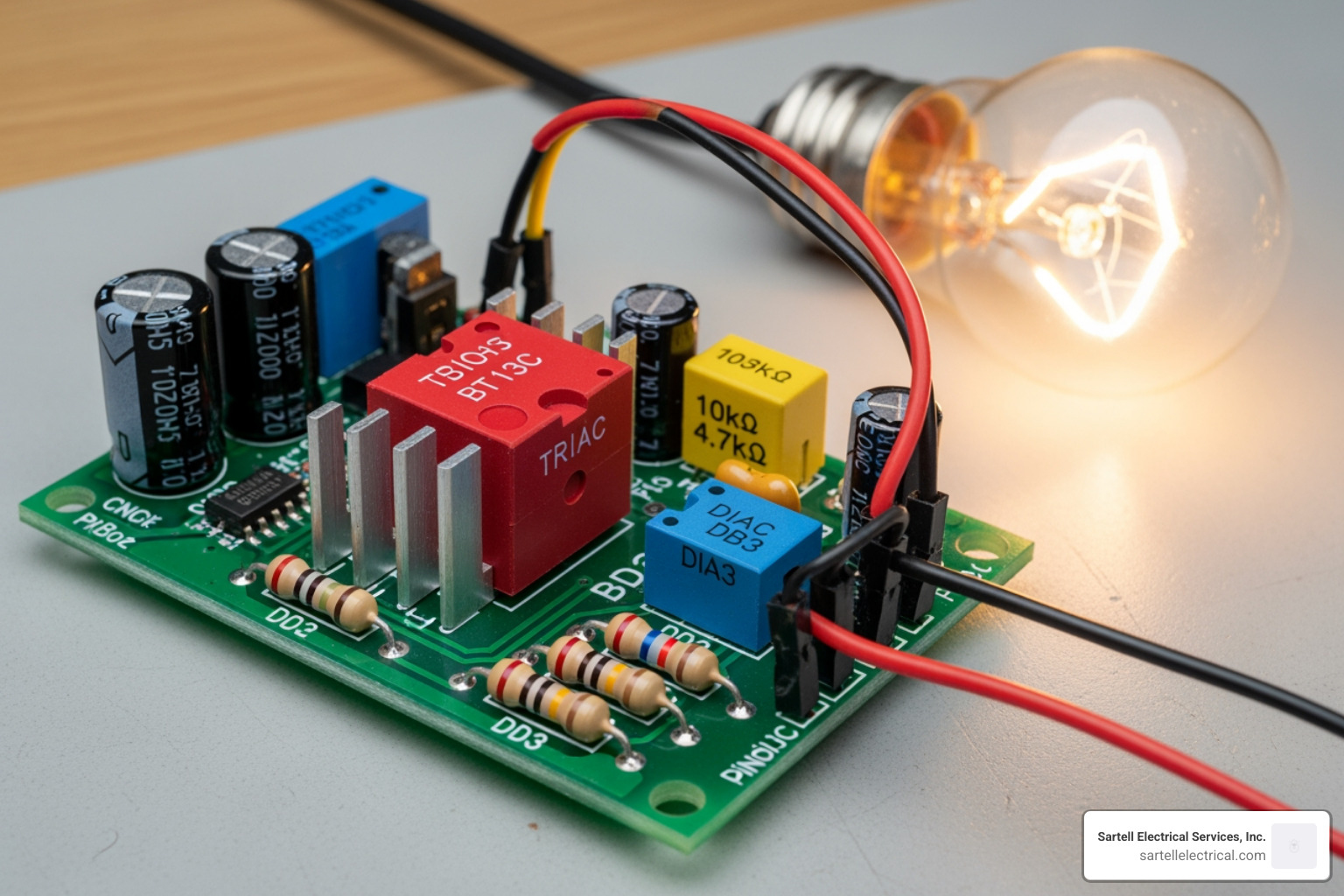
The simplest AC dimmer circuit often relies on a TRIAC and DIAC, controlled by an RC (Resistor-Capacitor) timing network. This design is foundational and a great starting point for understanding the principles. A 220V dimmer switch circuit is basically a TRIAC/DIAC based AC mains voltage regulator circuit which can be used for controlling the intensity of an incandescent bulb.
Here's a typical setup for a simple 220V/120V dimmer:
- VR1 (Potentiometer): A variable resistor, typically 220K or 470K linear. This is your primary control, allowing you to adjust the brightness. You could even use two 100K pots in series if a single 220K isn't available.
- R1, R2, R3, R4 (Fixed Resistors): For current limiting and establishing the timing network. Values like 15K, 330K, 33K, 100 Ohms are common.
- C1, C2, C3 (Capacitors): Polyester or metallized polypropylene capacitors are used, typically 0.022uF/250V or 0.1uF/400V. These charge and discharge to control the DIAC firing. Using 100nF capacitors instead of 0.022uF might affect the minimum adjustment range; the load might reach minimum (0V) before the pots can.
- DIAC (e.g., DB3): The trigger for the TRIAC.
- TRIAC (e.g., BT136): The main switching element.
- L1 (Inductor, optional): A 40uH inductor can be included for filtering.
When you turn the potentiometer (VR1), you change the resistance in the RC network. This alters the time it takes for the capacitor to charge to the DIAC's breakover voltage. A shorter charging time means the TRIAC fires earlier in the AC cycle, delivering more power and making the light brighter. A longer charging time delays the TRIAC's firing, reducing power and dimming the light. It's a simple yet effective dance between resistance, capacitance, and voltage thresholds.
An Improved Dimmer Design
While the basic TRIAC/DIAC circuit is functional, it can have some drawbacks, especially when dealing with inductive loads or when RF interference is a concern. Inductive loads, like motors or transformers, can return stored energy to the supply rails, which can affect the smooth operation of simpler dimmer circuits.
One significant issue with TRIAC dimmer circuits is their property of generating a lot of RF disturbances in the air while operating. This "noise" can interfere with other electronic devices. Therefore, an RC network (often called a "snubber circuit") becomes imperative with these dimmer switches for reducing the RF generations. This snubber circuit, typically a resistor and capacitor in series across the TRIAC, helps to suppress voltage spikes and smooth out the switching action, leading to less interference.
Improved designs often incorporate additional capacitors and resistors to allow the DIAC to be fired with consistent, short bursts of voltage. This results in smoother TRIAC transitions, which can lead to better performance and reduced flickering, especially with certain loads. For more in-depth exploration of advanced
ac dimmer circuit diagram designs, you can check out resources like
AC Light Dimmer Circuit.
The Modern Approach: Microcontroller-Based AC Dimmer Circuit Diagram
For ultimate control, flexibility, and integration into smart home systems, we turn to microcontroller-based AC dimmer circuits. These designs leverage the power of microcontrollers like Arduino, PIC, or STM32C0 to achieve precise and programmable dimming.
The core idea remains phase control, but instead of an analog RC network determining the firing point, a microcontroller handles the timing. This requires a few key elements:
- Zero-Crossing Detection: The microcontroller needs to know exactly when the AC waveform crosses zero volts. This acts as a synchronization point.
- Optocoupler Isolation: As discussed, an optocoupler (often a random-fire type like MOC3021) provides crucial galvanic isolation, protecting the low-voltage microcontroller from the high-voltage mains.
- Timer Interrupts: The microcontroller uses precise timer interrupts to measure a specific delay after each zero-crossing. Once this delay elapses, it sends a pulse through the optocoupler to trigger the TRIAC.
The advantages are significant:
- Precision: Microcontrollers allow for hundreds of brightness levels (e.g., 128 levels), offering very smooth dimming transitions.
- Programmability: You can implement features like soft-start, fade-in/fade-out, remote control (via Wi-Fi, Bluetooth, or MQTT), and even respond to sensors.
- Efficiency: Logic-level or SNUBBERLESS TRIACs can operate with low gate current and can be directly triggered by the MCU, simplifying the circuit.
- Versatility: In a TRIAC-based controller, the output power, and for instance, motor speed, are controlled by the phase delay of the TRIAC drive. This means power is controlled by the phase delay (td) of the TRIAC drive.
For anyone looking into sophisticated lighting controls or smart home integration, understanding these microcontroller-driven systems is key. It's a significant step beyond traditional switches and opens up a world of possibilities for
dimmer switch wiring in modern homes and businesses.
Advanced Dimming Concepts and Common Challenges
Delving deeper into AC dimming, we encounter different approaches and potential pitfalls. Choosing the right dimmer for the right load is critical for optimal performance and longevity.
| Feature |
Leading-Edge Dimming (TRIAC-based) |
Trailing-Edge Dimming (MOSFET/IGBT-based) |
| Switching Point |
Cuts power at the beginning of each AC half-cycle |
Cuts power at the end of each AC half-cycle |
| Components |
Primarily TRIACs, DIACs, RC networks |
MOSFETs, IGBTs, more complex control circuitry |
| Waveform |
Abrupt voltage cut-off, creating a "chopped" leading edge |
Smoother voltage cut-off, creating a "chopped" trailing edge |
| Load Suitability |
Incandescent, Halogen, some inductive loads (motors, transformers), older magnetic low-voltage transformers |
Dimmable LEDs, CFLs, electronic low-voltage transformers, resistive loads |
| Noise/Interference |
Can generate significant RF interference and acoustic noise (humming) |
Generally generates less RF interference and acoustic noise |
| Soft Start |
Typically not inherent, can be added with complex circuitry |
Often includes a "soft start" feature, extending lamp life |
| Complexity |
Simpler circuit design |
More complex circuit design |
Phase-Cutting: Leading Edge vs. Trailing Edge
The way an AC dimmer chops the sine wave defines its type. We primarily categorize them into two groups: leading-edge and trailing-edge dimmers.
Leading-Edge Dimming: This is the traditional method, most commonly associated with TRIAC-based dimmers. A leading-edge dimmer cuts parts off the beginning of the sine wave. The TRIAC is triggered at some point after the zero-crossing, and it conducts current until the next zero-crossing. This creates an abrupt voltage rise, which can sometimes cause audible humming in inductive loads or generate RF interference. These dimmers are excellent for resistive loads like traditional incandescent and halogen bulbs.
Trailing-Edge Dimming: A trailing-edge dimmer is a considerably more complex circuit, typically using MOSFETs or IGBTs as switching elements. Instead of cutting off the leading part of the waveform, it allows the voltage to rise normally and then cuts off the
trailing part of the sine wave. This results in a much smoother voltage transition. Most trailing-edge dimmers have another useful function — at least when used with incandescent lamps. The circuitry is designed to provide a 'soft start' feature, which gradually applies power to the bulb, extending its lifespan. Trailing-edge dimmers are generally preferred for modern electronic loads like dimmable LED and CFL bulbs, as well as electronic low-voltage transformers, due to their smoother operation and reduced noise.
Zero-Crossing Detection Explained
For any precise AC dimming, especially with microcontroller control, knowing exactly when the AC voltage crosses zero is paramount. This is the role of a zero-crossing detector.
A zero-crossing detector circuit provides a precise timing reference for the microcontroller, indicating the start of each AC half-cycle. Without this, the microcontroller wouldn't know when to begin its delay timer to fire the TRIAC, leading to inconsistent dimming, flickering, and potentially increased interference.
A common way this circuit works is by taking the mains 220V voltage through a resistor divider (e.g., two 30k resistors) to a bridge rectifier. This rectified signal is then fed to an optocoupler (like a 4N25 or H11AA1). As the AC voltage approaches and crosses zero, the input to the optocoupler drops, causing its output to switch. This generates a short pulse that the microcontroller can detect as the zero-crossing event. The 'bridge and opto-coupler' circuit is specifically used for zero-crossing detection. The resistor value should be as low as possible to avoid a wide zero-crossing signal, ensuring accuracy.
Common Problems: RFI, Flickering, and Load Compatibility
While AC dimmers offer fantastic control, they aren't without their quirks. We often encounter a few common challenges:
- RF Interference (RFI): As mentioned, TRIAC dimmer circuits have the property of generating a lot of RF disturbances in the air while operating. This can manifest as static on radios or interference with other sensitive electronics. An RC snubber network becomes imperative with these dimmer switches for reducing the RF generations. Capacitors are included in the design to filter the AC power and prevent interference in the control signals.
- Flickering: A flickering light is a tell-tale sign of an unhappy dimmer circuit or an incompatible load. This can be caused by poor zero-crossing detection, incorrect timing in microcontroller-based systems, or simply trying to dim a bulb that wasn't designed for it.
- Load Compatibility: This is perhaps the biggest headache. "Only regular incandescent lamps are truly suitable for dimming" with simple TRIAC circuits. LEDs and CFLs have complex internal electronics and often require specific "dimmable" versions and compatible trailing-edge dimmers to avoid issues like buzzing, flickering, or premature failure. PWM dimming, as in LEDs, is not done frequently with AC loads for a number of reasons related to the AC sine wave.
- Handling Inductive Loads: Inductive loads (motors, transformers) present a challenge because they store energy and can create voltage spikes when switched. This can stress the TRIAC. SNUBBERLESS TRIACs, like the T1635H-8T, have been specially designed to drive loads which generate very strong dynamic constraints, such as a vacuum cleaner motor. For light dimmers with resistive loads, dynamic constraints are lower, so a logic-level TRIAC (T810T-8T) can be used.
Safety First: Working with Mains Voltage
We cannot stress this enough: working with AC mains voltage (120V or 220V) is inherently dangerous and carries a significant risk of electric shock, which can be fatal. This circuit is safe if it is built and implemented only by people who know what they are doing.
Here are critical safety precautions we always adhere to:
- Always Disconnect Power: Before touching any part of an AC dimmer circuit, ensure the mains power is completely disconnected at the breaker.
- Galvanic Isolation: Always use optocouplers to ensure complete electrical separation between any low-voltage control circuitry and the high-voltage AC side. This is your primary defense against shock.
- Proper Enclosures: Once assembled, the entire circuit, especially any exposed high-voltage components, must be housed in a non-conductive, fire-resistant enclosure. Exposed wiring is an accident waiting to happen.
- Fuses: Always incorporate an appropriately rated fuse in series with the input supply line. A fuse protects the circuit and, more importantly, prevents fire hazards in case of a short circuit or component failure. For example, for a 100W lamp at 220V, a 0.45A or 0.5A fuse is needed.
- Component Ratings: Ensure all components (resistors, capacitors, TRIACs, DIACs) are rated for the full mains voltage and expected current. Over-specifying voltage ratings is a good safety practice.
- Professional Expertise: If you're unsure about any aspect of working with mains electricity or installing these circuits, do not proceed. Electrical work, especially with high voltages, is best left to licensed professionals. For complex installations or if you're ever unsure about your home's wiring or the proper integration of dimming systems, please consult with us. We regularly perform electrical safety checks for residential, commercial, and industrial clients across Massachusetts.
Frequently Asked Questions about AC Dimmers
Why can't I use a standard dimmer circuit for most LED or CFL bulbs?
Most simple TRIAC dimmers are leading-edge and designed for resistive loads like incandescent bulbs. LEDs and CFLs have complex internal electronics and often require specific trailing-edge or PWM-compatible dimmers to avoid flickering, buzzing, or damage.
What is Pulse Skip Modulation (PSM) and how is it different from phase-cutting?
PSM controls power by skipping entire AC cycles, turning the load on and off rapidly. Phase-cutting chops a portion out of each AC half-cycle. PSM is less common for lighting as it can cause noticeable flicker, while phase-cutting provides smoother dimming.
Why does my multimeter show a higher voltage on the dimmer's output than the wall outlet?
Standard multimeters are designed to measure pure sine waves. A dimmer circuit "chops" the AC waveform, creating a distorted signal. This can confuse the meter, leading to inaccurate and often surprisingly high voltage readings. A True RMS multimeter is needed for an accurate measurement.
Your Next Step in Lighting Control
From the foundational components like TRIACs and DIACs to the sophisticated control offered by microcontrollers, understanding an
ac dimmer circuit diagram reveals the clever engineering behind modern lighting and power management. We've explored how phase control works, the differences between leading-edge and trailing-edge dimming, and the critical role of safety measures like galvanic isolation and proper fusing.
Whether you're a hobbyist experimenting with circuits or a facility manager overseeing complex electrical systems, the principles of AC dimming are a valuable tool. However, the importance of safety when working with AC mains cannot be overstated. For complex installations, troubleshooting existing systems, or if you're ever unsure about implementing an AC dimmer, professional help is essential.
At Sartell Electrical Services, Inc., we provide expert installation and troubleshooting for all your home's lighting and electrical needs. Our team, serving Massachusetts communities from Boston to Andover, Cambridge to Woburn, and beyond, is committed to excellence and safety in every project.
Learn more about our residential electrical services and how we can help you achieve optimal lighting control in your home.