
When Your Switch Box Has No Neutral Wire: What You Need to Know
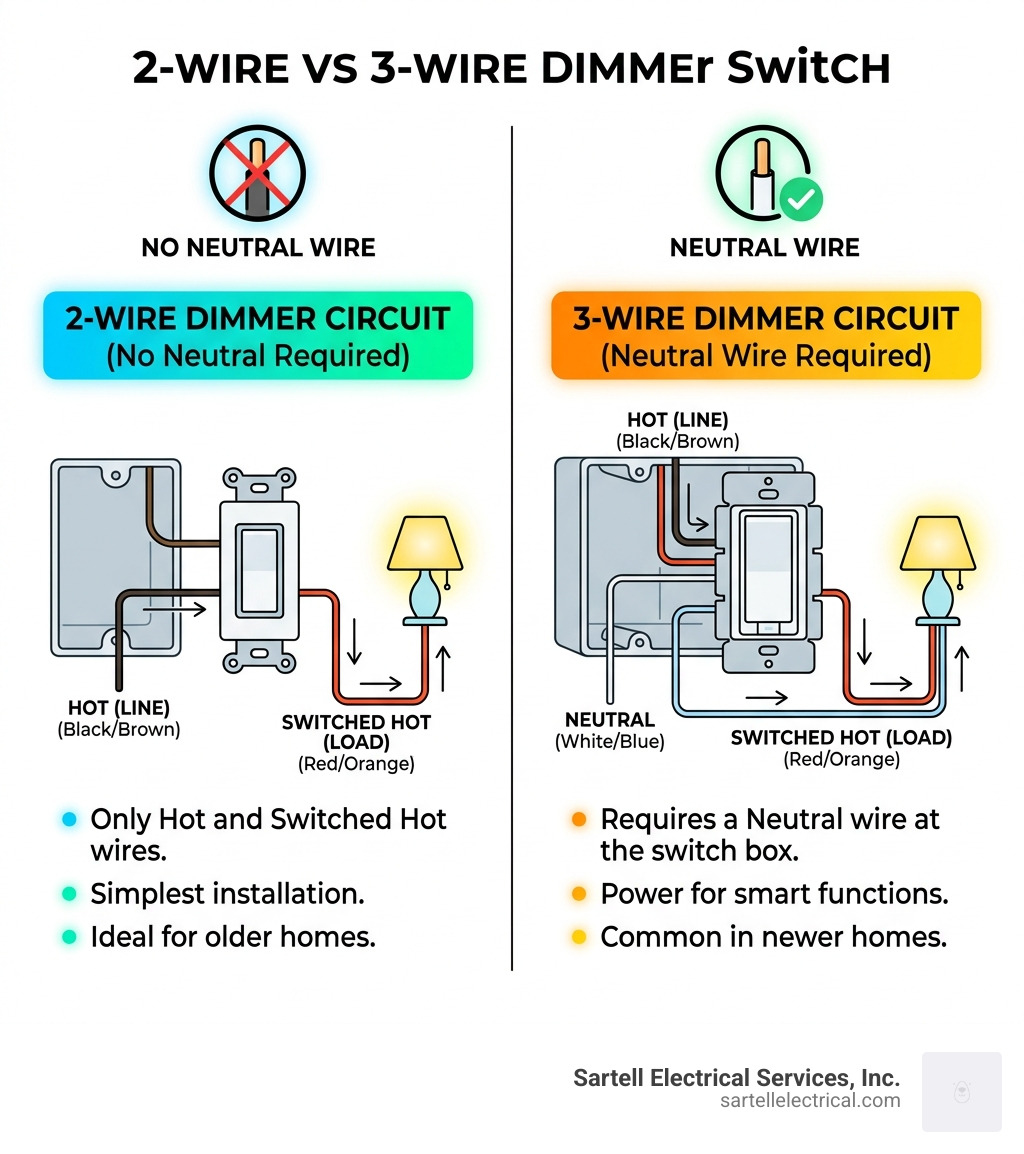
A 2 wire dimmer switch is the go-to solution when your wall switch box contains only two wires — a hot (line) and a switched hot (load) — with no neutral wire present. This is extremely common in older homes, where wiring was routed in a "switch loop" that never brought the neutral to the switch box.
Here's a quick answer to what you need to know:
| Question | Answer |
|---|---|
| What is a 2-wire dimmer? | A dimmer that needs only a line and load wire — no neutral required |
| Where is it used? | Older homes with switch loops; any box missing a neutral wire |
| Compatible bulbs? | Incandescent, halogen; select dimmable LEDs (check rating) |
| Can it be smart? | Yes — Zigbee and mesh-based smart dimmers work without neutral |
| DIY or professional? | Simple swaps are DIY-friendly; complex or older wiring needs a pro |
Many homeowners discover this gap only when they try to upgrade to a smart or modern dimmer — and the installation instructions call for a neutral wire that simply isn't there. It can be a frustrating surprise. But the good news is that purpose-built 2-wire dimmers solve this problem without rewiring your home.
I'm Ed Sartell, President of Sartell Electrical Services, and I've been working with residential and commercial wiring across Massachusetts since 1985 — including hundreds of 2 wire dimmer switch retrofits in older homes that predate modern neutral-at-box requirements. In this guide, I'll walk you through everything you need to make the right call for your project.
2 wire dimmer switch further reading:
Understanding the 2 Wire Dimmer Switch and How It Works
To understand why a 2 wire dimmer switch is so special, we first have to look at how a standard switch works. In a traditional electrical setup, the switch acts like a gatekeeper on the "hot" wire. When the gate is closed, power flows to the light; when it's open, the light goes out.
A standard smart switch or a high-end electronic dimmer usually needs its own power to stay "alive" so it can talk to your Wi-Fi or run its internal computer. This constant power usually comes from a neutral wire. However, if you live in one of the beautiful historic homes in Reading, North Reading, or Wakefield, there is a high chance your switch boxes only have two wires.
The 2 wire dimmer switch works by "leaking" a tiny, microscopic amount of current through the light bulb even when the switch is technically off. This current is so small that it doesn't light up an incandescent bulb, but it's enough to keep the dimmer's internal electronics running. You can find more technical details on the ac dimmer circuit diagram page.
Identifying Your Wiring
Before you run out to buy a new switch, we need to know what’s inside your wall. In many older Massachusetts homes, you’ll see two black wires (or one black and one white wire that has been "re-identified" with black tape).
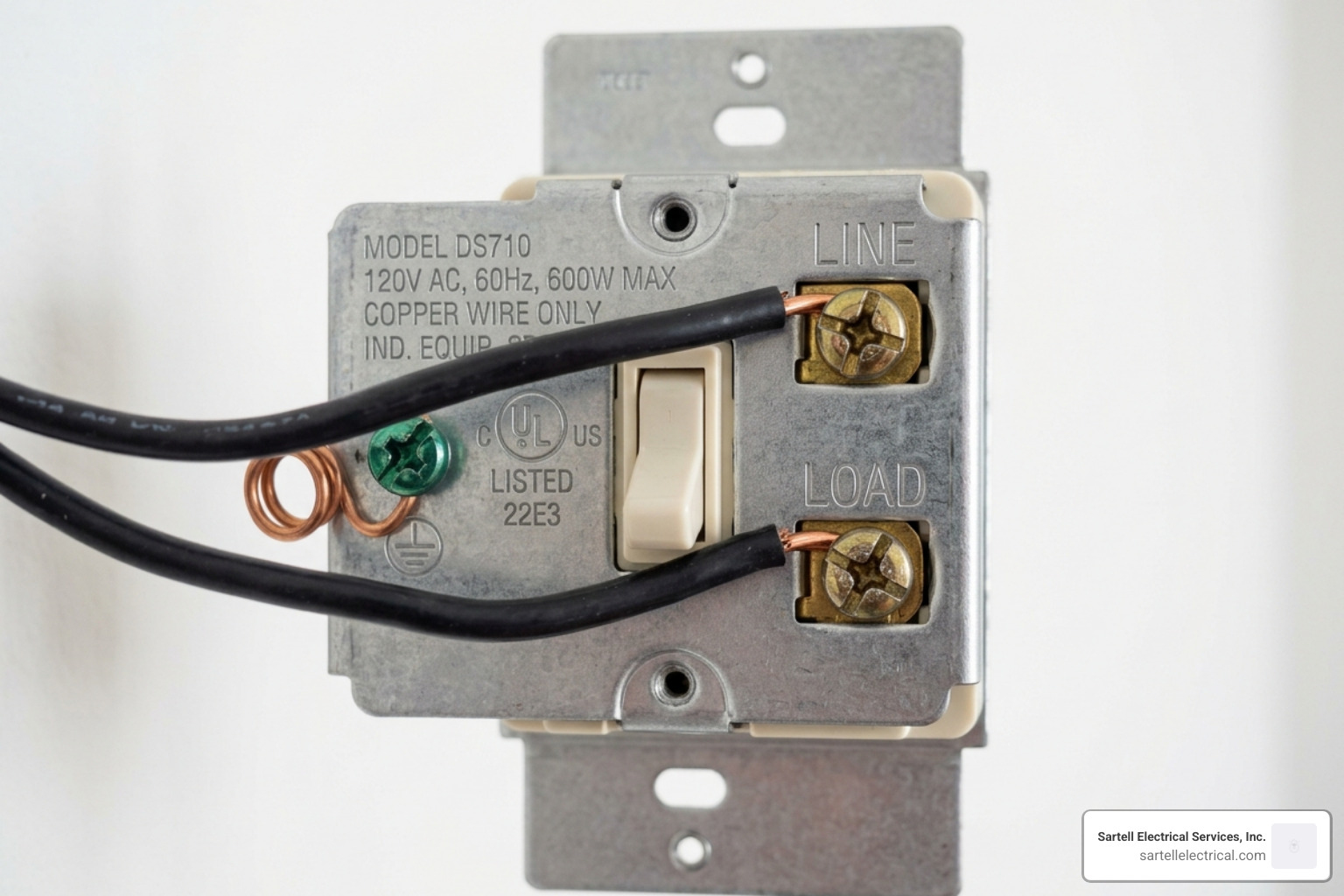
- Line Wire (Hot): This is the wire bringing power from your circuit breaker panel.
- Load Wire (Switched Hot): This wire carries the power from the switch to the light fixture.
- Ground Wire: Usually a bare copper or green wire. A ground wire is not the same as a neutral wire!
To safely identify these, we use a voltmeter. With the breaker on and the switch off, the "Line" wire will show voltage (usually around 120V), while the "Load" wire will show zero. If you're uncomfortable doing this, that's exactly why we're here to help. Modern codes (post-2011 NEC) require a neutral wire in most switch boxes, but for older installations, the 2-Wire Dimmer Switch | No Neutral Wire Setup Required is often the most cost-effective path.
Compatibility: LED, Incandescent, and Halogen Loads
Compatibility is the biggest hurdle when choosing a 2 wire dimmer switch. Because these switches "leak" current to stay powered, they can play tricks on modern bulbs.
| Bulb Type | Compatibility Level | Notes |
|---|---|---|
| Incandescent | Excellent | Very reliable; no flickering. |
| Halogen | Excellent | Works just like incandescent. |
| Dimmable LED | Good to Fair | Requires a "dimmable" specific bulb; may flicker at low levels. |
| Non-Dimmable LED | Poor | Do not use; will flicker or fail to turn off. |
| CFL | Poor | Generally not recommended for 2-wire setups. |
The most common issue with LEDs on a 2-wire circuit is "ghosting." This is when the light stays very dimly lit even when the switch is "off" because that tiny bit of leaked power is enough to activate the efficient LED chips. To prevent this, many high-quality dimmers like those from Lutron or TOPGREENER include a "trim" adjustment to set the minimum light level. Check out our guide on dimmer switch wiring for more on matching loads.
Smart Home Integration Without a Neutral
Can you have a smart home without neutral wires? Absolutely. Brands like FIBARO and Insteon have mastered this. The Smart Light Dimmer - The Dimmer 2 | FIBARO is a fantastic example. It uses Z-Wave technology and a unique algorithm to detect the light source and calibrate itself automatically.
These smart dimmers often use a "bypass" (a small component installed at the light fixture) to help manage the current and prevent flickering. This allows you to use voice commands or phone apps to control your lights in a home built in the 1920s just as easily as one built in 2026!
Step-by-Step Installation Guide
If you've confirmed you have a single-pole setup (one switch controlling one light) and you're ready to proceed, follow these steps. If you have any doubts, especially with older wiring in towns like Salem or Gloucester where insulation can be brittle, give us a call.

Preparing for Your 2 Wire Dimmer Switch Install
- Safety First: Turn off the power at the main circuit breaker. Don't just flip the wall switch; go to the panel.
- Verify Power is Off: Use a non-contact voltage tester to ensure no power is flowing into the box.
- Remove the Old Switch: Unscrew the mounting screws and gently pull the switch out.
- Label Your Wires: Identify which is the Line (Power In) and which is the Load (Power to Light).
- Check the Box Depth: Dimmers are often "chunkier" than standard switches. Ensure there is enough room for the wires to tuck back in without pinching.
For a deeper dive into the speediest way to get this done, read how to wire dimmer switch fast by using simple steps.
Multi-Way Configurations
What if you have two switches controlling one light (a 3-way setup)? This gets a bit more complex. Traditional 3-way switches use "traveler" wires to communicate. Some smart 2-wire dimmers use "virtual travelers," where one main dimmer does the heavy lifting and a secondary "remote" switch sends a wireless signal to it.
If you are dealing with a 3-way setup, we highly recommend reading our specific guide on 3-way dimmer switch install to avoid crossing your wires and tripping the breaker.
Troubleshooting and Safety Considerations
Installing a 2 wire dimmer switch usually goes smoothly, but there are a few "ghosts in the machine" you should watch out for.
Troubleshooting Common Issues with 2 Wire Dimmer Switches
- Flickering: This usually means the bulb isn't compatible or the load is too low. Some dimmers require a minimum wattage (like 10W or 25W) to operate correctly. If your single LED bulb is only 6W, the dimmer might struggle.
- Humming Sounds: This is often caused by the rapid switching of power (Pulse Width Modulation) inside the dimmer. Switching to a higher-quality "dimmable" LED often solves this.
- Overheating: If the switch plate feels hot to the touch, you might be exceeding the wattage rating. If you have a "multi-gang" box (several switches together), you may need to "derate" the dimmer (reduce its max wattage) because the metal tabs are removed.
- Lights Won't Turn Off Completely: This is the "ghosting" we mentioned earlier. A bypass resistor installed at the fixture is the professional solution here.
Frequently Asked Questions
Can I use a 2-wire dimmer with any LED bulb?
Not exactly. You must use bulbs specifically labeled as "dimmable." Even then, some brands perform better than others. We often recommend Lutron-compatible LEDs for the best results in Massachusetts homes. If the bulb doesn't provide enough resistance, the dimmer's internal computer won't stay powered, leading to a strobing effect.
Why do my lights stay dimly lit when the switch is off?
This is caused by "current leakage." The 2 wire dimmer switch needs to pass a tiny amount of electricity through the bulb to keep its own "brain" working. Because LEDs are incredibly efficient, that tiny bit of power is sometimes enough to make them glow. Adding a "load resistor" or "bypass" at the light fixture provides a path for that extra energy so the bulb stays dark.
Is a 2-wire dimmer safe for older aluminum wiring?
This is a critical question for homeowners in certain parts of Middlesex and Essex County where aluminum wiring was common in the 60s and 70s. Aluminum wiring requires special care because it expands and contracts differently than copper. You cannot simply twist a standard dimmer’s copper leads onto aluminum house wires. This requires COPALUM crimping or specific Al/Cu rated connectors to prevent fire hazards. If you see "AL" on your wire jackets, please stop and call a professional.
Conclusion
Upgrading to a 2 wire dimmer switch is one of the most rewarding "quick fixes" you can do for your home's ambiance, especially if you're dealing with the constraints of older wiring. Whether you're looking for a simple slider or a high-tech Zigbee smart solution, there is a no-neutral option waiting for you.
At Sartell Electrical Services, Inc., we've spent over 30 years helping our neighbors from Reading to Boston and all across the Greater Boston area navigate these electrical hurdles. We know the local Massachusetts Electrical Codes inside and out, and we're committed to ensuring your home is both beautiful and safe.
Don't let a missing neutral wire dim your plans for a modern home. If you're ready to upgrade your lighting or need a hand troubleshooting a flickering fixture, we're here to help.
Schedule your professional dimmer switch wiring today and let us bring over three decades of excellence to your next project.