Industrial Electrical Equipment Repair: 3 Crucial Steps
Why Industrial Electrical Equipment Repair is Critical for Your Operations
Industrial electrical equipment repair is the systematic process of diagnosing, fixing, and restoring electrical components and systems within industrial facilities. Here's what it involves:
Key Equipment Types:
- Programmable Logic Controllers (PLCs)
- Variable Frequency Drives (VFDs)
- Motor control centers and switchgear
- Industrial power supplies and transformers
- Servo motors and control panels
Common Repair Services:
- Component-level fault diagnosis and repair
- Circuit board restoration and replacement
- System troubleshooting and performance testing
- Emergency breakdown response
- Preventative maintenance and inspections
Critical Benefits:
- Cost savings: Repair typically costs 30-50% less than replacement
- Faster turnaround: Most repairs complete in days vs. weeks for new equipment
- Extended asset life: Proper repair can add years to equipment lifespan
When industrial electrical equipment fails, the clock starts ticking. Research shows that
manufacturing downtime costs an average of $5,600 per minute, making quick, reliable repair essential for profitability.
Electrical systems are the backbone of modern industry. From the PLCs controlling production lines to the VFDs regulating motor speeds, every component is critical for operational efficiency.
I'm Ed Sartell, President of Sartell Electrical Services. Since 1985, my team has helped Massachusetts businesses with complex
industrial electrical equipment repair. Our experience shows that the right repair approach saves time and money while keeping your operations running smoothly.
Understanding Equipment Failures: What Breaks and Why?
Picture this: you're in the middle of a crucial production run when suddenly, everything stops. The silence is deafening, and you can almost hear money flowing out the door. When critical industrial equipment fails, understanding
what broke and why becomes your most urgent mission.
Think of
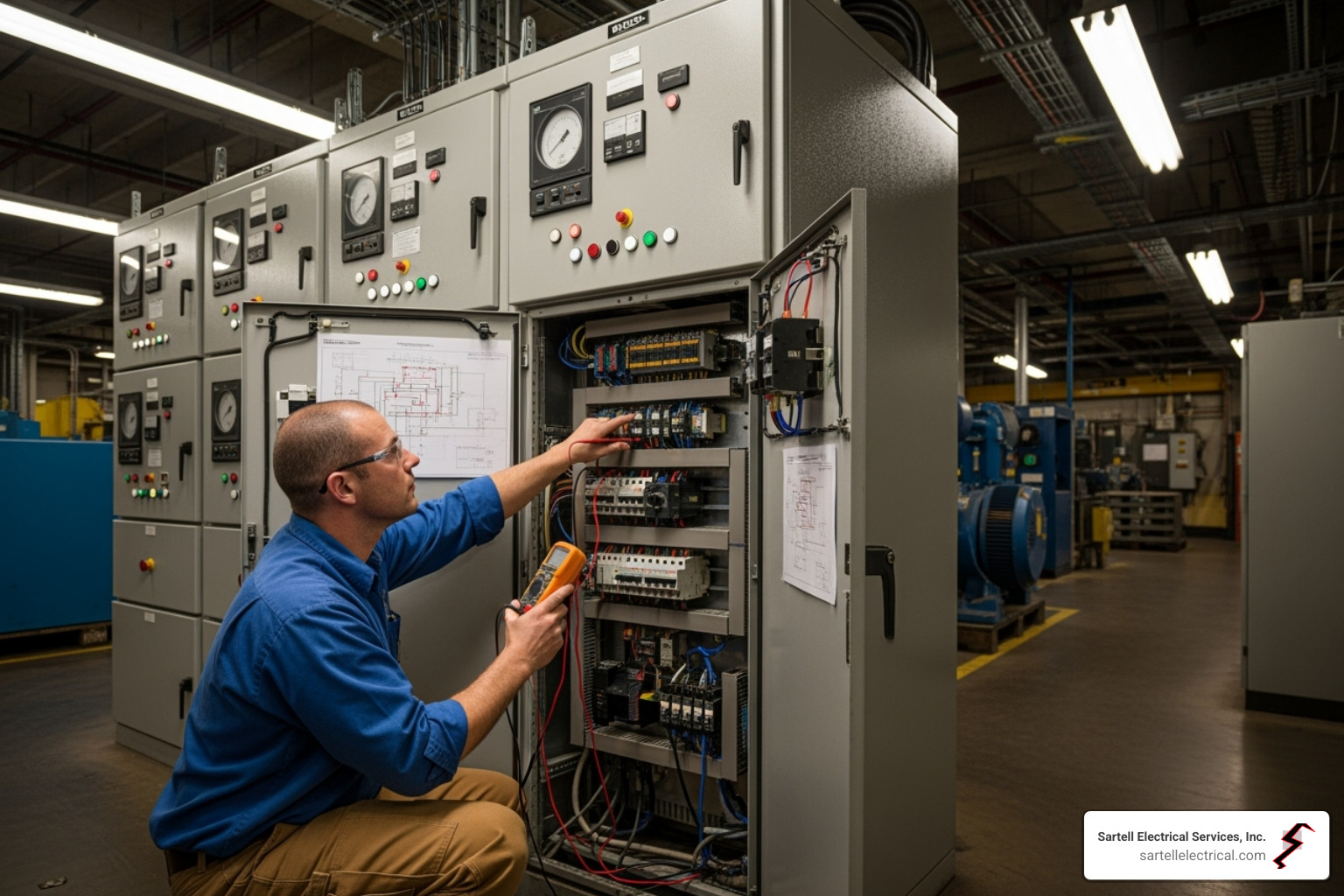
industrial electrical equipment repair like detective work. You're not just looking for what's obviously broken; you're digging deeper to find the root cause. That burnt relay might be the symptom, but what caused it to fail? Was it a power surge, poor ventilation, or simply age?
Your facility's environment—vibration, heat, or corrosive atmospheres—also contributes to wear and tear. Understanding these factors helps us not just fix the immediate problem but also prevent future failures.
Common Equipment Requiring Repair
Over my decades in the field, I've seen just about every type of industrial electrical equipment break down. Knowing what typically goes wrong can help you prepare.
Programmable Logic Controllers (PLCs) are the brains of your operation. When they fail, production can halt. Often, the issue is corrupted programming, which is why backups are critical to avoid weeks of downtime recreating lost logic.
Variable Frequency Drives (VFDs) control motor speed and are essential for energy efficiency. Their sensitive electronics are prone to heat and power quality issues, often requiring component-level repair.
Servo motors and drives are used in robotics and CNC machining for precision. Their complex feedback systems have unique repair needs, and failures immediately impact process accuracy.
AC and DC motors can fail due to bearing problems, winding shorts, or control circuit issues. Each type requires a different diagnostic and repair approach.
Industrial power supplies regulate power for control circuits. A single failure can cascade through multiple systems, making quick repair essential for stability.
Switchgear includes the breakers and fuses that protect your equipment. Faults can cause widespread outages or serious safety hazards, leading to shutdowns.
Control panels are the nerve centers of machinery, housing PLCs and other components. Problems can range from wiring faults to programming errors that need systematic troubleshooting.
Human-Machine Interfaces (HMIs) allow operators to interact with machinery. A malfunction can render equipment unusable, requiring specialized interface repair.
Circuit boards are the heart of many devices. Component-level repair is often more cost-effective than replacing an entire module.
The Leading Causes of Electrical Failure
After four decades of
industrial electrical equipment repair, I've learned that understanding why equipment fails helps prevent future breakdowns.
Power quality issues like voltage fluctuations, harmonics, and transients are a top cause of failure. They slowly damage sensitive electronics over time.
Component wear and tear is a fact of life. Capacitors dry out, contacts pit, and insulation degrades with age and use, a process that accelerates in older facilities.
Environmental factors such as extreme temperatures, humidity, dust, and vibration shorten equipment life. Heat is especially damaging. The Electrical Safety Authority also notes that even disuse can cause deterioration.
Lack of preventative maintenance allows small problems to become major failures. Proper preventive maintenance can reduce downtime by up to 25% and cut maintenance costs by 30%.
Improper operation, including human error or pushing equipment beyond its limits, can cause failures. These stresses often result in burnt components or tripped devices.
Mechanical failures often cause electrical problems. For example, a failing bearing can create vibrations that damage windings. Problems in one area quickly affect the other.
By identifying these root causes, we can fix the immediate problem and help you prevent it from happening again.
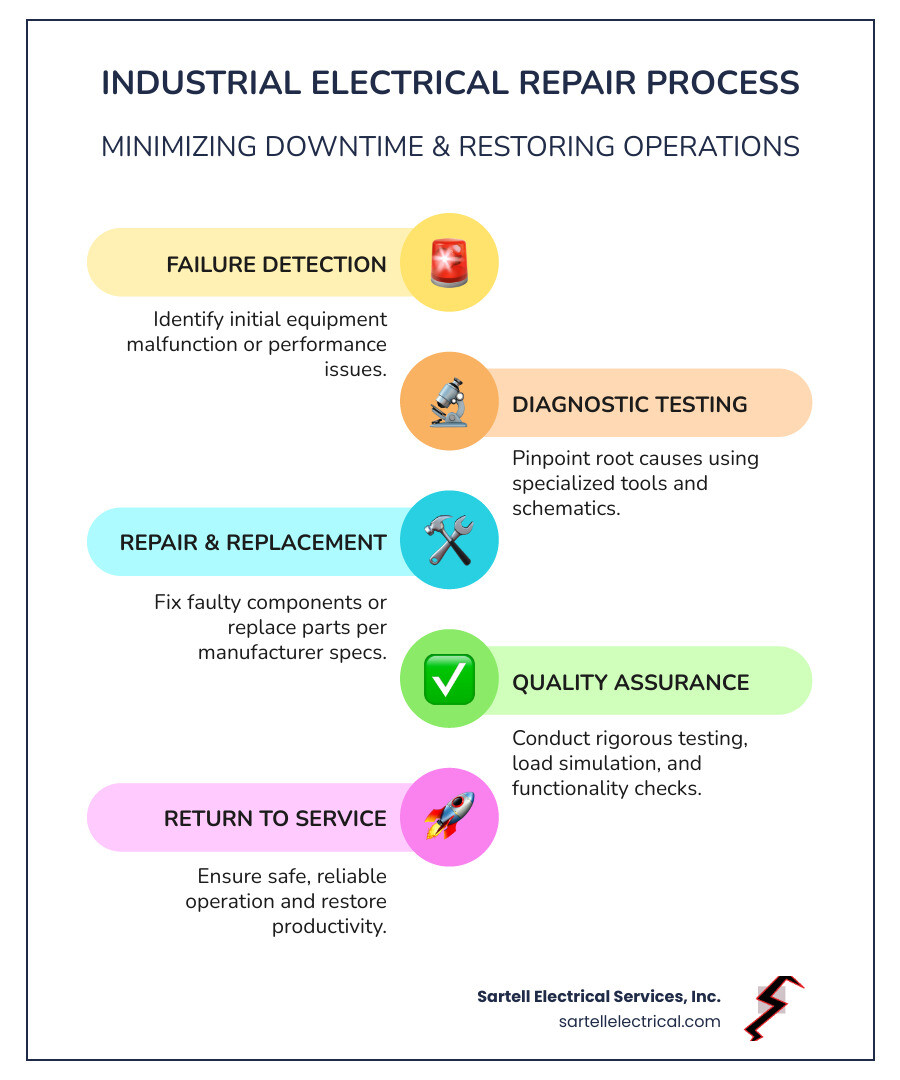
The Core Process of Industrial Electrical Equipment Repair
When your critical equipment fails, every minute counts. Our
industrial electrical equipment repair process is a systematic, three-step approach refined over decades to minimize your downtime and maximize reliability. We focus on root-cause analysis rather than just swapping parts, which is often ineffective and expensive. Detailed documentation creates a valuable history for your equipment, and safety protocols are fundamental to every step we take.

Step 1: Comprehensive Troubleshooting and Diagnostics
Effective repair starts with understanding exactly what went wrong and why. This diagnostic step prevents recurring issues. Our process begins by gathering information from your team, reviewing error codes, and understanding the circumstances of the failure. We then use specialized test equipment—from multimeters and oscilloscopes to thermal imaging cameras—and review schematics to identify the fault area. Our experience helps us distinguish symptoms, like a tripped breaker, from the root cause, such as an overloaded motor. This ensures we fix the underlying problem, not just the symptom.
Step 2: The Repair and Component Replacement
With the problem identified, our skilled technicians begin the repair. We prioritize
component-level repair on circuit boards and modules, which can save you significant money over full replacement. Instead of replacing an entire $5,000 drive, we can often replace a single failed capacitor. We use only OEM-specified or high-quality replacement parts to ensure longevity. Our technicians are skilled in precision soldering and circuit board work, adhering to all industry standards. Repairs also address related mechanical issues and always follow manufacturer specifications to ensure proper operation and safety.
Step 3: Rigorous Testing and Quality Assurance
A repair is only complete after rigorous testing and quality assurance. This step ensures reliability and separates professional
industrial electrical equipment repair from a temporary fix. We conduct comprehensive post-repair testing, including
load testing and
operational simulations, to verify that the equipment performs correctly under real-world conditions. This includes checking every feature, interlock, and safety system. Our final checks confirm the equipment is safe and reliable, meeting all regulatory requirements, including those from the Electrical Safety Authority, before it's returned to service. We stand behind our work, and this rigorous process is why.
The Strategic Decision: Repairing vs. Replacing Equipment
When equipment fails, you face the critical choice: repair or replace? There's no single right answer. The decision requires a
cost-benefit analysis that considers asset lifecycle, downtime, and long-term operational needs.
| Factor |
Repair |
Replacement |
| Cost |
Typically 30-50% less than new equipment |
High capital expenditure |
| Downtime |
Faster turnaround, days vs. weeks/months |
Lead times for new equipment can be extensive |
| Warranty |
Often comes with repair warranty (e.g., 2 years) |
Full manufacturer warranty |
| Equipment Age |
Good for mid-life equipment, extends utility |
Necessary for obsolete or severely damaged units |
| Efficiency |
Restores original efficiency |
Potential for improved efficiency with new tech |
| Availability |
Uses existing assets, no supply chain delays |
Subject to market availability and lead times |
The Financial Case for Industrial Electrical Equipment Repair
Financially,
industrial electrical equipment repair is often the best choice, typically costing 30-50% less than replacement. Key benefits include avoiding large capital expenditures, extending the life of existing assets, and a faster turnaround. Repairs are often completed in days, while new equipment can have lead times of weeks or even months, especially with current supply chain challenges. This speed advantage minimizes costly downtime and keeps your production lines moving.
When Replacement is the Smarter Choice
However, replacement is sometimes the wiser long-term decision. This is often true for
obsolete technology where parts and manufacturer support are unavailable. You should also consider replacement in these scenarios:
- Parts availability: Critical components are impossible to source.
- Catastrophic failures: Widespread damage from events like fire or internal explosions makes repair impractical.
- Energy efficiency gains: Newer models may offer significant operational savings that justify the investment.
- The 50-60% rule: When repair costs approach or exceed half the replacement cost, it's usually time to invest in new equipment.
Proactive Strategies: Prevention and Partnership
The best
industrial electrical equipment repair is the one you avoid entirely. Shifting from reactive maintenance (fixing what breaks) to a proactive strategy (keeping it running smoothly) prevents costly emergency shutdowns. This strategic approach requires a solid preventative maintenance program and the right expert partner.
The Power of a Preventative Maintenance Program
A solid preventative maintenance (PM) program gives you advance warning of potential issues, allowing you to schedule maintenance instead of reacting to emergencies. Key components include:
- Scheduled inspections: Trained technicians systematically look for early warning signs of trouble, like discolored connections or unusual vibrations.
- Cleaning and calibration: Regular cleaning removes dust and debris that cause overheating, while precise calibration ensures instruments and systems run at peak performance.
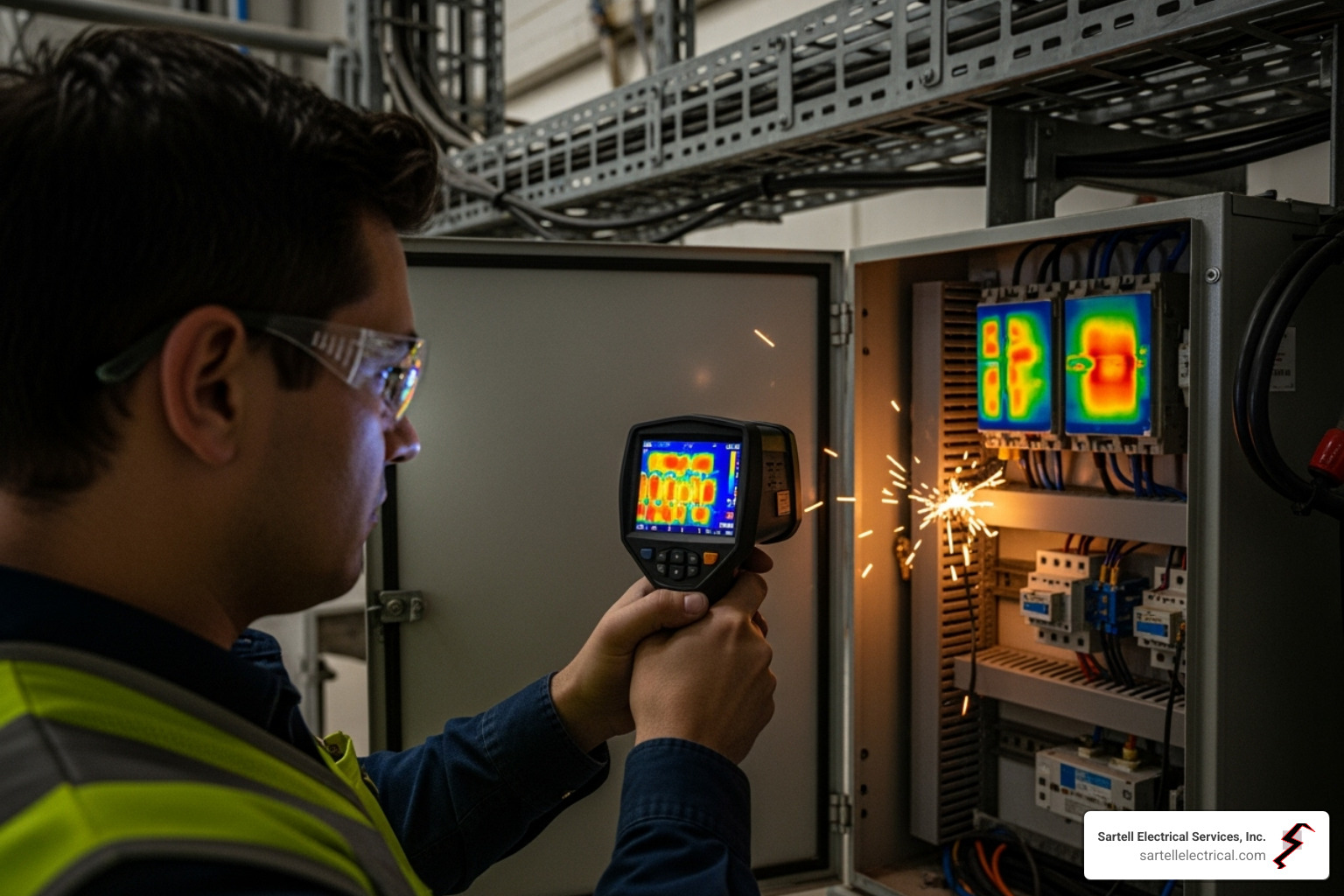
- Thermal imaging: This technology uses infrared cameras to detect hot spots caused by loose connections or overloaded circuits, allowing us to find problems before they cause a failure.
- Vibration analysis: Invaluable for rotating machinery, this technique detects changes in a machine's vibration signature that indicate bearing wear or misalignment.
These programs can
reduce failure rates by up to 25% and cut maintenance costs by 30%. Our
Industrial Power Monitoring System improves this by providing 24/7 oversight to spot inefficiencies and fine-tune maintenance.
Finding a Qualified Partner for Industrial Electrical Equipment Repair
Choosing a partner for your
industrial electrical equipment repair needs goes beyond finding a quick fix. You need a team with the expertise and commitment to safety to keep your operations running smoothly.
- Experience and certifications: Look for licensed electrical contractors with proven industrial experience and certifications like NFPA 70 and OSHA 10. As the Electrical Safety Authority emphasizes, only qualified professionals should perform this work.
- 24/7 emergency service: Failures don't keep business hours. A crucial feature is 24/7 emergency service with a live person ready to dispatch technicians immediately.
- In-house capabilities: A provider with in-house capabilities, such as component-level repair and specialized testing, can significantly shorten repair timelines from weeks to days.
- Safety record: A non-negotiable is an impeccable safety record and strict adherence to protocols like Lockout/Tagout. For more information, consult the Electrical Safety Authority resources.
As a local Massachusetts expert, Sartell Electrical Services offers rapid emergency response and deep knowledge of regional regulations. For over 30 years, from Boston—where we serve as an
Industrial Electrical Contractor Boston MA—to surrounding communities, we've been committed to keeping operations running smoothly with proactive maintenance and expert repair.
Frequently Asked Questions about Industrial Electrical Repair
When facing equipment failures, our clients often have similar, understandable concerns. Here are insights into the most common questions about
industrial electrical equipment repair.
What qualifications should a repair technician have?
A qualified technician should have a combination of formal training, specific expertise, and a commitment to safety. Look for:
- An electrician's license: This ensures foundational knowledge and compliance with electrical codes.
- Manufacturer-specific training: Technicians need specialized training for complex equipment like PLCs, VFDs, and servo motors.
- Experience with PLCs and VFDs: Expertise in troubleshooting logic, adjusting parameters, and resolving interface issues is crucial.
- A strong understanding of safety standards: Look for technicians with NFPA 70E knowledge and OSHA 10 certification. The ESA notes that competency in safe work practices is essential.
How can I minimize downtime during a repair?
Every minute of downtime costs money. Here are the most effective ways to minimize it:
- Partner with a service offering 24/7 emergency response: You need a team that can respond immediately, any time of day or night.
- Keep critical spare parts on hand: Stocking spares for components that fail frequently or have long lead times is insurance against extended shutdowns.
- Maintain updated system backups: Losing custom programming for PLCs or drives during a failure can turn a days-long repair into a weeks-long project.
- Work with a local contractor: A local partner like us in Woburn, MA offers faster response times and familiarity with your facility.
How does safety factor into the repair process?
Safety is absolutely critical in
industrial electrical equipment repair. Our process incorporates multiple layers of protection:
- Lockout/Tagout (LOTO) procedures: We strictly follow LOTO protocols to de-energize equipment and prevent accidental startup during repair.
- Personal Protective Equipment (PPE): Our technicians use appropriate PPE, including arc-rated clothing, insulated gloves, and safety glasses.
- Arc flash hazard analysis: For high-energy systems, we conduct an analysis to identify potential dangers and establish safe work boundaries.
- Adherence to all OSHA and ESA guidelines: We follow all regulations to ensure every repair is performed safely and correctly, using approved components and methods.
Conclusion
We've covered the essentials of
industrial electrical equipment repair, from diagnosing failures to the strategic choice between repair and replacement. The key takeaway is that smart repair is a strategic advantage that extends asset life and prevents costly shutdowns.
Choosing repair can save
30-50% on costs and get your equipment back online in days, not weeks. More importantly, a proactive approach with
preventative maintenance programs can reduce failures by up to 25%, turning emergencies into planned events.
Finding the right partner makes all the difference. You need an experienced team that understands the urgency and provides expert, safe solutions around the clock. For over three decades, Sartell Electrical Services has been that partner for businesses, ensuring their operations remain competitive and profitable.
Your electrical systems are the backbone of everything you do. They deserve expert care from people who understand their complexity and respect their critical role in your success.
For expert support with your facility's electrical systems, explore our comprehensive
industrial electrical services. We're here to help keep your operations running smoothly, safely, and profitably.