Why Electrical System Reliability Matters for Your Business and the Grid
Electrical system reliability is the ability of a power system to deliver electricity continuously and without interruption — to homes, businesses, hospitals, and industrial facilities — whenever it is needed.
Here is a quick breakdown of what it means and why it matters:
- What it is: The probability that your electrical system operates normally at any given moment
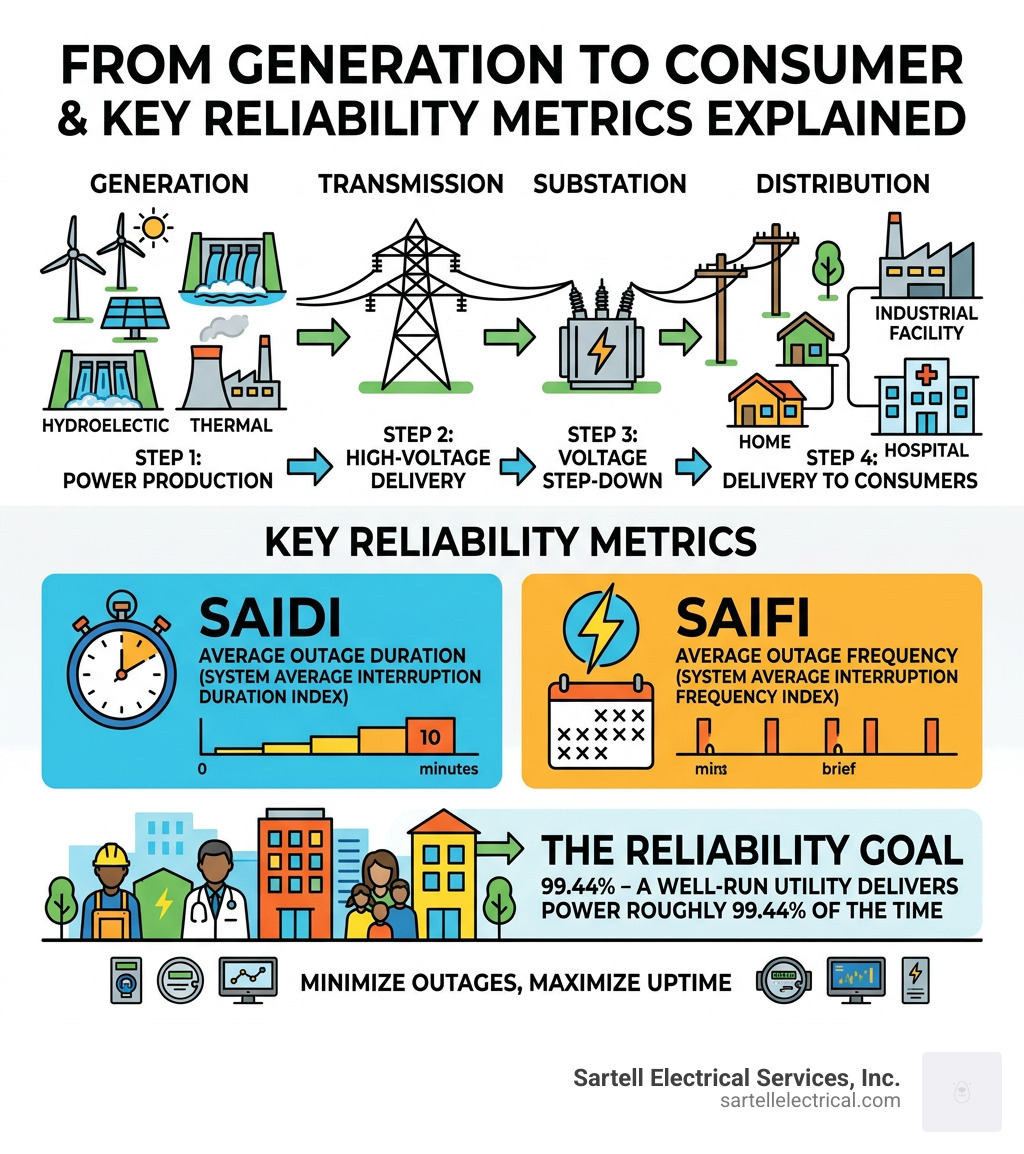
- How it's measured: Using metrics like SAIDI (average outage duration) and SAIFI (average outage frequency)
- Who oversees it: Regulatory bodies like FERC and NERC set and enforce mandatory standards
- Why it matters: A single daylong nationwide outage can erase 0.5% of the country's GDP
- Real-world benchmark: A well-run utility delivers power roughly 99.44% of the time
Most people don't think about their power until it goes out. But for commercial facilities, manufacturers, and healthcare operations, even a brief outage can mean scrapped processes, damaged equipment, and significant financial loss.
The grid is not a simple on/off switch. It is a massive, interconnected system — and its reliability depends on infrastructure quality, skilled personnel, smart technology, and strong regulatory oversight all working together.
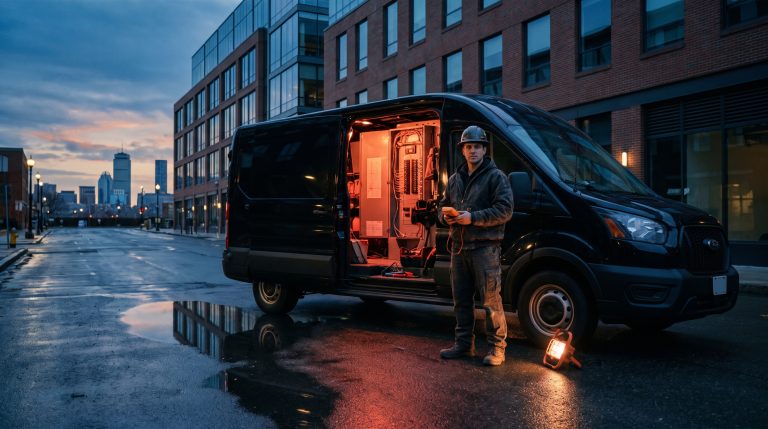
I'm Ed Sartell, President of Sartell Electrical Services since 1985, and over nearly four decades of electrical work across Massachusetts I've seen how electrical system reliability at the facility level directly mirrors the health of the broader grid. Whether it's aging panels, faulty wiring, or outdated distribution equipment, the vulnerabilities are often the same — and the stakes are just as high.
Electrical system reliability glossary:
- condition-based asset monitoring for electrical systems
- electrical asset management
- electrical network monitoring
Measuring Electrical System Reliability with SAIDI and SAIFI
When we talk about power system reliability, we aren't just making a guess about how "good" the power is. We use hard data to track performance. In the utility world, and even within large industrial complexes, we rely on specific indices to tell us the truth about our systems.
In 2023, data from utilities like EWEB showed a power availability rate of 99.44%. That sounds nearly perfect, right? But in critical electrical systems, that 0.56% of downtime represents nearly 50 hours of lost productivity, which can be catastrophic for a hospital or a data center.
To keep a pulse on this, the industry uses two primary "pulse points": SAIDI and SAIFI.
Understanding SAIDI and SAIFI in Electrical System Reliability
Think of these metrics as the "duration" and "frequency" of your electrical headaches.
- SAIDI (System Average Interruption Duration Index): This measures the average total duration of outages per customer over a year. For example, in 2023, a benchmark SAIDI metric was 48.56 minutes. This means the average customer was without power for just under an hour for the entire year.
- SAIFI (System Average Interruption Frequency Index): This measures how often the average customer experiences an outage. A 2023 benchmark for this was 0.376, meaning the average customer experienced less than one outage per year.
| Metric | What it Measures | 2023 Benchmark Example |
|---|---|---|
| SAIDI | Average outage duration (minutes) | 48.56 minutes |
| SAIFI | Average outage frequency (number) | 0.376 outages |
| Availability | Percent of time power is "on" | 99.44% |
These metrics are governed by the IEEE Guide for Distribution Reliability Indices, which provides the "apples-to-apples" comparison utilities need to justify infrastructure investments. If a circuit in Reading or Andover has a SAIDI score that starts climbing, we know it’s time to look at the industrial power monitoring system data and see what’s failing.
Primary Causes of Power Outages and Grid Disturbances
In our 30+ years serving Massachusetts, from the historic streets of Boston to the industrial hubs in Billerica and Peabody, we’ve seen that the grid is under constant assault from four main "villains."
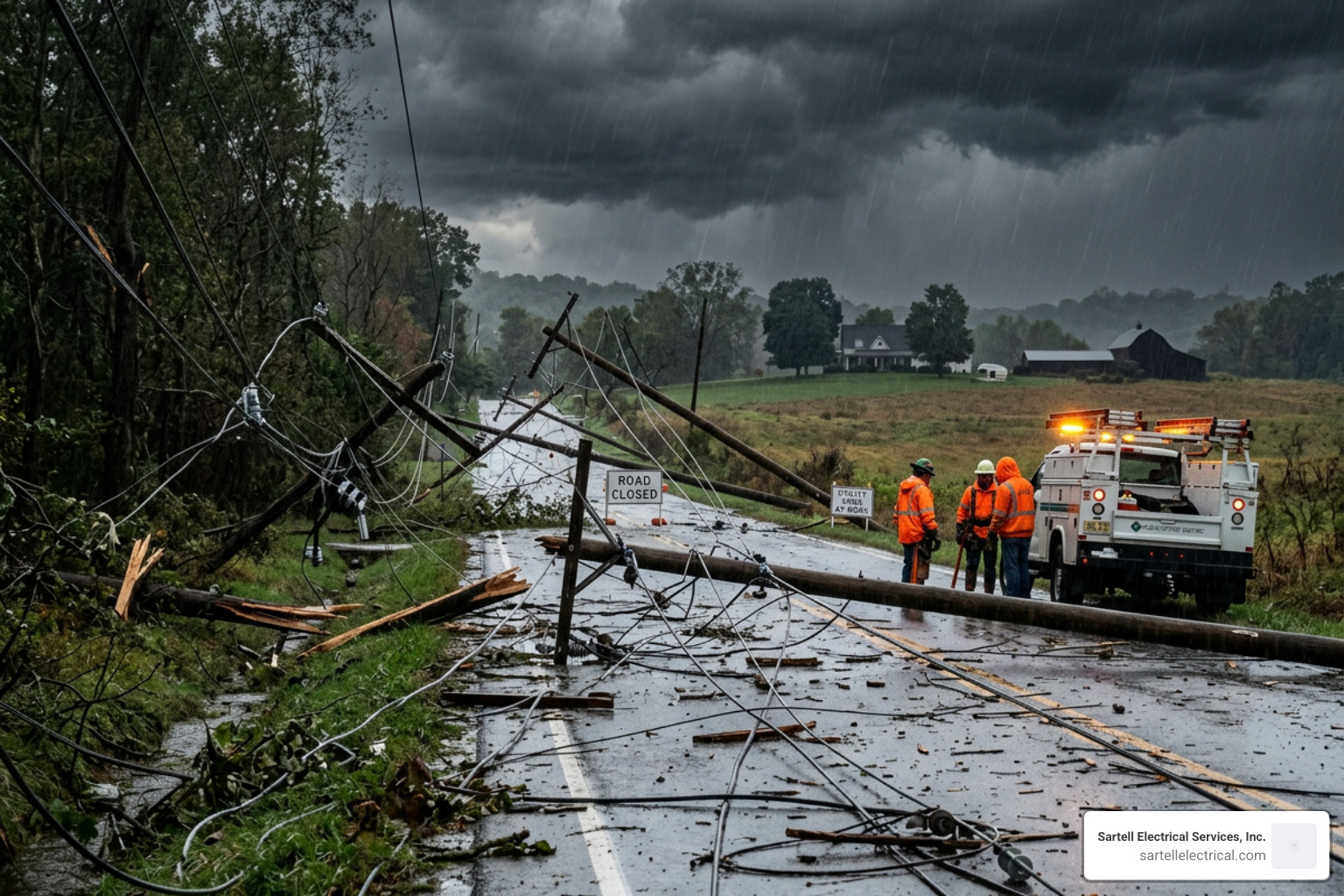
- Severe Weather: This is the big one. Whether it’s a Nor'easter bringing down lines in Essex County or high winds in Middlesex, weather is responsible for the vast majority of large-scale outages. In 2024, events like Hurricane Helene caused over 431 transmission outages, proving that even modern grids struggle against Mother Nature.
- Equipment Failure: Much of our infrastructure was built during the boom of the 1960s and 70s. While that gear has served us well, we are reaching a "rebuild or fail" tipping point. Aging transformers and substations are prone to "blowing a fuse" or worse.
- Wildlife: It sounds like a joke, but squirrels are a legitimate threat to electrical system reliability. A single squirrel in the wrong place can trip a substation and knock out power to thousands.
- Vehicle Crashes: A car hitting a utility pole is a common occurrence in densely populated areas like Chelsea or Somerville. These localized events can cause immediate, sharp spikes in SAIFI metrics.
A historical reminder of what happens when these disturbances aren't contained is the 2003 Northeast Blackout. What started as a few sagging lines hitting trees in Ohio cascaded into a failure that affected 50 million people across the Northeast and Canada, costing up to $10 billion.
The Impact of Emerging Technologies on Electrical System Reliability
As we move toward 2025, the grid is changing. We aren't just plugging in lightbulbs anymore; we’re plugging in AI data centers and massive battery banks.
- Data Centers: These facilities create rapid, unpredictable load changes. A single data center can pull as much power as a small city, and if they disconnect suddenly, it can destabilize the entire local frequency.
- Inverter-Based Resources (IBRs): Wind and solar power are great, but they use inverters that don't have the "spinning inertia" of old coal or gas plants. According to the NERC 2024 State of Reliability report, IBRs have shown unexpected output reductions during grid disturbances, which we are working to fix through software updates.
- Battery Energy Storage Systems (BESS): This is the good news. BESS is starting to act as a "buffer," providing frequency response and ramping capability to keep the grid stable when solar or wind power fluctuates.
Regulatory Oversight and Industry Standards
Maintaining electrical system reliability isn't just a suggestion; it’s the law. Following the major blackouts of the past, the U.S. moved to a system of mandatory standards.
- FERC (Federal Energy Regulatory Commission): They have jurisdiction over the "Bulk Power System" (BPS). Their job is to ensure the high-voltage "interstate highway" of electricity stays open.
- NERC (North American Electric Reliability Corporation): NERC develops the actual standards. If a utility fails to meet these, they can face penalties exceeding $1 million per day.
- The 1-in-10 Standard: This is a core planning goal. It means the system should be designed so that a "loss of load" (a blackout) only happens once every 10 years on average.
- N-1 Security Standard: This is the "fail-safe" rule. The grid must be able to withstand the sudden loss of its most important single component (like a major power plant or transmission line) without causing a wider outage.
For more technical details on how these standards are evolving, you can review the latest Resource Adequacy Report.
Strategies for Enhancing Grid Resilience and Performance
We don't just wait for things to break. At Sartell Electrical Services, we advocate for proactive "system hardening." This means making the infrastructure "tougher" through reinforced poles, undergrounding critical lines, and aggressive vegetation management (keeping the trees away from the wires!).
One of the most effective tools we have today is electrical condition monitoring. By using IoT sensors, thermal imaging, and vibration analysis, we can predict a failure before it happens.
Key strategies include:
- Predictive Maintenance: Moving away from "if it ain't broke, don't fix it" to "fix it because the data says it's about to break."
- Smart Grid Tech: Using automated switches that can "self-heal" the grid by rerouting power around a fault in seconds.
- Relay Coordination: Ensuring that protective devices trip in the right order so a small problem doesn't become a big one. You can read more about this in the research on relay coordination and reliability.
If you are managing a facility, you should also look into power plant monitoring systems or hospital power systems to ensure your local "grid" is just as resilient as the national one.
Overcoming Organizational Barriers to Electrical System Reliability
Surprisingly, the biggest threat to reliability isn't always a storm—it’s the "TTWWHADI" mindset. That stands for "That’s The Way We Have Always Done It."
Many organizations suffer from:
- Siloed Departments: When the maintenance team doesn't talk to the finance team, reliability suffers.
- Short-term Budgeting: Reliability is a marathon, not a sprint. We encourage our clients to use multi-year budgeting. Spreading the cost of a $1.2 million upgrade over four years is much easier to get approved than asking for it all at once.
- Procurement vs. Purchasing: Purchasing looks for the lowest price today; Procurement looks for the best value over the next 20 years. For electrical system reliability, you always want the Procurement mindset.
Implementing a solid electrical asset management plan is the best way to break down these silos and ensure everyone is on the same page.
Frequently Asked Questions about Grid Reliability
What is the difference between grid adequacy and security?
This is a common point of confusion. Adequacy means having enough power plants and wires to meet the demand. Security is the ability of that system to handle a "contingency"—like a lightning strike or a sudden equipment failure—without falling apart. You need both for true reliability.
How does weather impact long-term reliability metrics?
Severe weather can skew metrics like SAIDI for years. While utilities try to "harden" the system, a single major ice storm in Massachusetts can cause more damage in 24 hours than five years of normal wear and tear. This is why climate change is such a focus for grid planners; we are seeing more "billion-dollar disasters" that test our restoration times.
What role does BESS play in stabilizing the frequency of the grid?
Battery Energy Storage Systems (BESS) are the grid's "shock absorbers." When demand spikes or a generator trips, BESS can inject power into the grid in milliseconds. In the Texas Interconnection, BESS has recently provided up to 100% of the required frequency regulation during certain disturbances, keeping the lights on when traditional plants couldn't ramp up fast enough.
Conclusion: Future Investments for a Resilient Grid
As we look toward the future, the challenges are clear. We are facing growing demand from electric vehicles and data centers, an aging infrastructure that needs a "facelift," and more frequent extreme weather events.
Maintaining electrical system reliability requires a commitment to constant electrical condition monitoring and smart investment. Whether you are running a small business in Reading, MA, or managing a massive industrial site in Greater Boston, your local electrical system is your first line of defense.
At Sartell Electrical Services, Inc., we’ve spent nearly 40 years helping our neighbors across Essex, Middlesex, and Norfolk counties stay powered up. Reliability isn't just about the big wires over the highway; it’s about the commercial electrical system maintenance and industrial electrical maintenance that keeps your specific doors open.
Don't wait for the next Nor'easter to find out if your system is reliable. Let's work together to build a grid—and a facility—that can withstand whatever comes next.
Ready to boost your facility's reliability?