Hospital power systems: 3 Critical Lifelines
Why Hospital Power Systems Are Critical Infrastructure
Hospital power systems are the invisible lifeline that keeps patients alive. When the electrical grid fails, hospitals cannot simply go dark. Every second without power puts lives at risk.
Here's what makes hospital power systems unique:
- Dual power sources required: Normal utility power plus an alternate backup source (generator, fuel cell, or battery system)
- 10-second power restoration: Critical life-support systems must have power restored within 10 seconds of an outage
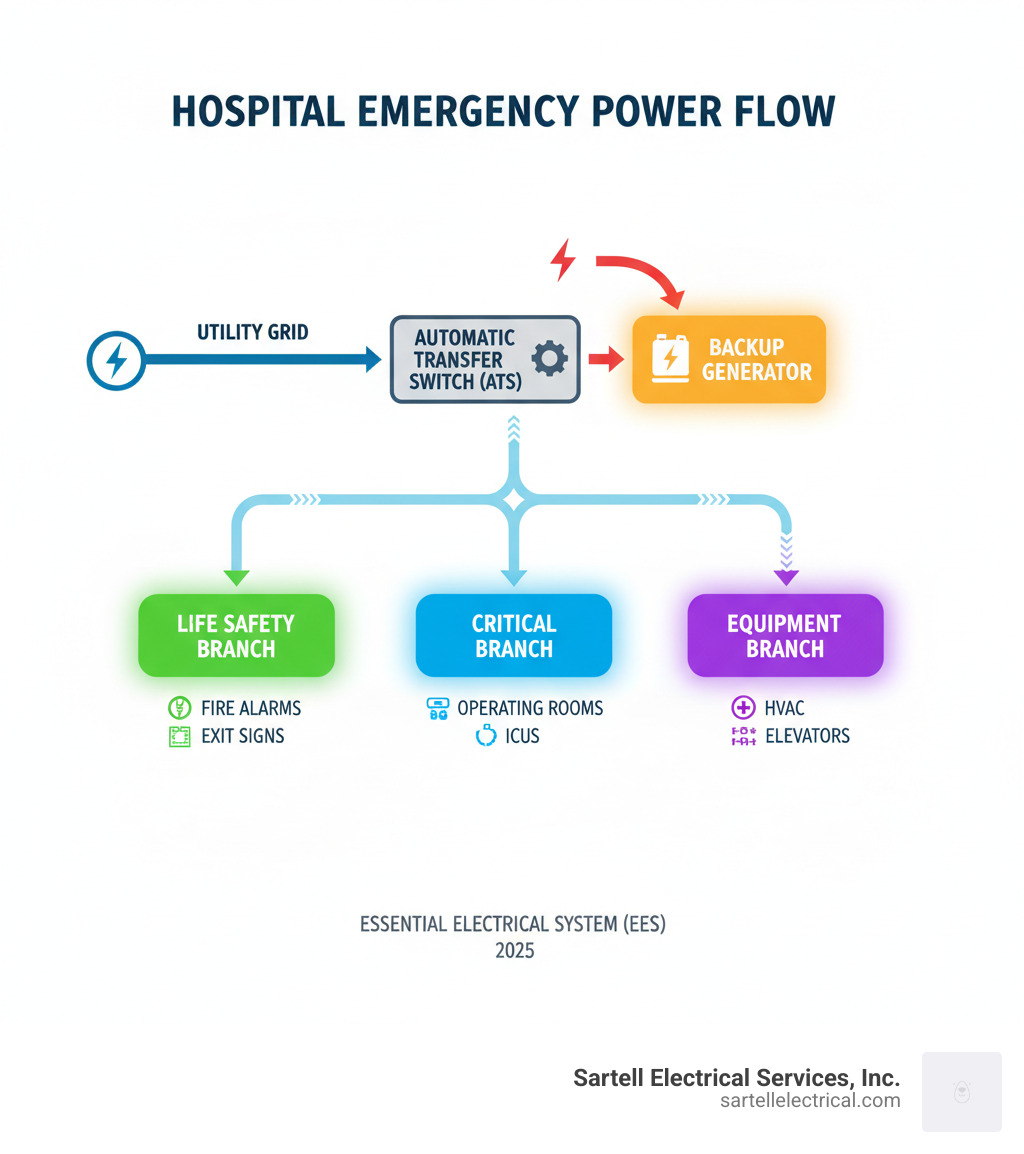
- Three essential branches: Life Safety (fire alarms, exit lighting), Critical (operating rooms, ICUs), and Equipment (HVAC, elevators)
- 96-hour fuel capacity: Most hospitals must store enough fuel to run generators continuously for four days
- Strict regulatory compliance: Must meet NFPA 99, NEC Article 517, and Joint Commission standards
Unlike most buildings where a power outage is an inconvenience,
hospitals face life-or-death situations. As Rod Allen, System Director of Plant Operations for Lee Memorial Health System, puts it: power is essential "for all healthcare operations."
These systems are far more complex than typical backup generators, requiring careful design, redundant components, automatic transfer switches, and constant testing. The US power grid is over 99 percent reliable, but that remaining fraction of unreliability is unacceptable in healthcare.
I'm Ed Sartell, and since founding Sartell Electrical Services in 1985, I've specialized in the complex electrical needs of healthcare facilities across Massachusetts. My team understands that in healthcare, there's no room for error when it comes to emergency power.
Why Uninterrupted Power is Non-Negotiable in Healthcare
When power fails in a hospital, lives hang in the balance.
Hospital power systems exist because healthcare facilities cannot afford downtime—not even for a few seconds. The equipment keeping patients alive doesn't pause, and surgeons mid-operation can't just stop and wait.
Here's what's at stake during a power failure:
- Patient Care Continuity: A ventilator needs constant power to breathe for a patient. Dialysis machines and vital sign monitors in ICUs are not conveniences—they are the difference between life and death.
- Surgical Suites: A brief power interruption can turn a routine surgery into a crisis. Operating rooms require power restoration within 10 seconds, with uninterruptible power supplies bridging even that tiny gap.
- Data Integrity: Modern healthcare runs on data. Electronic patient records, diagnostic imaging, and lab equipment all depend on continuous power. Without it, doctors can't access critical information to make life-saving decisions.
- Environmental Control: HVAC systems do more than keep people comfortable; they maintain sterile conditions in operating rooms, control humidity, and regulate temperatures. A failure can compromise sterility and endanger patients.
- Critical Supplies: Refrigerated medicines, vaccines, and blood products have strict temperature requirements. A power outage can spoil thousands of dollars worth of supplies and leave a hospital without vital resources.
- Safety and Communication: Security systems, access controls, nurse call systems, and internal communications all require reliable power to keep patients, staff, and visitors safe.
At Sartell Electrical Services, we ensure Massachusetts healthcare facilities have unwavering power reliability. Our work in
Health Care Electrical Services focuses on building systems that work flawlessly when needed most—because in healthcare, there is no acceptable alternative.
The Anatomy of Hospital Power Systems: EES, Generators, and UPS
Behind a hospital's calm surface is a sophisticated network keeping everything running. At its heart is the
Essential Electrical System (EES)—an engineered lifeline designed to respond in seconds.
 Hospital power systems
 act as a multi-layered safety net. The EES, backup generators, and Uninterruptible Power Supplies (UPS) work together, managed by an
Automatic Transfer Switch (ATS) that seamlessly shifts to backup power during an outage. This remarkable
system design relies on redundancy and intelligent
power distribution to ensure hospitals never go dark when lives are on the line.
The Essential Electrical System (EES): A Three-Branch Lifeline
The
Essential Electrical System is intelligently split into three separate branches, each with a specific job. This design, required by
NEC Article 517, ensures the most critical systems get power first.
- The Life Safety Branch is for safe evacuation. It powers fire alarms, emergency egress lighting, and exit signs, ensuring a clear path to safety during an emergency.
- The Critical Branch supports direct patient care. It feeds power to operating rooms, intensive care units (ICUs), and life-support equipment. This branch restores power within 10 seconds, keeping ventilators and monitors running.
- The Equipment Branch handles systems that keep the hospital functional, such as HVAC for sterile environments, elevators, medical air compressors, and central suction systems.
Additionally, all essential system receptacles have
distinctive color-coded plates, allowing staff to quickly identify backup power outlets. You can learn more about this and other safety features through this helpful resource on Article 517.
At Sartell Electrical Services, our experience with
Hospital Electrical Systems Best Practices means we understand why each branch matters for patient safety.
Generators vs. UPS: Understanding Your Backup Power Arsenal
Hospitals use a coordinated team of power sources, each with a specific role. Here's how
Emergency Generators,
Uninterruptible Power Supplies (UPS), and
Stored Emergency Power Supply Systems (SEPSS) work together.
- Emergency Generators: These are the workhorses, typically powered by diesel fuel or natural gas, that can run a hospital for 96 hours or more. They meet NFPA 110 requirements by starting and delivering power within 10 seconds. Some facilities now use cleaner Hydrotreated Vegetable Oil (HVO).
- Uninterruptible Power Supplies (UPS): Since 10 seconds is too long for sensitive equipment, battery-powered UPS systems provide instantaneous power. They bridge the gap, protecting patient monitors and servers from any flicker of power loss, usually for 5-15 minutes until the generator takes over. Our expertise with Hospital UPS Systems ensures these transitions are seamless.
- Stored Emergency Power Supply Systems (SEPSS): Often found in smaller outpatient or surgical centers, these systems provide instant power for shorter durations (up to 90 minutes). This is ideal for facilities that need to safely complete procedures or evacuate but don't require a full hospital's runtime.
This tiered approach creates a robust safety net: generators for endurance, UPS for instantaneous response, and SEPSS for smaller facilities. Together, they ensure continuous patient care.
Designing Resilient Hospital Power Systems: Redundancy and Sizing
Designing
hospital power systems requires meticulous planning for resilience. We don't just install a backup; we engineer a system with backups for the backups.
The core principle is
N+1 redundancy—installing one more generator than technically needed. If a hospital requires three generators, we install four. This eliminates a
single point of failure, as the remaining units can carry the full load if one fails or is down for maintenance.
Proper sizing involves careful
load calculations for all equipment and departments, plus thorough
risk assessments. We also plan for
scalability to accommodate future growth, as hospitals are constantly evolving with new wings and upgraded equipment.
This detailed approach to
Electrical System Design creates truly resilient systems. We're not just meeting today's needs; we're protecting patients for decades, giving administrators peace of mind.
Navigating the Regulatory Maze: Codes and Standards for Hospital Power
The regulatory landscape for
hospital power systems is complex, but these codes aren't red tape—they are lessons learned from real emergencies, written to protect patients.
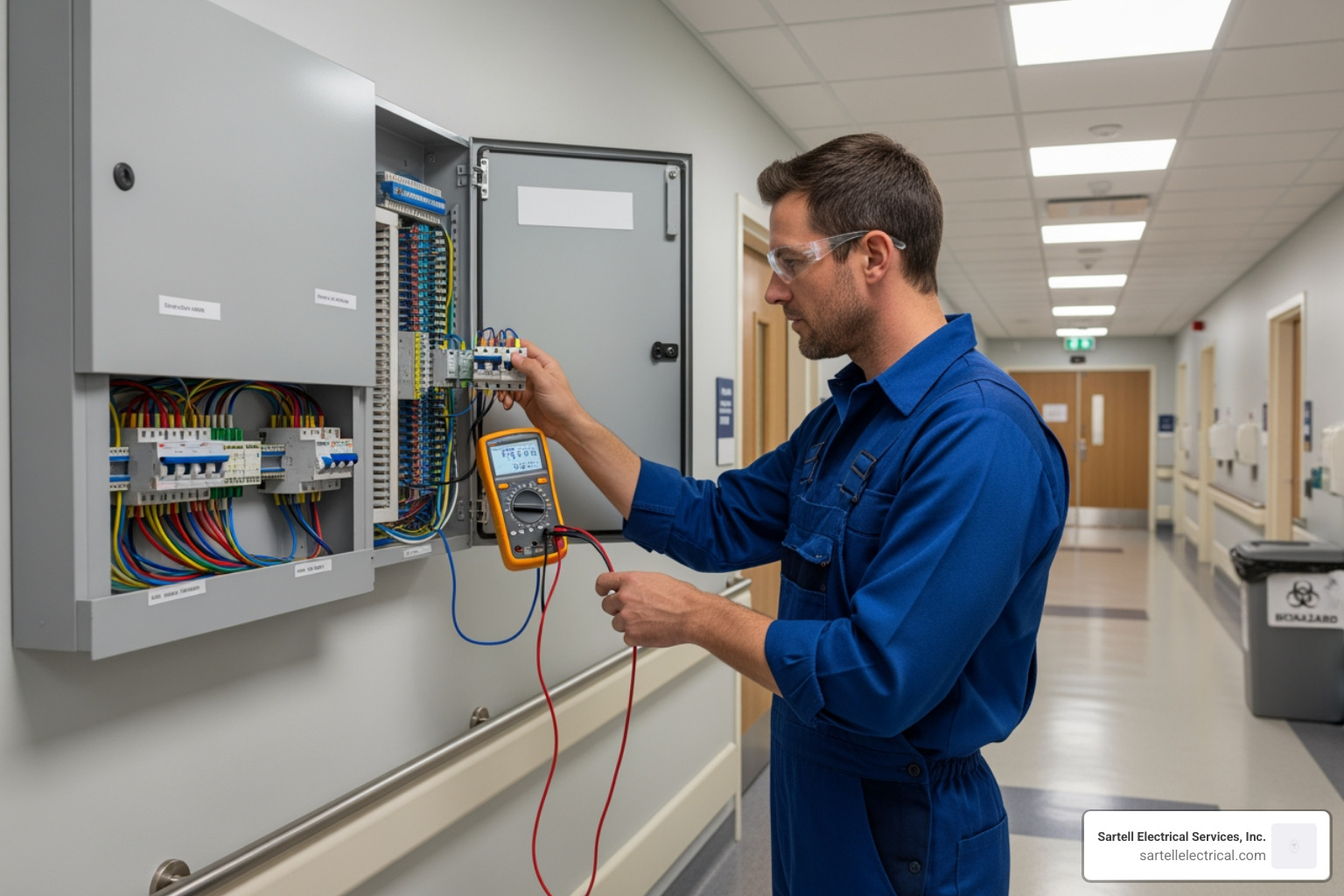
At Sartell Electrical Services, we've spent over three decades helping Massachusetts healthcare facilities steer this maze. Compliance is about creating systems that work flawlessly when lives depend on them, which requires meticulous documentation and regular audits.
Key Codes from the National Fire Protection Association (NFPA)
The National Fire Protection Association (NFPA) sets the gold standard for electrical and life safety in healthcare. Three of its codes are foundational for hospital electrical work.
- NFPA 99: Health Care Facilities Code: This code establishes risk categories. Category 1 areas, where power loss could cause injury or death, require the most robust backup systems. Most hospitals fall into this category.
- NFPA 70 (National Electrical Code or NEC): Article 517 of the NEC is the blueprint for healthcare electrical work. It mandates two independent power sources and specifies that Level 1 systems (supporting life support) must restore power within 10 seconds.
- NFPA 110: Standard for Emergency and Standby Power Systems: This standard defines the Emergency Power Supply System (EPSS). For hospitals, this typically means Class 96 systems (96-hour runtime), Type 10 transfer switches (10-second transfer), and Level 1 classification (protecting human life). These are legal requirements in Massachusetts and nationwide.
Accreditation and Oversight: The Joint Commission and DNV
Accrediting bodies also scrutinize
hospital power systems.
The Joint Commission (TJC) has strict, non-negotiable requirements. Hospitals must test generators
monthly to verify they start, transfer loads, and sustain operations. TJC also mandates a
96-hour Emergency Management Plan detailing how a hospital will operate during an extended outage, including fuel supply and staffing.
Det Norske Veritas (DNV) provides an alternative accreditation path with equally rigorous power system requirements, focusing on risk-based assessments. Both TJC and DNV require comprehensive all-hazards risk assessments for emergency power systems.
Our commitment to thorough
Electrical Safety Checks ensures Massachusetts healthcare facilities exceed these requirements and are always ready for inspection.
Best Practices for Testing and Maintenance of Hospital Power Systems
A great
hospital power system requires disciplined maintenance to remain reliable. Neglecting this work can have dire consequences during an outage.
Key best practices include:
- Load Bank Testing: This rigorous test simulates a hospital's full emergency electrical demand to prove a generator can handle the load, as required by NFPA 110. It reveals weaknesses that simple monthly tests might miss.
- Fuel Quality Management: For diesel generators, fuel quality is critical. Fuel can degrade, clog filters, and cause failures. Fuel polishing systems continuously clean stored fuel, ensuring it's ready for an emergency.
- Scheduled Maintenance: A strict regimen is essential. Weekly inspections check fluid levels and connections. Monthly tests under load (mandated by TJC) confirm readiness. Annual maintenance involves deeper inspections and parts replacement.
- Detailed Record Keeping: Meticulous logs prove compliance to regulators and help track system performance over time.
Our approach to
Electrical Maintenance Services treats these systems as the critical infrastructure they are, partnering with our clients to ensure uninterrupted patient care.
The Future of Hospital Power Resilience
The world of healthcare is changing, and
hospital power systems must keep pace. Hospitals face more extreme weather, aging infrastructure, and power-hungry medical equipment, all while trying to reduce their environmental footprint.

The good news is that we are in an era of innovation where sustainability and reliability go hand in hand. The future is about creating intelligent, adaptive systems that work smarter every day.
Advanced Microgrids and Sustainable Solutions
Advanced
microgrids are making hospitals more resilient and sustainable. A microgrid is a self-contained power network that can operate independently from the main utility grid, integrating sources like generators, solar panels, and
Battery Energy Storage Systems (BESS) for superior redundancy.
The
WellSpan York Hospital Microgrid is a prime example, improving reliability while reducing energy costs. These modern solutions offer benefits beyond emergencies.
- Solar Integration: Paired with battery storage, solar panels can generate clean power, store it for later use, and provide backup during outages. In Massachusetts, this is both environmentally responsible and economically sound.
- Battery Energy Storage Systems (BESS): BESS provides instant power, bridging the 10-second gap before generators start. As technology improves, more hospitals are using BESS to protect sensitive equipment.
- Combined Heat and Power (CHP): Also known as cogeneration, CHP systems capture waste heat from electricity generation to provide heating and hot water, boosting efficiency from ~50% to over 70%.
These sustainable solutions often pay for themselves through energy savings while improving reliability and meeting environmental goals.
Unique Challenges for Rural and Aging Facilities
Not all Massachusetts hospitals face the same challenges. Rural and older facilities often struggle with fundamental issues.
- Aging Infrastructure: Many older hospitals have electrical systems that weren't designed for today's power-hungry medical equipment like MRIs and CT scanners. These systems often require substantial upgrades before backup power can be improved.
- Geographic Isolation & Fuel Transportation: Rural hospitals can be hours from technicians, parts, or fuel deliveries during a major storm. This makes robust system design, redundancy, and preventive maintenance even more critical. Blocked roads can make diesel fuel transport a nightmare, making natural gas or renewables attractive alternatives.
At Sartell Electrical Services, we understand the unique needs of facilities across Massachusetts, from rural clinics to major Boston medical centers. Our
Medical Center Electrical Service Guide offers custom solutions for every budget and constraint.
System upgrades can be phased to make modernization affordable. We develop roadmaps that prioritize critical areas first, ensuring every hospital can achieve reliable power.
Frequently Asked Questions about Hospital Power Systems
Here are answers to common questions about
hospital power systems.
What are the three branches of an Essential Electrical System (EES)?
The EES is divided into three branches to prioritize power delivery:
- Life Safety Branch: Powers systems for safe evacuation, like fire alarms and exit lighting.
- Critical Branch: Powers life-support equipment and direct patient care areas like ICUs and operating rooms.
- Equipment Branch: Powers essential facility systems like HVAC and elevators.
How quickly must backup power be restored in a hospital?
According to NFPA standards,
critical systems that support life must have power restored within 10 seconds of an outage. This rapid transfer is medically necessary for patients on life support or in surgery.
What's the difference between a generator and a UPS?
A
generator provides long-term backup power (96+ hours) but takes a few seconds to start. An
Uninterruptible Power Supply (UPS) is a battery system that provides
instantaneous power, bridging the brief gap until the generator takes over. The UPS protects sensitive equipment from any interruption, while the generator handles the extended outage. Together, they ensure a seamless transition.
At Sartell Electrical Services, we've designed and maintained these integrated systems for healthcare facilities throughout Massachusetts since 1985. If you have questions about your facility's specific power needs, we're here to help.
Conclusion
Hospital power systems are a remarkable combination of technology, planning, and expertise dedicated to protecting human life. They are not just backup generators but orchestrated networks—from the EES branches and UPS systems to modern microgrids—all designed to ensure power is always there for patient care.
The complex regulatory framework of NFPA codes and Joint Commission standards exists for one reason:
patient safety and
operational resilience. Compliance provides peace of mind for patients, families, and staff who depend on uninterrupted power.
For over three decades, Sartell Electrical Services, Inc. has built and maintained these critical systems across Massachusetts. We understand that we're not just connecting circuits; we're building a safety net for entire communities. Whether you manage a large urban hospital or a small rural clinic,
system reliability is paramount.
If you're ready to ensure your healthcare facility has the resilient, compliant power infrastructure it needs,
partner with an expert for your healthcare electrical services. Let's work together to build systems that protect lives.