Control Your Lights from Two Locations: What You Need to Know About 2-Way Dimmer Switch Wiring
2-way dimmer switch wiring lets you control a single light fixture from two different locations — like the top and bottom of a staircase — while also adjusting brightness. Here's the quick answer:
How to wire a 2-way dimmer switch (quick summary):
- Turn off power at the breaker and verify with a voltage tester
- Replace one standard switch with a dimmer — leave the second as a regular 2-way switch
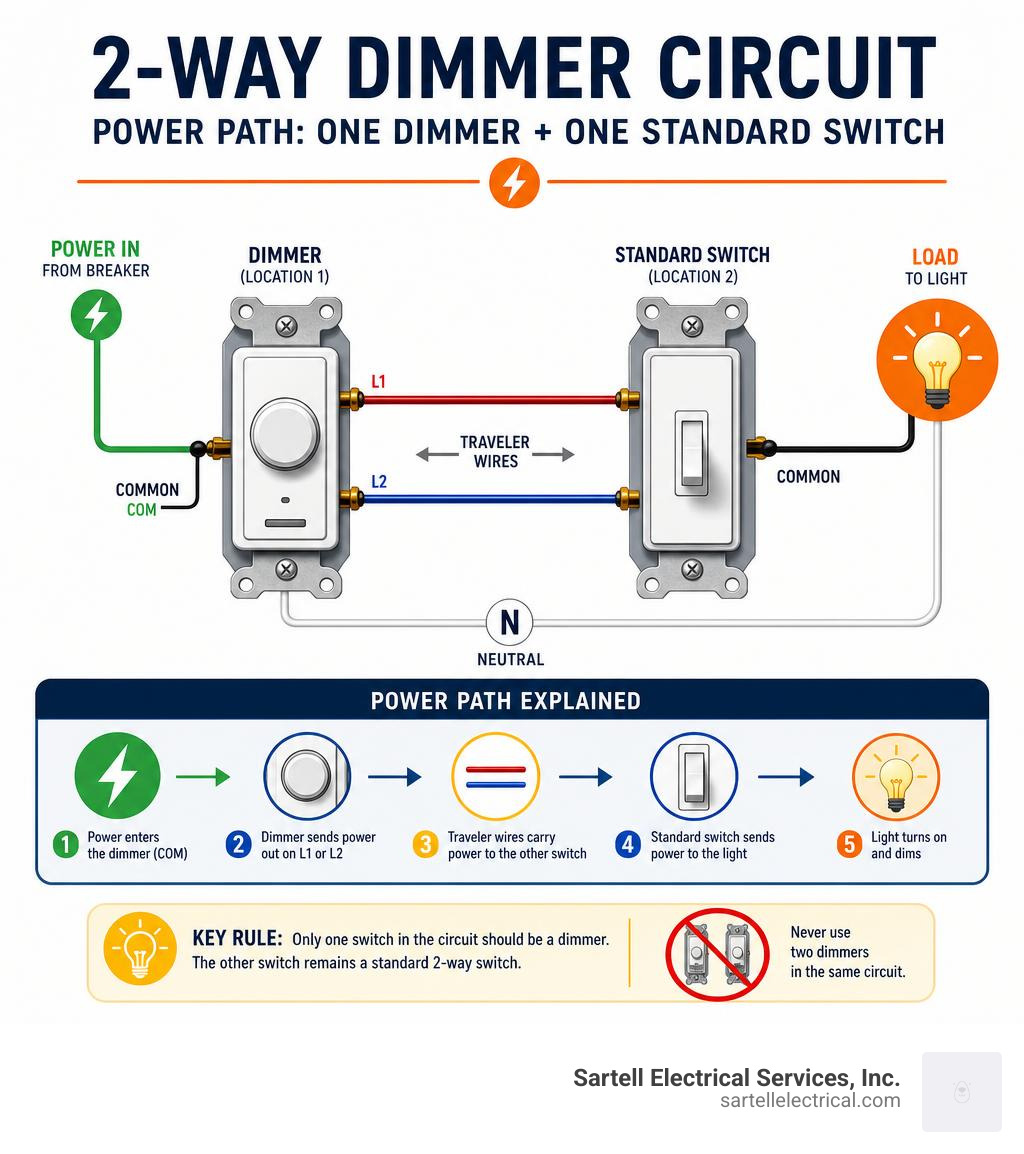
- Connect the common wire to the COM terminal on the dimmer
- Connect the traveler wires to the L1 and L2 terminals
- Restore power and test from both switch locations
Key rule: Only one switch in the circuit should be a dimmer. Never install two dimmers in the same 2-way circuit — it causes flickering, uneven brightness, and wiring conflicts.
This applies whether you're wiring a staircase, hallway, or large open room. The second switch stays a standard 2-way toggle.
A few things determine whether your installation goes smoothly:
- The type of dimmer you choose (single-pole vs. 2-way/3-way rated)
- Whether your switch box has a neutral wire (many older homes don't)
- Bulb compatibility — dimmable LEDs need an LED-rated dimmer
- Local code requirements, especially if you're in Massachusetts
This guide walks through every step — from identifying your wires to testing the finished install.
I'm Ed Sartell, President of Sartell Electrical Services in Reading, Massachusetts, with nearly four decades of hands-on electrical experience helping homeowners tackle projects like 2-way dimmer switch wiring safely and correctly. I've seen how a small wiring mistake — like swapping the common and traveler terminals — can turn a 30-minute job into a full diagnostic session, and this guide is built to help you avoid exactly that.
2 way dimmer switch wiring basics:
What Is a 2-Way Dimmer Switch and How Is It Different from a Standard 2-Way Switch?
A 2-way dimmer switch setup lets you control one light fixture from two separate switch locations and dim the light from one of those locations.
In UK-style wiring guides, this is called 2-way switching. In North America, including Massachusetts, the same general two-location lighting setup is usually called a 3-way switch circuit. Here is the simple translation:
- UK/common search term: 2-way switch
- North American electrical term: 3-way switch
- What it means: Two switches control the same light
A standard 2-way or 3-way switch only turns the light on or off. A 2-way dimmer setup adds brightness control, usually by replacing one of the two switches with a dimmer rated for multi-location use.
This type of setup is useful on staircases, in hallways, in large rooms with two entrances, and in bedrooms. For a general overview of traditional 2-way switch wiring, this 2-way light switch guide shows the basic switching concept.
Standard 2-Way Switch vs. 2-Way Dimmer Switch
A standard 2-way switch is a mechanical switch. It routes power between terminals so the light can be turned on or off from either location.
A 2-way dimmer switch does more. It includes electronics that reduce the power delivered to the lighting load, allowing the brightness to rise or fall.
The terminals usually include:
- COM or common: The pivot point of the circuit. This connects either to the incoming live/hot wire or the outgoing switched live/load wire, depending on the box.
- L1 and L2: The two traveler terminals, also called strappers.
- Ground or earth: The safety grounding connection, usually green or bare copper.
- Neutral, if required: Used by some smart or electronic dimmers to power their internal electronics.
Can You Install Two Dimmers in One 2-Way Circuit?
Usually, no.
In a typical 2-way dimmer setup, you should install one dimmer and one standard 2-way/3-way switch. Installing two ordinary dimmers in the same circuit can cause:
- Flickering lights
- Uneven dimming
- Buzzing
- Failure to turn on or off properly
- Conflicting electronics between the dimmers
- Premature dimmer or lamp failure
There are exceptions, but only when the manufacturer specifically designs the system for multi-location dimming. These systems usually use one master dimmer and compatible companion controls. We explain this in more detail in our guide: Dimmer Duos Can You Really Use Two Dimmers On One 3 Way Switch.
Where 2-Way Dimmers Work Best
A 2-way dimmer is ideal anywhere you want both convenience and atmosphere. Common locations include:
- Staircases with switches at the top and bottom
- Long hallways
- Bedrooms with a switch near the door and bed
- Open-plan kitchens and living rooms
- Dining rooms and finished basements
They are especially useful with dimmable LED fixtures because you can lower brightness for comfort and reduce energy use. Just remember: LED success depends heavily on choosing the right dimmer.
2 Way Dimmer Switch Wiring: Wires, Terminals, and Common Diagrams

Before touching any wires, you need to understand what each conductor does. In 2 way dimmer switch wiring, the most important mistake to avoid is mixing up the common wire with the traveler wires.
For more background on dimmer wiring basics, see our complete Dimmer Switch Wiring guide.
Essential Wires in 2 Way Dimmer Switch Wiring
Wire colors vary by age of home and region. Never rely on color alone; use terminal markings and testing.
Here are the essential wires:
- Line hot or permanent live: The wire bringing power from the electrical panel.
- Load or switched live: The wire carrying controlled power from the switching circuit to the light fixture.
- Common wire: The wire attached to the common terminal. In one box it may be the incoming hot; in the other, it may be the switched leg to the light.
- Traveler wires: The pair of wires running between the two switches. These connect to L1 and L2 or the two traveler screws.
- Neutral wire: Usually white in North American wiring. Standard switches often do not use it, but smart dimmers and some electronic dimmers may require it.
- Ground wire: Bare copper or green. This connects to the green screw or ground lead for safety.
In North American 3-way boxes, travelers are often red and black, but older Massachusetts homes may have inconsistent colors. The common terminal is your best clue.
How to Identify the Common Wire and Traveler Wires
Here is our field-tested process:
- Turn off power first.
- Remove the wall plate and gently pull the switch forward.
- Find the screw that is a different color from the other two non-ground screws. This is usually the common terminal.
- Look for a stamped label such as COM, COMMON, or a darker screw.
- Take a clear photo before disconnecting anything.
- Tag the wire on the common terminal with tape.
- Mark the two remaining insulated wires as travelers.
- Keep the ground wire separate.
If the switch is already disconnected, use a continuity tester with power safely isolated to identify the traveler pair. If you must identify a permanent live conductor, call an electrician.
A good rule: map terminals, not colors. The red wire is not always a traveler. The black wire is not always common.
Common 2 Way Dimmer Switch Wiring Configurations

Most 2-way dimmer setups use one of these layouts:
| Configuration | What It Means | Key Wiring Idea |
|---|---|---|
| Power at first switch | Line hot enters the first switch box | Common on first switch connects to incoming hot |
| Power at light fixture | Power enters at the ceiling box first | Switch loop wiring may be present |
| Power at second switch | Line enters the other switch box | Common location may be opposite of what you expect |
| UK-style 3-core and earth | Uses COM, L1, L2 and strappers | Non-brown live conductors should be properly identified |
| North American 14/3 or 12/3 cable | Uses common plus two travelers | Neutrals are spliced through, grounds are bonded |
In a basic North American two-location lighting circuit:
- One common connects to line hot.
- The two travelers run between switches.
- The other common connects to the switched hot going to the light.
- Neutrals are spliced together and normally do not land on a standard mechanical switch.
- Grounds are connected to each switch and metal box, if present.
If you are replacing an existing switch, do not redesign the circuit. Replace like-for-like using the old terminal mapping and the dimmer manufacturer’s wiring diagram.
For another explanation of two-way lighting layouts and common mistakes, see this guide on wiring a double dimmer switch on a two-way lighting circuit.
When a Neutral Wire Is Required
Not every dimmer needs a neutral wire, but many modern dimmers do.
A neutral wire may be required for:
- Smart Wi-Fi dimmers
- Some Zigbee or other hub-based dimmers
- Digital dimmers with locator lights
- Dimmers with advanced programming
- Certain LED-compatible electronic dimmers
Why? The dimmer’s internal electronics need a small amount of constant power, even when the lights are off. A neutral provides that return path.
Many older homes in Reading, Boston, Cambridge, Andover, Woburn, and Newton may not have a neutral in the switch box. In older switch-loop wiring, the neutral may only be at the light fixture.
Options include:
- Use a dimmer specifically listed as no-neutral required
- Have a neutral added by a licensed electrician
- Use a compatible smart lighting system designed for your wiring
- Keep a standard 2-way switch if dimmer compatibility is poor
Some no-neutral Zigbee-style dimmers are designed to work in older two-wire switch boxes, but compatibility still depends on the lighting load, bulb type, minimum wattage, and manufacturer instructions. We cover this topic in more detail here: The No Neutral Solution For Your 2 Wire Dimmer Switch.
How to Choose the Right Dimmer Before You Start Wiring
Choosing the right device is half the job. The wrong dimmer can make perfect wiring look broken.
| Dimmer Type | Best For | Not For | Notes |
|---|---|---|---|
| Single-pole dimmer | One switch controls one light | Two-location control | Wrong choice for 2-way/3-way circuits |
| 2-way/3-way dimmer | Two switches control one light | Circuits needing two independent dimmers | Use one dimmer plus one standard switch unless listed otherwise |
| Smart dimmer | App, schedule, voice, automation | Boxes without required wiring unless no-neutral rated | Many need neutral |
| No-neutral dimmer | Older switch boxes without neutral | All loads automatically | Check LED compatibility and minimum load |
| Multi-location dimmer system | Dimming from multiple points | Mixing random dimmers | Requires matched companions/remotes |
Single-Pole vs. 2-Way or 3-Way Dimmer
A single-pole dimmer is for a light controlled from one location. It typically has line, load, and ground connections.
A 2-way/3-way dimmer is for a light controlled from two locations. It has a common connection and traveler connections, or manufacturer-specific leads that perform the same function.
If you install a single-pole dimmer in a two-location circuit, symptoms may include:
- One switch stops working
- The light only works in one switch position
- The dimmer behaves unpredictably
- The breaker trips or the light will not turn off fully
Always look for packaging or instructions that say the dimmer is rated for 3-way or multi-location use. In Massachusetts, most product labeling will use the North American term “3-way,” even if you searched online for “2-way dimmer.”
LED, CFL, Halogen, and Incandescent Compatibility
Not all dimmers work with all bulbs.
Use this quick guide:
- Dimmable LED bulbs: Use an LED-rated dimmer. Trailing-edge dimmers often perform better with LEDs.
- Non-dimmable LED bulbs: Do not use with a dimmer.
- CFL bulbs: Must be labeled dimmable and paired with a compatible dimmer.
- Incandescent bulbs: Usually work with many older dimmers, but still follow wattage limits.
- Halogen bulbs: Often work with leading-edge dimmers, but check ratings.
- Low-voltage fixtures: Need dimmers matched to transformer type, such as magnetic low-voltage or electronic low-voltage.
Avoid mixing bulb types on the same dimmer. For example, do not put two dimmable LEDs and one old incandescent on the same dimmed load. Mixed loads can cause flickering, buzzing, or strange low-end behavior.
Smart bulbs are a separate issue. Most smart bulbs want full power all the time. Putting them on a wall dimmer can cause app control problems, flicker, reset issues, or shortened bulb life.
Wattage Rating, Box Depth, and Heat
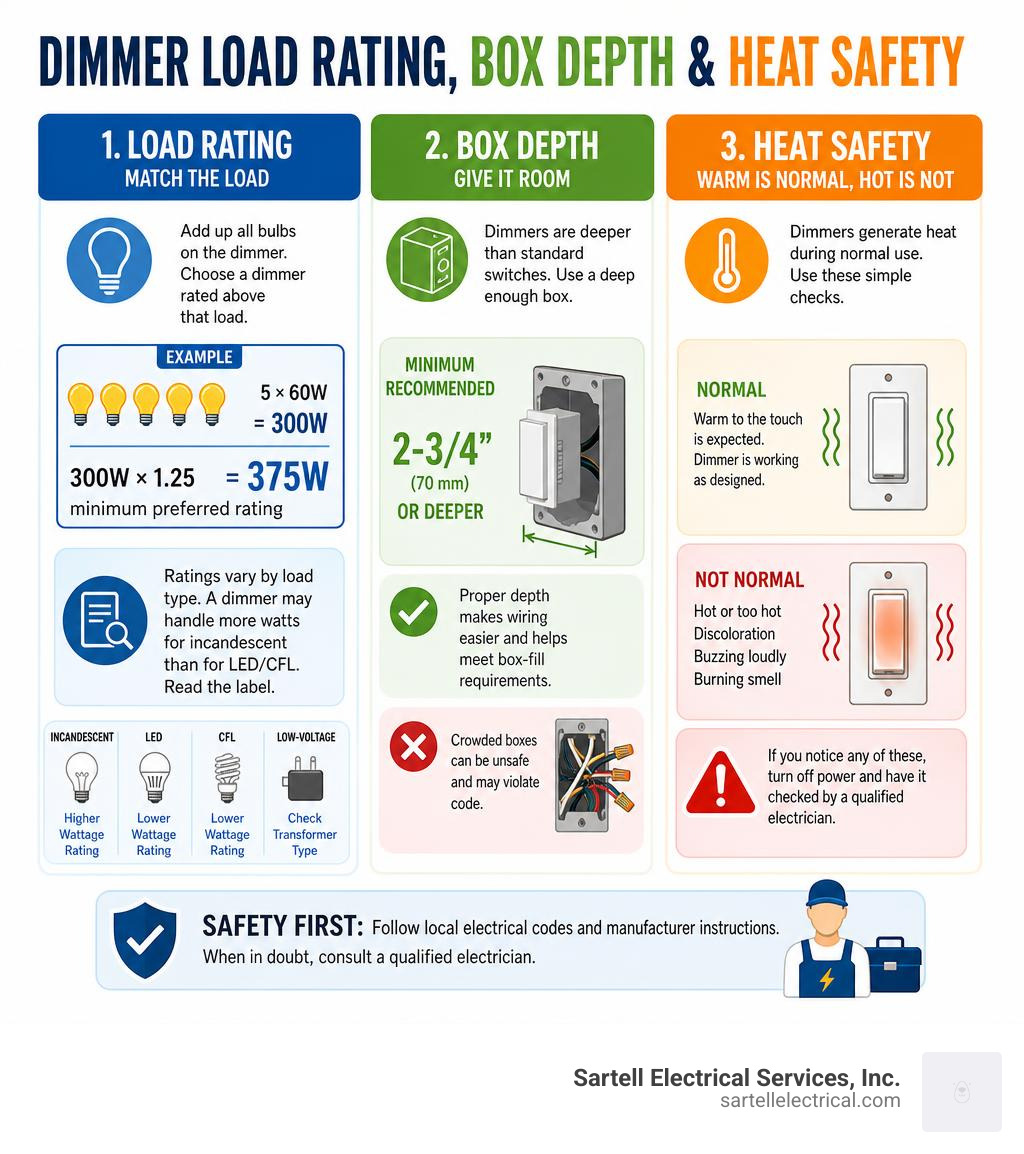
Add up the wattage of every bulb or fixture controlled by the dimmer. Then choose a dimmer rated above that load. We like a safety margin of about 25 percent where practical.
Example:
- Five 60-watt bulbs = 300 watts
- 300 watts x 1.25 = 375 watts minimum preferred rating
Many dimmers are rated differently for different loads. A device might handle 600 watts of incandescent lighting but only 300 watts of LED/CFL load. Read the label carefully.
Also check the wall box depth. Many dimmers are bulkier than standard switches. A commonly recommended minimum wall box depth is about 2-3/4 inches, especially for larger electronic dimmers. Crowded boxes are harder to wire safely and may violate box-fill requirements.
And yes, dimmers can feel warm during normal operation. They dissipate heat as part of controlling the load. Warm is expected. Hot, discolored, buzzing loudly, or smelling burnt is not.
Step-by-Step 2 Way Dimmer Switch Wiring Installation
A quick safety note: electrical work must comply with local codes. In Massachusetts, some projects require permits and inspections. If you are unsure whether your project qualifies as a simple device replacement, consult a professional before starting.
For a broader walk-through, see our guide on how to wire a dimmer switch fast by using simple steps.
Tools and Safety Gear You Need
Gather everything before opening the switch box:
- Non-contact voltage tester
- Multimeter or two-lead voltage tester
- Insulated screwdrivers
- Wire stripper and wire cutter
- Approved wire connectors and electrical tape
- Flashlight or headlamp
- Phone camera
- Wire labels or masking tape
- Permanent marker
- Safety glasses
- Torque screwdriver, if required by the device instructions
- Correct 2-way/3-way rated dimmer
- Matching wall plate and manufacturer wiring diagram
Do not use tape as a substitute for proper wire connectors.
Safety Checks Before Touching Any Wires
Follow these checks every time:
- Turn off the circuit breaker.
- Test your voltage tester on a known live source.
- Test the switch wires to confirm power is off.
- Test the voltage tester again on a known live source to confirm it still works.
- Lock or label the breaker if someone else is home.
- Inspect the box for damage, scorch marks, brittle insulation, or moisture.
- Stop if you find aluminum wiring, knob-and-tube wiring, melted insulation, or no grounding path.
Never assume a switch box is dead because the light is off. In multi-way circuits, wires can remain energized depending on other switch positions.
Step-by-Step 2 Way Dimmer Switch Wiring Checklist
Use this checklist for replacing one existing 2-way/3-way switch with a compatible dimmer.
- Turn off power at the breaker.
- Verify power is off. Use a voltage tester at both switch locations.
- Remove the wall plate. Unscrew the existing switch and gently pull it forward.
- Photograph the wiring. Take clear pictures of the terminals before removing wires.
- Tag the common wire. Identify the wire on the darker or labeled common screw. Mark it with tape.
- Label the travelers. Mark the two remaining non-ground wires as travelers.
- Disconnect the old switch. Keep wires separated so they do not get mixed up.
- Connect the ground first. Attach the bare or green ground to the dimmer’s green screw or ground lead. Bond the metal box if required.
- Connect the common wire. Attach the tagged common wire to the dimmer’s COM, black lead, or common terminal as directed.
- Connect the traveler wires. Attach the two traveler wires to L1 and L2 or the dimmer’s traveler leads. In many traditional switches, traveler order does not matter, but follow the manufacturer’s diagram.
- Handle the neutral correctly. If the dimmer requires neutral, connect it to the neutral bundle using an approved connector. If it does not require neutral, leave the neutral bundle intact. Do not disconnect neutrals just because they are in the box.
- Cap unused wires. Any unused dimmer lead must be capped according to the instructions.
- Fold wires neatly into the box. Avoid sharp bends and do not crush conductors behind the device.
- Mount the dimmer. Secure it evenly. Do not overtighten.
- Install the wall plate.
- Restore power and test.
For a related multi-location installation guide, see Wiring Wonders Installing Your 3 Way Dimmer Switch Like A Pro.
Testing the Dimmer After Installation
Test before celebrating. We recommend checking:
- The light turns on and off from both switch locations.
- The dimmer works through its full range.
- The light does not flicker at low brightness.
- The dimmer does not buzz loudly.
- The breaker does not trip.
- The faceplate fits flat.
- The switch feels warm at most, not hot.
- The minimum brightness setting is comfortable.
Many LED dimmers feature a low-end trim. If lights flicker at the lowest setting, raise the minimum brightness until stable.
Troubleshooting, FAQs, and When to Call a Professional
Even careful DIYers run into problems. Most dimmer issues fall into a few categories: wrong dimmer, wrong bulbs, loose connection, or mixed-up common/travelers.
For a deeper technical look at dimmer operation, see our AC Dimmer Circuit Diagram resource.
Fixing Flickering, Buzzing, or Lights That Won’t Dim
Common causes include:
- Non-dimmable LED bulbs or LED bulbs not compatible with the dimmer
- Dimmer not rated for LED loads or load below the dimmer’s minimum requirement
- Loose wire connector or mixed bulb types on one dimmer
- Low-end trim set too low or overloaded dimmer
- Faulty light fixture, incompatible LED driver, or defective dimmer
Try these steps:
- Confirm every bulb is labeled dimmable.
- Check the dimmer’s approved bulb compatibility list.
- Replace mixed bulbs with identical dimmable bulbs.
- Adjust the low-end trim.
- Turn power off and recheck wire connections.
- Confirm total wattage is within the dimmer rating.
- Test with a known compatible bulb.
If buzzing comes from the dimmer itself, it may be overloaded or incompatible. If buzzing comes from the fixture, the lamp or driver may be the issue.
Why the Dimmer Does Not Work from Both Switch Locations
If the dimmer works from one location but not the other, look for:
- Common wire connected to traveler terminal (or vice versa)
- Single-pole dimmer used instead of 2-way/3-way dimmer
- Failed standard switch at the other location
- Incompatible companion switch or remote
- Loose traveler connection
- Neutral mistakenly used as a traveler
- Incorrect manufacturer diagram for your wiring layout
The most common cause is a swapped common. That one little wire can make the whole setup act unpredictably.
When to Stop DIY and Call an Electrician
Stop and call a licensed electrician if you find:
- Unknown or unmarked wiring
- No ground wire or questionable grounding
- Aluminum branch-circuit wiring or knob-and-tube wiring
- Scorch marks inside the box or a burning smell
- Breaker trips repeatedly or warm/hot wall plate
- Melted wire insulation or crowded electrical box
- Moisture in or near the box
- Lights flickering throughout the home
- Any commercial, industrial, healthcare, or telecom wiring
- Uncertainty about Massachusetts code or permit requirements
At Sartell Electrical Services, Inc., we serve Reading, Greater Boston, and surrounding Massachusetts communities. With over 30 years of experience across residential, commercial, and industrial electrical work, we are here to help before a small issue becomes a major problem.
FAQ: Can I Use Smart Bulbs with a 2-Way Dimmer?
Usually, we do not recommend using smart bulbs on a standard wall dimmer.
Smart bulbs require constant full voltage for their internal electronics (Wi-Fi, Bluetooth, Zigbee). A dimmer reduces power, causing:
- Flickering
- Bulbs dropping offline
- App control failure
- Random resets
- Buzzing or shortened bulb life
Better options include:
- Use dimmable LED bulbs with a compatible wall dimmer.
- Use smart bulbs with standard on/off switches.
- Use a smart dimmer with compatible standard dimmable bulbs.
- Use a no-neutral smart dimmer only if it is compatible with your wiring and load.
FAQ: Does Every Dimmer Need a Neutral Wire?
No.
Standard rotary, slide, or toggle dimmers rarely need a neutral. However, smart and digital dimmers require a neutral to provide constant power for their internal electronics and wireless communication.
If your box has a bundle of white wires tucked in the back, that may be a neutral bundle. Do not assume. Test and verify.
If no neutral is present, your options are:
- Choose a listed no-neutral dimmer
- Use a standard non-smart dimmer rated for your load
- Have a neutral added by an electrician
- Use another lighting control strategy
Never borrow a neutral from another circuit. That can create serious shock and code hazards.
FAQ: What Is the Maximum Wire Length for Multi-Location Dimming?
Multi-location dimming systems using companion controls often have a maximum wire length limit, typically 300 feet from the master dimmer to all remotes.
Long traveler runs can cause communication issues, voltage drop, flicker, or delayed response.
For large homes, long hallways, multi-story stair circuits, or commercial applications, follow the exact manufacturer instructions. If the run is unusually long, have an electrician evaluate it before selecting devices.
Conclusion: Wire Your 2-Way Dimmer Safely and Confidently
2-way dimmer switch wiring is manageable when you slow down, identify the common wire correctly, use one compatible dimmer, and match the device to your bulbs and wiring.
Remember the big points:
- Use one dimmer and one standard switch unless the system is specifically designed for multi-location dimming.
- Choose a 2-way/3-way rated dimmer, not a single-pole dimmer.
- Use LED-rated dimmers with dimmable LED bulbs.
- Do not rely on wire color alone.
- Label the common wire before disconnecting anything.
- Leave neutral bundles intact unless your dimmer requires neutral.
- Stop if you see damaged, old, overheated, or confusing wiring.
If you want help making sure your dimmer installation is safe, code-compliant, and built to last, Sartell Electrical Services, Inc. is here to help. We are based in Reading, MA and serve homeowners and businesses throughout Greater Boston and surrounding Massachusetts communities.
For more wiring guidance, visit our main Dimmer Switch Wiring resource.