
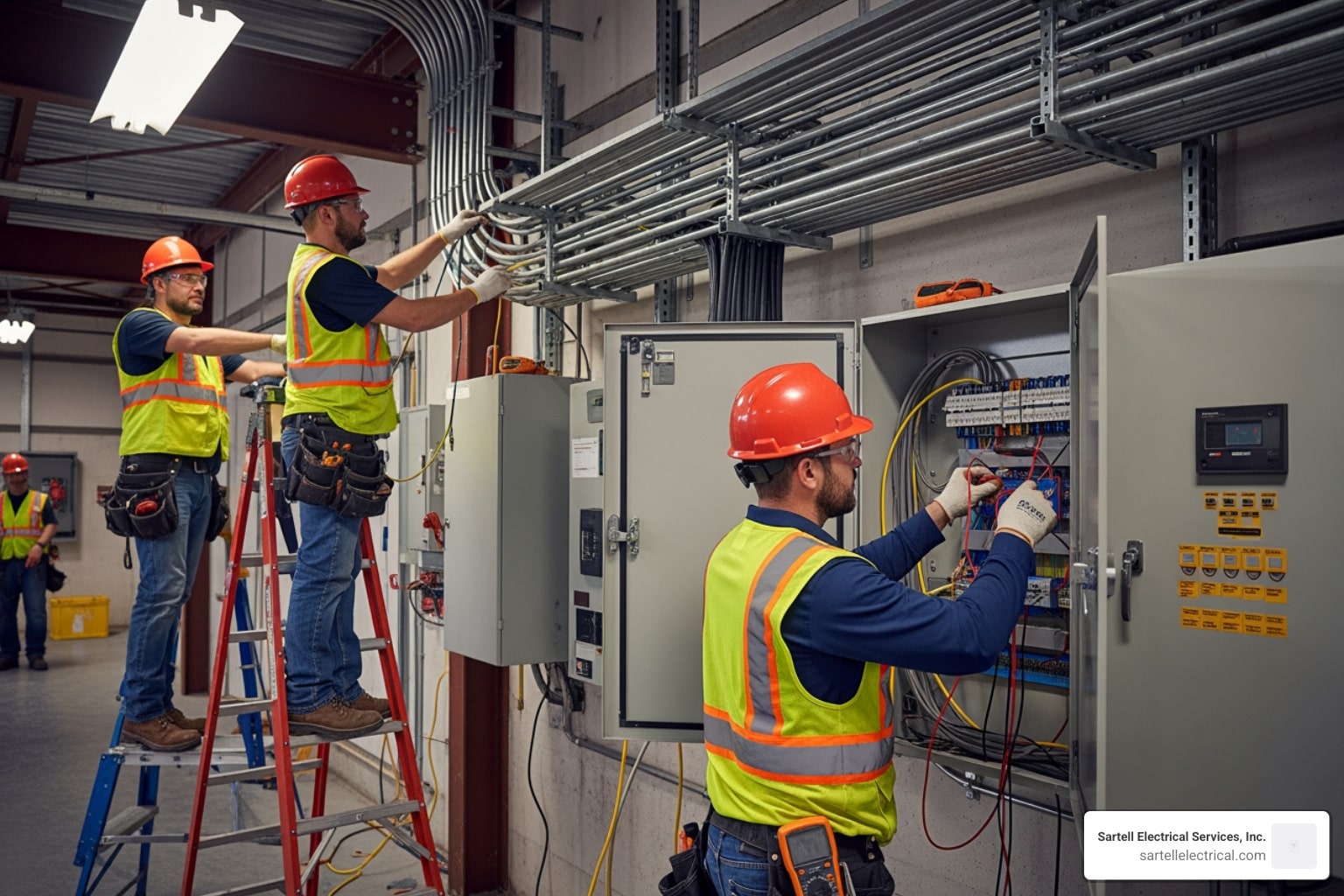
Why Choosing the Right Commercial Electrical Contractor Can Make or Break Your Project
Commercial electrical contractors are licensed professionals who design, install, maintain, and repair electrical systems in business, industrial, and institutional buildings.
Here's a quick look at what they do and how to hire one:
| What to Know | Key Points |
|---|---|
| What they do | New construction, renovations, maintenance, lighting, generators, EV charging, data cabling, security |
| Why it matters | Code compliance, safety, uptime, liability protection |
| What to look for | Licensed, bonded, insured, master electricians, relevant sector experience |
| Red flags | Vague bids, no insurance, poor communication, no references |
| When to call | New builds, remodels, service upgrades, emergencies, energy upgrades |
Getting the electrical right on a commercial project isn't just a technical checkbox. It's the difference between a smooth opening and weeks of costly delays. The wrong contractor can leave you with failed inspections, code violations, or worse — a serious safety hazard that puts your employees and customers at risk.
And yet, many businesses rush this decision. They pick the lowest bid, skip the credential checks, and hope for the best. That rarely ends well.
Whether you're planning a ground-up build, a tenant fit-out, or a full facility upgrade, knowing how to evaluate commercial electrical contractors before you sign is one of the most important things you can do to protect your timeline, your budget, and your people.
I'm Ed Sartell, President of Sartell Electrical Services, Inc., and I've been working with businesses across Massachusetts as a commercial electrical contractor since 1985. In this guide, I'll walk you through exactly what to look for — and what to avoid — so you can hire with confidence.
Commercial electrical contractors terms you need:
What Commercial Electrical Contractors Actually Do
A lot of people hear "electrician" and think wires, outlets, and maybe a breaker panel. Commercial work is much broader than that.
Commercial electrical contractors support the full electrical life cycle of a business property, from preconstruction planning to emergency repairs years after move-in. That can include offices, warehouses, healthcare spaces, retail stores, schools, telecom facilities, multifamily buildings, and industrial environments across Greater Boston, Essex County, Middlesex County, Norfolk County, and Suffolk County.
Core services commercial electrical contractors provide
Most commercial projects involve some mix of these services:
- Electrical system design and layout
- New power distribution installation
- Service upgrades and panel replacements
- Switchgear and distribution equipment installation
- Branch circuit wiring
- Interior and exterior lighting
- Backup power and generator connections
- Fire alarm coordination
- Low-voltage systems
- Data and communication cabling
- Security and access control wiring
- EV charging infrastructure
- Preventative maintenance
- Troubleshooting and repairs
- Electrical inspections and testing
In plain English: we help make sure your building has the power it needs, where it needs it, safely and reliably.
For a broader breakdown of service categories, see our commercial electrical services page.
Commercial electrical contractors for new builds, remodels, and ongoing service
Commercial electrical work is not one-size-fits-all. A contractor who is great at simple service calls may not be the right fit for a fast-track build-out or occupied renovation.
Common project types include:
- Ground-up construction
- Tenant fit-outs and build-outs
- Office renovations
- Warehouse retrofits
- Facility expansions
- Lighting upgrades
- Service equipment replacement
- Temporary power setups
- Ongoing maintenance contracts
- Emergency troubleshooting after outages or equipment failures
For example, a business renovating an occupied office in Boston or Cambridge may need phased work after hours to avoid disruption. A warehouse in Woburn or Billerica may need lighting upgrades and power for equipment without shutting down operations. A healthcare property in Reading, Burlington, or Somerville may require tight coordination around patient safety and critical systems.

Modern technology work commercial electrical contractors now handle
Commercial electrical work in 2026 is not just conduit and panels. The best contractors also support modern building technology, including:
- LED lighting retrofits
- Lighting controls and occupancy sensors
- Smart scheduling controls
- EV charger installation
- Structured data cabling
- CCTV and video surveillance wiring
- Card access and door control
- Solar-ready electrical infrastructure
- BIM coordination
- CAD-based planning and documentation
Research across the industry shows experienced contractors increasingly use BIM and CAD to improve layout accuracy, reduce clashes with other trades, and coordinate more effectively before installation starts. That matters because solving conflicts in a model is much cheaper than solving them in a ceiling with three trades staring at each other.
Why Hiring the Right Contractor Protects Your Business
Choosing the right electrical contractor is about much more than getting power turned on. It is about protecting your business from preventable risk.
Why professional commercial electrical contractors matter for business safety and compliance
Commercial systems must meet code, utility requirements, permit conditions, and inspection standards. A professional contractor helps manage that process from start to finish.
That includes:
- Following the National Electrical Code and local requirements
- Pulling permits where required
- Coordinating inspections
- Maintaining proper documentation
- Working safely around occupied facilities
- Helping avoid failed inspections or utility issues
- Reducing fire and shock hazards
- Supporting insurance and liability protection
For a general reference on national electrical safety rules, you can review the National Electrical Code.
In some markets, utility violations or metering problems can lead to immediate compliance issues. While local utility procedures vary, the lesson is universal: businesses need contractors who know how to handle documentation, coordination, and correction work quickly.
If compliance is a current concern, our guide to commercial electrical inspections is a good next read.
The biggest benefits of experienced commercial electrical contractors
Experience pays for itself in ways that are not always obvious in the first bid.
An experienced contractor usually brings:
- Better planning before work begins
- Faster troubleshooting when problems appear
- More realistic schedules
- Cleaner coordination with other trades
- Fewer callbacks and punch-list issues
- Better cost control
- Stronger closeout documentation
- More scalable systems for future growth
Industry research shows some established commercial electrical firms have operated for decades, and the reason longevity matters is simple: companies do not stay in business for 30, 40, 60, or even 90-plus years by winging it. Long-term experience often reflects process maturity, deeper field knowledge, and stronger project controls.
At Sartell Electrical Services, we bring more than 30 years of experience serving Massachusetts businesses, with work across commercial, industrial, telecom, and healthcare environments. That mix helps us solve both straightforward and highly specialized problems.
How contractors improve energy efficiency and long-term operating costs
A good contractor does not just install systems that work today. We also help you reduce waste and plan for tomorrow.
That may include:
- Energy audits
- LED fixture upgrades
- Occupancy sensors
- Daylight controls
- Load balancing
- Power quality checks
- Infrared scanning
- Value engineering
- Smarter control strategies
- Replacement of outdated, inefficient equipment
LED upgrades alone can make a major difference in offices, retail spaces, parking lots, and warehouses. Better controls help ensure lights are not blazing away in empty rooms like they are auditioning for a Broadway show.

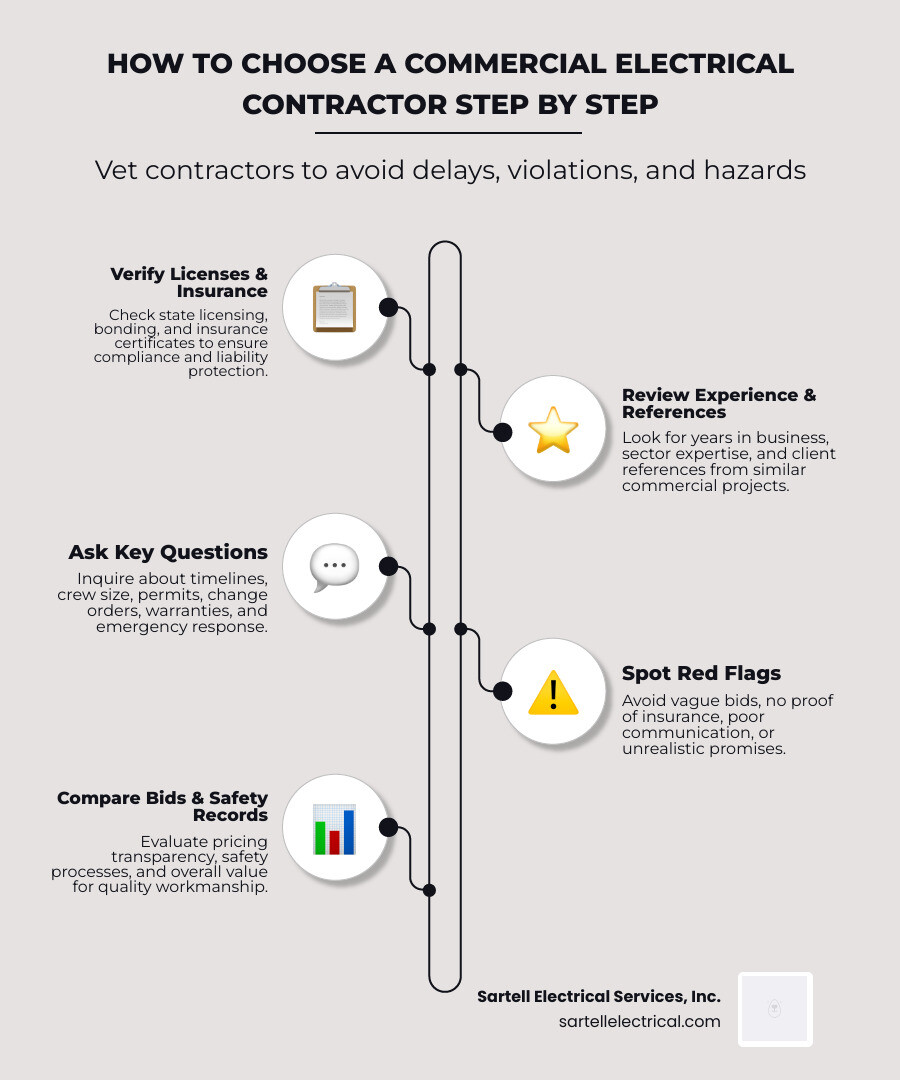
How to Vet Commercial Electrical Contractors Before You Sign
Hiring the right contractor is part technical evaluation, part risk management, and part common sense.
Credentials and experience to look for in commercial electrical contractors
Before you sign anything, verify the basics:
- Proper state licensing
- Insurance coverage
- Bonding, if needed for your project
- Trained electricians and qualified supervision
- Experience with commercial work, not just residential jobs
- Experience in your industry
- Familiarity with local permitting and inspections
- Ability to self-perform key scopes
- Emergency service capability if your facility needs it
- Clear safety procedures
Also ask how long they have been in business and what kinds of projects they handle most often. Years alone are not everything, but they do matter. Research from established firms in the commercial space shows strong contractors often highlight multi-decade experience, project management depth, and service capacity because clients value reliability.
If your project is in Boston, Reading, Waltham, Andover, or elsewhere in our Massachusetts service area, local code familiarity and response time should be part of your checklist too.
Questions to ask before hiring
Here are smart questions to ask any contractor you are considering:
- Have you completed projects like ours before?
- Who will supervise the work day to day?
- Will your own team perform the work, or will you subcontract most of it?
- Who handles permits and inspections?
- How do you manage change orders?
- What is the expected timeline?
- What are the biggest risks you see in this project?
- What documentation will we receive at closeout?
- Do you offer maintenance after completion?
- What is included in your warranty?
- How do you handle emergency calls?
- How do you communicate project updates?
The answers matter almost as much as the credentials. A contractor who communicates clearly before the job is more likely to communicate clearly during the job.
Red flags that should make you walk away
Some warning signs should stop the process immediately.
Watch for:
- Vague or incomplete proposals
- No proof of insurance
- No license information
- Very low bids with no scope detail
- Slow or inconsistent communication
- Unrealistic timelines
- No clear safety process
- No references or project examples
- Refusal to explain change orders
- Hidden fees or confusing exclusions
Here is a simple way to compare:
| Qualified Contractor | Risky Contractor |
|---|---|
| Detailed written scope | One-page vague estimate |
| Licensed, insured, documented | "We can send that later" |
| Relevant commercial experience | Mostly unrelated work |
| Clear schedule and process | Timeline sounds made up |
| Strong communication | Hard to reach before contract |
| Safety plan and compliance focus | Little mention of safety |
| Transparent pricing | Suspiciously cheap bid |
If you are weighing local options, our resources on top rated commercial electricians to power your business and the 7 best commercial electrical service providers compared can help you build a stronger shortlist.
Project Types and Industries the Best Contractors Support
The best Commercial electrical contractors can handle both everyday upgrades and highly technical environments.
Common commercial projects from small upgrades to complex facilities
Typical project scopes include:
- Service upgrades
- Electrical distribution equipment
- Panel and breaker replacement
- Tenant build-outs
- Interior remodels
- Parking lot lighting
- Site electrical work
- Temporary power
- Standby generator connections
- Fire alarm and low-voltage coordination
- Office and warehouse lighting retrofits
- New equipment power feeds
Some businesses need just one of these. Others need all of them in phases across months of construction and occupancy.
Industry-specific needs: healthcare, manufacturing, retail, and warehouses
Different industries bring very different electrical demands.
Healthcare:
- Critical power reliability
- Infection-control coordination
- Minimal disruption in occupied spaces
- Emergency system awareness
- Careful documentation and scheduling
Manufacturing:
- Equipment power requirements
- Uptime protection
- Motor and control coordination
- Safety lockout awareness
- Expansion planning for production growth
Retail:
- Attractive lighting layouts
- Reliable power for POS systems
- Minimal downtime during remodels
- Security and data coordination
- Fast schedules tied to opening dates
Warehouses and distribution:
- High-bay LED lighting
- Equipment and conveyor power
- Dock and exterior lighting
- Energy efficiency improvements
- Service support for large spaces
Our own work across Massachusetts has shown that industry fit matters. A contractor who understands warehouses in Lowell or Wilmington may need different planning methods than one supporting healthcare spaces in Greater Boston.
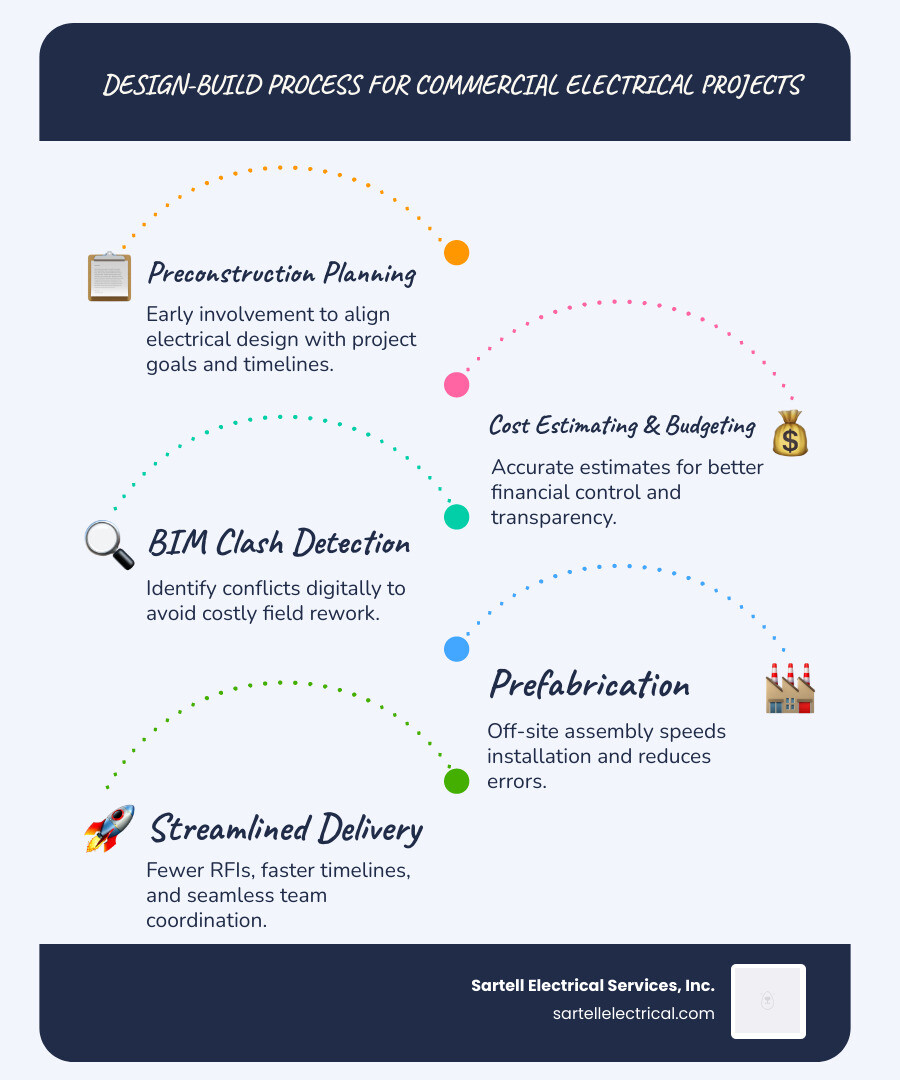
How design-build and design-assist speed up commercial projects
Design-build and design-assist services can be a huge advantage, especially when schedule and budget matter.
With these approaches, the electrical contractor gets involved earlier to help with:
- Preconstruction planning
- Budgeting and cost estimating
- Constructability review
- Coordination with architects and engineers
- Prefabrication opportunities
- BIM clash detection
- Material lead-time planning
- Scope refinement before field work begins
Benefits often include:
- Faster project delivery
- Fewer RFIs
- Fewer field conflicts
- Better cost visibility
- More practical installation planning
- Better collaboration across the team
Many experienced contractors across the industry now rely on design-build workflows, BIM, and prefabrication to improve efficiency and reduce mistakes. If your project is moving quickly, those capabilities can be the difference between a smooth job and a daily stress festival.
Learn more about our commercial electrical design build approach.
Emergency Service, Maintenance, and Future-Ready Upgrades
A good contractor is not just there for ribbon-cutting day. We should also help keep your building running long after the project wraps up.
When 24/7 emergency commercial electrical contractors are worth it
Emergency electrical service matters when downtime costs money, disrupts tenants, or creates safety risks.
Common emergency scenarios include:
- Sudden power outages
- Tripped main breakers
- Equipment failure
- Storm-related damage
- Overheated panels
- Generator issues
- Transformer or service problems
- Tenant power loss
- Unsafe conditions requiring immediate shutdown
In these moments, response time matters. A contractor who can mobilize quickly, isolate the issue, and coordinate the fix can save you from a long night, an even longer invoice from lost operations, or both.
Preventative maintenance that avoids expensive downtime
Preventative maintenance is one of the smartest things a business can invest in.
A maintenance program may include:
- Scheduled inspections
- Thermal imaging or infrared scans
- Breaker testing
- Panel cleaning
- Tightening and torque checks
- Lighting maintenance
- Generator testing
- Surge protection review
- Battery and emergency system checks
- Documentation of system condition
Research from commercial electrical service providers consistently points to preventative maintenance as a major way to reduce costly outages and extend equipment life. We agree. Most electrical disasters do not come out of nowhere. They send warning signs first. The trick is catching them before they become everyone else's emergency.
For more, visit our commercial electrical system maintenance page.
Future-ready upgrades businesses should plan for in 2026
If you are already opening walls, replacing gear, or expanding a facility, think ahead.
Smart upgrades to consider in 2026 include:
- EV charging infrastructure
- LED retrofits
- Occupancy and daylight controls
- Smart panels and monitoring
- Structured cabling upgrades
- Backup power planning
- Surge protection
- Renewable-ready electrical capacity
- Capacity planning for future equipment
- More resilient system layouts
The commercial electrical field has evolved fast. Across the industry, contractors now commonly support EV charging, advanced lighting controls, low-voltage systems, BIM coordination, energy reviews, and other technology-driven upgrades that were far less common a decade ago.
Frequently Asked Questions About Commercial Electrical Contractors
How much experience should a commercial electrical contractor have?
There is no magic number, but we recommend looking for a contractor with solid commercial experience and a track record on projects similar to yours. Tenure matters, but relevant project history matters more. Ask about team depth, supervision, sector experience, and how they handle scheduling, compliance, and service after completion.
Do commercial electrical contractors handle both power and low-voltage systems?
Many do. Commercial contractors often support power distribution, lighting, data wiring, security infrastructure, access control, and fire alarm coordination. The exact scope varies by company, so ask what is performed in-house and what requires specialty partners.
Should I choose a local contractor or a larger regional team?
For most Massachusetts businesses, a local or regionally established contractor offers major benefits:
- Better familiarity with local codes and inspectors
- Faster response time
- Easier communication
- Stronger accountability
- Better understanding of local building types and business needs
The right answer depends on your project size and complexity, but local knowledge is often a real advantage, especially for ongoing service and maintenance.
Conclusion
Hiring Commercial electrical contractors should never feel like a gamble. The right partner helps you protect safety, pass inspections, avoid downtime, control costs, and build a system that can grow with your business.
If you remember nothing else, remember this checklist:
- Verify licenses, insurance, and experience
- Ask detailed questions about scope, schedule, and supervision
- Look for industry-specific knowledge
- Prioritize communication and transparency
- Do not ignore maintenance and emergency support
- Plan for future technology, not just today's minimum needs
At Sartell Electrical Services, we have spent more than 30 years helping businesses across Massachusetts with commercial, industrial, telecom, healthcare, and facility electrical needs. Whether you are planning a renovation in Boston, a service upgrade in Reading, a warehouse project in Woburn, or ongoing maintenance anywhere in our service area, we are here to help.
Ready to talk with experienced Commercial Electricians? We would be glad to help you plan your next project without the shocks, surprises, or mystery invoices.