
Why Your House Wiring Panel Is the Heart of Your Home's Electrical System
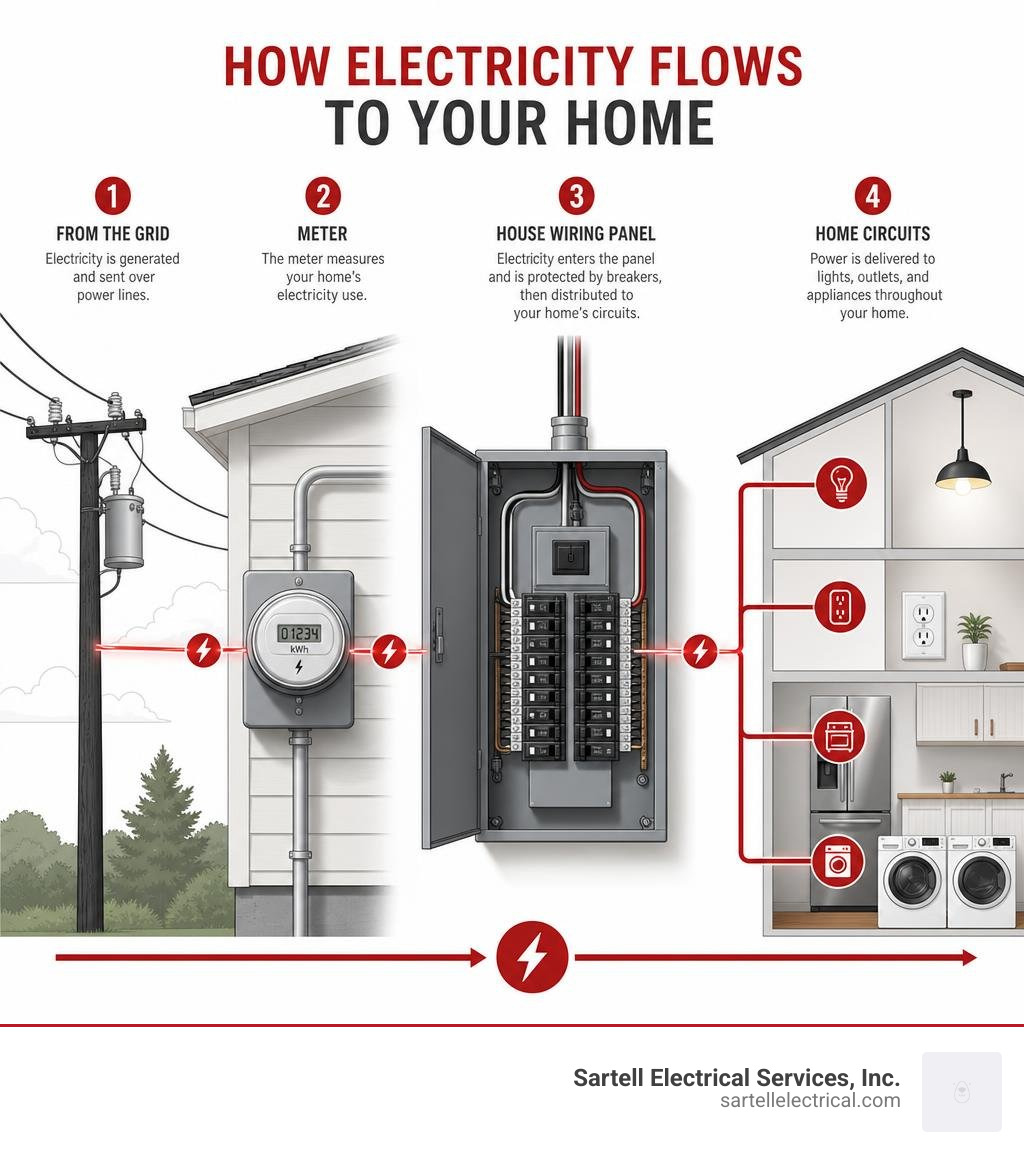
Your house wiring panel is the central hub that receives electricity from the utility grid and distributes it safely to every circuit in your home.
Quick answer: What does a house wiring panel do?
- Receives high-voltage power from the utility and steps it down for home use
- Splits electricity into individual circuits (lighting, appliances, outlets)
- Protects each circuit with a breaker or fuse that shuts off power during overloads
- Provides a single shutoff point for the entire home in an emergency
- Allows circuits to be added or upgraded as your power needs grow
Most homes built before the 1980s were wired for 60–100 amps. Today, 200-amp service is the standard — and homes adding EV chargers, heat pumps, or solar often need even more capacity.
When your panel is undersized or aging, the symptoms are hard to ignore. Lights that flicker when the AC kicks on. Breakers that trip every time you run the microwave and toaster at the same time. A faded, barely-legible label on a box that hasn't been touched in decades. These aren't just annoyances — they're warnings.
This guide walks you through everything you need to know: how panels work, when to upgrade, what it costs, and how to stay safe and code-compliant through the process.
I'm Ed Sartell, President of Sartell Electrical Services, and I've been working with residential and commercial house wiring panel installations across Massachusetts since 1985. Over nearly four decades in the trade, I've seen what happens when panels are undersized, neglected, or improperly installed — and I'm here to help you avoid those problems entirely.
Understanding Your House Wiring Panel: Components and Function
To understand how your home handles electricity, think of your house wiring panel as a highly organized highway interchange. Power arrives from the utility company at a high pressure (voltage) and is safely funneled into smaller, manageable "streets" (branch circuits) that run through your walls.
Inside the metal enclosure of a standard Electrical Panel Box for Home, several critical components work together to keep the power flowing safely:
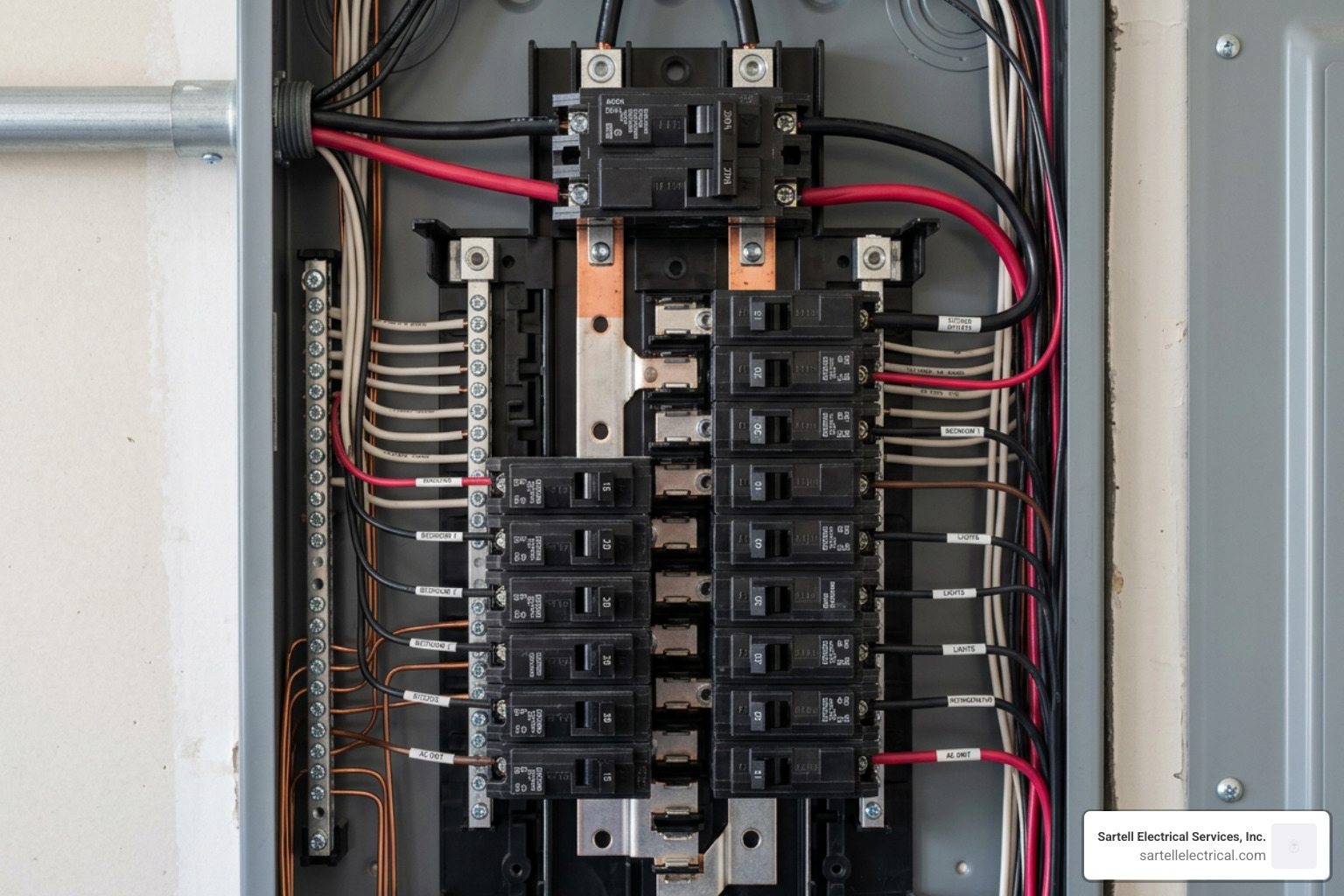
- The Enclosure: The physical metal box that houses all internal components. It must remain closed and free of rust or physical damage to protect your family from accidental contact with live wires.
- The Main Breaker: This is the master switch. Flipping this breaker cuts off all electricity to the entire house. It is also rated for the total amperage capacity of your home (e.g., 100, 200, or 400 amps).
- Hot Busbars: These are two thick metal strips running down the center of the panel. They carry 120 volts of electricity each from the main service lines. Your circuit breakers snap directly onto these busbars to draw power.
- The Neutral Bar: After electricity travels through your home's appliances and devices, it must return to the panel to complete the circuit. The white neutral wires connect to this silver bar, which sends the current back to the utility grid.
- The Ground Bar: This is your safety net. Copper ground wires connect to this bar, which is physically bonded to a metal rod driven deep into the earth outside your home. If a hot wire accidentally touches a metal appliance or box, the ground bar safely diverts that dangerous current into the earth, tripping the breaker rather than shocking you.
For a deeper dive into these internal dynamics, you can Learn more about the distribution board on Wikipedia or read our comprehensive Residential Main Electrical Panel Complete Guide.
Main-Lug vs. Main-Breaker vs. Subpanels
Not all panels are configured the same way. Depending on your home's layout and electrical design, you may encounter three distinct configurations:
- Main-Breaker Panels: This is the most common type of main panel. It features a built-in main circuit breaker that can instantly shut off all power to the system. It serves as the primary service disconnect for your home.
- Main-Lug Panels: These panels do not have a main breaker built into them. Instead, the electrical wires connect directly to "lugs" on the busbars. Main-lug panels are typically used as downstream panels or when there is a separate main service disconnect switch located near your electric meter outside.
- Subpanels: A subpanel is a smaller breaker box fed by a double-pole breaker from your main panel. Subpanels are incredibly useful during home renovations, additions, or when wiring up detached garages. They allow you to add multiple new circuits to a specific area of your home without running dozens of individual wires all the way back to the main panel.
Crucial safety note: When wiring a subpanel, the National Electrical Code (NEC) strictly requires that the neutral bar and the ground bar remain completely isolated from each other. In a main panel, they are bonded together; however, bonding them in a subpanel violates code and creates parallel paths for fault current, which can energize metal surfaces and pose a severe shock hazard.
Circuit Breakers vs. Fuses: How They Protect Your Home
Both circuit breakers and fuses serve the exact same primary purpose: they act as safety valves to protect your home's wiring from overheating, melting, and catching fire. However, the way they accomplish this is entirely different.
A fuse is an older technology. It contains a thin metal filament designed to melt and break when the electrical current exceeding its rated capacity passes through it. Once a fuse "blows," it is permanently destroyed and must be replaced with a new one.
A circuit breaker is a modern, reusable switch. Inside the breaker, an electromagnet or a bimetallic strip detects when the current is too high. When an overload or short circuit occurs, the breaker mechanically trips, moving the switch to the "off" or "tripped" position and stopping the flow of electricity. To restore power, you simply resolve the issue that caused the trip and flip the switch back to "on."
To learn more about how these safety devices compare, check out the Home Electrical Panel: Complete Guide & Diagrams and our article Keeping the Lights On What is a Breaker Box.
Within a modern house wiring panel, you will typically find two main types of breakers:
- Single-Pole Breakers: These are narrow, single switches that snap onto one hot busbar, supplying 120 volts of electricity. They are used for standard household circuits like lighting, bedroom outlets, and living room electronics. They usually come in 15-amp or 20-amp ratings.
- Double-Pole Breakers: These are wider, double-connected switches that snap onto both hot busbars simultaneously, supplying 240 volts of electricity. They are dedicated to high-demand appliances like central air conditioners, electric dryers, water heaters, and electric vehicle (EV) chargers.
Modern Safety Features: AFCI, GFCI, and Surge Protection
A modern house wiring panel is equipped with advanced safety devices designed to protect against distinct types of electrical hazards:
- Arc-Fault Circuit Interrupters (AFCIs): Standard breakers only trip when there is a massive overload or a direct short circuit. They cannot detect "arcing"—which happens when a damaged, frayed, or loose wire creates sparks behind your walls. Arcing is a leading cause of residential electrical fires. AFCI breakers use microprocessors to continuously analyze electrical waveforms, instantly shutting down power if they detect dangerous arcing patterns.
- Ground-Fault Circuit Interrupters (GFCIs): These are designed to protect people from lethal electrical shocks. A GFCI breaker monitors the balance of current between the hot and neutral wires. If it detects even a tiny leak of current (as low as 4 to 6 milliamperes)—which could mean electricity is flowing through a person to the ground—it cuts the power in milliseconds. These are essential for wet areas like kitchens, bathrooms, unfinished basements, and outdoor outlets.
- Surge Protective Devices (SPDs): Modern homes are packed with sensitive electronics, from smart TVs to computer workstations. A whole-home surge protector is installed directly inside or adjacent to your main panel. It acts as a shield, clamping down on high-voltage transient surges caused by lightning strikes or utility grid fluctuations, safely diverting that excess energy into the ground before it can fry your appliances.
For detailed diagrams and installation guides on modern safety standards, refer to Graphic1.
Upgrading Your Electrical Panel: Pros, Cons, and Future-Proofing
If you are planning to modernize your home, you will quickly discover that your electrical panel is the foundation of all your goals.

As Massachusetts homeowners embrace home electrification—transitioning away from fossil fuels toward clean energy—the demand on our electrical systems is skyrocketing. Installing a Level 2 EV charger, switching to energy-efficient heat pumps, installing solar panels, or adding a hot tub all require substantial electrical capacity.
If your current panel is maxed out, a Home Electrical Panel Upgrade is the only path forward.
Pros and Cons of a Panel Upgrade
| Pros of Upgrading | Cons of Upgrading |
|---|---|
| Enhanced Safety: Eliminates fire hazards associated with old, corroded, or loose-fitting breakers. | Upfront Cost: Upgrading is a significant investment, typically ranging from $2,000 to $5,000. |
| Increased Capacity: Provides the power needed to run modern, high-draw appliances simultaneously. | Utility Coordination Delays: The process requires scheduling power shutoffs with local utilities (like Eversource or National Grid). |
| Future-Proofing: Adds physical space (empty slots) for future solar, batteries, or EV charging. | Potential Secondary Costs: If your service mast or meter box is outdated, those must be replaced too. |
| Code Compliance: Brings your home up to modern safety standards, satisfying home insurance requirements. | Minor Disruption: Your home will be completely without power for several hours on installation day. |
When to Upgrade Your House Wiring Panel
Electrical panels do not last forever. While a well-installed panel has a typical lifespan of 25 to 40 years, components degrade over time. If your panel is over 20 years old, it is wise to start planning for its replacement.
Keep an eye out for these immediate warning signs that your panel is struggling or failing:
- Flickering or Dimming Lights: If your lights dim every time your refrigerator or central AC kicks on, your system is struggling to handle the sudden load.
- Frequent Tripping Breakers: If you find yourself constantly walking down to the basement to reset a tripped switch, the circuit is overloaded, or the breaker itself has weakened and failed.
- Physical Warmth or Burning Smells: If the panel door feels warm to the touch, or if you notice a faint plastic burning smell near the box, shut off your main breaker immediately and call a professional. This indicates a highly dangerous loose connection or active arcing.
- Corrosion or Rust: Water intrusion from a damaged outdoor service cable can slowly drip into your panel, causing rust and corrosion on the busbars. This ruins electrical conductivity and creates a severe fire risk.
- Outdated Brands: If your home still has a fuse box, or if your panel was made by defunct manufacturers known for safety failures (such as Federal Pacific Electric or Zinsco), it must be replaced immediately.
For a detailed look at the decision-making process, read Should You Replace Your Electrical Panel Decisions Costs and DIY Considerations.
Choosing the Right Size for Your House Wiring Panel
How much power does your home actually need? To determine this, we perform a formal load calculation based on your home's square footage, heating/cooling systems, and major appliances.
Here is a quick breakdown of common residential service sizes:
| Panel Rating (Amps) | Typical Home Profile | Capability |
|---|---|---|
| 60 Amps | Common in pre-1960s homes. | Highly outdated. Barely enough for lighting and basic outlets. Cannot support modern appliances. |
| 100 Amps | Standard for small-to-medium older homes with gas appliances. | Adequate for basic lighting, electronics, and a few standard appliances, but lacks room for expansion. |
| 150 Amps | Common in mid-sized homes built in the 1980s and 1990s. | Provides decent capacity for standard homes, but may struggle if you add an EV charger and electric heat pumps. |
| 200 Amps | The Modern Standard for new construction and major renovations. | Easily handles a fully electric home, including central AC, electric cooking, EV charging, and solar. |
| 400 Amps | Large luxury homes (typically over 3,500 sq. ft.) with heavy heating/cooling loads. | Excellent for homes with multiple EV chargers, heated pools, guest houses, and extensive smart home automation. |
To learn how to calculate your home's specific power demands, consult our Residential Electrical Capacity Guide.
Traditional vs. Smart Electrical Panels
As we navigate through 2026, home energy technology is evolving rapidly. Traditional panels are passive devices—they sit in your basement or garage, and you only interact with them when a breaker trips. Smart electrical panels (such as the SPAN panel) are changing this completely.
A smart panel replaces standard breakers with computer-controlled, cloud-connected switches. This offers several game-changing benefits:
- Real-Time Energy Monitoring: Through a smartphone app, you can see exactly how many watts of electricity every single appliance in your home is drawing at any given second.
- Active Load Management: If you are close to exceeding your panel's electrical capacity, a smart panel can automatically pause lower-priority loads (like your water heater or EV charger) while your high-priority loads (like your electric stove or heat pump) are running. This smart load-sharing can save you thousands of dollars by allowing you to fully electrify your home without paying your utility company for a costly service upgrade.
- Optimized Battery Backup: During a power outage, a smart panel allows you to instantly toggle off non-essential circuits from your phone, extending your home battery backup life by up to 40%.
The Installation Process: Costs, Permits, and Safety Standards
Upgrading a house wiring panel is a highly regulated process that requires precision, expertise, and strict adherence to local codes.
In Massachusetts, all electrical work must comply with the Massachusetts Electrical Code, which incorporates the National Electrical Code (NEC) along with specific state amendments.
The Typical Upgrade Timeline & Step-by-Step Process:
- Permitting: We pull an electrical permit with your local town or city hall (whether you are in Reading, Andover, Chelsea, or Boston).
- Utility Coordination: We coordinate with your utility provider (Eversource or National Grid) to schedule a specific date for power disconnection and restoration.
- The Tear-Down: On installation day, the utility disconnects the power at the street or meter. We carefully remove your old panel, service wires, and meter socket.
- The Build-Out: We install a brand-new, code-compliant meter box, service entrance cables, weatherhead, grounding rods, and the new breaker panel itself.
- Circuit Wiring & Bonding: We carefully wire each branch circuit into its new breaker, ensuring proper separation of neutrals and grounds, and installing modern AFCI/GFCI breakers as required by code.
- Inspection & Reconnection: A local municipal electrical inspector reviews our work to ensure it is 100% safe. Once approved, the utility company reconnects the live power lines to your home.
Upgrading Costs
The typical cost for a standard residential panel upgrade ranges between $2,000 and $5,000. This generally includes the cost of the new panel, circuit breakers, meter socket, service cables, permit fees, and labor.
However, if your home requires a major service upgrade—such as running new underground service lines or having the utility company replace a nearby transformer—the total cost can scale up, occasionally reaching up to $25,000 in complex scenarios.
For a detailed breakdown of pricing factors, view our Home Electrical Panel Upgrade Cost page.
Organizing and Labeling Circuits for Safety
A safe panel is an organized panel. When emergency strikes, you cannot afford to waste time guessing which breaker controls which room.
During our installations, we prioritize clean wire management and logical organization:
- Clean Dressing: Wires are neatly routed along the sides of the panel enclosure, avoiding a "rat's nest" of tangled cables. This ensures proper heat dissipation and easy serviceability.
- Clear Circuit Directory: We fill out a permanent, highly detailed circuit directory on the inside door of your panel. Instead of vague labels like "Plugs," we use precise descriptions like "Kitchen Counter GFCIs," "Master Bedroom Outlets," or "Sump Pump - Dedicated."
To understand how circuits should be laid out, check out our guide on House Breaker Panel Wiring.
Frequently Asked Questions about House Wiring Panels
How long does an electrical panel upgrade take?
For a standard residential home, the actual installation work takes one full working day (typically 6 to 8 hours). During this window, your power will be completely shut off. We handle all the utility coordination and town inspections beforehand to ensure that power is safely restored by the end of the afternoon.
Can I upgrade my electrical panel myself?
Absolutely not. Working inside a house wiring panel exposes you to live, unmetered utility lines that carry enough current to cause fatal shocks. Furthermore, improper wiring can lead to catastrophic house fires, code violations, and the denial of home insurance coverage. Always hire a licensed, insured electrician to perform panel work.
To keep your system running smoothly between professional visits, you can follow The Essential Circuit Breaker Maintenance Checklist for Homeowners.
How much does it cost to replace a main breaker panel?
While a simple panel swap (keeping your existing service capacity) typically costs between $2,000 and $4,000, upgrading your overall service capacity to 200 amps usually ranges from $3,000 to $5,000 because it requires replacing the electric meter, service mast, and heavy-gauge service wires. For a deeper look at these figures, read our guide on the Cost to Replace Main Breaker Panel.
Conclusion
Your house wiring panel is the unsung hero of your home. It works 24/7 to keep your lights shining, your appliances running, and your family safe. Whether you are dealing with flickering lights, planning to install an EV charger, or preparing to transition to clean solar energy, upgrading your panel is the smartest investment you can make for your home's safety and future value.
At Sartell Electrical Services, we have spent over 30 years helping homeowners across Reading, Middlesex County, Essex County, and the Greater Boston area modernize their electrical systems. We pride ourselves on exceptional craftsmanship, absolute safety compliance, and unmatched customer service.
Are you ready to take the next step toward a safer, more powerful home? Explore our specialized guide on Residential Main Panel Wiring or contact us today to schedule your professional panel assessment!