What Is Commercial Power Distribution (And Why It Matters for Your Business)
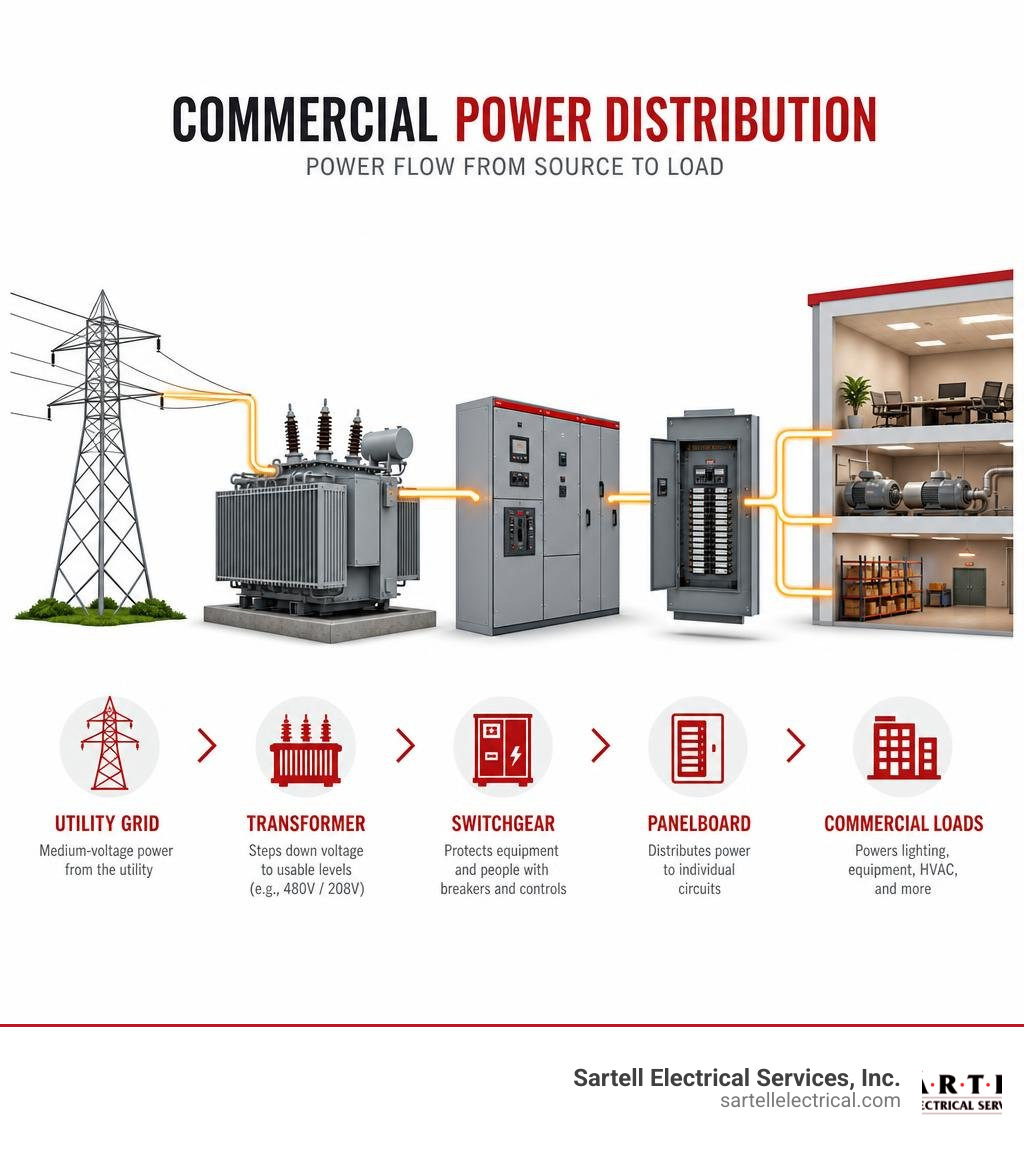
Commercial power distribution is the system that takes incoming utility electricity and safely delivers it — at the right voltage, capacity, and reliability — to every load in your building.
Here's a quick breakdown of what that means in practice:
- Source: Utility grid delivers medium-voltage power (typically 4–35 kV) to your facility
- Step-down: Transformers reduce voltage to usable levels (commonly 480V or 208V)
- Protection: Switchgear and circuit breakers guard equipment and people
- Distribution: Panelboards and busbars route power to individual circuits
- Monitoring: Metering systems track energy use and flag problems
- Backup: Transfer switches and generators maintain power if the grid fails
This is different from plugging a lamp into a wall. Commercial systems handle much higher loads, require three-phase power, and must meet strict safety codes — all while keeping your operations running without interruption.
The stakes are real. In 2013 alone, the U.S. recorded over 3,200 power outages averaging nearly 197 minutes each. For a business, that kind of downtime isn't just inconvenient — it's costly.
I'm Ed Sartell, President of Sartell Electrical Services, Inc., and I've been designing and installing commercial power distribution systems across Massachusetts since 1985. In that time, I've seen how the right distribution design keeps businesses running safely and efficiently — and how the wrong one creates problems that are expensive to fix.
Quick Commercial power distribution definitions:
Understanding Commercial Power Distribution vs. Residential and Industrial Systems
To truly grasp how a commercial power distribution system works, it helps to look at how it compares to residential and heavy industrial environments. While all three systems exist to deliver electrical energy from point A to point B, their scale, complexity, and structural layouts are vastly different.
Residential systems are relatively simple. They typically rely on single-phase power delivered at 120/240 volts. This is more than enough to run your refrigerator, HVAC system, and home entertainment center. The load profile is highly predictable, peaking in the morning and evening when families are home.
Commercial and industrial systems, on the other hand, operate on a completely different level. They utilize three-phase power to deliver continuous, non-pulsing energy. This is essential for driving large electric motors, commercial HVAC chillers, and massive IT infrastructures. However, even commercial and industrial systems have distinct differences in their design goals and operational environments.
| Feature | Residential Systems | Commercial Systems | Industrial Systems |
|---|---|---|---|
| Primary Voltage | 120V / 240V | 120V/208V, 277V/480V | 480V up to 4,160V (and higher) |
| Phase Configuration | Single-phase | Three-phase | Three-phase |
| Load Profile | Low to moderate; morning/evening peaks | High, steady daytime demand; continuous IT loads | Extremely high; highly inductive; 24/7 continuous |
| Typical Infrastructure | Single breaker panel, overhead drop | Switchboards, dry-type transformers, subpanels | Substation transformers, heavy switchgear, bus ducts |
| Key Priority | Basic safety and cost-efficiency | Reliability, flexibility, energy monitoring | Maximum uptime, heavy machinery protection |
In a commercial setting, such as an office building in Boston or a retail complex in Woburn, the primary challenges are load flexibility, power quality, and space optimization. Commercial spaces undergo frequent layout changes (tenant fit-ups), meaning the electrical distribution system must be adaptable.
In contrast, industrial systems are highly specialized and built around heavy machinery, assembly lines, and chemical processing plants. They deal with massive inductive loads that can severely disrupt power quality. If you want to dive deeper into these distinctions, check out our comprehensive guide on Industrial vs Commercial and Everything in Between.
Key Components of a Commercial Power Distribution System
A robust commercial electrical system is only as strong as its individual parts. Each component must be precisely sized, rated, and coordinated to ensure safety and system longevity.

Let’s look at the primary components that make up the backbone of commercial power distribution:
1. Transformers
Since utility lines transmit electricity at medium voltages (often between 4 kV and 35 kV) to minimize transmission line losses, your facility needs a way to step that voltage down to a usable level. This is the job of the transformer. In commercial buildings, we typically install dry-type step-down transformers. These are air-cooled and placed in dedicated electrical rooms to transition utility power down to 480V or 208V.
2. Switchgear and Switchboards
Switchgear and switchboards serve as the central routing stations for your building's electrical system.
- Switchgear is designed to handle high-power applications, offering advanced circuit protection, metal-enclosures, and high short-circuit ride-through capabilities.
- Switchboards are slightly less heavy-duty but serve a similar purpose: they take the main electrical feed and divide it into smaller sections for distribution throughout the building.
For highly demanding applications, modular solutions like the Modular Main Distribution Boards Enclosures provide incredible flexibility, allowing us to customize configurations for air circuit breakers and busbars in space-constrained electrical rooms.
3. Integrated Facility Systems (IFS)
In modern commercial design, saving physical space is a major priority. Traditional designs require mounting separate transformers, switchboards, panelboards, and dry-type transformers along an electrical room wall, which eats up valuable square footage.
To solve this, we often utilize solutions like the Integrated Facility Systems IFS switchboard. These systems consolidate multiple standalone electrical components into a single, factory-assembled unit. By integrating these components, facilities can achieve up to a 50% reduction in total footprint and improve installation times by as much as 80%.
4. Panelboards and Subpanels
Panelboards are the final distribution points before electricity reaches your lights, computers, and wall receptacles. They house the thermal-magnetic circuit breakers that protect individual branch circuits from overcurrents and short circuits.
Primary Voltage Classifications in Commercial Power Distribution
When designing a commercial system, choosing the right voltage configuration is critical for balancing system performance and equipment costs. Commercial buildings in Massachusetts typically utilize one of two primary three-phase configurations:
- 480Y/277V (Three-Phase, Four-Wire): This is the gold standard for mid-to-large commercial properties. The higher 480-volt line-to-line voltage is used to power heavy loads like HVAC compressors, elevators, and large electric pumps. Meanwhile, the 277-volt line-to-neutral connection is ideal for commercial LED lighting systems. Operating at higher voltages reduces the current (amperage) required for the same amount of power, allowing us to use smaller copper wires and conduits, which dramatically lowers installation costs.
- 208Y/120V (Three-Phase, Four-Wire): This configuration is used for standard office environments, retail outlets, and schools. The 120-volt line-to-neutral connection powers standard wall outlets, computers, and office equipment. The 208-volt line-to-line connection runs smaller three-phase motors, commercial kitchen appliances, and small HVAC units.
For a detailed look at how these voltages are mapped out during the engineering phase, refer to the Power Distribution Systems Design Guide for Modern Industries.
Ensuring Reliability and Compliance in Commercial Power Distribution
Operating a commercial facility comes with a heavy burden of regulatory compliance. It isn't just about keeping the lights on; it's about protecting human life and expensive assets from electrical hazards.
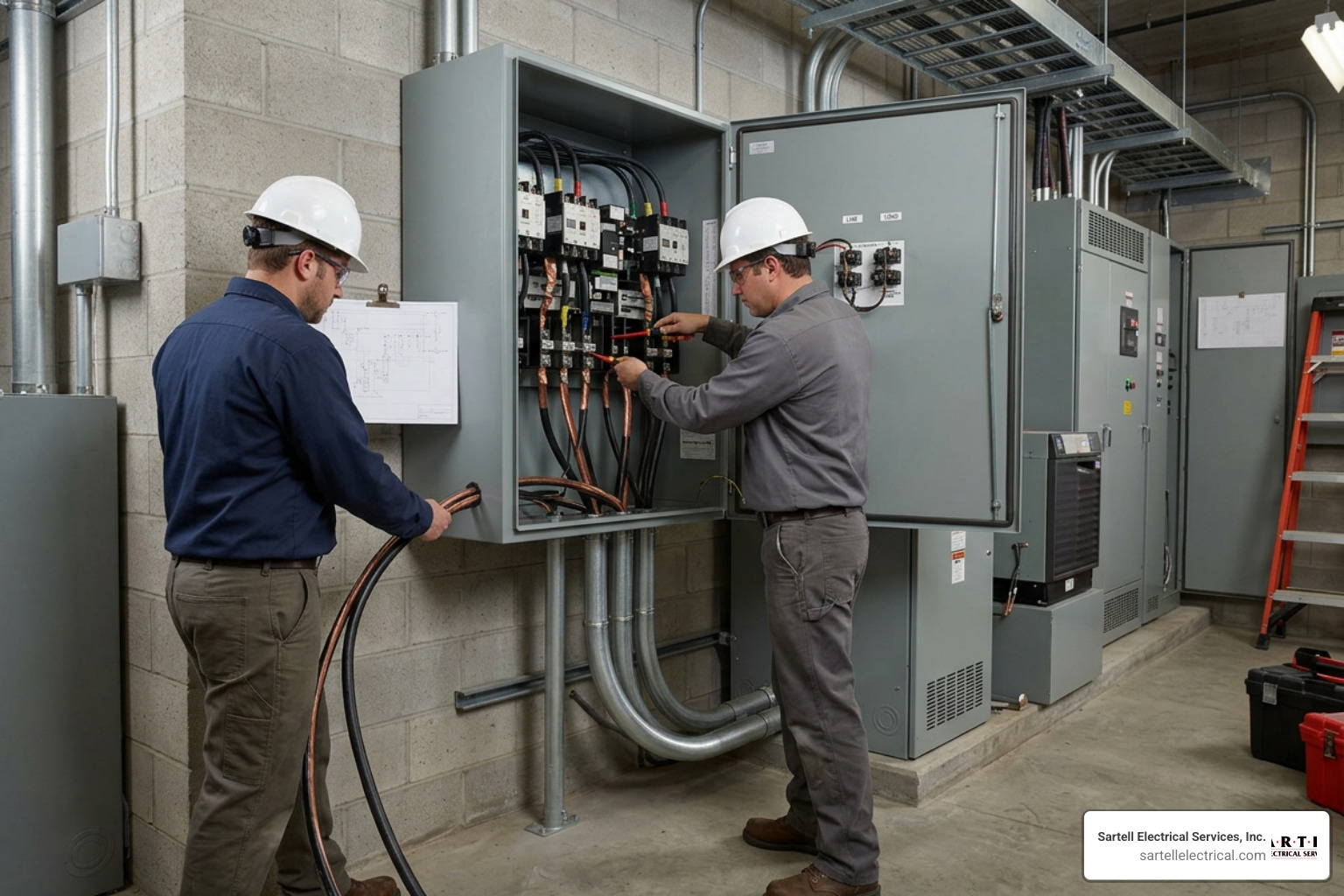
To ensure safety and reliability, commercial power systems must strictly adhere to three primary standards:
1. The National Electrical Code (NEC)
The NEC (NFPA 70) dictates the minimum standards for safe electrical design, installation, and inspection. It covers everything from wire sizing and conduit fill to grounding and overcurrent protection. In Massachusetts, state-specific amendments are periodically integrated, making it essential to work with a local licensed contractor who understands the exact codes enforced in your town, whether you are in Reading, Andover, or Boston.
2. NFPA 70B (Standard for Electrical Equipment Maintenance)
Historically, electrical maintenance was treated as a "best practice." However, NFPA 70B has transitioned into a mandatory standard. It requires commercial facility managers to implement formal, preventive maintenance programs for their electrical distribution equipment. This includes regular infrared thermography (thermal imaging) to spot overheating connections, contact resistance testing, and physical cleaning of switchgear. You can learn how to structure your facility's plan in our Commercial Electrical System Maintenance Guide.
3. OSHA 70E (Standard for Electrical Safety in the Workplace)
OSHA 70E focuses on protecting personnel from the hazards of shock, electrocution, and arc flash incidents. An arc flash is an explosive release of energy caused by an electrical fault. It can reach temperatures hotter than the surface of the sun. OSHA 70E requires facilities to perform arc flash hazard analyses, label electrical equipment with safety boundaries, and ensure that maintenance personnel wear appropriate Personal Protective Equipment (PPE).
Integrating Backup Systems into Commercial Power Distribution
When the utility grid fails, your business cannot afford to grind to a halt. Incorporating emergency backup systems directly into your commercial power architecture is the only way to guarantee business continuity.
The system relies on three critical elements working in perfect harmony:
- Automatic Transfer Switches (ATS): The ATS is the brain of your backup system. It constantly monitors incoming utility power. If the voltage drops or cuts out completely, the ATS commands the backup generator to start. Once the generator reaches the correct speed and voltage, the ATS safely disconnects the building from the utility grid and connects it to the generator. This transition happens in seconds.
- Generator Docking Stations (Tap Boxes): For facilities that do not have a permanent, multi-million-dollar standby generator, a generator docking station is a brilliant, cost-effective alternative. It is a permanently mounted outdoor enclosure that connects directly to your main switchboard. If an extended outage occurs, a portable roll-up generator can be delivered to your site and plugged directly into the docking station using quick-connect Cam-Lok cables, restoring power in minutes without complex field wiring.
- Paralleling Switchgear: In massive commercial spaces, data centers, or healthcare facilities, a single generator might not be enough. Paralleling switchgear allows multiple generators to synchronize their electrical outputs and connect to the same busbar. This provides incredible redundancy — if one generator fails to start, the remaining units can still power your critical loads.
For a deeper dive into designing emergency electrical systems, explore our Commercial Electrical Services Ultimate Guide.
Permanent vs. Portable Power Solutions for Commercial Facilities
As commercial operations evolve, facility managers often find themselves needing to choose between permanent infrastructure and temporary, portable power setups. Each has its place, and a smart facility design often utilizes a hybrid approach.
Permanent power solutions are the standard, hardwired installations that form the core of your building. These include your main switchboards, permanent dry-type transformers, and dedicated branch circuit panelboards. They are designed for long-term reliability, maximum energy efficiency, and compliance with building codes. Permanent systems are ideal for your day-to-day business operations where loads remain relatively stable.
Portable power solutions, on the other hand, offer unmatched flexibility. These include portable transformers, distribution panels, "spider boxes" (compact temporary distribution units), and heavy-duty cable assemblies.
Portable solutions are highly appropriate in several commercial scenarios:
- Renovations and Tenant Fit-Ups: Providing safe, temporary power to construction crews without interrupting operations in other parts of the building.
- Disaster Recovery: Restoring power to critical circuits after severe weather events or equipment failure.
- Outdoor Events & Seasonal Demands: Powering temporary structures, outdoor retail events, or specialized equipment.
Integrating these two approaches requires careful planning. For example, installing a permanent quick-connect docking panel on the exterior of your building allows you to seamlessly plug in portable generator systems whenever the need arises. To learn more about how to wire your facility for both scenarios, take a look at our Commercial Electrical Wiring Insights.
Managing Power Quality, Load Balancing, and Energy Efficiency
In modern commercial facilities, the quality of the power running through your conduits is just as important as the quantity. Poor power quality can ruin sensitive office electronics, cause LED lights to flicker, overheat electric motors, and lead to massive utility penalties.
Managing your power system effectively involves focusing on three key areas:
Power Factor Correction
Power factor is a measure of how effectively your system converts electrical energy into useful work. Inductive loads, like large HVAC motors and compressors, draw "reactive power" that does not perform real work but must still be supplied by the utility.
If your power factor drops too low (typically below 90% or 0.90), local utilities like Eversource or National Grid will hit you with expensive power factor penalties on your monthly bill. Installing power factor correction capacitor banks at your main service entrance solves this by supplying the necessary reactive power locally, keeping your utility bills low.
Harmonic Distortion Mitigation
Today's office buildings are packed with non-linear loads, including computers, servers, LED lighting drivers, and variable frequency drives (VFDs). These devices pull current in short, rapid pulses rather than a smooth sine wave. This creates "harmonics" — high-frequency electrical noise that distorts your system.
Left unchecked, harmonics cause neutral wires to overheat, trip circuit breakers unexpectedly, and shorten the lifespan of transformers. We mitigate this by installing active harmonic filters and utilizing line reactors on VFDs.
Smart Metering and Load Balancing
If one phase of your three-phase system is carrying significantly more load than the others, it leads to voltage imbalances, increased energy losses, and overheated equipment.
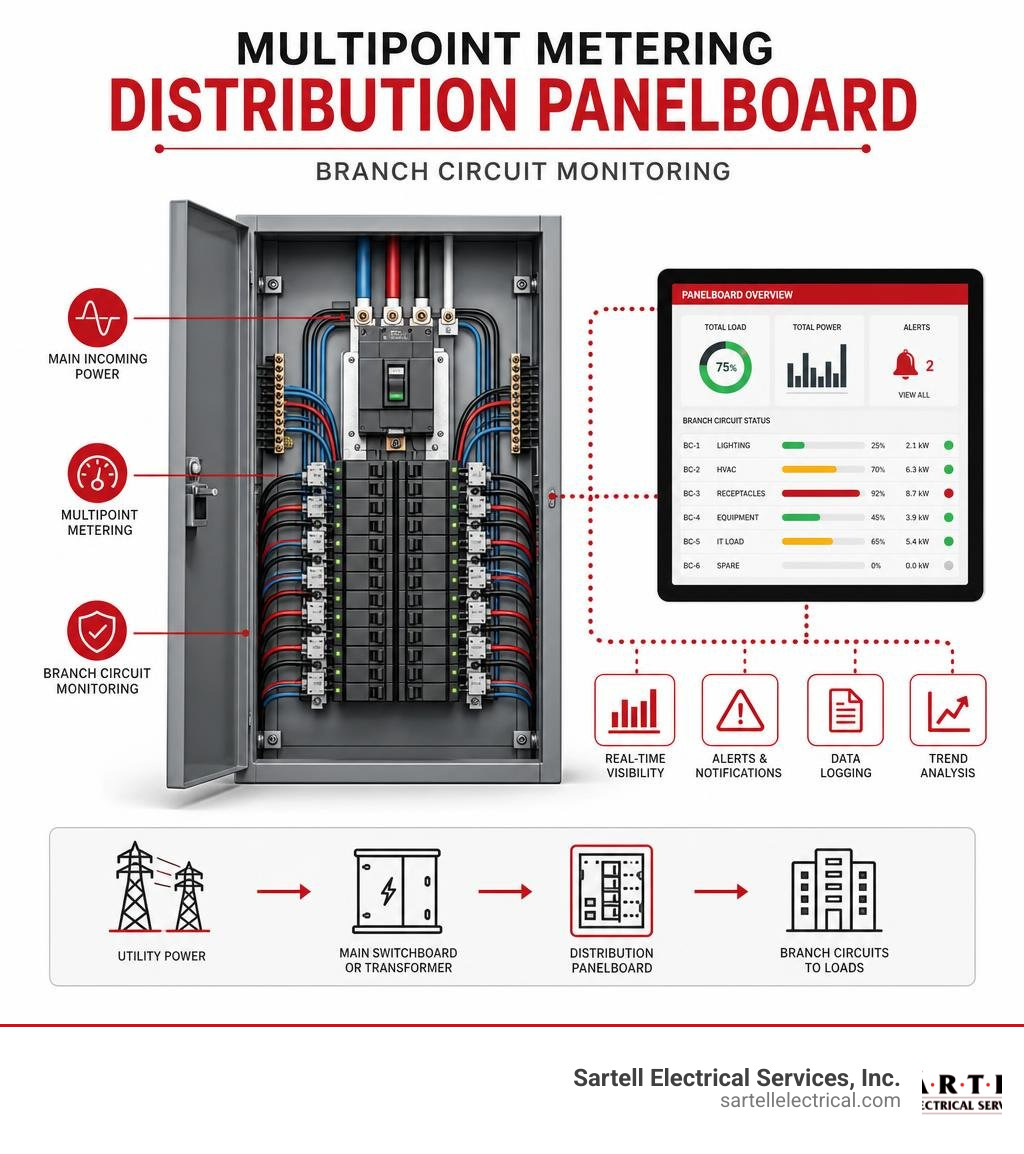
To prevent this, we utilize advanced systems like the Branch circuit metering panel. These panels feature integrated multipoint meters that track energy usage on a circuit-by-circuit level. This real-time data allows facility managers to balance loads across all three phases, benchmark energy consumption, and identify energy-wasting equipment before it fails.
This level of detailed planning is especially critical for specialized, power-hungry environments. If you are managing a high-density environment, you can read our guide on Data Center Power Planning to see how these principles apply at scale.
Frequently Asked Questions
What are the most common voltage configurations used in commercial buildings?
The two most common configurations are 480Y/277V and 208Y/120V three-phase, four-wire systems. 480Y/277V is preferred for heavy machinery, large HVAC systems, and commercial lighting because it reduces current and allows for smaller wiring. 208Y/120V is standard for general office spaces, convenience outlets, and everyday electronics.
How often should commercial electrical distribution equipment be maintained?
According to NFPA 70B standards, commercial electrical equipment should undergo formal, preventive maintenance at least once a year. This includes infrared thermography to detect loose, hot connections. Physical inspections, cleaning, and mechanical testing of circuit breakers should be performed every one to three years, depending on the operating environment.
What is the difference between switchgear and switchboards?
While both distribute power, switchgear is built for higher-voltage, high-power environments (often up to 38 kV) and features metal-enclosed, draw-out power circuit breakers designed to withstand short circuits for up to 30 cycles. Switchboards are typically used for lower-voltage applications (600V and below), are front-accessible, utilize molded-case circuit breakers, and require a smaller physical footprint.
Conclusion
Designing, installing, and maintaining a commercial power distribution system is a highly complex task that directly impacts your business’s bottom line, safety, and operational continuity. From stepping down utility voltages to managing power quality and ensuring compliance with modern NFPA 70B standards, every decision requires expert engineering and precise execution.
At Sartell Electrical Services, Inc., we have spent over 30 years helping businesses throughout Greater Boston and Eastern Massachusetts navigate these exact challenges. Based in Reading, MA, our team of highly skilled Commercial Electricians is committed to delivering excellence, safety, and unmatched customer service on projects of all sizes.
Whether you are planning a tenant fit-up, upgrading your facility's switchgear, or implementing a mandatory preventive maintenance program, we are here to help. Reach out to us today to discuss your next commercial project and ensure your business stays powered for the future.