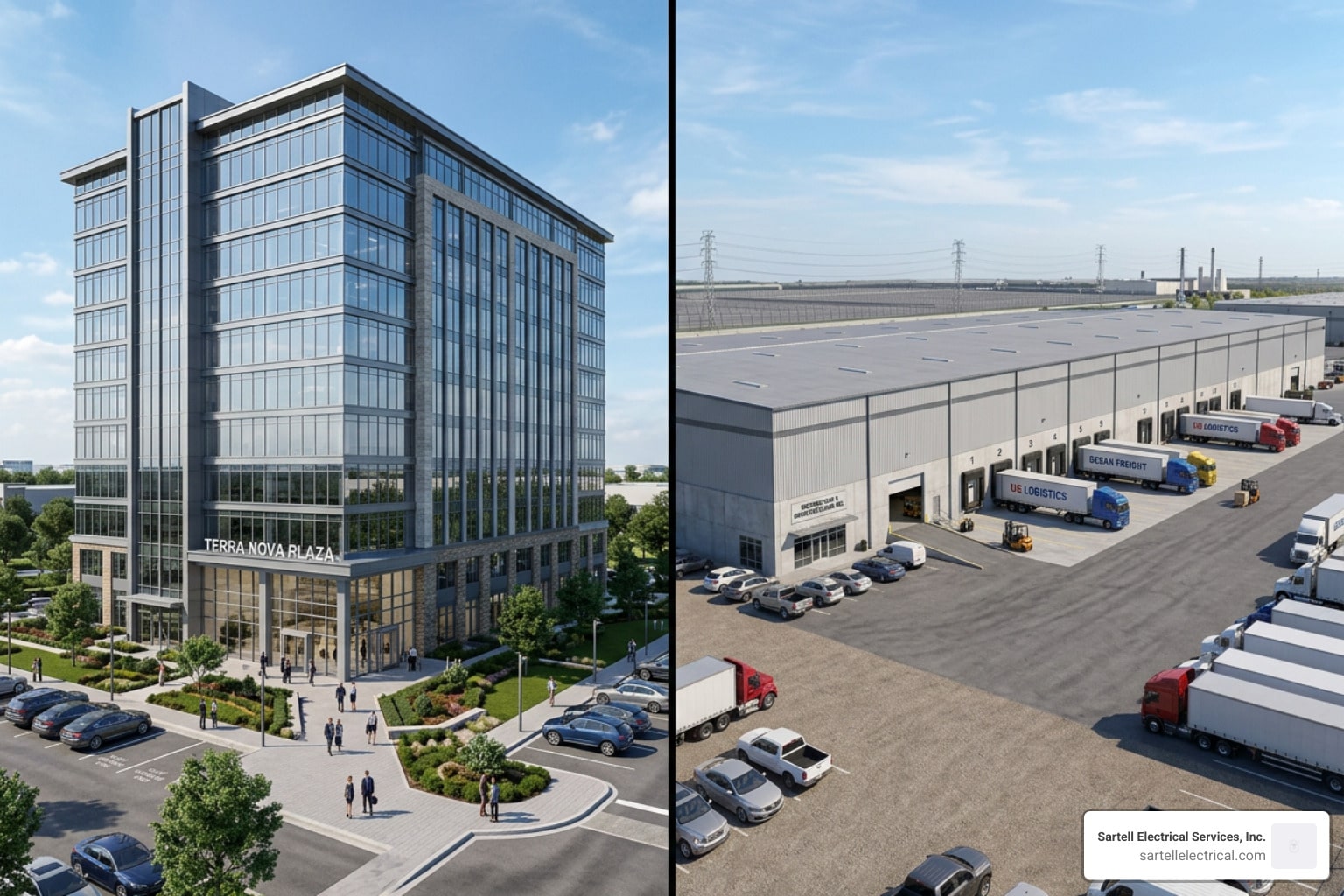
What's the Difference Between Commercial and Industrial?
Commercial vs industrial is one of the most common points of confusion for property owners, investors, and businesses planning a new facility or electrical project. Here's a quick breakdown:
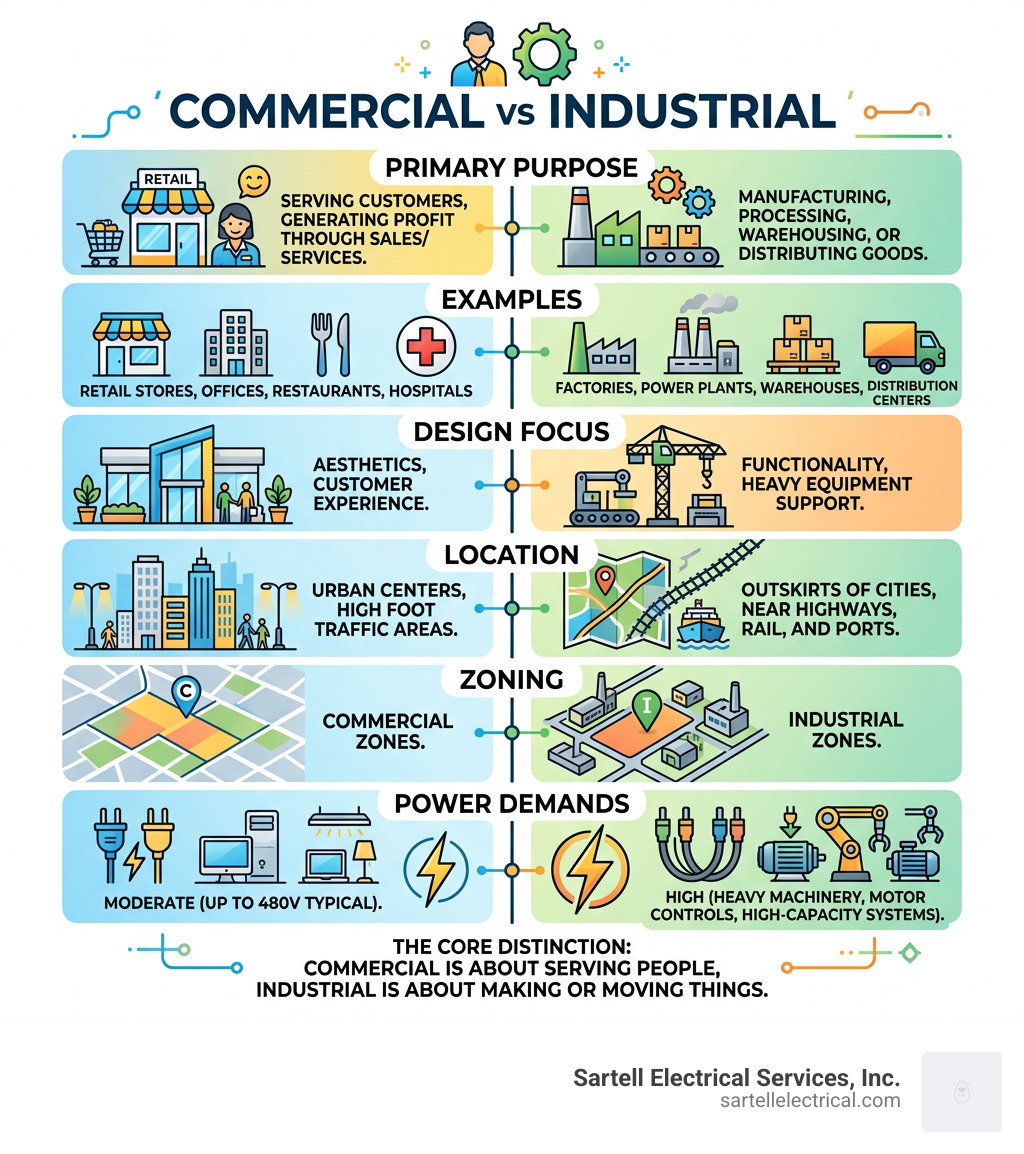
| Factor | Commercial | Industrial |
|---|---|---|
| Primary Purpose | Serving customers and generating profit through sales or services | Manufacturing, processing, warehousing, or distributing goods |
| Examples | Retail stores, offices, restaurants, hospitals | Factories, power plants, warehouses, distribution centers |
| Location | Urban centers, high foot traffic areas | Outskirts of cities, near highways, rail, and ports |
| Design Focus | Aesthetics, customer experience | Functionality, heavy equipment support |
| Zoning | Commercial zones | Industrial zones |
| Power Demands | Moderate (up to 480V typical) | High (heavy machinery, motor controls, high-capacity systems) |
The core distinction is simple: commercial is about serving people, and industrial is about making or moving things.
Both sectors have unique design, infrastructure, regulatory, and electrical requirements. Understanding those differences matters whether you're developing a property, hiring a contractor, or planning a career in the trades.
I'm Ed Sartell, President of Sartell Electrical Services, and I've been working across commercial vs industrial electrical projects in Massachusetts since 1985. Over nearly four decades, I've seen how the demands of a retail fit-out differ dramatically from wiring a manufacturing plant — and I'll walk you through exactly what those differences mean for your project.
Commercial vs industrial terms made easy:
The Fundamental Differences: commercial vs industrial
When we talk about the commercial vs industrial divide, we are looking at two distinct engines of the economy. While both are built to generate revenue, the "how" and "where" couldn't be more different.
Commercial ventures are profit-driven motives centered on transactions with the public. Think of a bustling shopping plaza in Peabody or a bank in downtown Boston. These businesses need to be attractive, accessible, and inviting to the average person.
On the flip side, the industrial sector is focused on the large-scale production, manufacturing of goods, and supply chain logistics. These facilities are the "backstage" of our economy. They aren't worried about whether a customer likes the color of the siding; they are worried about whether a 53-foot trailer can make a tight turn into the loading dock or if the floor can support a 20-ton piece of machinery.
The rise of e-commerce has blurred the lines slightly—some call a massive Amazon warehouse a "commercial" property because it’s a business, but in terms of construction and electrical needs, it is purely industrial. You can learn more about these nuanced differences at Commercial vs. Industrial.
Defining the Commercial Sector
In our work as a commercial electrical contractor in Peabody, MA, we define the commercial sector as any space where business meets the public. This includes:
- Retail Stores: From small boutiques to massive malls.
- Office Buildings: Ranging from single-story professional suites to high-rise towers in Greater Boston.
- Hospitality: Hotels, restaurants, and entertainment hubs.
- Healthcare Facilities: Hospitals and urgent care centers that require specialized power for life-saving equipment.
The goal here is occupancy and comfort. If the lights are too dim or the AC is too loud, customers won't stay.
Defining the Industrial Sector
Industrial projects are a different beast entirely. As an industrial electrical contractor in Chelsea, MA, we see these facilities as high-performance machines. Key examples include:
- Warehousing and Distribution: Massive hubs that keep the supply chain moving.
- Power Plants and Refineries: Facilities that generate energy or process raw materials.
- Manufacturing Plants: Where everything from microchips to food and beverages is assembled.
These sites often operate 24/7, and the cost of downtime can be staggering—sometimes reaching $100,000 per minute in high-output environments.
Design and Aesthetic Priorities in commercial vs industrial Buildings
If buildings could talk, an industrial structure would say, "Let’s get to work," while a commercial building would flash a friendly smile and offer you a seat.

Architectural Focus for Public Spaces
For commercial construction, aesthetic attractiveness is a top priority. Developers focus on "curb appeal" to draw in foot traffic. You’ll see large glass windows to showcase products, polished interiors, and complex foot-traffic patterns designed to guide customers through a space.
In these environments, we often implement commercial lighting solutions in MA that highlight specific architectural features or create a certain mood. Everything must adhere to the International Building Codes to ensure public safety and accessibility.
Structural Requirements for Production
Industrial buildings swap the "wow factor" for raw durability. You won't find many decorative glass curtains here. Instead, you'll see:
- Reinforced Concrete: Floors designed to withstand the crushing weight of heavy machinery.
- Corrugated Metal Siding: Durable, easy to maintain, and functional.
- High Ceilings: Often 30 to 40 feet or more to accommodate vertical storage and gantry cranes.
- Loading Docks: Strategically placed for 24/7 shipping and receiving.
In these settings, our team provides industrial electrical solutions that focus on protecting the wiring from harsh environments, vibrations, and heavy usage.
Operational Infrastructure in commercial vs industrial Facilities
The "guts" of a building—the Mechanical, Electrical, and Plumbing (MEP) systems—vary wildly between these two sectors.
| System | Commercial | Industrial |
|---|---|---|
| Water Service | Up to 25 GPM (Gallons Per Minute) | 25 to thousands of GPM |
| HVAC | Centralized for human comfort | Often compartmentalized or specialized for cooling machinery |
| Power Capacity | Standard 120V/240V or 480V | High-capacity, often requiring custom substations |
Electrical Systems and Load Demands
Commercial wiring typically uses MC (Metal Clad) or EMT (Electrical Metallic Tubing) conduit. The focus is on lighting control and energy efficiency. However, industrial sites often require Rigid pipe to protect wires from physical damage.
In our industrial electrical service work, we deal with motor controls, heavy-duty 480V systems, and complex PLC (Programmable Logic Controller) panels. While a commercial building might trip a breaker because of a space heater, an industrial plant could face a massive surge from a 500-horsepower motor starting up. For specialized high-tech needs, we also manage data center electrical systems where "uptime" is the only metric that matters.
Technology and Modern Efficiency
Technology is transforming both fields. Many commercial developers now use Building Information Modeling (BIM) to visualize every wire and pipe before a single brick is laid. Smart building systems are also standard, allowing managers to control lighting and HVAC from a smartphone.
In the industrial world, technology is about precision and safety. We see giant automated cranes positioning steel beams with millimeter accuracy, and IoT sensors performing vibration analysis on motors to predict a failure before it happens.
Location, Zoning, and Regulatory Compliance
Where you build is just as important as what you build. Commercial vs industrial zoning laws are designed to keep loud, high-traffic manufacturing away from quiet residential neighborhoods.
Commercial properties thrive in urban centers or busy intersections where they are visible to the public. Industrial facilities, however, need to be near logistical hubs like the Port of Boston, Logan Airport, or major highways like I-95 and I-495. You can explore the complexities of these land uses in this guide on commercial and industrial zoning.
Permitting and Public Accessibility
Commercial projects face a mountain of "red tape" regarding public safety. This includes ADA compliance for disabilities, strict fire exit requirements, and occupancy limits. When we handle commercial electrical design-build projects, we ensure every emergency light and exit sign is placed exactly where the fire marshal expects it.
Industrial Safety and Hazardous Materials
Industrial sites have their own set of watchdogs. Compliance with the Occupational Safety and Health Administration (OSHA) is non-negotiable for worker safety. Furthermore, the National Fire Protection Association (NFPA) sets rigorous standards for electrical safety in hazardous locations where dust or chemicals might be present.
Environmental impact is also a major concern. The Environmental Protection Agency (EPA) monitors these sites for hazardous waste and emissions. Our work as an industrial electrical contractor in Burlington, MA often involves installing systems that help monitor and mitigate these environmental risks.
Investment Potential and Career Paths
Whether you are looking to invest your capital or your career, both sectors offer "tremendous returns," though the risks differ.
Real Estate Returns
Industrial real estate is currently one of the hottest property subtypes. Driven by the e-commerce boom, demand is at an all-time high. While multifamily cap rates usually hover between 3-6%, some prime industrial properties near port areas are trading at sub-3% cap rates. Leasing a space to a national tenant like an Amazon distribution center provides a level of stability that a small retail shop simply can't match.
Career Specialization for Electricians
For those entering the trades, the choice between becoming a commercial electrician or an industrial specialist is a big one.
- Commercial Electricians: Often focus on lighting, power distribution, and "service work." It’s a great path if you want to eventually start your own business, as the barrier to entry is lower.
- Industrial Electricians: Deal with motor control boards, PLC programming, and high-voltage systems. The work is often more complex and higher-paying, but the pressure is intense—remember that "$100k a minute" downtime cost!
In Massachusetts, obtaining a comprehensive license (like the 309A in other regions) is key to being a versatile commercial and industrial electrician.
Frequently Asked Questions about Commercial and Industrial Sectors
Which sector offers better investment returns?
Industrial real estate is currently the leader. The explosion of online shopping has made warehouse and distribution space incredibly valuable. While office and retail spaces are still viable, industrial properties often see higher demand and longer lease terms (often 5-10+ years compared to 1-5 years for commercial).
How do construction timelines differ between the two?
Industrial projects almost always take longer. Because of the scale (some buildings are over 1 million square feet), the need for specialized materials, and the installation of heavy machinery, these projects require extensive site preparation. Commercial projects are usually on a faster track to get the doors open and start generating sales.
What are the main differences in power requirements?
Commercial buildings are designed for human comfort, meaning the electrical load is mostly lighting, HVAC, and office equipment (typically up to 480V). Industrial facilities are power-hungry. They require high-capacity systems to run massive production lines, industrial-grade exhaust systems, and heavy-duty motors.
Conclusion
Understanding the nuances of commercial vs industrial is essential for any successful project in Massachusetts. Whether you are building a boutique in Reading or a manufacturing plant in Chelsea, the electrical requirements are the foundation of your operation.
At Sartell Electrical Services, Inc., we’ve spent over 30 years mastering both worlds. Based in Reading, MA, we bring a commitment to excellence and leadership to every job site, from small commercial fit-outs to massive industrial installations across Middlesex, Essex, and Suffolk Counties.
If you’re ready to start your next project with a team that knows the difference between a retail "look" and industrial "power," we are here to help. More info about industrial electrical services is just a click away, or you can reach out to us directly to discuss your specific needs. Let’s build something that lasts.