Data Center Power Planning: Ultimate Guide 2025
Why Data Center Power Planning Defines Operational Success
Data center power planning is the strategic process of designing and managing the electrical infrastructure needed to support a data center. It ensures you have the right power capacity, redundancy, and distribution to meet current needs and scale for future growth. Proper planning is foundational to operational success, impacting everything from uptime and reliability to cost and scalability.
The core elements include:
- Calculating total load requirements for IT gear, cooling systems, and support infrastructure.
- Designing for redundancy using an appropriate tier level (1-4) and model (N, N+1, 2N).
- Planning the power chain from the utility service to the rack.
- Accounting for actual utilization versus nameplate power ratings.
- Implementing monitoring tools like DCIM software to track capacity and optimize efficiency.
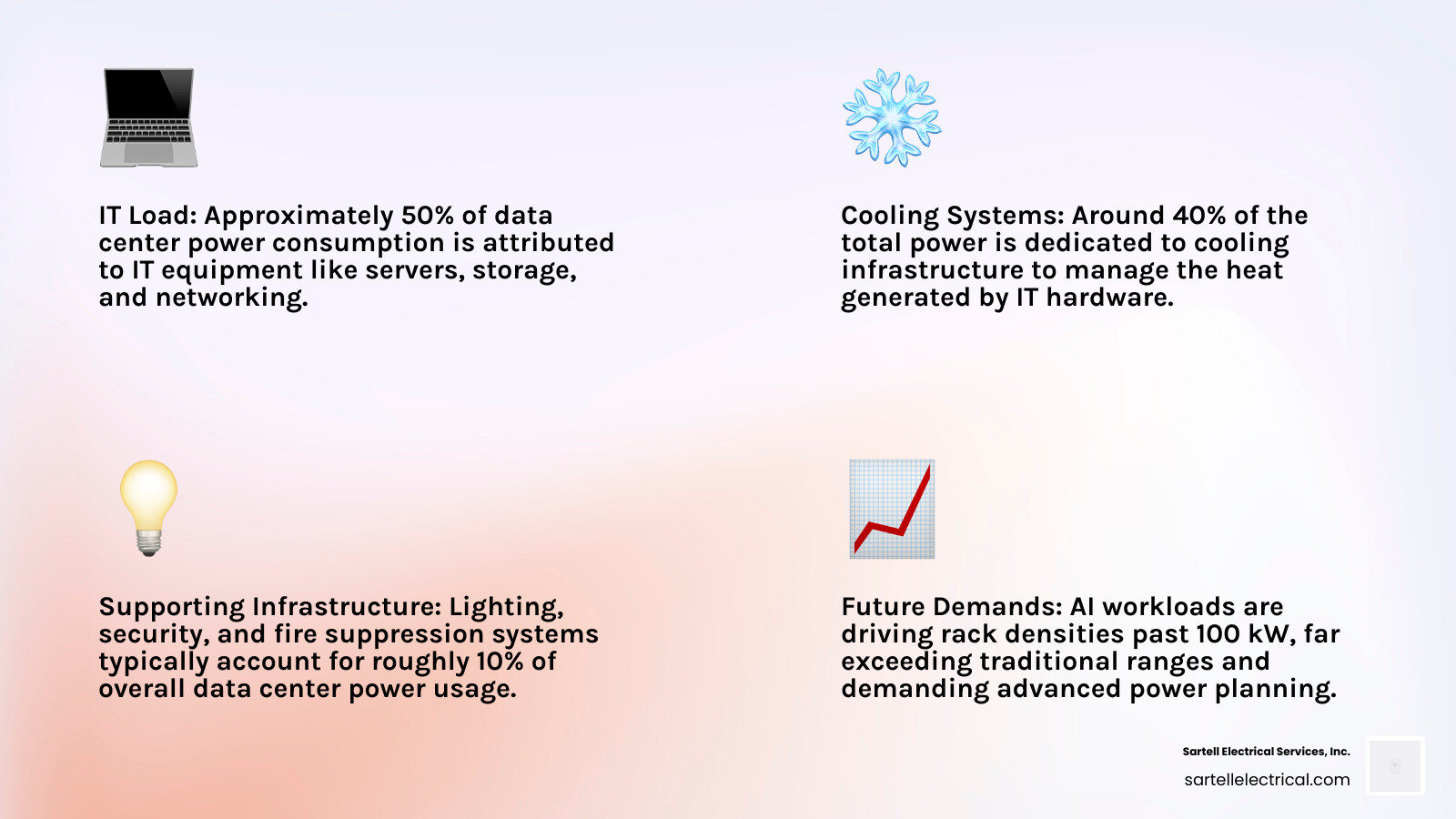
The stakes are higher than ever. AI is driving a new wave of innovation, but its energy needs are immense. Data centers can now consume hundreds of megawatts, with AI clusters pushing rack densities past 100 kW—far beyond the traditional 10-20 kW. Without proper planning, the computing environment cannot support these use cases.
A major challenge is the gap between perceived and actual power use. Many assume data centers run at maximum demand 24/7, but factors like maintenance, redundancy, and variable workloads mean actual utilization is often well below 80%. This can lead to overbuilding infrastructure and unnecessary costs.
Effective power planning is a continuous process, not a one-time project. It aligns business strategy with infrastructure capabilities and bridges the communication gap between facilities and IT teams. I'm Ed Sartell, President of Sartell Electrical Services. Since 1985, my team and I have delivered dependable electrical infrastructure for mission-critical facilities across Massachusetts, where precision and reliability are paramount.
The Core Components of the Data Center Power Chain
Understanding a data center's power chain is essential for effective
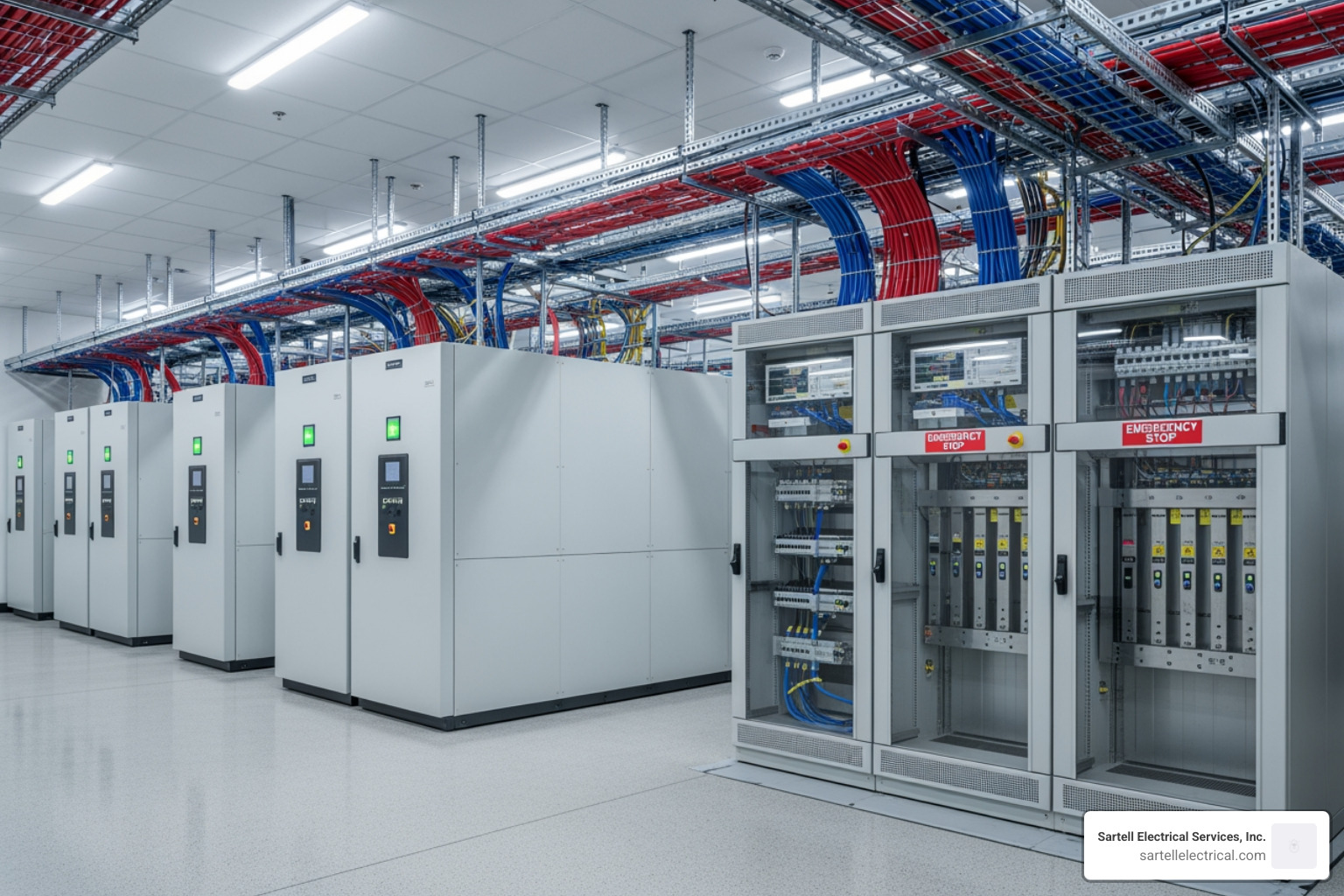
data center power planning. Electricity passes through multiple components, each playing a critical role in delivering clean, reliable power to IT equipment.
The journey begins at the
utility service entrance, where high-voltage power arrives from the local grid.
Transformers step this down to usable levels for the facility. From there,
switchgear controls power distribution and protects against overcurrents, allowing sections to be isolated for maintenance.
The
Automatic Transfer Switch (ATS) monitors the power source and instantly switches to
backup generators if the utility fails. These generators provide long-term power during outages. However, generators need 10 to 30 seconds to start.
Uninterruptible Power Supply (UPS) systems bridge this gap, providing instant battery power to ensure seamless operation.
Finally,
Power Distribution Units (PDUs) refine and distribute electricity to the data hall, while
Rack PDUs deliver power directly to individual servers and network gear. Each component in this chain must be sized correctly, a core principle of expert
Electrical System Design.
Single-Phase vs. Three-Phase Power Explained
A foundational decision in
data center power planning is choosing between single-phase and three-phase power.
Single-phase power, common in homes, uses one alternating current waveform. It's simple and cost-effective for small loads but has limitations for high-power computing.
Three-phase power is the heavy lifter for data centers. It uses three waveforms to create a constant, smooth flow of power. This allows it to deliver more electricity with smaller conductors, making it more efficient and cost-effective for
high-density racks. The massive HVAC systems that cool data centers also run on three-phase power. For modern data centers with rack densities above 10-15 kW, it's essential.
| Feature |
Single-Phase Power |
Three-Phase Power |
| Waveforms |
1 |
3 (120 degrees apart) |
| Typical Voltage |
120V, 240V |
208V, 400V, 480V |
| Best For |
Small loads, lighting, low-density equipment |
High-density IT equipment, motors, chillers, entire data centers |
| Efficiency |
Lower for large loads |
Higher, with smoother power delivery |
| Power Capacity |
Limited |
Substantially higher through same conductor size |
| Cost |
Lower upfront for small setups |
More cost-effective for large power requirements |
How Data Center Tiers Dictate Power Redundancy
The Uptime Institute's tier classification system defines facility reliability and dictates power redundancy requirements.
- Tier 1 (Basic Capacity): A single power path with no redundancy. Allows for up to 28.8 hours of annual downtime. Suitable only when downtime is tolerable.
- Tier 2 (Redundant Components): Adds N+1 redundancy (one extra component for backup) but still has a single power path. Uptime is 99.741%, allowing for 22 hours of downtime. Maintenance may require a shutdown.
- Tier 3 (Concurrently Maintainable): Multiple independent power paths and N+1 redundancy. Achieves 99.982% uptime (1.6 hours of downtime). Maintenance can be performed without disrupting operations. This is a common choice for enterprise operations.
- Tier 4 (Fault Tolerant): The pinnacle of reliability, with multiple active power paths and 2N redundancy (two complete, independent systems). It achieves 99.995% uptime (0.4 hours of downtime) and can withstand multiple equipment failures.
The choice between
N,
N+1, or
2N redundancy models shapes your infrastructure's complexity and cost. Our
Electrical Project Management Complete Guide ensures your chosen tier is designed and built to perform as intended.
The Strategic Framework for Data Center Power Planning
Effective
data center power planning is a continuous process that evolves with your business. A strategic approach ensures your facility can support growth and adapt to changing needs, as capacity demands can shift hourly, not just quarterly.

Key strategic elements include:
- Business stakeholder alignment: Your IT capacity forecasts must tie directly to the company's growth strategy to ensure the power infrastructure is ready for new services or market expansions.
- IT and facilities collaboration: When facilities teams (managing power and cooling) and IT teams (managing servers) work together, they create a shared understanding of how infrastructure changes impact one another. This prevents miscommunication and costly surprises.
The goal is to find the balance between
over-provisioning (wasting capital and operational expenses) and
under-provisioning (risking downtime and poor performance). This requires expertise and ongoing attention.
Step 1: Calculating Loads for Accurate Data Center Power Planning
Accurate load calculations are the foundation of effective
data center power planning. The process begins with a
needs assessment to understand business applications and their availability requirements, which determines the necessary level of redundancy.
Next, identify your
critical IT loads by inventorying all hardware. Crucially, you cannot simply add up the
nameplate ratings. These labels show worst-case consumption, often 33% or more higher than real-world usage. Using diversity factors and sizing calculators provides a more realistic estimate of actual power draw, preventing overbuilding.
The
cooling load calculation is another major factor, as cooling can consume about half of a data center's total power. This is calculated based on the heat generated by IT equipment. Finally, account for
lighting and support loads like security and fire suppression systems. The sum of these loads provides a total power requirement that guides the entire electrical design. For a deeper dive, Schneider Electric offers a guide on
Calculating Total Power Requirements for Data Center. Our
Electrical Project Management Complete Guide details how we manage these complex projects.
Step 2: Understanding and Forecasting True Utilization
Data centers rarely run at the utilization levels many assume. Understanding the difference between
Load Factor (average demand vs. peak demand) and
Capacity Utilization Rate (actual usage vs. rated facility capacity) is key. A facility can have a high load factor but low capacity utilization.
Several factors contribute to lower-than-expected utilization:
- Impact of maintenance and redundancy: To achieve high uptime, redundant systems (N+1 or 2N) are necessary. These components are often idle or running below full capacity, lowering average utilization.
- Hardware fragility: In large-scale deployments like AI clusters, component failures can lead to idle hardware and reduced utilization.
- AI workload variability: AI training jobs can have highly variable and synchronous power patterns, with dramatic swings in power draw.
This creates a
"puzzle" of low utilization, where a significant portion of installed power infrastructure may be underused. Understanding these real numbers is crucial for efficient planning and has major
implications for grid planning, as it helps utilities avoid overbuilding generation and transmission infrastructure.
Step 3: Developing a Cost and Management Strategy
A comprehensive cost and management strategy is vital. This involves balancing
Capital Expenditures (CapEx)—upfront costs for equipment like generators and UPS systems—with
Operational Expenditures (OpEx), the ongoing costs of electricity and maintenance. Investing more in high-efficiency equipment upfront can significantly reduce long-term OpEx.
Key strategies include:
- Energy procurement: Develop a strategy to secure reliable, cost-effective power, especially in high-cost areas like Massachusetts. This includes managing utility rates and demand charges.
- Power capping: Set maximum power consumption limits for IT equipment to operate within a defined power envelope and avoid costly demand charge spikes.
- Virtualization and consolidation: Reduce the number of physical servers by running multiple applications on fewer machines, drastically cutting power and cooling needs.
- Regular energy audits: Identify opportunities for savings, from inefficient lighting to phantom loads. Audits provide a prioritized roadmap for improvements. Our Electrical Maintenance Services help keep your systems optimized.
In data centers, what gets measured gets managed. The right metrics and tools transform
data center power planning from guesswork into precision engineering. Modern data center management relies on
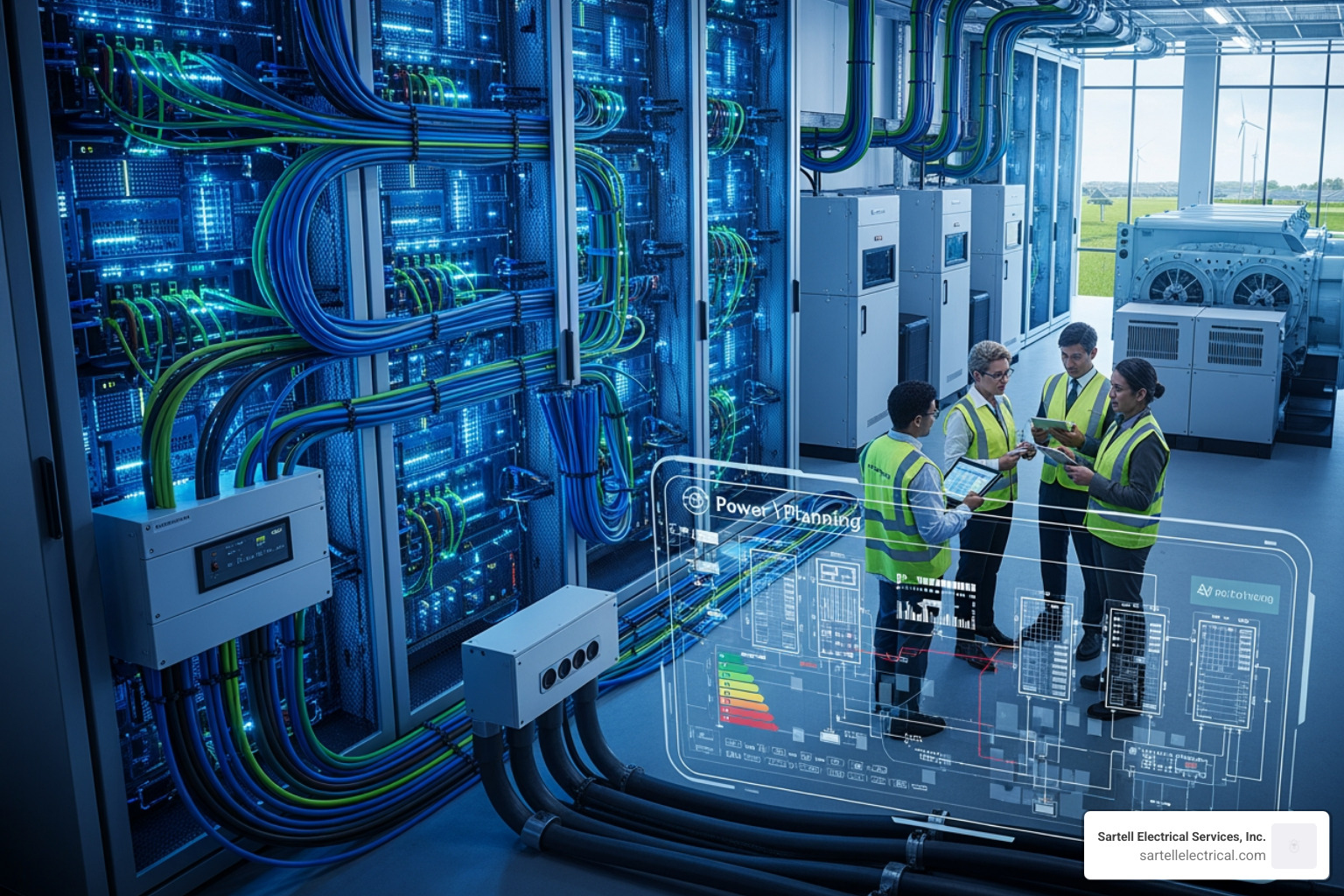
real-time monitoring to track power, temperature, and other environmental conditions.
 Predictive analytics
 uses this data to forecast future needs, allowing you to anticipate problems rather than react to them.
Asset management tracks every piece of equipment, while
what-if analysis lets you simulate changes—like adding a new high-density rack—in a virtual environment before committing resources.
Essential KPIs for Power and Capacity
Tracking the right metrics reveals how your data center is truly performing.
- Power Usage Effectiveness (PUE): The industry standard, calculated as Total Facility Power / IT Equipment Power. A lower score is better, with the ideal being 1.0.
- Carbon Usage Effectiveness (CUE): Measures total carbon emissions relative to IT energy consumption, reflecting your environmental impact.
- Data Center Infrastructure Efficiency (DCiE): The inverse of PUE (IT Power / Total Facility Power), expressed as a percentage. A higher percentage is better.
- Load Factor: The ratio of average demand to peak demand, indicating how consistently you use power.
- Capacity Utilization Rate: Measures how much of your facility's total rated capacity you are actually using.
- Stranded Power: Available power capacity that cannot be used due to physical or logical constraints. Identifying and recovering it is a quick win for efficiency.
- Days of power capacity remaining: A forward-looking metric calculated by DCIM systems that estimates when you will reach your power limits based on current trends.
The Role of DCIM in Modern Data Center Power Planning
A data center without
Data Center Infrastructure Management (DCIM) software is like a business running on paper ledgers. DCIM acts as the
operating system for your facility, creating a
single source of truth that unites facilities and IT teams.
The software
aggregates metrics from across the data center—power, cooling, environmental sensors, and equipment status—into one central system. This allows you to:
- Identify waste with precision, such as an overworked cooling unit or underused racks.
- Forecast capacity needs based on real data, enabling you to right-size infrastructure with confidence.
- Run what-if analysis to simulate the impact of new equipment on your power and cooling systems before installation.
For businesses serious about gaining granular control, implementing an
Industrial Power Monitoring System integrated with DCIM is essential. The ROI is often realized within the first year through improved efficiency and avoided costs.
Navigating Modern Challenges and Future Trends
The data center industry is changing rapidly, with new technologies and sustainability pressures reshaping
data center power planning. Staying ahead of these trends is key to building solutions that work today and adapt for tomorrow. For a comprehensive overview, the Department of Energy offers a
Best Practices Guide for Energy-Efficient Data Center Design.
The Rise of AI, Liquid Cooling, and High-Density Racks
Artificial intelligence is rewriting the rules for power and cooling. AI workloads create highly
synchronous loads, where many components draw peak power simultaneously. This has pushed
rack densities over 100 kW, a five- to ten-fold increase over the traditional 10-20 kW range. Traditional air cooling cannot handle this level of heat.
This reality is driving the adoption of
liquid cooling systems:
- Direct-to-chip cooling uses cold plates mounted on components like GPUs to remove heat efficiently.
- Immersion cooling submerges entire servers in a dielectric fluid for maximum heat transfer in extreme-density environments.
Industry standards are evolving to meet these needs. The
TIA-942-C standard updates now include guidance on liquid immersion cooling, recognizing that a new era of high-density computing has arrived.
Green Energy, Storage, and Grid Flexibility
Sustainability is now a core component of
data center power planning. The industry is pursuing
24/7 carbon-free energy goals, aiming to match consumption with clean energy sources on an hourly basis.
Key strategies include:
- On-site renewables like solar panels to generate clean power directly.
- Battery Energy Storage Systems (BESS) to store excess renewable energy and provide backup power.
- Demand response programs, where data centers voluntarily shift or reduce power demand to help stabilize the grid. As Google has demonstrated, this flexibility can strengthen power grids and accelerate renewable energy integration. Learn more about their approach in How data centers can benefit power grids.
- DC power distribution, an emerging trend to reduce energy loss by minimizing AC-to-DC power conversions within the data center.
These trends show data centers evolving from passive energy consumers into active participants in a more resilient and sustainable energy ecosystem.
Frequently Asked Questions about Data Center Power
Here are clear, straightforward answers to common questions about data center power.
What is the difference between data center power planning and capacity planning?
Though often used interchangeably, they have distinct meanings.
Data center power planning focuses specifically on the electrical infrastructure: calculating loads, designing redundancy, and sizing components like UPS systems and generators.
Capacity planning is a broader strategy that ensures the entire data center can meet future demands. It encompasses
power, but also
space (rack units and floor space),
cooling (HVAC and liquid cooling systems), and
connectivity (network bandwidth and cabling). Power planning is a critical pillar that supports the larger structure of capacity planning.
How much power does a data center actually use?
The answer varies dramatically, from a few hundred kilowatts for a small colocation space to hundreds of megawatts for a hyperscale facility. A large portion of this power is used for non-IT functions.
- Cooling systems are the largest consumer, often accounting for nearly 50% of total electricity in a traditional facility.
- The IT load (servers, storage, networking) rarely runs at maximum capacity. An IT device's actual power draw is typically much lower than its nameplate rating.
- The PUE metric (Power Usage Effectiveness) helps quantify this. A PUE of 1.5 means that for every 1 watt used by IT equipment, an additional 0.5 watts are used for overhead like cooling and power distribution losses.
Data Center Infrastructure Management (DCIM) software is the most important tool for modern power management. While physical components like UPS systems and generators are essential, DCIM is the intelligence layer that makes the system responsive and efficient.
DCIM acts as the operating system for your facility, providing:
- Centralized monitoring of power consumption from the utility entrance down to individual servers.
- Capacity forecasting using predictive analytics to determine when you'll need to upgrade.
- What-if scenarios to simulate the impact of new equipment before you invest.
DCIM provides the data-driven insights needed for effective
data center power planning and helps identify waste, optimize efficiency, and bridge the gap between IT and facilities teams. Our
Industrial Power Monitoring System services integrate with DCIM platforms to provide complete visibility.
Conclusion
Data center power planning is not a one-time task but a continuous process that is the heartbeat of your facility. It requires constant attention to keep your operations running smoothly and efficiently.
This guide has covered the essentials: understanding the power chain, selecting the right redundancy tier, accurately calculating loads while avoiding the nameplate trap, and developing smart cost management strategies. The goal is to balance reliability, efficiency, and scalability.
The data center landscape is evolving rapidly, with AI driving rack densities over 100 kW and sustainability goals pushing for green energy and grid flexibility. Navigating this requires the right tools and metrics. A robust DCIM system provides the visibility to track PUE, understand true capacity utilization, and eliminate stranded power.
However, knowledge and tools are only part of the solution. Execution requires an experienced electrical partner who understands the real-world challenges of maintaining a 24/7 mission-critical facility.
At Sartell Electrical Services, Inc., we have spent over three decades helping businesses across Massachusetts build electrical infrastructure they can count on. Our commitment is to deliver reliable, efficient, and scalable solutions that are right for today and ready for tomorrow.
Whether you are planning a new facility, upgrading for higher densities, or optimizing your current operations, our team is here to help.
Ready to take the next step?
Partner with us for your next design-build electrical project and let's build something reliable together.