
Boston Homeowners Are Going Electric — Here's What You Need to Know First
EV charger installation Boston is one of the fastest-growing electrical services in the region — and for good reason. Here's a quick overview of what the process involves:
How EV charger installation works in Boston:
- Assess your electrical panel — confirm you have capacity for a 240V circuit
- Choose your charger — Level 1 (120V) or Level 2 (240V) based on your needs
- Pull an electrical permit — required through Boston's ISD Permit Portal
- Hire a licensed Massachusetts electrician — unpermitted work can void insurance
- Install the circuit and mount the charger — typically completed in 3–4 hours
- Schedule a final inspection — required for code compliance
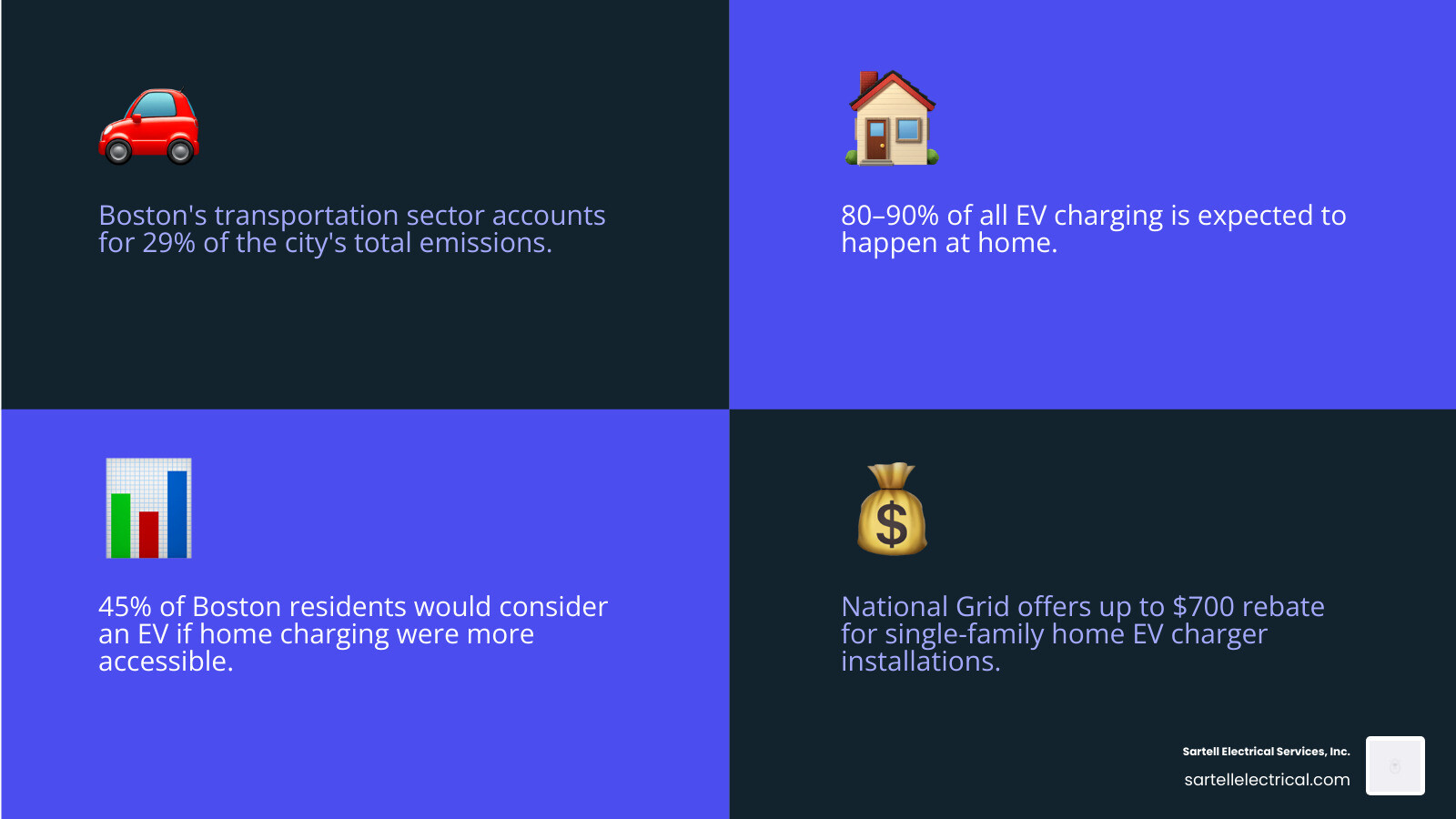
- Apply for rebates — National Grid offers up to $700 for single-family homes
Boston's transportation sector accounts for 29% of the city's total emissions, and nearly 45% of Boston residents say they'd consider an EV if home charging were more accessible. With 80–90% of all EV charging expected to happen at home, getting a reliable home charger installed isn't just convenient — it's essential.
The good news: incentives, rebates, and a clear permitting process make it more affordable than most homeowners expect.
I'm Ed Sartell, President of Sartell Electrical Services, Inc., and I've been delivering safe, code-compliant electrical solutions across Massachusetts since 1985 — including a growing number of EV charger installation Boston projects for homeowners ready to make the switch. In this guide, I'll walk you through everything you need to know to get it done right.
Essential EV charger installation Boston terms:
- Data cabling installation Boston
- Data center solutions Boston
- Boston electrical contractor companies
Understanding EV Charger Installation Boston: Level 1 vs. Level 2
When you first bring home an electric vehicle, the most important decision you'll make is how to "fuel" it. While every EV comes with a basic cord that can plug into a standard wall outlet, most Boston drivers quickly realize that a dedicated home setup is the way to go.
Level 1 (120V): The Standard Wall Outlet
Think of Level 1 charging like a slow drip. It uses a standard 120-volt AC outlet—the same one you use for your toaster or vacuum.
- Speed: Adds about 3 to 5 miles of range per hour.
- Best For: Drivers with very short commutes (under 30 miles a day) or those who can leave their car plugged in for 20+ hours.
- Pros: No special installation required.
- Cons: Extremely slow; often fails to fully replenish a battery overnight.
Level 2 (240V): The Gold Standard for Homeowners
This is what we typically mean when we talk about EV charger installation Boston. A Level 2 station requires a 240-volt circuit, similar to what a large clothes dryer or electric oven uses.
- Speed: Adds 12 to 80 miles of range per hour (averaging 25–35 miles for most home units).
- Best For: Almost everyone. It can fully charge most EVs in 4 to 10 hours.
- Pros: Fast, reliable, and qualifies for significant utility rebates.
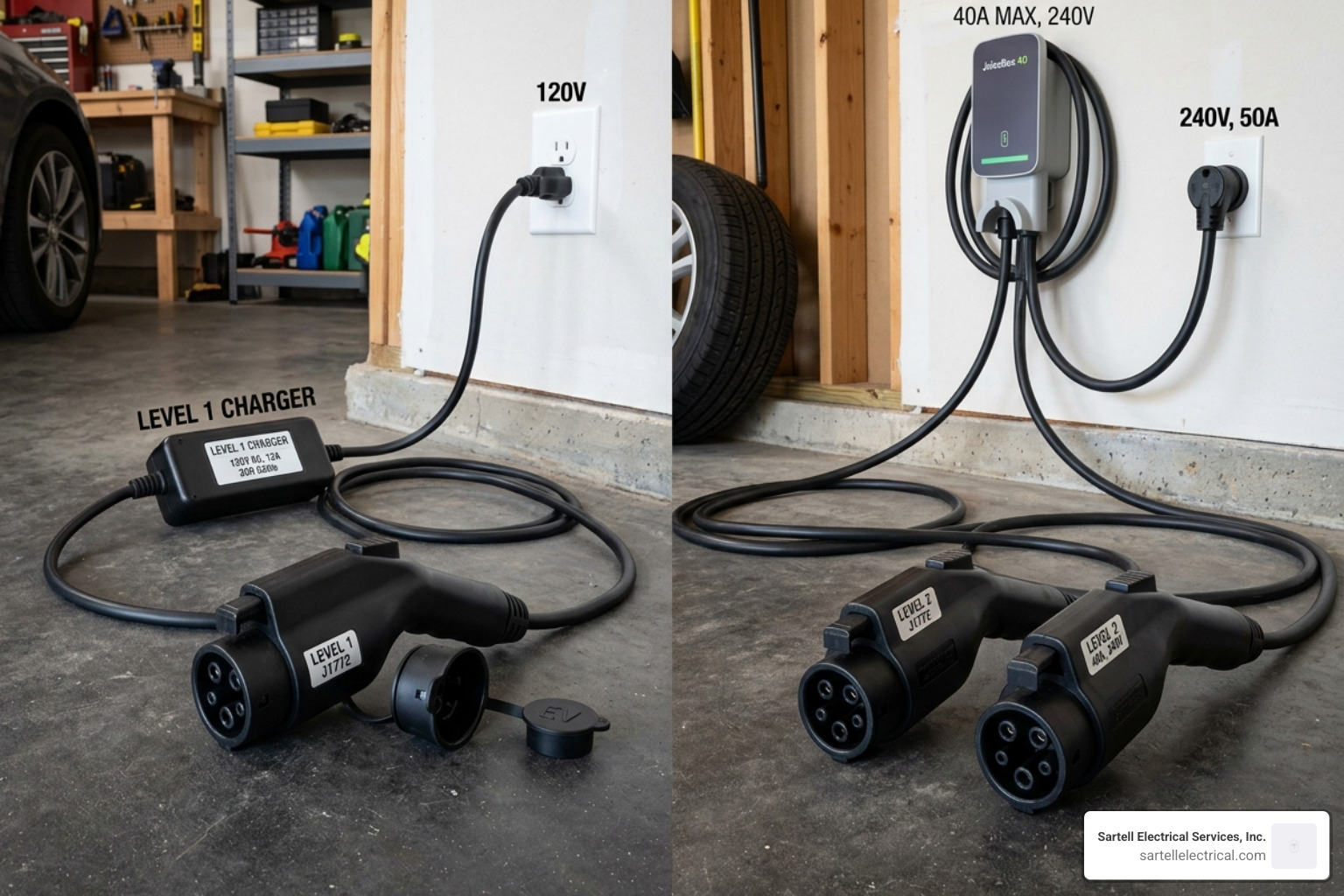
| Feature | Level 1 (120V) | Level 2 (240V) |
|---|---|---|
| Voltage | 120V AC | 208V / 240V AC |
| Amperage | 12–16 Amps | 16–80 Amps (40A common) |
| Range Per Hour | 3–5 miles | 12–80 miles |
| Full Charge Time | 20+ hours | 4–10 hours |
| Installation | None (Plug & Play) | Required (Licensed Electrician) |
If you're looking for more information on how we handle these high-voltage setups, check out our residential electrical service page.
Determining Your Home’s Electrical Capacity
Before we can mount a shiny new charger in your garage, we have to look at the "brain" of your home: the electrical panel. Most older Boston homes feature 100-amp service, while newer builds typically have 200-amp service.
A Level 2 charger usually requires a dedicated 40-amp to 60-amp circuit. If your panel is already crowded with central air conditioning, electric ranges, and hot tubs, we may need to discuss a 200-amp service upgrade to ensure your home can handle the load safely.
In some cases, we can utilize load management systems. These smart devices monitor your home's total power usage and throttle the EV charger down if you turn on the oven or dryer, preventing a blown main breaker while avoiding the cost of a full service upgrade.
Choosing the Right EV Charger Installation Boston for Your Vehicle
Not all chargers are created equal. When selecting hardware, consider these factors:
- Connector Types: Most non-Tesla EVs use the J1772 connector. Tesla uses the NACS (North American Charging Standard), though many manufacturers are switching to NACS in the coming years. We can install adapters or universal stations like the ChargePoint Home Flex.
- Smart Features: We highly recommend "Smart" chargers with Wi-Fi connectivity. These allow you to schedule charging via an app, track energy costs, and—most importantly—participate in utility "Off-Peak" programs that save you money.
- Safety Standards: Only purchase chargers that are UL-certified. You can verify compliant models through the State Appliance Standards Database.
Costs, Permits, and Local Regulations in Greater Boston
Let's talk numbers. For a standard EV charger installation Boston, homeowners in the Greater Boston area typically spend between $1,200 and $2,200. This range includes the charging unit itself ($400–$700) and the professional labor and materials ($800–$1,500).
Your specific cost will depend on:
- The distance between your electrical panel and the charging location.
- Whether you need a panel upgrade.
- If we need to run conduit through finished walls or underground.
For a detailed breakdown of what goes into these costs, see our guide on dedicated circuit installation cost.
The Importance of Permitting
In the City of Boston and surrounding towns like Reading or Andover, an electrical permit is non-negotiable. We handle this through the Boston ISD Permit Portal.
Why does a permit matter?
- Safety: An inspector reviews our work to ensure it meets the National Electrical Code (NEC).
- Insurance: If an unpermitted installation causes a fire, your homeowner's insurance may deny the claim.
- Resale: Unpermitted work can hold up a home sale during the inspection phase.
Navigating the Step-by-Step Process for EV Charger Installation Boston
When you hire us for your installation, we follow a proven process to get you powered up quickly:
- Site Assessment: We evaluate your panel capacity and map out the wire run.
- Permit Acquisition: We file the necessary paperwork with your local building department.
- Circuit Installation: We install a new dedicated 240V breaker and run the heavy-duty wiring to your parking spot.
- Hardware Mounting: We securely mount your EVSE (Electric Vehicle Supply Equipment) and make the final connections.
- Testing: We verify the voltage and communication between the charger and a test vehicle.
- Final Inspection: We coordinate with the municipal inspector to sign off on the work.
- Rebate Filing: Once the job is done, you'll need to complete the online application to receive your rebate.
Maximizing Rebates and Incentives for Massachusetts Residents
One of the best parts of living in Massachusetts is the financial support for "going green." Utility companies like National Grid and programs like Mass Save offer substantial rebates that can cover a huge chunk of your installation costs.
- National Grid Residential EV Charging Infrastructure Program: Offers up to $700 for single-family homes to help cover the cost of installing a 240-volt circuit.
- 2-4 Unit Buildings: If you live in a duplex or small multi-family building, the rebate jumps up to $1,400.
- Off-Peak Savings: By enrolling in an off-peak program, you can save roughly $100 per year just by charging your car when the grid isn't stressed (usually overnight).
To see if your specific neighborhood qualifies for even higher incentives, you can check the map of Environmental Justice Populations in Massachusetts.
Qualifying for Enhanced Rebates and Low-Income Programs
Massachusetts is committed to making EV ownership accessible to everyone. If you live in an Environmental Justice community or are enrolled in the Discount Rate (R-2) program, you may qualify for enhanced incentives:
- Enhanced Wiring Rebate: Up to $1,000 for single-family homes and $2,000 for 2-4 unit buildings.
- Smart Charger Rebate: Low-income (R-2) customers can receive up to $700 toward the purchase of a smart charger.
- Turnkey Program: In some cases, these programs can cover 100% of out-of-pocket costs.
To apply, you'll need your paid electrician's invoice (showing voltage and amperage), photos of the installed equipment, and proof of EV ownership. You can start the application process here.
Special Considerations for Renters, Condos, and Multi-Unit Buildings
If you don't own a single-family home with a private garage, don't worry—you still have options.
The "Right to Charge" Law: Massachusetts has laws that prevent HOAs or condo associations from unreasonably prohibiting the installation of an EV charger, provided the owner pays for the installation and electricity.
For Landlords and Condo Boards: Installing charging stations is a massive value-add. Boston's new EV policy actually requires 25% of parking spaces in new off-street parking areas to have chargers installed. For existing buildings, we offer commercial electrical services to help design shared charging solutions that track usage and bill tenants individually.
Future-Proofing Your Installation and Smart Charging
We always tell our customers: "Don't just build for the car you have today; build for the cars you'll have tomorrow."
- Dual-Port Chargers: If you think you'll become a two-EV household, we can install chargers that share a single circuit but can plug into two cars.
- Oversized Conduit: Running a slightly larger pipe now makes it much cheaper to add more power later.
- Panel Readiness: Even if you aren't ready for a full home electrical panel upgrade today, we can "prep" your system so the final jump is seamless.
Frequently Asked Questions about EV Charger Installation Boston
How long does the installation take and what maintenance is required?
A typical EV charger installation Boston takes our team 3 to 4 hours. If a panel upgrade is required, it may take a full day.
Maintenance is minimal. We recommend:
- Visually inspecting the charging cable for wear or cracks.
- Keeping the connector clean and free of debris.
- Ensuring the unit is firmly mounted. Most high-quality chargers come with a 3-year parts-and-labor warranty.
Which chargers are compatible with the National Grid Off-Peak Charging Program?
To earn that $100 annual credit, you must use a "Smart" charger that National Grid can communicate with. Popular compatible brands often include ChargePoint, Enel X (JuiceBox), and certain Tesla Wall Connectors. Always verify the latest list on the State Appliance Standards Database before buying.
Can I install an EV charger myself in the City of Boston?
Technically, a very handy homeowner might try, but we strongly discourage it.
- Code Compliance: EV chargers pull a heavy continuous load for hours. One loose wire can lead to a fire.
- Permits: Most Massachusetts towns will only issue electrical permits to a Master Electrician.
- Liability: If something goes wrong, your insurance provider will look for a professional's signature and a city inspector's sticker. It's not worth the risk.
Conclusion
Making the switch to an electric vehicle is an exciting step toward a more sustainable lifestyle—and a much lighter hit to your wallet at the "pump." But the quality of your EV experience starts with the quality of your home charging setup.
At Sartell Electrical Services, Inc., we bring over 30 years of experience to every project. Whether you're in a historic home in Boston, a condo in Cambridge, or a new build in Reading, our team ensures your EV charger installation Boston is safe, permitted, and optimized for maximum rebates.
Ready to power up your ride? Book your installation with our expert electrical contractors in Boston today and let's get you on the road!