Data center solutions Boston: Premier 2025 Hub
Boston's Data Center Advantage: Why Location Matters
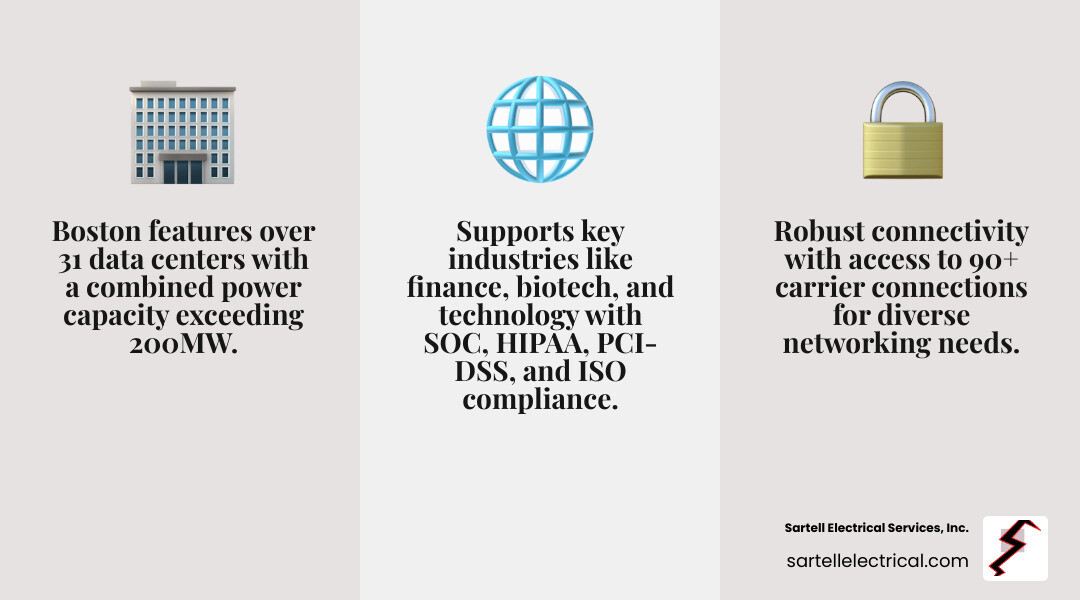
Data center solutions Boston offers businesses unparalleled access to one of America's most strategically positioned and well-connected technology hubs. As a cornerstone of the Northeast's digital economy, Boston ranks as the ninth-largest metro area in the U.S. and eighth in gross domestic product. This economic powerhouse status makes it a critical and non-negotiable node for robust digital infrastructure.
Key Boston Data Center Options:
- Colocation Services - Businesses can find flexible solutions ranging from single cabinets for startups to secure private suites and fully customized build-to-suit deployments for large enterprises.
- Major Facilities - The region boasts over 31 data centers, including industry giants like CoreSite BO1 (273,000+ sq ft), Digital Realty BOS14 (164,000 sq ft), and the massive Markley's One Summer Street (920,000 sq ft).
- Power Capacity - The available power infrastructure is built for scale, with facilities offering capacities from a modest 0.5MW to an immense 57MW, accommodating a wide spectrum of computing needs.
- Connectivity - Best network access is a hallmark of Boston, with carrier-neutral facilities like Markley's "Carrier Hotel" providing connections to over 90 different carriers.
- Compliance - Highly regulated industries can operate with confidence, as many facilities offer certifications for SOC 1/2, HIPAA, PCI-DSS, ISO 27001, and FedRAMP.
Boston's unique combination of world-class universities, thriving biotech and financial sectors, and a workforce with nearly 25% employed in digital economy sectors creates immense and consistent demand for reliable data infrastructure. The city serves as New England's primary telecommunications facility, with hubs like Markley's One Summer Street offering 30MW of power backed by on-site generation and a rich ecosystem of over 90 different carriers and network providers. This density ensures low-latency connections and resilient service.
As Ed Sartell, President of Sartell Electrical Services since 1985, I've seen how critical proper electrical infrastructure is for
data center solutions Boston facilities. From the initial power distribution design and high-voltage installations to the implementation of multi-layered emergency backup systems, every component must be flawless. My four decades of experience in Massachusetts electrical contracting has given me deep insight into the specialized requirements that make these mission-critical facilities truly reliable, secure, and efficient.
Why Boston is a Premier Data Center Hub
Boston isn't just another tech city – it's where innovation meets opportunity in ways that make
data center solutions Boston truly exceptional. Picture this: you have world-class universities pumping out brilliant minds, Fortune 500 financial firms moving billions of dollars daily, and cutting-edge biotech companies performing life-saving research. All of this happens in a city that ranks as America's ninth-largest metro area and eighth in GDP. That's the kind of dynamic, high-stakes environment where data centers don't just survive – they thrive on the demand for performance and reliability.

The Thriving Tech and Business Ecosystem
What makes Boston special is its interconnectedness. You have
MIT and Harvard churning out the next generation of tech leaders right alongside established
healthcare and life sciences companies that need massive computing power for drug findy, genomic sequencing, and AI-driven diagnostics. Then there are the
financial services firms that require split-second data processing for high-frequency trading and risk analysis, and the
technology and research organizations pushing the boundaries of what's possible in fields like robotics and artificial intelligence.
Nearly 25% of Boston's workforce powers the digital economy. That's not just a statistic – it's proof that this city runs on data. This concentration of talent also means a readily available pool of skilled professionals to manage and operate these complex facilities. When biotech companies need to process petabytes of genomic data or financial firms execute high-frequency trades where every millisecond counts, they turn to Boston's robust data infrastructure.
The
federal agency presence adds another layer of demand, especially for secure, compliant solutions that meet stringent government standards. As a
commercial electrical contractor Boston MA, I've seen how these diverse industries create unique electrical challenges – from the clean, uninterrupted power required for sensitive research lab equipment to the fully redundant N+1 or 2N systems demanded by financial operations where downtime is not an option.
If you want to see how all these pieces fit together, take a look at how businesses explore Boston's digital ecosystem to find the right connections for their needs.
Best Connectivity and Infrastructure
Here's where Boston really shines: connectivity. The city serves as
New England's primary telecommunications facility, with centralized access to
over 90 carriers. Think of it as the digital equivalent of a major international airport hub – data from across the globe flows through here, creating a rich and resilient network ecosystem.
The crown jewel is what locals call the
"Carrier Hotel" – a facility that acts as the region's main
fiber hub. This concentration of networks delivers the
low-latency routes that financial traders dream about, minimizing the delay between a trade order and its execution. For other businesses, it means faster application performance and a better experience for end-users. This setup also provides the kind of redundancy that keeps CIOs sleeping soundly at night, knowing that a single fiber cut won't take their business offline.
Peering exchanges like MASS-IX further improve this ecosystem. They allow different internet service providers and content delivery networks to exchange traffic directly, rather than sending it on a long, inefficient journey across the country. It's like having a local shortcut between major highways, resulting in faster speeds, lower costs, and a more resilient internet for everyone connected.
As a
telecommunications electrical contractor Boston MA, I've worked on the intricate electrical systems that keep these connections running 24/7. The power infrastructure behind this connectivity is incredibly sophisticated, involving redundant UPS systems, backup generators, and advanced power distribution units. It has to be flawless when you're supporting the digital backbone of New England.
A Deep Dive into Data Center Solutions Boston
When you're exploring
data center solutions Boston, you'll quickly find it's not a one-size-fits-all market. The beauty of Boston's data center landscape lies in its incredible flexibility and depth of options. Whether you're a startup running your first server or a Fortune 500 company needing massive computing power for global operations, there's a solution that fits your technical requirements, budget, and growth trajectory.
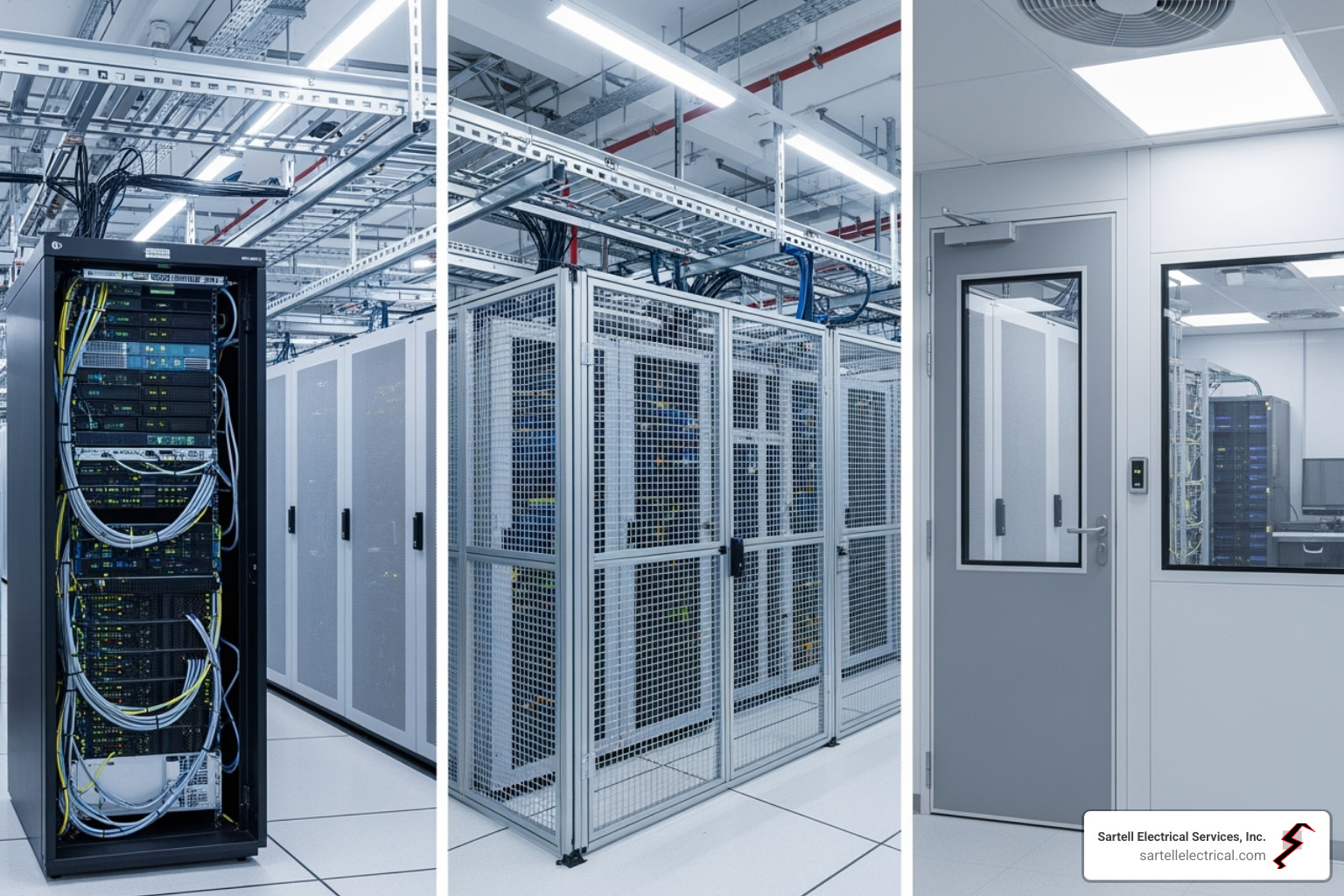
The scalability story here is particularly compelling. You might start with a single cabinet for your growing business, then expand to a caged area for improved security and control as your team grows, and eventually move to a private suite or even a build-to-suit deployment for complete customization. This progression happens naturally within Boston's top-tier data centers, and the underlying power and cooling infrastructure is designed to support that journey seamlessly without requiring disruptive migrations.
Types of Data Center Services Available
Colocation services form the backbone of most Boston data center offerings. These start with
single cabinets – perfect for smaller deployments where you need secure, professionally managed space. As your needs grow,
private cages offer more dedicated, physically segregated space with improved security, while
private suites and
build-to-suit options cater to large enterprises with specific compliance, security, or operational requirements.
Cloud services integration has become increasingly sophisticated. Boston's facilities offer dedicated, low-latency connections to
public cloud platforms like Amazon Web Services (AWS), Microsoft Azure, and Google Cloud. This allows for robust
hybrid cloud strategies, where you can keep sensitive data on private hardware while leveraging the public cloud's scalability for variable workloads. This "best of both worlds" approach is a key advantage of modern colocation.
Managed services take a huge burden off your IT team's shoulders.
Remote hands support handles basic tasks like rebooting servers or swapping cables, while
smart hands services provide more specialized technical support for hardware installation, complex troubleshooting, and equipment configuration. Round-the-clock
monitoring services keep a vigilant watch over your systems, with
proactive incident response ensuring problems get addressed before they can impact your business operations.
Disaster recovery and business continuity services have evolved far beyond simple backup solutions. Boston data centers now offer
secure off-site replication to a secondary location, comprehensive
backup services, and even
hot seat arrangements – dedicated workspace with pre-configured network access for your team during declared disasters. These services are critical for ensuring your business keeps running no matter what Mother Nature or Murphy's Law throws your way.
For demanding applications,
high-density colocation solutions support the intense power and cooling requirements of AI, machine learning, and high-performance computing (HPC) workloads. These specialized environments can handle up to 18kW per rack or more, enabled by robust electrical infrastructure and advanced cooling that prevents hotspots and ensures peak performance.
Core Features and Specifications
The foundation of reliable
data center solutions Boston lies in carefully engineered infrastructure. Power and cooling redundancy levels vary from a basic N configuration (no redundancy) to N+1 (one extra component for failover) and fully redundant 2N systems (a completely mirrored, independent system). This allows you to choose a level of resilience that matches your uptime requirements and risk tolerance.
Power capacity across Boston facilities ranges dramatically – from smaller 0.5MW facilities perfect for regional edge deployments to massive 57MW campuses supporting enterprise-scale workloads.
Cooling systems have evolved beyond traditional air conditioning, with many facilities now using highly efficient
chilled water systems and innovative
waterless cooling technologies that reduce environmental impact while maintaining precise temperature and humidity control.
Raised floor space is a common feature, providing the flexibility needed for under-floor power and network cable management and optimized cold air delivery. Many Boston data centers have achieved
LEED Gold certification, reflecting their commitment to energy efficiency and environmental responsibility. Given New England's weather patterns,
hurricane-rated construction and liftd critical systems ensure your infrastructure stays protected during severe weather events.
The electrical systems powering these facilities require expert design and implementation. As we've learned through decades of providing electrical solutions for industrial environments, the reliability of any data center ultimately depends on the quality of its electrical infrastructure. This includes everything from the utility feeds and switchgear to the backup generators, automatic transfer switches, UPS systems, and power distribution units (PDUs) at the rack level.