Commercial and industrial electrician: 2 Core Insights
Why Understanding Electrician Specializations Matters
A
commercial and industrial electrician isn't just "an electrician" - they're specialized professionals with distinct skills, training, and expertise custom to specific work environments and electrical systems.
Quick Answer: Key Differences Between Commercial and Industrial Electricians
| Aspect |
Commercial Electrician |
Industrial Electrician |
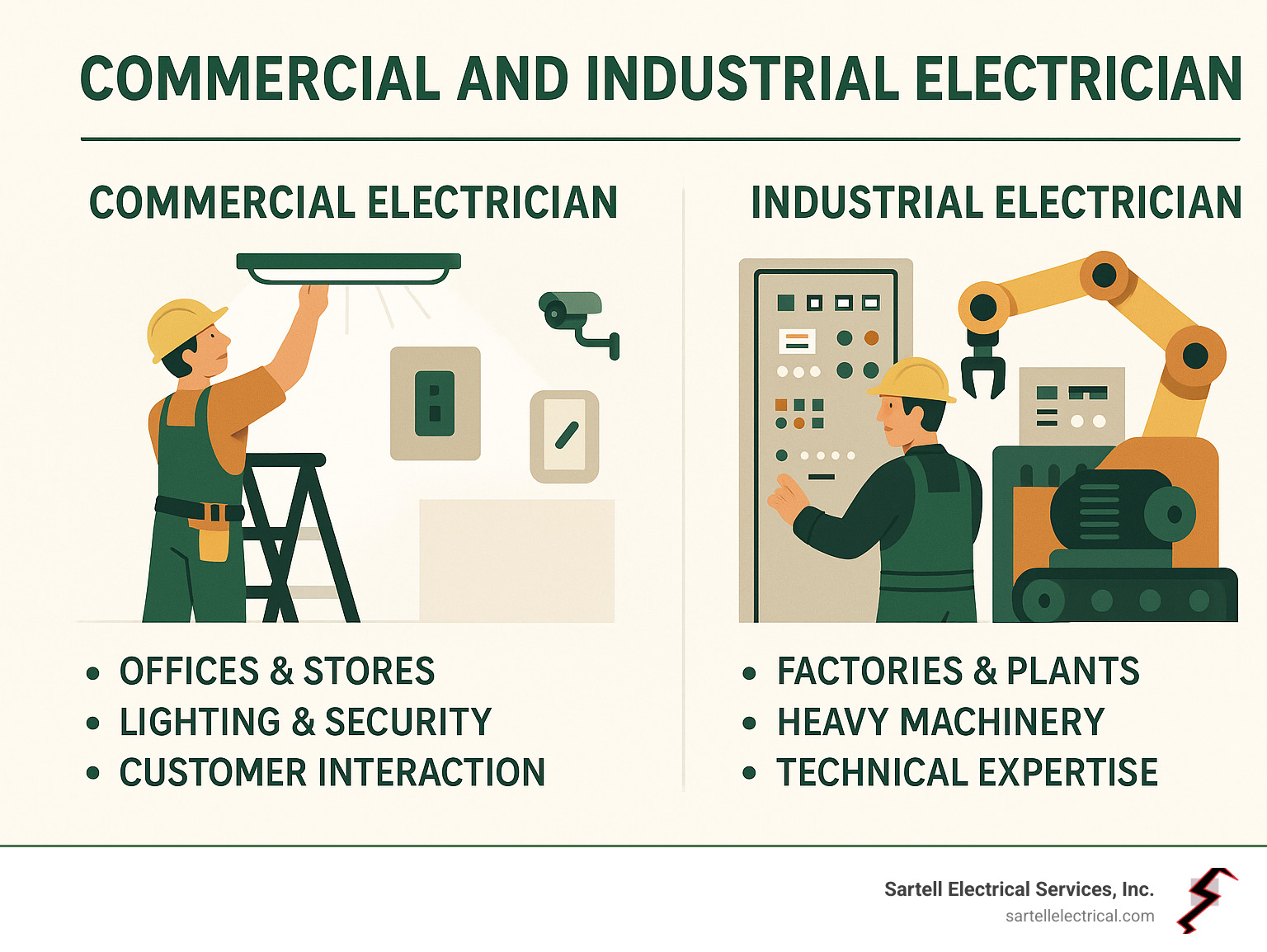
| Work Environment |
Offices, retail stores, restaurants, schools |
Manufacturing plants, factories, chemical facilities |
| Power Systems |
Lower voltage, standard electrical systems |
High-voltage, complex three-phase systems |
| Primary Focus |
Customer-facing installations, building systems |
Heavy machinery, production equipment |
| Typical Projects |
Lighting, HVAC, security systems |
Motor controls, robotics, process equipment |
| Average Salary |
~$55,000 annually |
~$70,000+ annually |
As one industry expert noted:
"The designations of 'Industrial Electrician' and 'Commercial Electrician' are often used to describe the same types of professionals and often interpreted to mean the same thing, they are different types of specializations that require unique training and are used in different types of professional environments."
The reality is simple: not all electricians are created equal. You wouldn't hire a family doctor for brain surgery, and you shouldn't hire the wrong type of electrician for your project.
For business owners, facility managers, and project coordinators, this distinction matters. The wrong choice can lead to:
- Safety risks from inadequate expertise
- Project delays due to learning curves
- Cost overruns from inefficient work
- Code violations requiring expensive corrections
Understanding these specializations helps you make informed hiring decisions for your electrical projects, whether it's a facility upgrade or an office renovation.
The Core Distinction: Work Environments and Scope
The most fundamental difference between a
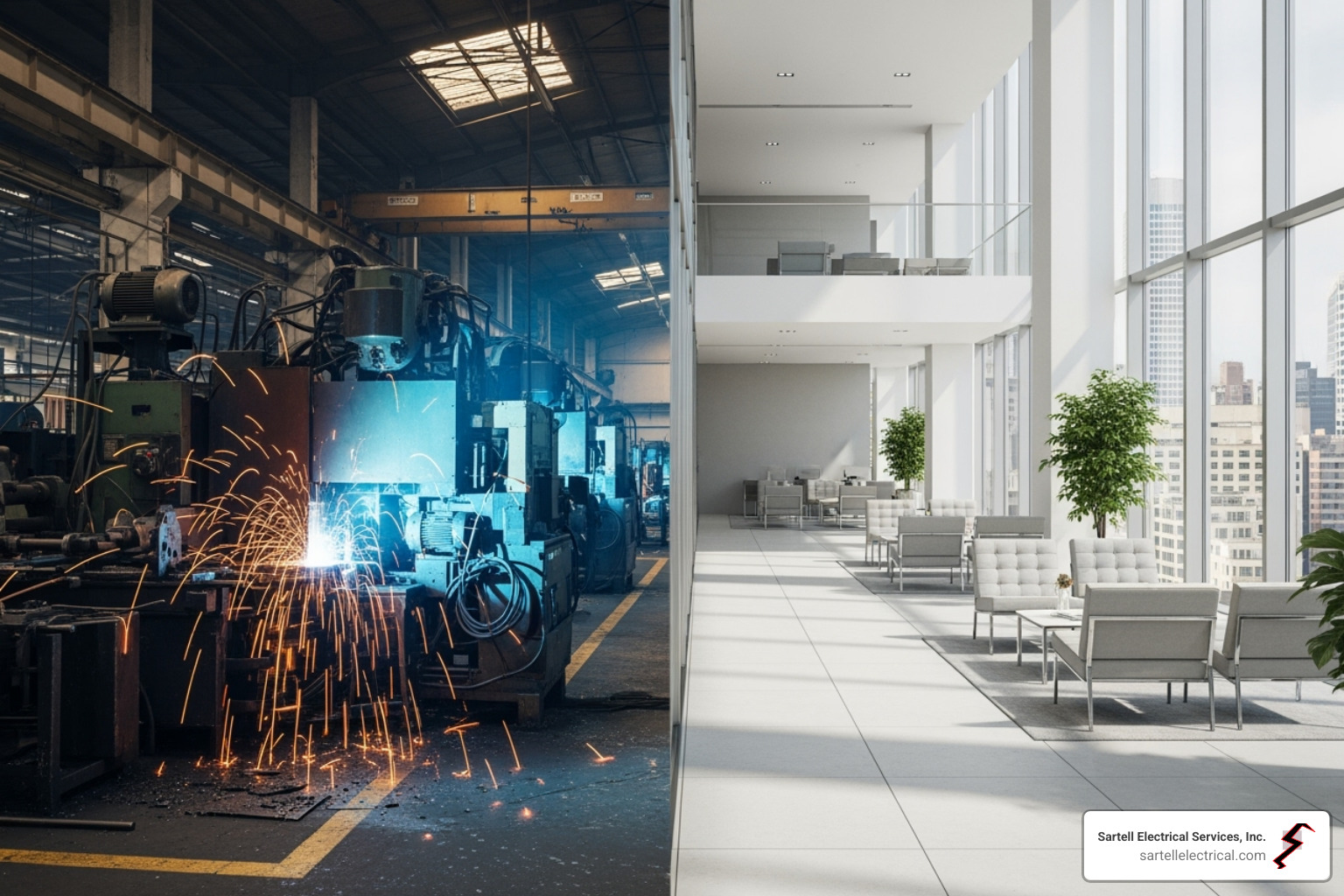
commercial and industrial electrician comes down to where they spend their days. It's like comparing a busy downtown office to a massive manufacturing plant - both need electricity, but the challenges couldn't be more different.
Imagine a sleek corporate office versus a steel mill with towering machinery. Each environment shapes the electrician's work, from their tools to their safety protocols.
The work environment isn't just about location - it determines the
scope of work entirely. Industrial settings focus on keeping production running 24/7, while commercial spaces prioritize creating comfortable, functional environments for employees and customers. One is production-focused, the other is people-focused.
At Sartell Electrical Services, we understand that choosing the right specialist isn't just about technical skills - it's about finding someone who knows your specific environment inside and out.
More info about our electrical services
Industrial Electrician Environments
Industrial electricians work in the powerhouses of our economy - places where raw materials become finished products and massive machinery never sleeps. These are
high-stakes environments where a single electrical failure can shut down entire production lines.
Industrial electricians work in
manufacturing plants, chemical plants, power plants, and
mines, where harsh conditions and precision controls are the norm.
Factories, warehouses, shipyards, and refineries all rely on them to maintain complex automation systems, from massive cranes to intricate process controls.
What makes these
high-risk environments particularly challenging? It's the combination of
high voltage systems, moving machinery, and hazardous materials all working together. An industrial electrician must think like both an electrical expert and a safety professional, understanding that downtime costs thousands of dollars per minute.
Our industrial electricians at Sartell Electrical Services have spent years mastering these demanding environments, bringing both technical expertise and safety-first thinking to every project.
Industrial Electrical Services
Commercial Electrician Environments
Commercial electricians bring power to the places where we work, shop, and learn every day. Their work touches the daily lives of countless people, making businesses run smoothly and creating comfortable spaces for employees and customers.
In
office buildings, they install lighting and power to keep workstations running. In
retail stores, they handle everything from display lighting to security systems.
Restaurants require a mix of kitchen and ambient lighting power, while
schools need safe systems for classrooms and labs.
High-rise buildings demand expertise in complex vertical power distribution.
The
scope of their job in
supermarkets and shopping malls involves balancing massive refrigeration systems with customer comfort, ensuring that the electrical infrastructure supports both business operations and a pleasant shopping experience.
Commercial electricians work closely with business owners, architects, and contractors to create electrical solutions that are both functional and aesthetically pleasing. They understand that their work directly impacts customer experience and employee productivity.
At Sartell Electrical Services, our commercial electricians combine technical expertise with an understanding of business needs, delivering solutions that keep your operations running smoothly while creating the right environment for success.
Commercial Electrical Services
The true difference between a
commercial and industrial electrician lies in their tools and the systems they manage. The complexity of equipment, duties, and responsibilities reveals their distinct specializations.
It's like comparing a watchmaker to a crane operator. Both work with mechanical systems, but their scale and complexity are vastly different. The same principle applies to electricians.
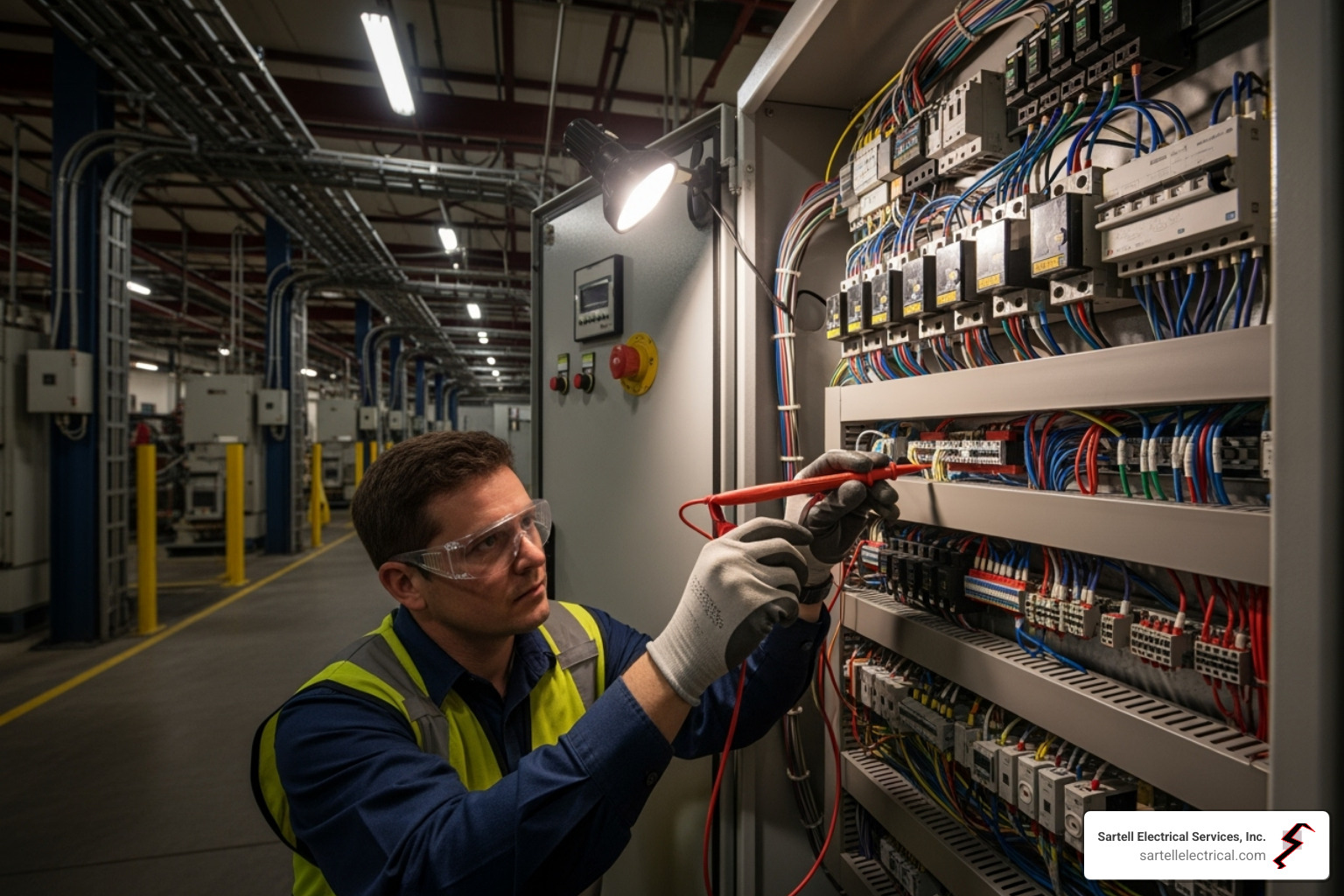
An industrial electrician's world revolves around
high-voltage systems and
three-phase power designed to keep massive industrial operations running 24/7.
Their work involves
motors, generators, and
Programmable Logic Controllers (PLCs) that automate manufacturing. They are the experts who troubleshoot and repair robotic assembly lines to prevent costly downtime.
Robotics integration is a key skill, as they connect automated systems and work with
pneumatic systems and
hydraulics that use electrical controls to manage air and fluid power.
Industrial electricians also master
control circuitry and use
rigid metallic conduit (RMC) to protect wiring from harsh manufacturing environments with sparks, chemicals, and heavy machinery.
Their primary responsibilities center on
troubleshooting complex machinery and
preventative maintenance. When a production line shuts down, every minute costs thousands. These professionals diagnose problems quickly, often using specialized diagnostic equipment to identify issues before they become costly breakdowns.
The Commercial Electrician's Focus
Commercial electricians work in a different world, focusing on
lower voltage systems that power the spaces where we work, shop, and learn. While industrial electricians focus on production, commercial electricians focus on people.
Lighting systems are a huge part of their work, from basic office fixtures to smart LED installations. They also ensure
HVAC systems and
power distribution through
breaker panels function correctly to keep commercial spaces comfortable and operational.
Security systems and
fire alarms are also critical parts of their expertise.
Commercial electricians excel at
client-facing installations, working with business owners and architects to create solutions that are both functional and aesthetically pleasing. They must balance performance with appearance.
At Sartell Electrical Services, our commercial team also specializes in
Telecommunications Electrical Services – the backbone of modern business communications. From fiber optic installations to network infrastructure, they ensure businesses stay connected.
The key difference? Industrial electricians keep machines running. Commercial electricians keep businesses running. Both are essential, but their daily challenges and expertise couldn't be more different.
The Path to Proficiency: Training, Skills, and Licensing
Becoming a skilled
commercial and industrial electrician requires dedication, hands-on experience, and commitment. Like learning an instrument, it demands both theory and countless hours of practice to excel.
While both paths start with similar foundations, they diverge into specializations. Both roles require
strong problem-solving abilities and
good physical fitness, as the work is physically demanding and requires on-site troubleshooting.
Training and Licensing for a Commercial and Industrial Electrician
The journey typically begins with
apprenticeship programs, which are the backbone of electrical training. These comprehensive programs blend classroom learning with real-world experience.
Apprenticeships last
four to five years, requiring
8,000 to 10,000 hours of on-the-job experience. The path for industrial electricians is often more intensive, demanding around
9,000 hours of combined on-the-job work and in-school training.
The
classroom training portion covers essential topics like electrical theory, safety codes, blueprint reading, motor controls, transformers, and power distribution. Industrial electricians often spend approximately
four years in classroom training, diving deeper into complex systems.
Once apprentices complete their training and pass a competency exam, they reach
journeyman level, allowing them to work independently. With additional experience and another exam, electricians can achieve
master electrician status, which often permits them to design electrical systems and supervise others.
State licensing is mandatory and typically requires a high school diploma, a completed apprenticeship, and passing a licensing exam.
Certification level
Licensing requirements
Specialized vs. Interpersonal Skills
While both types of electricians share core competencies like attention to detail and strict safety adherence, their daily work environments shape distinctly different skill sets.
Industrial electricians develop highly technical, machinery-focused skills. They become experts at
reading electrical schematics and interpreting blueprints that are often far more complex than standard building plans. Their
mechanical proficiency extends to understanding how hydraulics, pneumatic systems, and robotics interact with electrical components.
Crucially, industrial electricians master
analytical thinking and problem-solving to diagnose intricate electrical faults on production lines where downtime is costly. They develop deep
knowledge of manufacturing processes and how electricity drives production in specific industries.
Commercial electricians, on the other hand, excel in people-focused skills. Their
interpersonal communication abilities shine when working directly with business owners, facility managers, and clients.
Customer service becomes second nature as they build lasting relationships and ensure client satisfaction.
Commercial electricians also master
project collaboration, working seamlessly with other trades in construction or renovation settings. Their
resourcefulness helps them adapt to diverse layouts and client needs. Many also develop leadership skills by
mentoring apprentices.
Power and Precision: A Commercial and Industrial Electrician Comparison
When you're trying to understand a
commercial and industrial electrician, it helps to see the differences side by side. Think of it like comparing a Swiss watch to a massive industrial turbine - both are precisely engineered, but they serve completely different purposes and operate at different scales.
| Aspect |
Commercial Electrician |
Industrial Electrician |
| Work Environment |
Offices, retail, restaurants, schools, public-facing buildings |
Manufacturing plants, factories, mines, power plants, refineries |
| Voltage |
Typically lower to medium voltage (120V-480V) |
Often high voltage (600V+), complex control systems |
| Key Equipment |
Lighting, HVAC, panels, security, general outlets |
PLCs, robotics, large motors, generators, heavy machinery |
| Primary Focus |
Building systems, safety for occupants, aesthetics |
Production uptime, process control, machinery maintenance |
| Downtime Impact |
Business interruption, inconvenience, lost sales |
Catastrophic production loss, supply chain disruption, safety risks |
The power systems and wiring techniques used by each type of electrician tell their own story about the demands of their work environments.
Critical Differences in Power and Wiring
Industrial wiring is built for durability. Electricians there work primarily with
three-phase power setups for heavy machinery and use
rigid metallic conduit (RMC) to shield wiring from electromagnetic interference. This protection is critical for sensitive electronics. The focus is always on
proper grounding of manufacturing systems and installing power conductors that won't interfere with delicate control systems.
Commercial wiring is different. While larger buildings use
three-phase power, electricians often work with
single-phase power for lighting and outlets. They may use
exposed conduit or flexible
sheathed cables, prioritizing
accessibility and aesthetic integration in finished spaces. The key difference? Commercial wiring needs to look good and be easily maintainable, while industrial wiring needs to be bulletproof and interference-free.
The High Stakes of Downtime and Errors
Here's where the pressure really shows the difference between these two specializations. The consequences of problems vary dramatically depending on whether you're working in a corner office or a chemical plant.
Industrial downtime is a plant manager's nightmare, as a single hour of stoppage can cost
millions of dollars in lost output and disrupt supply chains. An error can cause severe safety incidents, damage expensive machinery, and create widespread outages. This environment demands
extreme precision, proactive maintenance, and the ability to troubleshoot problems at lightning speed.
Commercial downtime, while still significant, operates on a different scale. When the power goes out in an office building, people lose productivity. A restaurant losing power loses sales for that shift. These situations are costly for businesses but rarely create the systemic impact of an industrial shutdown. Commercial electricians focus on
safety for the public and staff and ensuring reliable power for daily business operations.
Career Progression and Earning Potential
Both career paths offer stability and growth, but the specialized nature of industrial work often translates to higher compensation.
The numbers tell an interesting story.
Industrial electricians typically earn more than their commercial counterparts, reflecting their specialized expertise and the critical nature of their work. While salaries vary by location and experience, the premium for industrial skills is common. Master electricians in both fields can earn well over $100,000 annually.
Career opportunities in both fields are robust but different. Industrial electricians might advance into automation specialists or facility management roles. Commercial electricians can specialize in smart building technology, energy management, or become project managers.
The choice often comes down to personality and interests: Do you thrive on the intricate challenge of keeping massive machinery running smoothly? Or do you prefer the variety and client interaction that comes with commercial work? At Sartell Electrical Services, we've seen successful careers flourish in both directions, and we're proud of the diverse projects our team tackles.
Our Projects
Frequently Asked Questions about Electrician Roles
When comparing commercial and industrial electricians, several questions frequently arise from business owners and facility managers. Let's tackle the most common ones.
While both types of electricians share fundamental electrical knowledge,
industrial work demands specialized expertise that goes far beyond basic electrical skills. Think of it like asking if a family doctor can perform heart surgery - they understand the human body, but that doesn't mean they're qualified for every medical procedure.
An industrial electrician has undergone specific training for high-voltage systems, complex machinery, and industrial safety protocols. They've spent years learning about PLCs, three-phase power distribution, and keeping production lines running smoothly.
Industrial electricians have a higher level of expertise due to their required education and specialized experience. They work with systems in manufacturing plants that commercial electricians rarely encounter. It's not just about knowing electrical code - it's about understanding entire manufacturing processes.
A commercial electrician would typically need
additional training and experience to work safely and effectively in an industrial setting. The stakes are simply too high when a single mistake could shut down a multi-million-dollar production line.
What are the biggest safety hazards for each type of electrician?
The safety challenges faced by each type of electrician reflect their different work environments, and understanding these differences helps explain why specialization matters so much.
Industrial electricians face serious hazards like high-voltage equipment where arc flash incidents can be catastrophic. Moving machinery, confined spaces, and hazardous materials create a complex web of safety concerns that demand strict adherence to every protocol. The consequences of error are often severe, including electrocution, injuries from automated machinery, and exposure to chemicals.
These environments demand strict adherence to lockout/tagout procedures.
Commercial electricians face different but equally important safety challenges. Their work in finished, public spaces means they're often working on ladders or lifts in occupied buildings. Falls, electrical shock, and fire hazards are constant concerns, but the scale is generally different from heavy industrial settings.
Both specializations require rigorous safety training, but the specific protocols differ significantly.
Is an industrial or commercial electrician career better?
This is like asking whether chocolate or vanilla ice cream is better - the answer depends entirely on your personal preferences and what energizes you professionally.
Industrial work is perfect for those who love complex problem-solving and keeping massive systems running. If you enjoy troubleshooting a robotic assembly line or programming a PLC, an industrial career might be your calling. It involves deep technical challenges and the satisfaction of keeping manufacturing operations online. The trade-off can be more demanding schedules, but
the higher earning potential reflects the specialized expertise required.
Commercial work appeals to people who enjoy variety and human interaction. If you like seeing different job sites, working directly with business owners, and collaborating with other trades, commercial work offers that diversity. Commercial electricians often enjoy
more predictable schedules and the satisfaction of creating systems that improve people's daily experiences. The work is more client-facing, requiring strong communication skills.
Both paths offer stable, essential careers. The "better" choice depends on whether you're drawn to the technical complexity of industrial systems or the variety and client interaction of commercial work. At Sartell Electrical Services, we've seen excellent electricians thrive in both specializations - it's all about finding the right fit.
Conclusion: Choosing the Right Expert for Your Electrical Needs
Understanding the difference between a
commercial and industrial electrician isn't just technical knowledge - it's the key to making smart decisions for your electrical projects. As we've explored throughout this guide, these aren't interchangeable roles. They're distinct specializations that require different training, equipment expertise, and safety protocols.
Think of it this way: you wouldn't ask a heart surgeon to fix your broken leg, even though both are doctors. Similarly, the industrial electrician who expertly maintains complex PLCs and high-voltage systems in your manufacturing plant might not be the best choice for upgrading the lighting in your retail store.
The specialization matters.
The stakes are simply too high to get this wrong. Whether it's the safety of your employees, the efficiency of your operations, or the bottom line of your business, hiring the right electrical professional makes all the difference. Industrial downtime can cost millions per hour, while commercial electrical issues can shut down customer-facing operations and damage your reputation.
At Sartell Electrical Services, we've spent over 30 years building expertise across both commercial and industrial sectors. Our Massachusetts-based team understands that a manufacturing facility's electrical needs are vastly different from those of an office building or retail space. We don't just show up with a toolbelt - we arrive with the specific knowledge and experience your project demands.
Experience tells the story. Our electricians have steerd the complexities of industrial automation systems and the aesthetic demands of commercial spaces. They understand when rigid metallic conduit is essential for industrial applications and when flexible solutions work better in commercial settings. They know the difference between troubleshooting a production line that can't afford downtime and installing security systems in a busy retail environment.
What sets us apart is our commitment to excellence, leadership, and genuine customer service. We handle projects of all sizes because we believe every electrical need - whether it's keeping your factory running or ensuring your customers feel safe and comfortable in your business - deserves expert attention.
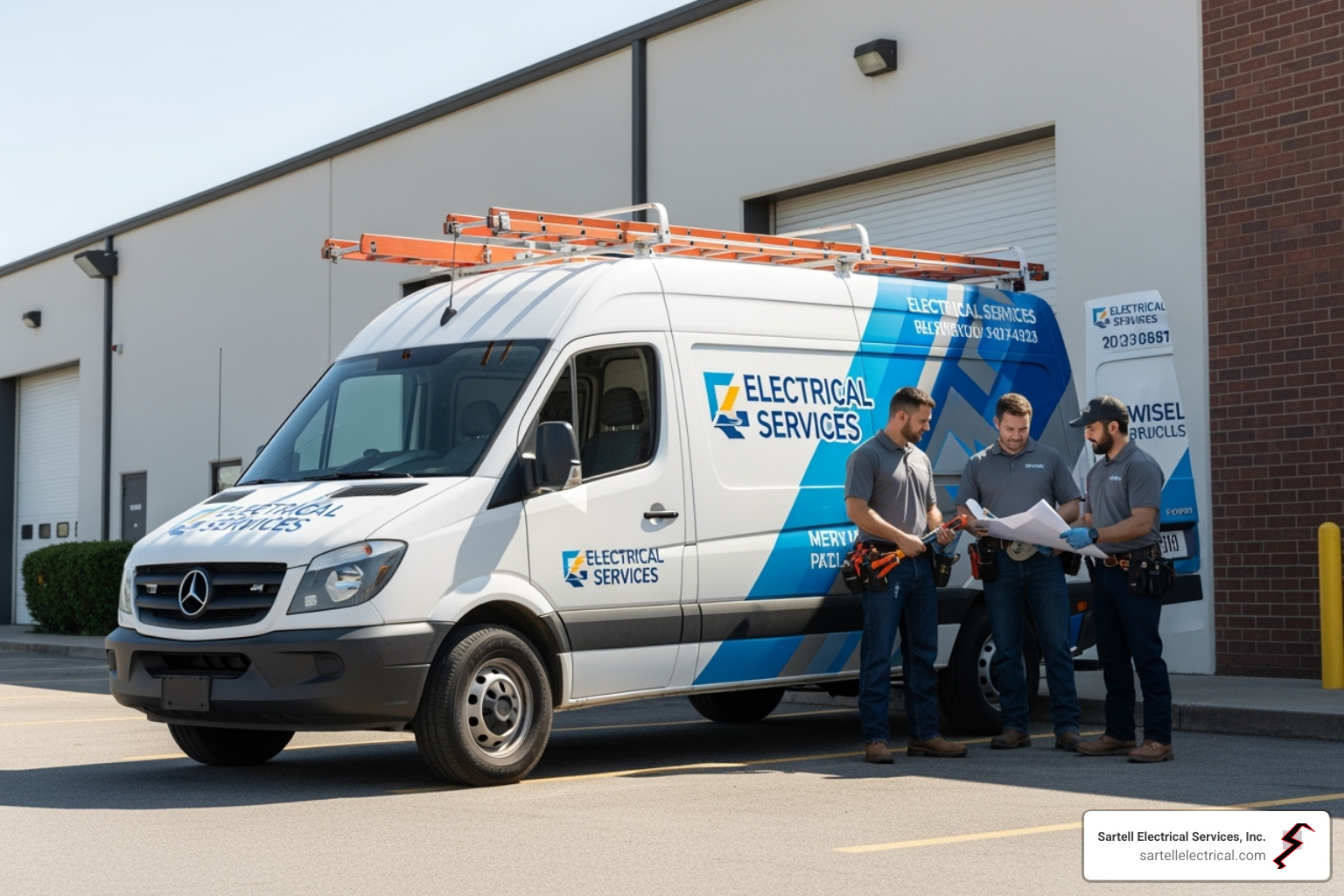
When you're ready to move forward with your electrical project, you'll have the confidence to choose the right specialist for your specific needs. Whether you need industrial expertise for heavy machinery or commercial know-how for your business space, the right professional will deliver safety, efficiency, and peace of mind.
Contact us for your commercial electrical needs - or any electrical project across Massachusetts. We're here to power your vision with the precise expertise it deserves.