The average price to replace electrical panel in most U.S. homes falls between $1,300 and $2,900, depending on amperage, location, and labor. Here’s a fast breakdown:
| Panel Size | Typical Total Cost |
|---|---|
| 100-amp | $850 – $1,600 |
| 200-amp | $1,200 – $2,900 |
| 400-amp | $2,000 – $4,000 |
Most homeowners pay around $2,500 for a standard 200-amp replacement. Costs can climb above $4,500 if rewiring, relocation, or code upgrades are required.
Unexpected electrical panel failures don’t wait for a convenient time. One day your breakers are tripping constantly, the next your insurance company is flagging your outdated fuse box — and suddenly you’re staring at a repair bill you never planned for. Understanding what drives these costs before you’re in that situation puts you in a much stronger position.
I’m Ed Sartell, President of Sartell Electrical Services, Inc., and I’ve been helping Massachusetts homeowners and businesses navigate the average price to replace electrical panel since 1985. In nearly four decades of hands-on electrical work, I’ve seen every scenario — from straightforward panel swaps to full rewiring jobs — and I’ll walk you through exactly what to expect.
Quick average price to replace electrical panel terms:
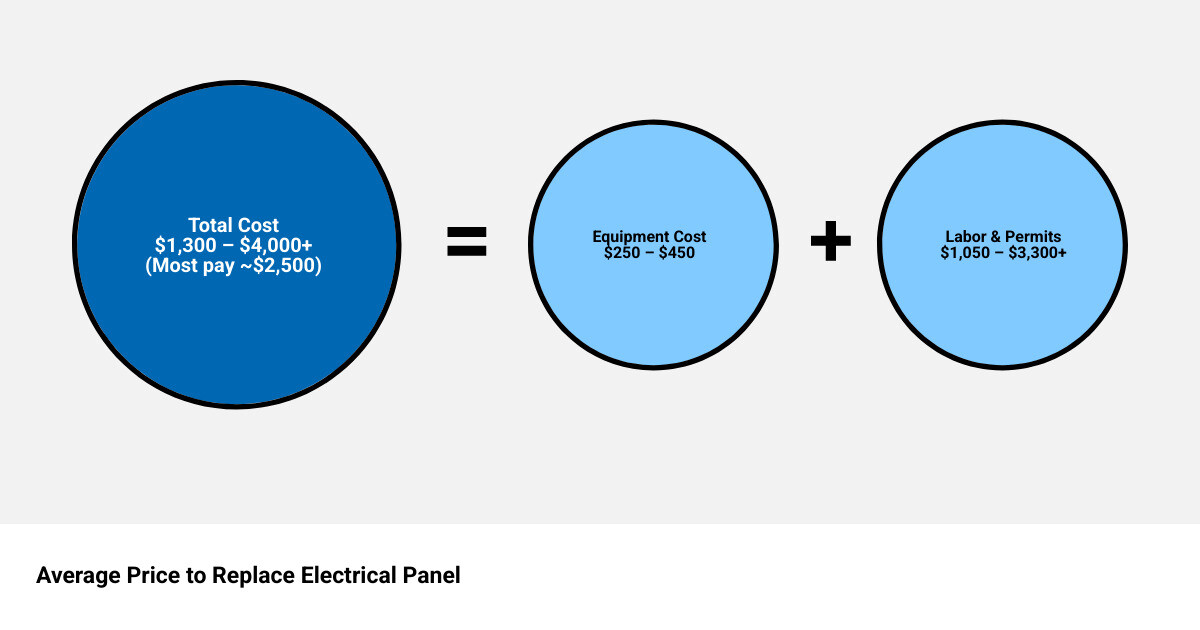
When we talk about the average price to replace electrical panel, we are looking at a wide spectrum. For a basic unit in a smaller home, you might see figures as low as $520 for a simple swap, but for most modern residences in the Massachusetts area, the realistic expectation is between $2,100 and $2,900.
The total investment is essentially split into two buckets: materials and professional expertise. The panel itself—the “box” and the main breaker—usually costs between $250 and $500. However, the labor required to safely migrate every circuit in your home to a new, code-compliant system is where the bulk of the cost lies. If you are looking for more details on the specific breakdown, our electrical panel change cost guide offers a deep dive into these numbers.
Amperage is essentially the “bandwidth” of your home’s electrical system. The more “stuff” you want to run at once—AC units, electric car chargers, hot tubs—the more amperage you need.
Location matters significantly. In Quebec, for instance, a 200-amp panel might cost between $1,200 and $2,500 CAD. Meanwhile, in high-demand markets like Vancouver, prices can skyrocket to between $8,000 and $12,500 if the utility infrastructure needs a complete overhaul.
Here in the Greater Boston area and surrounding towns like Reading and Andover, we see costs influenced by strict Massachusetts electrical codes. These codes ensure your safety but may require additional hardware like AFCI (Arc Fault Circuit Interrupter) breakers, which cost about $65 each compared to $8 for a standard breaker. For a local perspective, you can read more about how much it really costs to upgrade your electrical panel in our region.
No two homes are identical, and several variables can push your quote up or down.

Safety is the primary reason we perform these upgrades. According to the ESFI, electrical issues cause over 51,000 fires every year. Your panel is designed to be the “brain” that stops these fires before they start, but if the brain is old or damaged, it can’t do its job.
Watch out for these red flags:
Most panels have a lifespan of 25 to 40 years. If your home was built in the 1970s or 80s and still has the original box, you are likely at the end of that safety window. Furthermore, if you still have a fuse box, many insurance companies in Massachusetts will actually deny coverage or significantly raise premiums until you perform a fuse box replacement.
We generally follow the “$1,000 Rule.” If a repair is going to cost more than $1,000, it’s almost always better to invest that money toward a full replacement. Repairing an old panel is like putting a new transmission in a car with 300,000 miles—you’re fixing one part, but the rest of the system is still old.
There are also “Must-Replace” scenarios. If you have a Federal Pacific (FPE) Stab-Lok or a Zinsco panel, these are known fire hazards with high failure rates. They often fail to trip during an overload, which is why a breaker panel upgrade isn’t just a home improvement—it’s a life-saving necessity.
Replacing a panel is never a DIY project. Even if you’ve swapped an outlet or a light fixture, the main service lines entering your home remain “live” even when the main breaker is off. One wrong move can lead to fatal electrocution or a massive house fire.
When you hire us, here is what the labor looks like:
The average price to replace electrical panel is an investment, but there are ways to soften the blow.
For more tips, see our electrical panel upgrade cost guide 2025. If the upfront cost is a concern, many homeowners utilize HELOCs (Home Equity Lines of Credit) or personal home improvement loans to spread the payments out.
Most industry experts agree that a panel lasts 25 to 40 years. However, if you live in a coastal area (like Gloucester or Rockport), salt air can accelerate corrosion, potentially shortening that lifespan to 15-20 years. Regular maintenance and annual inspections can help you get the most out of your system. If you’re wondering about the cost to replace main breaker panel versus just a single breaker, we can help you evaluate the condition of the whole unit.
Absolutely, and for most modern families, we highly recommend it. If you are planning on adding an EV charger, an electric range, or a heat pump, 100 amps simply won’t be enough. The change electrical panel from 100 to 200 cost is one of our most requested services because it future-proofs the home for the next several decades of technology.
Smart panels (like Span or Leviton Smart) cost significantly more—often $2,000 to $5,000 for the hardware alone. However, they allow you to monitor energy usage circuit-by-circuit from your phone. They are especially valuable if you have a solar array or a battery backup system, as they can automatically “shed” non-essential loads during a power outage to make your battery last longer. For a look at how this tech scales up, check our commercial electric panel complete guide.
Your electrical panel is the heart of your home. While the average price to replace electrical panel might seem like a daunting number, it is a critical investment in your family’s safety and your property’s value. An outdated or overloaded panel isn’t just an inconvenience—it’s a liability that can lead to fires, insurance issues, and damaged electronics.
At Sartell Electrical Services, Inc., we bring over 30 years of experience to every job site. Whether you are in Reading, Boston, or anywhere across Essex and Middlesex counties, our team is committed to providing transparent pricing and expert installation. We don’t just swap boxes; we ensure your entire system is safe, efficient, and ready for the future.
Don’t wait for the lights to go out or for a “burning” smell to alert you to a problem. Request a quote for electrical services today, and let us help you keep your home powered safely.

236 Ash St Reading, MA 01867
(By Appointment Only)
