Electrical project management: Mastering Success 2025
Why Electrical Project Management Is Critical to Success
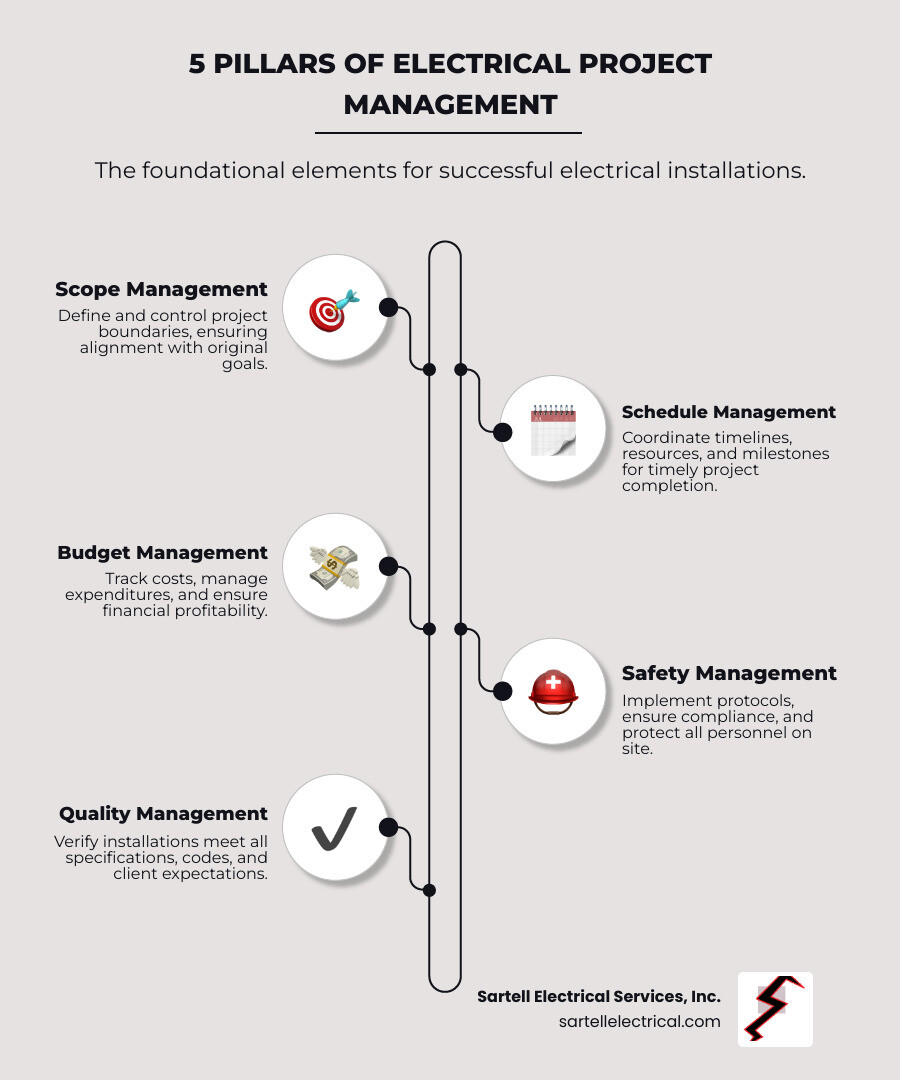
Electrical project management is the process of planning, organizing, and controlling all phases of an electrical construction project, from design to closeout. It ensures complex installations are completed on time, within budget, and to the highest safety and quality standards.
Key components of electrical project management include:
- Planning & Scheduling – Defining project scope, timelines, and resource allocation
- Cost Control – Tracking budgets, managing change orders, and forecasting expenses
- Team Leadership – Coordinating electricians, subcontractors, and stakeholders
- Safety & Quality – Ensuring compliance with codes, standards, and best practices
- Communication – Managing documentation, RFIs, submittals, and client relations
Research by ELECTRI International highlights the impact: projects with effective management achieved a
27% average gross profit margin, while poorly managed projects saw an average
loss of 6%. This underscores a simple truth:
the electrical project manager is the conductor of the orchestra, ensuring every element works in harmony. Without strong project management, teams face missed deadlines, budget overruns, and safety risks.
Success in the multi-million dollar electrical construction industry is defined by profitability, customer satisfaction, safety, and quality. Communication is the number one predictor for success—more important than education or experience alone.
I'm
Ed Sartell, President of Sartell Electrical Services. Since 1985, I've managed electrical projects across Massachusetts, from residential builds to complex commercial and industrial installations. I've seen how disciplined
electrical project management transforms challenges into profitable successes and builds lasting client relationships.
The Role of the Electrical Project Manager
The
electrical project manager is the heartbeat of any successful electrical construction project. This dynamic role demands technical expertise, strategic thinking, and strong people skills. The EPM oversees the planning, scheduling, and organization of workers, materials, equipment, and budget to ensure everything aligns from start to finish.
Core responsibilities include planning, scheduling, cost control, forecasting, and resource management. Beyond technical duties, they are team leaders and client relations specialists, building trust and fostering collaboration.
You can learn more about our dedicated team and our commitment to excellence on our
About Us page. For those looking to dive deeper into the nuances of this role, NECA offers an excellent
The Role of the Electrical Project Manager course.
Key Responsibilities in Electrical Project Management
The daily life of an electrical project manager involves a whirlwind of critical tasks.
Estimating provides accurate cost projections for labor, materials, and equipment, setting the project's financial tone.
Managing submittals involves reviewing and approving shop drawings, product data, and samples to ensure they meet specifications, preventing costly fixes in the field. Related to this, issuing and tracking
purchase orders for materials and equipment keeps the supply chain moving.
Change orders are an essential element of construction. The EPM identifies, documents, prices, and processes contract modifications arising from design adjustments, site conditions, or client requests. Effective management protects project scope and profitability. NECA offers an
Introduction to Change Orders course for those wanting to master this skill.
Overseeing
contracts and subcontracts involves managing client contracts and maintaining productive subcontractor relationships.
Quality control ensures installations meet design specifications, industry standards, and codes. Verifying quality and implementing commissioning prevents rework, the "profit killer" in our industry.
Safety compliance is a top priority. Developing and enforcing safety protocols protects workers and the job site. Our team handles all projects with precision, leveraging our expertise in
Commercial and Industrial Electrician services.
Essential Skills for Success
To succeed, an electrical project manager needs both technical and interpersonal skills. While
technical knowledge of electrical systems, codes, and construction is the foundation, soft skills often separate good managers from great ones.
A deep understanding of electrical systems, safety protocols, and codes like the NEC is non-negotiable for anticipating challenges and ensuring compliance.
Leadership involves inspiring and guiding the team, delegating tasks effectively, and fostering a positive, collaborative environment.
Problem-solving is essential as projects rarely go exactly as planned. EPMs must quickly identify issues, analyze causes, and devise practical solutions on-site.
Communication skills are the top predictor of project success. Clear, consistent communication with the team, clients, and stakeholders keeps projects on track and includes active listening and clear written and verbal correspondence. Research on
building great teams consistently highlights communication as paramount.
Negotiation is a daily requirement for handling subcontractor bids and client change orders. Negotiating fair terms and resolving disputes maintains profitability and relationships.
Adaptability is key in dynamic construction environments. Flexibility in response to unforeseen conditions, delays, or design changes is crucial for success under pressure.
Top 5 Soft Skills for Electrical Project Managers:
- Communication – Ensuring everyone stays on the same page from kickoff to closeout
- Leadership – Guiding teams, fostering collaboration, and making decisive actions
- Problem-Solving – Quickly addressing unexpected issues on site
- Customer Relations – Building strong relationships that ensure satisfaction and repeat business
- Conflict Management – Navigating disagreements skillfully to keep projects moving forward
These skills empower our project managers to steer the complexities of
electrical project management with confidence and deliver exceptional results.
Navigating the Electrical Project Lifecycle
Every electrical project follows a lifecycle of distinct phases. Managing these stages separates profitable projects from costly disasters. At Sartell Electrical Services, our refined, standardized methodology helps us manage scope creep and adapt to surprises. This structured approach breaks down complex installations into manageable phases with clear objectives and deliverables, ensuring seamless coordination and on-time, on-budget completion.

Stage 1: Pre-Planning and Mobilization
Project success is decided long before the first wire is pulled. Pre-planning is where we set ourselves up to win. This stage starts with reviewing blueprints and estimates to identify all materials and equipment. We prioritize and immediately order long-lead items to prevent cascading delays. The NECA offers an excellent
Introduction to Preplanning course that covers these fundamentals.
Job kickoff meetings bring the team, subcontractors, and client together to align expectations and establish communication channels, building relationships crucial for overcoming future challenges. The NECA Learning Center provides helpful guidance on conducting effective
Job Kickoff Meetings.
We then establish
The Baseline Schedule, our project's roadmap. It defines critical paths, milestones, and task sequences, serving as our guide for tracking progress and identifying roadblocks.
Materials management ensures components arrive on-site exactly when needed, avoiding storage issues or delays. We coordinate procurement, delivery, and storage. Similarly,
tool and equipment management keeps crews productive by ensuring the right tools are maintained and available when needed, preventing downtime.
Before anyone steps on site, we conduct thorough
Safety Preplanning. We identify hazards, implement preventative measures, and ensure all safety equipment is on hand. Safety is integrated into our planning from day one.
Finally,
crew planning ensures the right number of skilled electricians are assigned to each task to maintain schedule and control labor costs. The NECA's course on
Planning Crew Size and Structure helps optimize this balance.
Stage 2: Execution and Monitoring
Once the foundation is laid, the project moves into execution, where plans meet real-world conditions.
Our project managers are actively on-site to observe progress, address concerns, and ensure adherence to plans and safety protocols. This hands-on approach fosters open communication with our crews.
We maintain
daily job logs to document accomplishments, challenges, on-site personnel, and plan deviations. These
Daily Job Logs are invaluable for future estimates and process improvement.
Requests for Information (RFIs) are used to clarify ambiguities in design documents. We streamline our
RFI processing for quick resolution. Proposing solutions within the RFI speeds up approvals.
Submittal tracking ensures materials and equipment are approved before installation. We manage the process of
Preparing, Processing and Tracking Submittals diligently, reviewing drawings and data to prevent rework.
No construction project proceeds exactly as planned. We manage changes by carefully updating
as-built drawings throughout construction. These become essential for future maintenance and troubleshooting, making our
Building Electrical Maintenance services more efficient.
Stage 3: Quality, Safety, and Closeout
The final phase ensures everything works as designed for a smooth client transition. Rushing closeout can undermine the entire project.
We follow rigorous
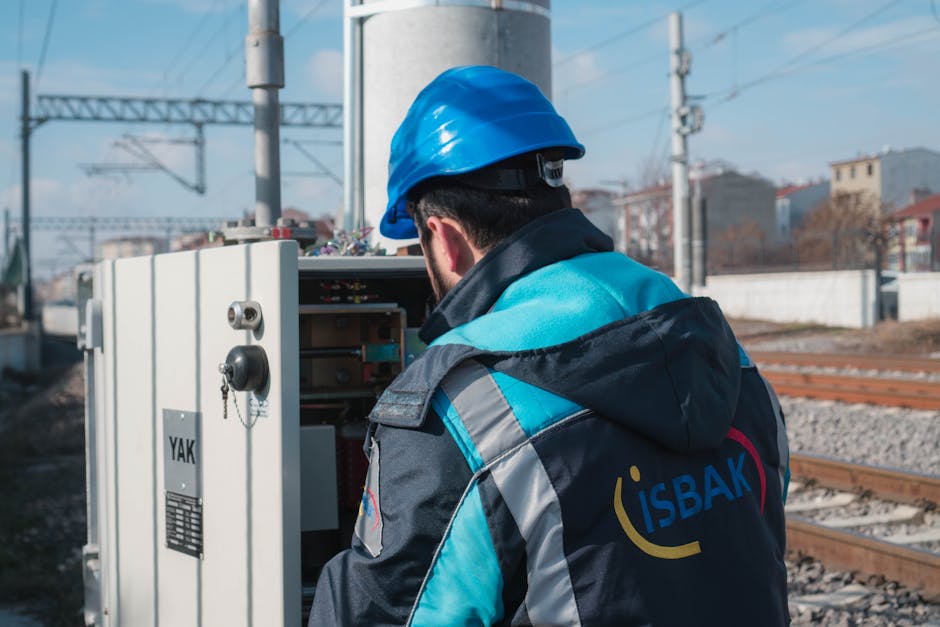
Quality Assurance and Quality Control procedures, especially during closeout. Regular site visits and comprehensive testing protocols verify that every component functions as intended.
Safety remains paramount. Our project managers understand
The Project Manager's Role in Safety, implementing safety logs and conducting compliance walks. We also ensure basic site necessities are available to prevent accidents.
Commissioning and testing verifies that all electrical systems perform reliably and safely before handover. We follow systematic procedures to prove functionality.
We use
pre-punchlists to proactively resolve issues before the official punch list. After completion, we prepare final documentation, including as-builts, warranties, and manuals.
The
Project Closeout course guides this phase, where we close out all change orders, purchase orders, and contracts, reconciling all financials.
The
handover includes client training and a documentation review. This final step demonstrates our professionalism and equips clients to operate and maintain their new systems successfully.
Core Principles of Effective Electrical Project Management
Successful
electrical project management rests on fundamental principles. The core is the "triple constraint"—scope, budget, and schedule. These interconnected elements must be balanced against real-world complexities. Beyond this, we focus on proactive risk mitigation, anticipating pitfalls from supply chain issues to site conditions with contingency plans. We view change orders not as problems, but as a natural part of construction to be managed efficiently. Whether for
Industrial Electrical Services or a large installation, these principles guide our decisions, ensuring profit, safety, and client satisfaction.
Managing Scope, Budget, and Schedule
The relationship between scope, budget, and schedule is critical. A small scope change can impact the entire project's timeline and cost, which is why we manage these constraints with systematic control.
Cost control is vital. We use rigorous systems for tracking all expenses and comparing them to the budget weekly to spot variances early. Effective cash flow management is also critical, and we've learned from the
Managing Cash on a Project principles to ensure healthy financial flow.
Change orders are inevitable in construction. We manage them professionally, ensuring each is clearly documented, fairly priced, and promptly processed. Following best practices for
Creating Change Orders protects profitability and project success. Our team has mastered the process outlined in NECA's
Introduction to Change Orders course.
Scope definition prevents scope creep. We establish clear scope upfront and use a formal process for any proposed changes to ensure everyone understands what is included.
Schedule adherence is maintained by using the baseline schedule as a living tool. Our teams use a three-week look-ahead schedule in weekly meetings to anticipate needs, coordinate trades, and prevent delays.
Mitigating Risks and Overcoming Challenges
No electrical project goes exactly as planned. Success often depends on how well you anticipate problems and prepare solutions. Effective
electrical project management means being ready for the unexpected.
Risk assessment starts early. In pre-planning, we identify potential issues like price fluctuations, labor shortages, or site access challenges before they become crises.
Contingency planning is our insurance policy. For each risk, we develop a plan, such as identifying backup suppliers or building buffer time into the schedule. We order long-lead items immediately.
Supply chain challenges are prominent. We mitigate them by working with trusted suppliers, maintaining strong relationships, and booking subcontractors early. Ordering long-lead items at the project's start prevents delays in final commissioning.
Labor shortages affect the industry. We attract and retain top talent by building strong teams, fostering a positive culture, and providing growth opportunities.
Unforeseen site conditions are common. Our experience as
Electrical Civil Contractors has taught us to conduct detailed site surveys, communicate openly with other trades, and remain flexible.
Rework is a silent profit killer. We prevent it through meticulous documentation, clear drawings, real-time communication, and consistent quality control. Documenting challenges creates valuable knowledge for future projects, as prevention is cheaper than correction.
In modern construction, technology is as essential to
electrical project management as any physical tool. Digital tools like Building Information Modeling (BIM), prefabrication, and automation transform how we manage projects, delivering unprecedented precision. Our project managers accept this digital evolution, understanding
The Project Manager's Role in BIM and its integration into modern electrical construction.
Essential Software for Electrical Project Management
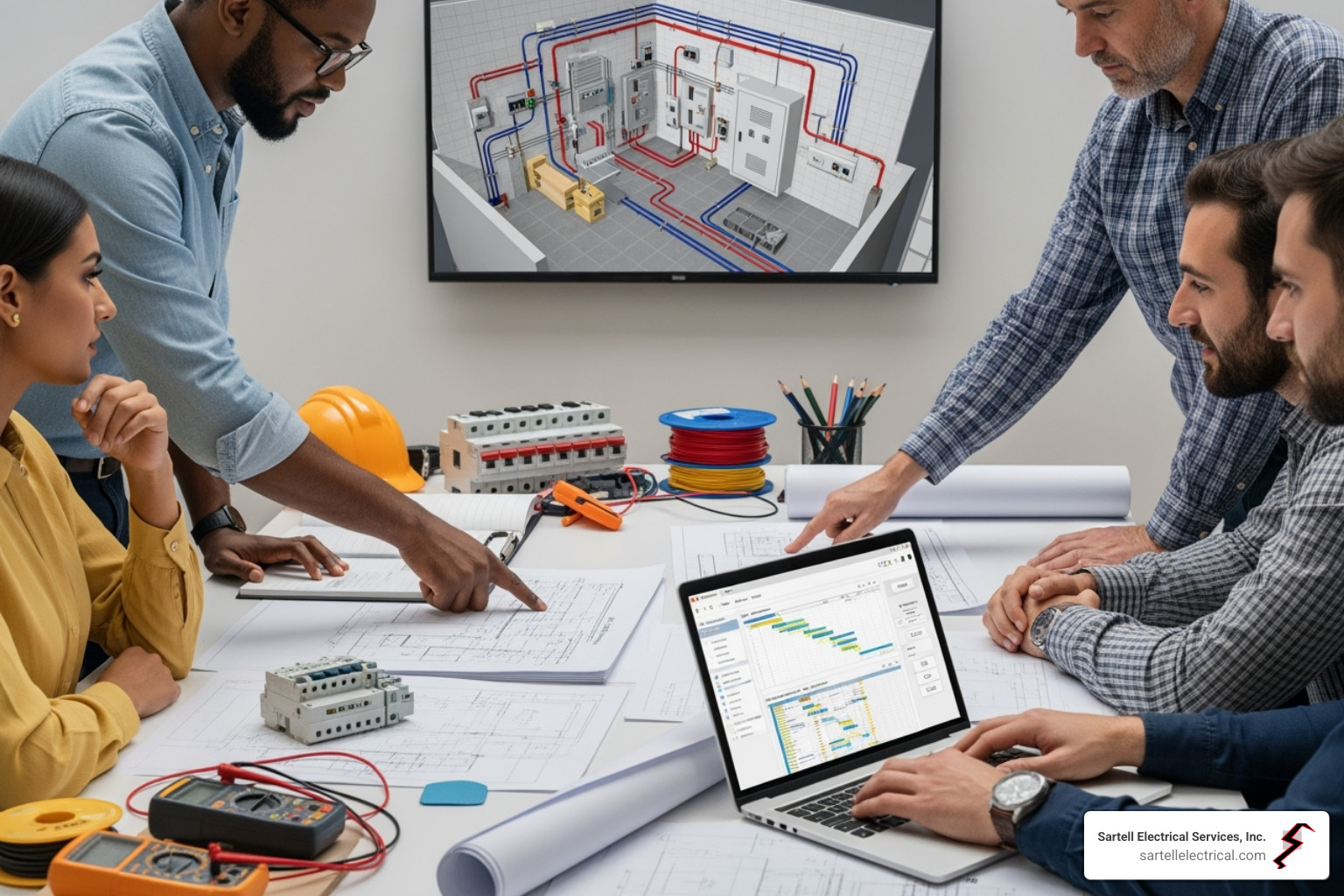
The right software is crucial for a smooth project. It's a digital toolbox where each tool helps manage complex tasks.
- Project management platforms like Asana or Smartsheet are the backbone of our planning. They help track tasks, deadlines, and budgets, providing team-wide visibility.
- Design software like AutoCAD Electrical and Revit is indispensable for creating detailed, accurate plans.
- Simulation software like SPICE or Multisim allows engineers to test designs virtually. This reduces errors, cuts costs, and saves time by catching problems before construction begins.
- Communication platforms like Slack and Microsoft Teams keep our teams connected across job sites with instant messaging and file sharing.
- Version control systems like Git are vital for tracking design changes, enabling effective collaboration.
Specialized tools like MATLAB and Simulink handle advanced analysis. Most modern platforms are cloud-based, allowing our team to access documentation from anywhere with a tablet. This real-time access improves transparency and simplifies
electrical project management.
Improving Communication and Collaboration
Communication is the number one predictor of project success. At Sartell Electrical Services, our reputation is built on technical excellence and superior communication with all project stakeholders.
We establish clear communication protocols from the start, defining who needs information, how often, and through which channels. Our weekly production meetings keep all stakeholders aligned.
A three-week look-ahead schedule is a cornerstone of our team meetings. This focused, agenda-driven discussion leads to actionable decisions about current and upcoming work.
Strong client relationships are built on proactive, transparent communication. We provide regular updates and address concerns promptly, an approach that has earned us significant repeat business.
Disagreements are inevitable. Our project managers are trained in
constructive conflict management to foster trust and cooperation.
Tools like
Smartsheet and
Slack have transformed information sharing. Centralized files and real-time updates eliminate confusion and wasted time.
Clear, detailed drawings customized for field teams—not just for estimating—eliminate ambiguity and prevent costly rework.
We encourage an open feedback loop with our teams and clients to continuously refine our processes. The results of this commitment are visible in
our past projects.
Frequently Asked Questions about Electrical Project Management
How do you become an electrical project manager?
The path to becoming an
electrical project manager blends education, hands-on experience, and skill development. Most start with a bachelor's degree in Electrical Engineering or Construction Management. This is followed by several years of field experience as an electrician or project engineer, which provides invaluable practical knowledge of installations, wiring, and safety protocols. Developing strong leadership, communication, and problem-solving skills is also essential. Many professionals pursue a Project Management Professional (PMP) certification to demonstrate mastery of project management principles. The complete journey, including education and experience, typically takes 7-10 years.
What are the biggest challenges for an electrical project manager?
Electrical project management is demanding. The primary challenge is managing the
"triple constraint" of scope, schedule, and budget, as a change in one affects the others. Other significant challenges include:
- Ensuring job site safety: This is a fundamental, non-negotiable responsibility.
- Coordinating with multiple trades: Effective coordination with GCs and other trades is crucial to avoid conflicts and delays.
- Managing supply chain disruptions: Unpredictable material availability and lead times require proactive procurement and contingency planning.
- Adapting to change: Projects rarely go exactly as planned. The ability to adapt to unforeseen conditions or design revisions is key.
- Preventing communication breakdowns: Clear communication is the top predictor of project success and prevents costly rework and delays.
- Navigating labor shortages: Finding and retaining skilled electricians is a persistent industry challenge.
Can you be an electrical project manager without an engineering degree?
Absolutely. While many EPMs have engineering degrees, many successful ones come up through the trades. Starting as an electrician provides invaluable hands-on experience that cannot be learned in a classroom. This path offers a practical understanding of what is realistic on a job site. For those taking this route, a deep knowledge of electrical codes (like the NEC), safety standards, and construction processes is essential. This expertise is often supplemented with certifications like the PMP or industry-specific training from organizations like
NECA. What matters most is the ability to successfully plan, coordinate, and execute complex electrical projects, regardless of whether the knowledge was gained through a degree or years of field experience.
Conclusion
As we've explored, the
electrical project manager is the conductor of the orchestra, guiding projects through their lifecycle using core principles and modern tools. Skilled project management is the difference between success and failure. Strong leadership transforms complex installations into profitable successes that are completed on time, on budget, and with the highest standards of safety and quality.
The data confirms it: effective management can mean the difference between a
27% gross profit margin and a
6% loss. At Sartell Electrical Services, we've built our reputation on this disciplined approach for over three decades. Our team brings comprehensive planning, meticulous coordination, and an unwavering commitment to safety and quality to every job.
When you hire us, you're investing in expertise, reliability, and peace of mind. If you're planning an electrical project and want a team that understands how to deliver a successful outcome, we're here to help.
Contact our expert telecom electrical contractors in Boston, MA today, and let's discuss how we can bring your vision to life.