60 amp meter with 100 amp panel: Critical Risks 2025
Understanding the 60 Amp Meter with 100 Amp Panel Mismatch
A 60 amp meter with 100 amp panel is a common and dangerous mismatch found in many older homes. This situation often arises when a homeowner upgrades their electrical panel without updating the exterior service equipment.
Quick Answer:
- The Problem: Your 60 amp service wiring can only safely handle 60 amps, even though your panel is rated for 100 amps.
- The Risk: The 100 amp main breaker will not protect the 60 amp wires from overheating, creating a significant fire hazard.
- The Solution: A full service upgrade is required, including a new meter socket, service wires, and coordination with your utility company.
- Who Can Help: This work must be performed by a licensed electrician, as it requires permits and inspections.
According to the National Fire Protection Association, electrical issues are a leading cause of residential fires, and mismatched service ratings contribute to this risk. The core issue is that using 60 amp wiring with a 100 amp breaker leaves the conductors
under-protected. They could overheat and ignite a fire long before the oversized breaker trips. As one forum member noted, "100 amp breaker protecting 60 amp wire leaves them under protected as they could overheat before the breaker would open."
As
Ed Sartell, I've been resolving electrical service mismatches like the
60 amp meter with 100 amp panel since founding Sartell Electrical Services in 1985. Serving Massachusetts homeowners for nearly four decades, I've seen how these hazards develop and, more importantly, how to fix them safely and to code.
How to Identify Your Home's Electrical Service
Understanding your home's true electrical capacity requires looking at several components, not just one. When we talk about a
60 amp meter with 100 amp panel, we're looking at two parts of a system that must be properly matched. The meter socket connects your home to the utility, while the electrical panel distributes power to your circuits. To get a clear picture, an electrician examines the
Service Entrance Conductors (the main wires from the utility), the
main breaker rating, the
electrical panel label, the
meter socket, and the
wire gauge.
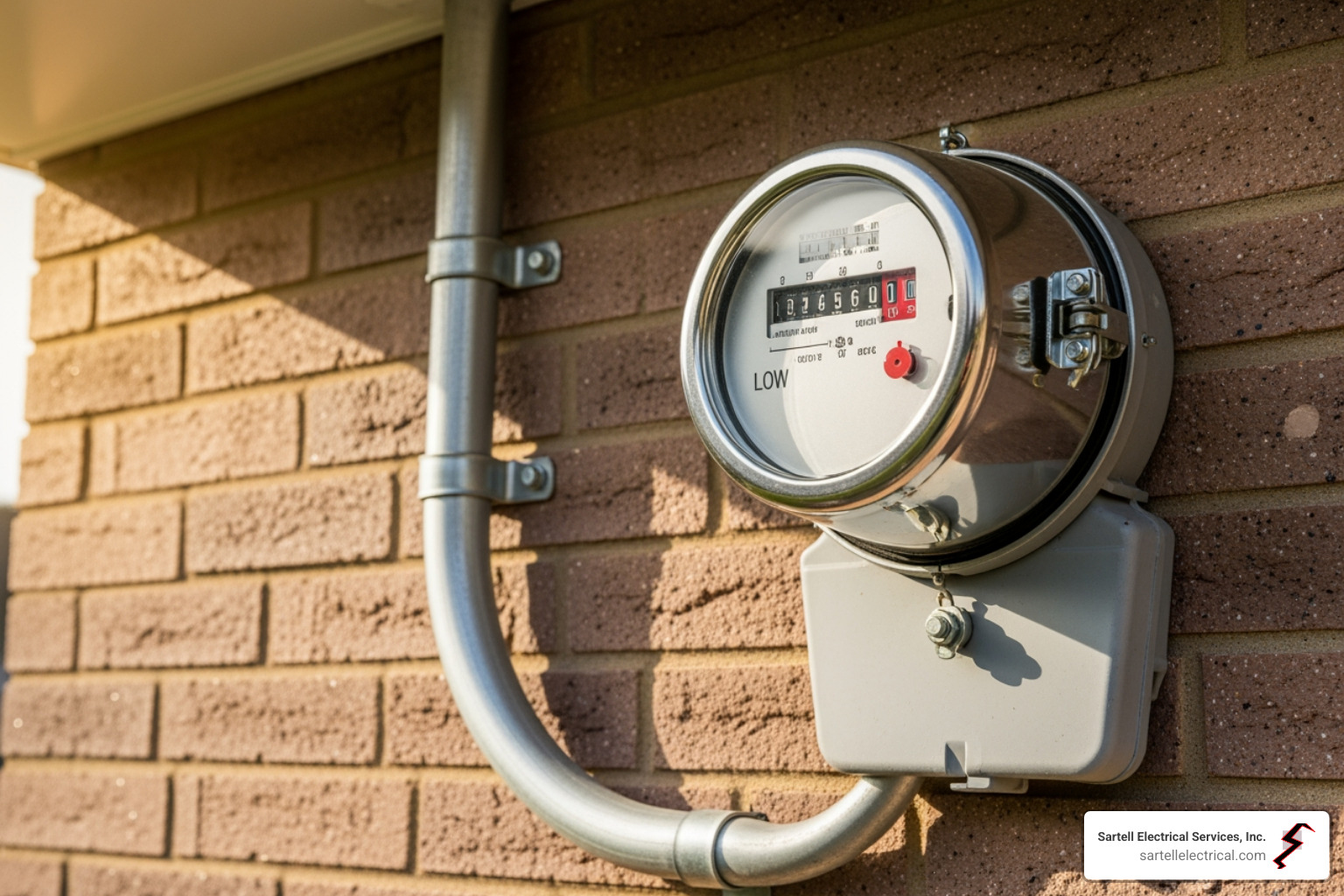
Many homeowners are surprised to learn that the meter itself doesn't determine service capacity. A meter labeled "CL200" is rated for 200 amps, but your actual service might be much less. The true limit is set by the service wires and the main breaker.
What are the main differences between a 60 amp and a 100 amp electrical service?
The difference between 60 and 100 amp service is about capacity. A 100 amp service can power more modern appliances and devices simultaneously without overloading the system.
The most significant difference is
wire size. A 60 amp service typically uses
#6 copper wire, while a 100 amp service requires thicker
#4 copper wire (or #2 aluminum). Thicker wires can carry more current safely without overheating.
In terms of
power capacity, a 60 amp service provides up to
14,400 watts (240V x 60A), sufficient for basic lighting and some appliances. A 100 amp service offers
24,000 watts, comfortably supporting central air conditioning, electric dryers, EV chargers, and multiple large appliances at once.
Physical hardware also differs. Older 60 amp services often have distinctive
round meter sockets. While some round sockets are rated for 100 amps, they are less common and are about
3/4 inch thicker than their 60 amp counterparts. The
conduit (pipe) for the wires is also larger for a 100 amp service (
1-1/2 inches vs.
1-3/16 inches) to accommodate the bigger wires.
| Feature |
60 Amp Service |
100 Amp Service |
| Typical Wire Size |
#6 copper wire (or #4 aluminum) |
#4 copper wire (or #2 aluminum) |
| Power Capacity (watts) |
Up to 14,400 watts (240V x 60A) |
Up to 24,000 watts (240V x 100A) |
| Common Appliances Supported |
Basic lighting, small appliances, limited large appliances (e.g., small electric water heater, stove) |
Modern appliances, central AC, electric dryer, EV chargers, multiple large appliances simultaneously |
| Meter Socket Style |
Often older, round meter sockets |
Typically newer, square meter sockets (though some round 100A exist) |
| Conduit Size (Raceway) |
Typically 1-3/16 inches in diameter |
Typically 1-1/2 inches in diameter |
How can a homeowner identify if they have a 60 amp meter with 100 amp panel?
Identifying a mismatch requires some detective work, but for your safety, a professional assessment is always recommended for a definitive answer.
Start by
checking your main breaker. In your main electrical panel, the main breaker is usually the largest one at the top. It will be clearly marked with a number like 60, 100, or 200. This indicates the maximum amperage your
panel is designed for.
Next,
inspect your meter socket outside. Older homes often have round meter sockets, which are typically rated for 60 amps. While the meter itself may be marked "CL200," this rating belongs to the utility company's device and does not reflect your home's service capacity.
The most reliable indicators are the
service entrance wire gauge and
conduit size. A 60 amp service uses #6 copper wire and a 1-3/16 inch conduit, while a 100 amp service uses #4 copper wire and a 1-1/2 inch conduit. Identifying wire gauge accurately and safely requires an electrician.
If you find a 100 amp main breaker but see signs of a 60 amp service (like a round meter socket or smaller wires), you likely have this dangerous mismatch. For more on understanding your home's electrical system, see our guide on
Residential Electrical Service.
What are the signs that a home's electrical service is insufficient?
Your house will often show clear warning signs when its electrical service is overloaded. These symptoms are red flags that should not be ignored:
- Flickering or dimming lights, especially when large appliances like an air conditioner or microwave turn on.
- Frequently tripping circuit breakers or blowing fuses. This is a sign that circuits are drawing too much current.
- Warm or hot outlets and light switches, or any discoloration around them. This indicates dangerous heat buildup.
- A burning smell from outlets, switches, or the electrical panel requires immediate attention.
- The inability to run multiple large appliances at the same time without causing issues.
- Heavy reliance on extension cords and power strips, which indicates an insufficient number of outlets and circuits.
These are not just inconveniences; they are serious safety concerns. If you experience these symptoms, it's time for a professional evaluation. Learn more about diagnosing such issues in our resource on
Electrical Troubleshooting Cost.
The Risks of a 60 Amp Meter with 100 Amp Panel
A
60 amp meter with 100 amp panel is a genuine safety hazard. This mismatch can put your home and family in real danger. The National Electrical Code (NEC) establishes rules to keep electrical systems safe, and a core principle is that every wire must have appropriate overcurrent protection. Installing a 100 amp breaker on 60 amp wiring violates this fundamental rule.
What are the potential risks and dangers of this mismatch?
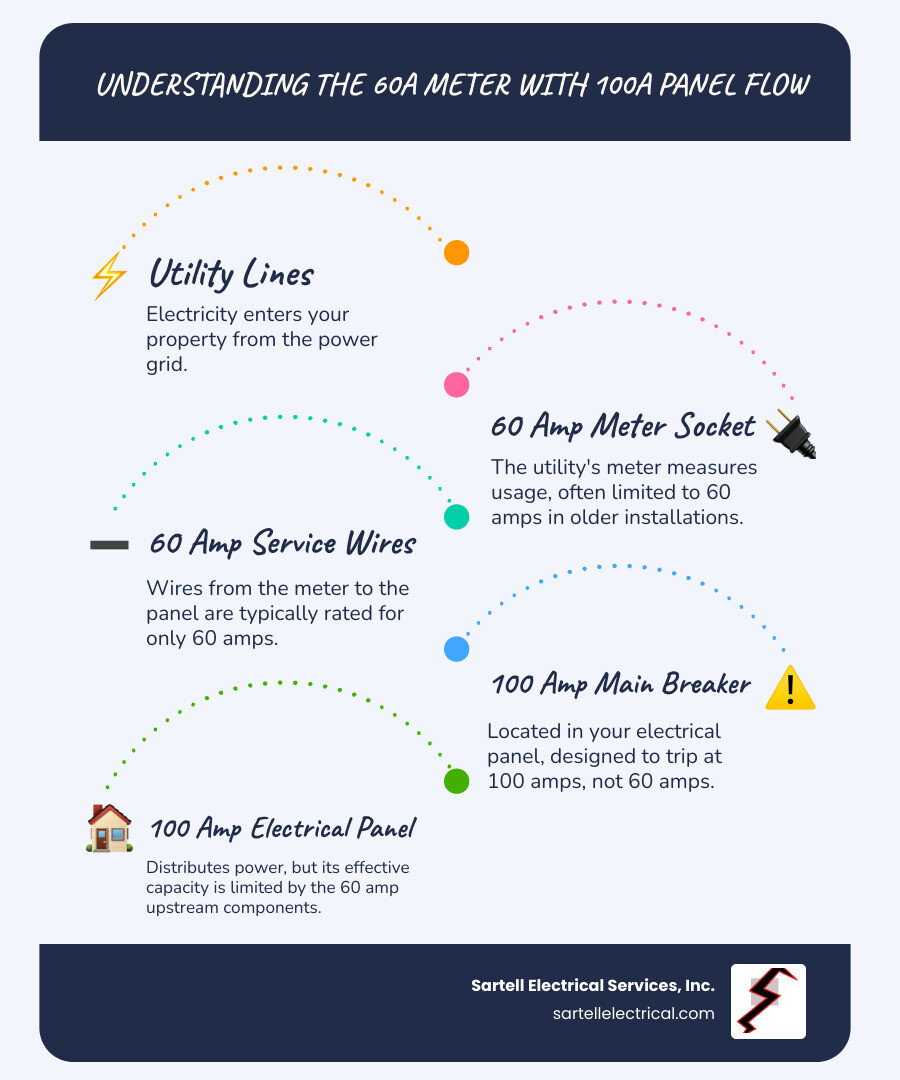
The primary danger is "under-protection." Your 60 amp service wiring is designed to safely carry a maximum of 60 amps. A 100 amp main breaker, however, won't trip until the current exceeds 100 amps. If your home draws 70, 80, or 90 amps, the 60 amp wires will dangerously overheat while the breaker remains on, thinking everything is fine.
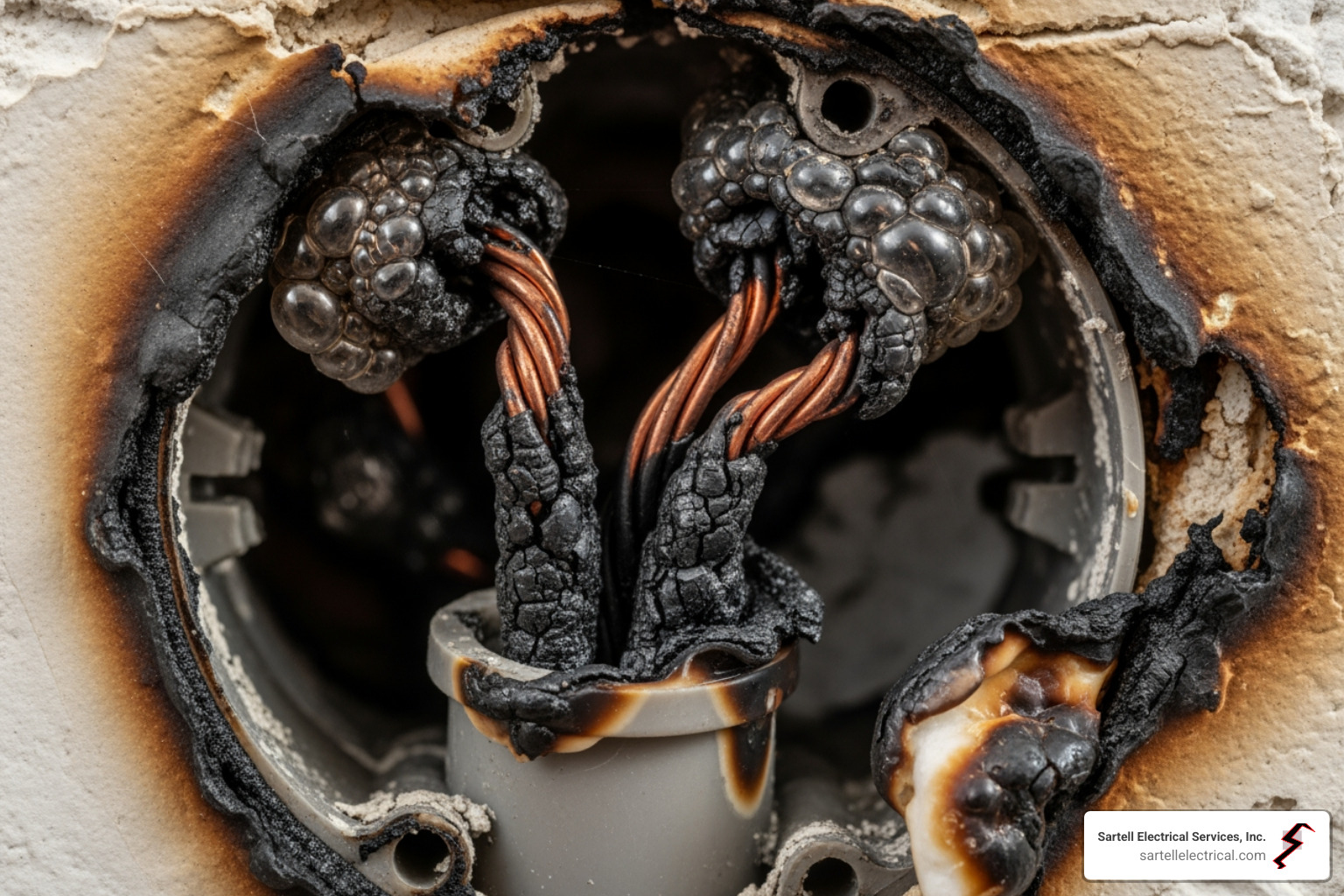
This excessive heat is a major fire hazard. As the wires overheat, their insulation can melt and break down, potentially igniting surrounding wood framing and insulation inside your walls. This heat can also damage the meter socket, causing arcing (dangerous electrical sparks) and eventual failure. As one electrical inspector noted in a
real-world discussion, "100 amp breaker protecting 60 amp wire leaves them under protected as they could overheat before the breaker would open."
There are also legal and insurance implications. If an electrical fire occurs due to an improperly configured system, your homeowner's insurance claim could be denied. An unpermitted panel "upgrade" that creates this mismatch can void your coverage and lead to complications when selling your home.
Are there specific code requirements regarding mismatched service and panel ratings?
Yes, emphatically. The National Electrical Code (NEC) is strict on this point. NEC Article 240.4 requires that every conductor be protected by an overcurrent device (like a breaker) sized for that conductor's capacity. Installing a 100 amp main breaker to protect 60 amp service components is a direct violation of this rule.
The entire service entrance—from the utility connection, through the meter socket and service wires, to the main panel—must be rated consistently. A 100 amp main breaker implies a 100 amp service, meaning every component upstream must also be rated for 100 amps. When it's not, you have a dangerous weak link.
This is why permits and inspections are mandatory. Local inspectors in Massachusetts communities like Reading, Andover, and Boston are trained to spot these deficiencies. Mismatched systems often result from unpermitted work done to save money, but cutting corners on electrical safety never pays off. For more on doing things correctly, see our
Residential Electrical Upgrades Guide.
Can a 100 amp panel be used with a 60 amp service, and what are the limitations?
Technically, you can connect a 100 amp panel to a 60 amp service, but it provides no real benefit and creates a serious hazard if done incorrectly. Your home's electrical capacity is always limited by the smallest bottleneck in the system. If your service wires and meter socket are rated for 60 amps, you have a 60 amp service—the panel's rating doesn't change that.
The danger arises when a 100 amp panel is installed with its 100 amp main breaker, creating the under-protection problem. A safer, though still limited, approach is to install a 60 amp main breaker in the 100 amp panel to properly protect the service wiring. However, you are still limited to 60 amps for your entire home.
This setup can create a false sense of security, leading homeowners to add large electrical loads the system cannot handle. A true service upgrade requires replacing all components: the service drop, meter socket, service entrance conductors, and the main panel. For a complete overview, consult our
Main Electrical Panel Upgrade Complete Guide.
The Process for Upgrading to a True 100 Amp Service
If you have a
60 amp meter with 100 amp panel, the solution is a complete service upgrade. While it's a significant project, it's a crucial investment in your home's safety and functionality. A true upgrade is a coordinated effort involving a licensed electrician, your local utility company, and the building department.
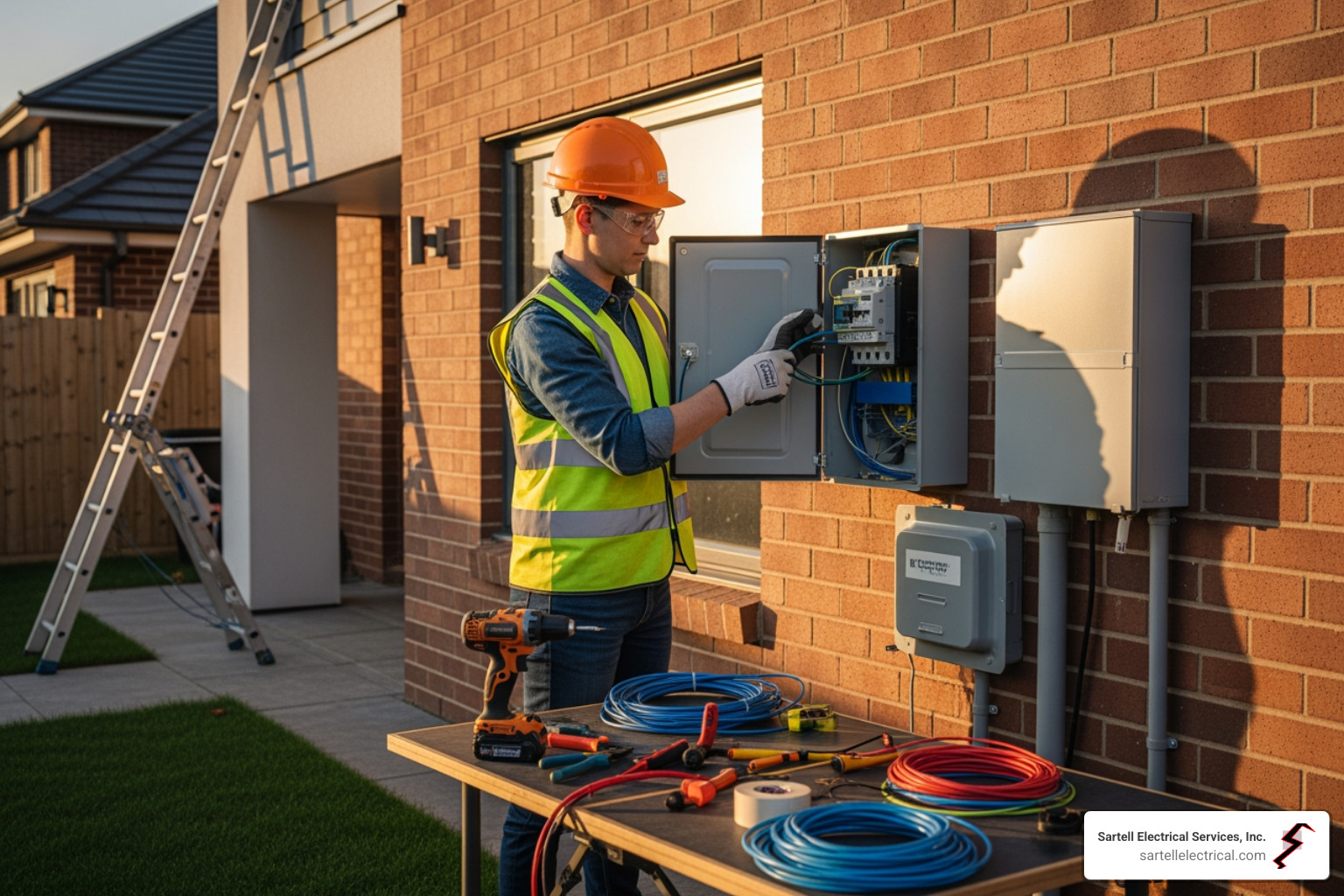
At Sartell Electrical Services, we've guided Massachusetts homeowners through this process since 1985, ensuring every upgrade is safe, compliant, and built to last.
What is the process for upgrading a 60 amp service to a 100 amp service?
Upgrading from 60 to 100 amps is a comprehensive project that touches every part of your electrical service. Here are the key steps:
- Assessment and Load Calculation: We start by examining your existing service and performing a detailed load calculation to determine your home's current and future power needs.
- Utility Coordination: We contact your utility company (e.g., National Grid, Eversource) to schedule a power disconnection and coordinate any necessary upgrades to their service drop.
- Permitting: We pull all required permits from your local building department. This ensures the work is legally performed and will be verified by a qualified inspector.
- Meter Socket Replacement: The old 60 amp meter socket is replaced with a new, weather-tight 100 amp-rated socket.
- Service Wire Upgrade: We replace the old 60 amp wiring (typically #6 copper) with new 100 amp conductors (usually #4 copper or #2 aluminum) and upgrade the conduit if it's too small.
- Panel Installation: We install a new 100 amp panel with a 100 amp main breaker, ensuring all circuits are properly connected and protected.
- Grounding and Bonding: We upgrade your home's grounding system to meet current code requirements, a critical safety feature.
- Inspection and Reconnection: After our work is complete, a local electrical inspector verifies compliance. Once approved, we coordinate with the utility to reinstall the meter and restore power.
For a more detailed look at this process, see our
Main Electrical Panel Upgrade Complete Guide.
This job is exclusively for a
licensed electrician. It is not a DIY project. Service upgrades involve working with high-voltage electricity that can be fatal if handled incorrectly.
A licensed electrician provides:
- Expertise: Deep knowledge of load calculations, wire sizing, the National Electrical Code, and safe work practices.
- Code Compliance: Guarantees that the work will meet all state and local regulations and pass inspection.
- Permitting and Utility Coordination: Manages all paperwork and scheduling with building departments and utility companies.
- Insurance and Warranties: Professional work is insured and warrantied, protecting your investment and home.
Attempting this work yourself or hiring an unlicensed handyman can lead to fire, electrocution, voided homeowner's insurance, and legal penalties. When looking for a professional, our resource on finding a
Licensed Home Electrician can help.
What are the typical costs and long-term benefits of upgrading?
An electrical service upgrade is an investment in your home's safety, value, and functionality. In Massachusetts, a 60 to 100 amp upgrade typically costs from several thousand dollars up to five or six thousand, depending on the project's complexity. The cost covers skilled labor, materials (panel, meter socket, wires), and permit fees. Our
Electrical Panel Upgrade Cost Guide 2025 offers more detailed information.
The long-term benefits far outweigh the cost:
- Increased Safety: Eliminates the fire hazard from the mismatched system.
- Higher Home Value: A modern, code-compliant electrical system is a major selling point.
- Modern Capacity: Power for all your appliances, central AC, and other high-demand devices without issue.
- Future-Proofing: Prepares your home for future technologies like EV chargers.
- Insurance Compliance: Ensures your electrical system meets your insurer's requirements, preventing potential claim denials.
Conclusion: Ensuring Your Home's Electrical Safety and Capacity
As you now know, a
60 amp meter with 100 amp panel is a serious safety concern, not just a technical quirk. Your home's electrical system is only as safe as its weakest component. In this scenario, the 60 amp service wires can dangerously overheat long before the oversized 100 amp breaker trips, creating a significant fire risk.
The importance of a balanced, code-compliant system cannot be overstated. Every component, from the utility connection to your main panel, must be rated for the same amperage to ensure safe, reliable power.
At Sartell Electrical Services, we have been resolving these exact issues for Massachusetts homeowners since 1985. Serving communities like Reading, Framingham, and Boston, we ensure every upgrade is performed correctly, with proper permits, utility coordination, and a guarantee to pass inspection.
A professional assessment is the only way to be certain of your service capacity. An upgrade provides more than just safety—it increases your home's resale value, provides capacity for modern appliances and EV chargers, and delivers invaluable peace of mind.
Don't let an outdated or mismatched electrical service put your home at risk. If you suspect you have a
60 amp meter with 100 amp panel or are ready to increase your home's electrical capacity, we are here to help.
Contact us for a Main Electrical Panel Upgrade and let's start the conversation about powering your home safely and reliably for years to come.