How Much Is a Permit to Upgrade an Electrical Panel? (Quick Answer)
How much is a permit to upgrade electrical panel work in your home? Here's the short answer:
| Permit Type | Typical Fee Range |
|---|---|
| National average (most municipalities) | $50 – $500 |
| Standard 200-amp upgrade | $50 – $300 |
| Higher amperage (200–400 amp) | $79 – $400 |
| Over 400-amp service | $95 – $500+ |
A few real examples from official fee schedules:
- Pasadena, CA: $62 issuing fee + $57 for service equipment up to 200 amps
- West Valley City, UT: $53 for up to 200 amps; $79.50 for 200–400 amps
- National range (electrician forums): $35 to $250+ depending on jurisdiction
Permit fees are just one part of the total project cost. A full panel upgrade typically runs $1,500 to $4,500, with permits making up a small but non-negotiable slice of that budget.
I'm Ed Sartell, President of Sartell Electrical Services, Inc., and with nearly four decades of hands-on electrical work across Massachusetts, I've guided hundreds of homeowners through exactly the question of how much is a permit to upgrade electrical panel — and what to expect from start to finish. Let me walk you through everything you need to know.
Relevant articles related to how much is a permit to upgrade electrical panel:
Understanding the Cost: How Much Is a Permit to Upgrade Electrical Panel?
When we talk about the cost of a permit, we aren't just talking about a piece of paper. We are talking about the legal authorization to perform high-voltage work on your home and the guarantee that a third-party expert (the inspector) will verify the safety of that work.
Across the United States, and specifically here in the Greater Boston area and surrounding Massachusetts counties like Middlesex and Essex, permit fees are determined by the local municipality. While the Electrical Panel Upgrade Cost Guide (2026) notes a national average range of $50 to $500, the specific price often depends on the "tier" of the upgrade.
Comparison of Permit Fees by Amperage
Most jurisdictions use a tiered system. As the amperage increases, the complexity of the service entrance equipment increases, and so does the fee.
| Amperage Capacity | Estimated Permit Fee Range |
|---|---|
| 100-Amp Panel | $50 – $150 |
| 200-Amp Panel (Most Common) | $100 – $300 |
| 400-Amp Panel (Large Homes/EVs) | $250 – $500+ |
In some areas, you might see a flat "issuing fee" (often around $60) plus a per-item charge. For example, some cities charge specifically for the "service equipment" (the panel itself) and then additional small amounts for each new circuit added during the upgrade.
Documentation Required for a Permit to Upgrade Electrical Panel
You can't just walk into a town hall in Reading or Andover and ask for a permit with a handshake. The "Authority Having Jurisdiction" (AHJ)—usually your local building department—requires specific paperwork to ensure the person doing the work is qualified. Typical requirements include:
- Contractor License: Proof that we are licensed by the Commonwealth of Massachusetts.
- Proof of Insurance: Specifically workers' compensation and liability insurance.
- Load Calculations: A mathematical breakdown proving that the new 200-amp or 400-amp panel can actually handle the electrical "load" of your home (HVAC, appliances, EV chargers).
- Site Address and Owner Info: Standard contact details for the property.
- One-Line Diagrams: A technical drawing showing how the power travels from the utility pole, through the meter, and into your new panel.
- Project Valuation: The estimated cost of the project, which some towns use to calculate a percentage-based fee.
Calculating How Much Is a Permit to Upgrade Electrical Panel in Your Area
Every town has its own quirks. In some Massachusetts towns, the fee is a flat rate for residential service upgrades. In others, they might add a "records system charge" or an "administrative surcharge."
If you look at the Electric Panel Upgrade – City of Palo Alto, CA guide, you'll see how detailed these requirements can get, including specific clearances from gas lines and windows. While we are on the East Coast, the principle remains the same: your local AHJ sets the rules, and we must follow them to the letter to get that permit approved.
Factors That Influence Electrical Permit Fees
Why is a permit $75 in one town and $250 in the next? Several factors influence the final "line item" for the permit on your invoice:
- Project Scope: Are we just swapping the "guts" of the panel (a straight swap), or are we moving the panel to a new location? Moving a panel often requires a more extensive permit because it involves new wiring and potentially structural considerations.
- Amperage Rating: As shown in our table, a 400-amp service is a much larger undertaking than a 100-amp service. It requires heavier-duty equipment and more rigorous inspection.
- Residential vs. Commercial: Permits for commercial properties in places like Boston or Chelsea are almost always more expensive than residential ones due to the increased complexity of three-phase power systems.
- Plan Review Fees: For larger upgrades (especially 400-amp services or those involving solar/battery backups), the town may charge a "plan review fee" where an engineer or senior inspector must sit down and study the diagrams before the permit is even issued.
- Utility Coordination: While the permit fee goes to the town, the utility company (like National Grid or Eversource) may have their own "service connection" fees. We handle this coordination for you, but it’s a factor in the total "authorization" cost.
- Inspection Frequency: Some complex jobs require a "rough-in" inspection and a "final" inspection. Each visit from the inspector might carry a fee.
Why You Can’t Skip the Permit for Your Panel Upgrade
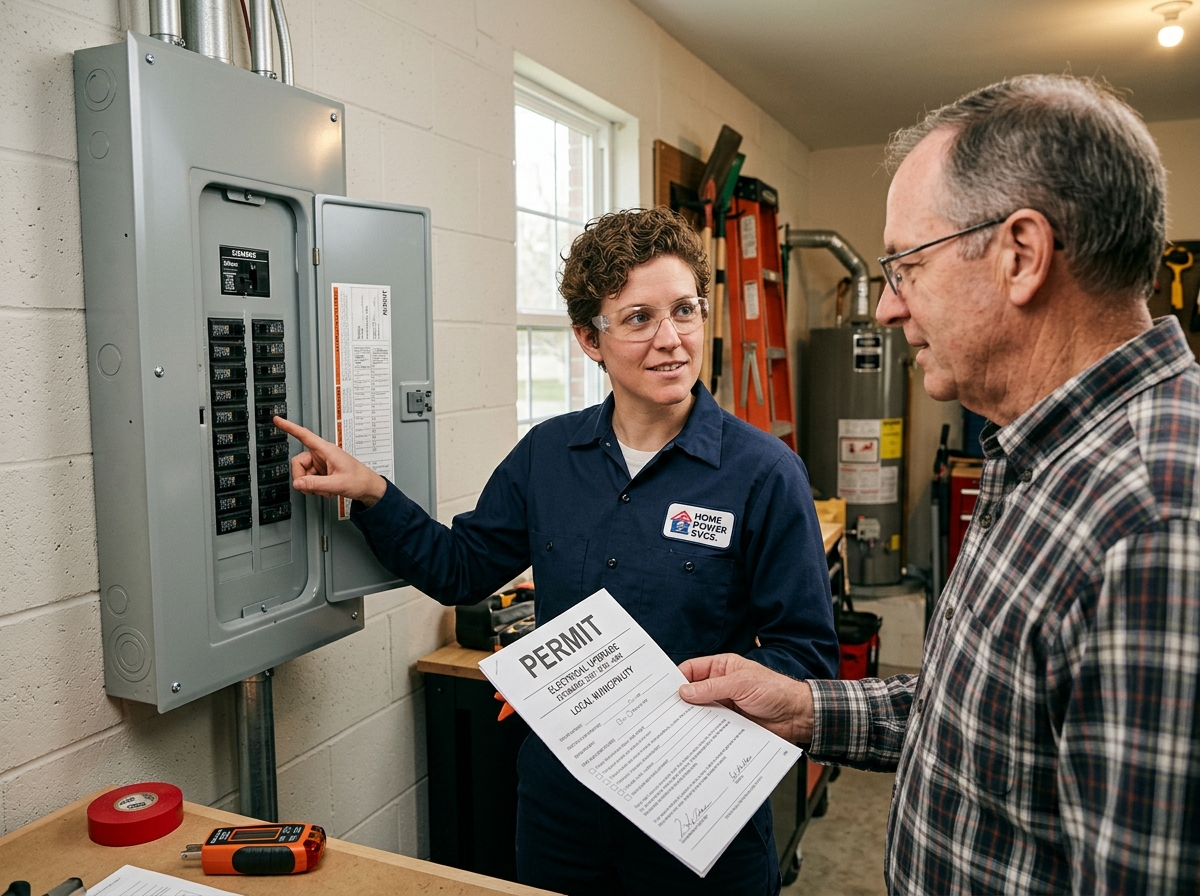
We sometimes hear from homeowners who wonder if they can "save a few bucks" by skipping the permit. In our 30+ years of experience, we can tell you: don't do it. Here is why the permit is the most valuable $100–$300 you will spend on your home:
- Fire Hazards: The National Electrical Code (NEC) is written in blood—meaning the rules exist because someone’s house burned down in the past. A permit ensures the work meets the 2026 NEC standards, significantly reducing the risk of electrical fires.
- Insurance Denial: If you have an electrical fire and your insurance company discovers the panel was upgraded without a permit or inspection, they have a legal "out" to deny your claim. You could lose your entire home and receive zero compensation.
- Municipal Fines: In some jurisdictions, the fine for working without a permit is double or triple the original permit cost. In Pasadena, for instance, the fine is $279—far more than the permit itself!
- Resale Complications: When you go to sell your home in Reading, Lexington, or Newton, the buyer’s home inspector will check the panel. If there is no permit on file for the upgrade, it can stall the sale or force you to pay for a "retroactive" permit and potentially tear out drywall so an inspector can see the wiring.
- Circuit Integrity: The inspection process verifies that your breakers are sized correctly for the wire gauge in your walls. This prevents wires from overheating behind your ears while you sleep.
How to Obtain Your Electrical Permit: A Step-by-Step Guide
When you work with us at Sartell Electrical Services, we handle this entire headache for you. But if you're curious about the "behind the scenes" of how we get it done, here is the sequence:
- The Assessment: We visit your home to perform load calculations. We need to know if your current service can handle that new Tesla charger or heat pump.
- AHJ Contact: We reach out to the local building department in your specific town (e.g., Billerica, Peabody, or Quincy) to confirm their latest fee schedule and specific local amendments.
- Application Submission: We submit the technical drawings, our license info, and the application form.
- Fee Payment: The permit fee is paid. This is usually the $50 to $500 amount we've been discussing.
- Plan Review: The town inspector reviews the plans. This can take anywhere from 1 to 10 business days depending on how busy the office is.
- Permit Issuance: Once approved, the permit is "pulled" and usually posted on-site (often on the front window or near the electrical meter).
- The Upgrade: We perform the work, which typically takes 4 to 8 hours for a standard 200-amp swap.
- Scheduling Inspections: We call the inspector. They come out to verify the grounding, bonding, and breaker sizes.
- Utility Hookup: Once the inspector "greens" the tag, the utility company is authorized to make the final permanent connection to the grid.
Signs Your Home Needs a Panel Upgrade
How do you know it's even time to start asking how much is a permit to upgrade electrical panel? Look for these "cries for help" from your home:
- The 25-Year Rule: If your panel is older than 25–30 years, the breakers may have become "stiff" and might not trip when they are supposed to.
- Flickering Lights: This often happens when a large appliance (like the AC) kicks on, signaling that your panel is struggling to distribute power.
- Frequent Tripping: If you can't run the microwave and the toaster at the same time, your 100-amp service is likely maxed out.
- Burning Smells: This is an emergency. It means wires are arcing or overheating.
- Recalled Brands: If you see the names Federal Pacific (FPE) or Zinsco inside your panel door, these are known fire hazards that many insurance companies now require you to replace.
- New Technology: Adding an EV charger or a whole-home heat pump almost always triggers the need for a 200-amp or 400-amp upgrade.
Frequently Asked Questions about Electrical Panel Permits
How long does the permitting process take?
In most Massachusetts towns like Medford or Somerville, the administrative processing takes 1 to 5 business days. However, the total timeline from "I want an upgrade" to "Final Inspection" is usually 1 to 2 weeks. The actual installation only takes one day, but we have to coordinate with both the town inspector and the utility company's schedule.
Can a homeowner pull their own electrical permit?
In many jurisdictions, state law allows a homeowner of a single-family residence to pull their own permit as an "owner-builder." However, we strongly discourage this. When you pull the permit, you are the one legally responsible for code compliance and safety. If the work fails inspection or causes a fire, the liability rests on your shoulders. Furthermore, most utility companies will not reconnect power unless a licensed electrician has signed off on the work.
What additional fees should I expect beyond the base permit?
Beyond the base fee, you might encounter:
- Re-inspection Fees: If the inspector finds a mistake and has to come back a second time, they often charge a "re-inspection fee" (usually $50–$100). (We aim to get it right the first time so you never see this!)
- Sub-panel Permits: If we need to add a sub-panel in a garage or basement, that may require its own separate permit or an "add-on" fee.
- Utility Disconnect/Reconnect Fees: Some utilities charge a fee to send a truck out to pull the "meter glass" and reconnect it later.
Conclusion
Upgrading your electrical panel is one of the smartest investments you can make in your home's safety and future value. While the question of how much is a permit to upgrade electrical panel usually results in a relatively small number—somewhere between $50 and $500—the peace of mind that permit provides is priceless. It ensures your family is protected from fire hazards and that your home remains fully insurable and ready for resale.
At Sartell Electrical Services, Inc., we take the mystery out of the process. Whether you are in Reading, Greater Boston, or anywhere across Middlesex, Essex, or Norfolk counties, we handle the load calculations, the town hall paperwork, the utility coordination, and the professional installation. With over 30 years of experience, we ensure your upgrade meets every local and national code requirement.
Ready to boost your home's power safely? Learn more about the total main panel upgrade cost and how we can help you navigate the permitting process from start to finish. Give us a call today—we’d love to help you power your home for the next generation.