

Understanding the Electrical Project Coordinator Role
An electrical project coordinator job description outlines the responsibilities of a professional who serves as the central hub for managing commercial and industrial electrical projects from initial planning through completion. This role bridges the gap between office administration and on-site execution, ensuring projects stay on schedule, within budget, and meet quality standards.
Quick Overview: Electrical Project Coordinator Core Responsibilities
- Project Administration: Manage RFIs (Requests for Information), submittals, and close-out documentation
- Stakeholder Coordination: Serve as the primary contact between customers, field staff, contractors, and utilities
- Budget & Schedule Tracking: Monitor project costs against labor and materials in real-time
- Quality & Safety Management: Conduct on-site inspections and ensure compliance with protocols
- Technical Support: Review electrical drawings, specifications, and coordinate equipment procurement
- Communication: Handle customer inquiries, facilitate meetings, and maintain project documentation
Typical Requirements: 3+ years of experience in electrical project coordination, proficiency in Microsoft Office (especially Excel), understanding of electrical systems, and strong organizational skills. Bachelor's degree in Electrical Engineering or Construction Management is preferred but not always required.
Salary Range: $45,000-$70,000 annually, with an average of $62,500, depending on experience and location.
The role functions like the conductor of an orchestra, as one industry source describes it—coordinating diverse team members, managing negotiations with manufacturers and subcontractors, and ensuring every element comes together on time. Unlike a Project Manager who carries direct financial accountability, the Project Coordinator focuses on administrative excellence and logistical support that keeps projects moving forward.
As Ed Sartell, President of Sartell Electrical Services since 1985, I've worked alongside talented coordinators who make complex commercial and industrial projects succeed through meticulous attention to the electrical project coordinator job description. Their behind-the-scenes work in pre-construction planning and daily coordination is what transforms blueprints into functioning electrical systems.
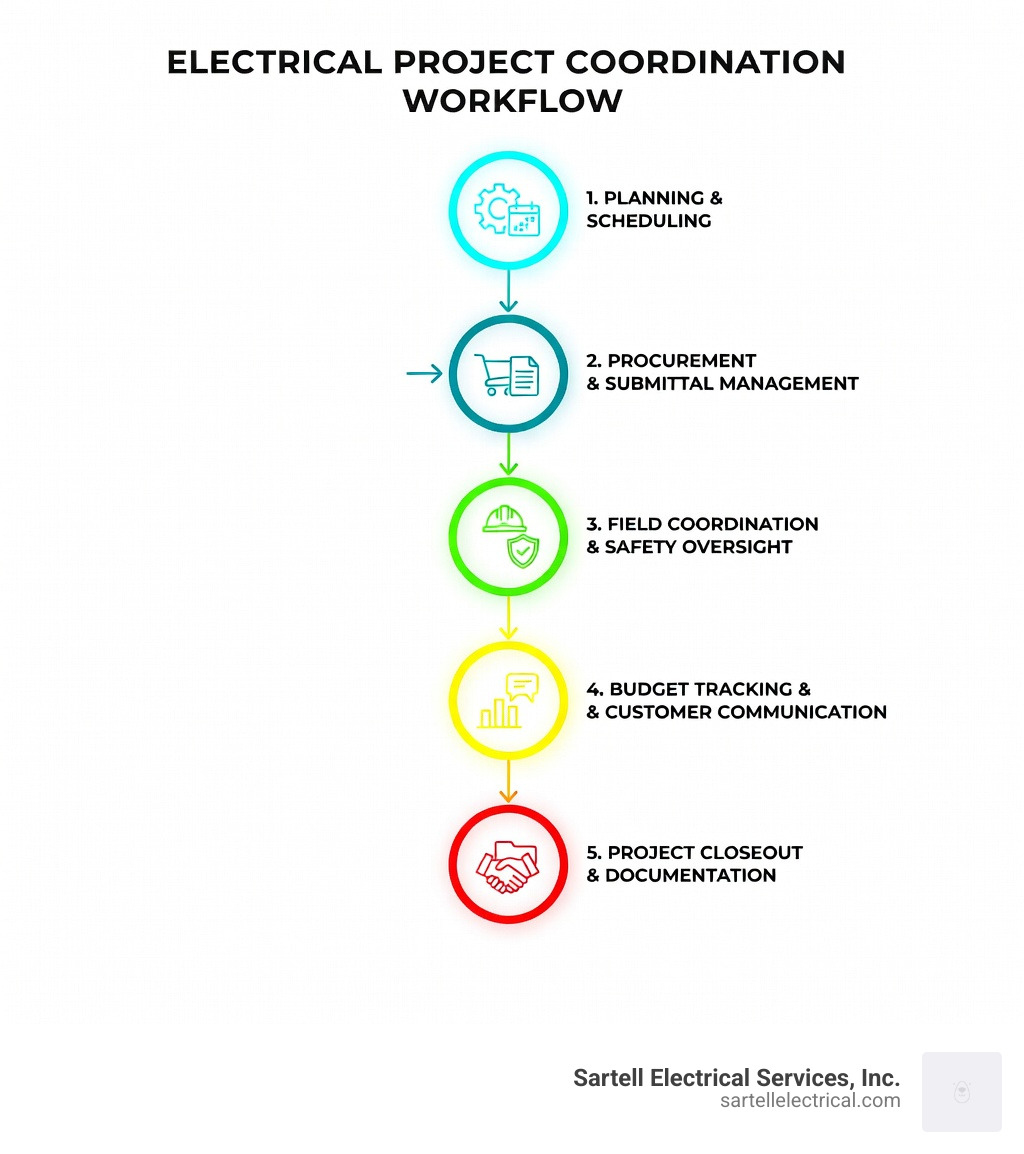
Defining the Electrical Project Coordinator Job Description
When we look at the electrical project coordinator job description, we see a role that is fundamentally about connection. At Sartell Electrical Services, we view the coordinator as the "glue" that holds a project together. They are the central point of contact for everyone involved—from the master electricians pulling wire in the field to the developers sitting in boardrooms in Greater Boston.

The primary role of a coordinator is to facilitate the flow of information. If a foreman in the field has a question about a circuit layout, the coordinator ensures that a Request for Information (RFI) is generated, sent to the engineer, and answered before the work hits a standstill. This level of Electrical Project Coordination is what prevents costly delays and keeps the project's "heartbeat" steady.
As a Electrical Project Coordinator, you aren't just filing papers; you are a stakeholder liaison. You are negotiating with manufacturers for gear delivery dates and ensuring that the utility company has approved the service adequacy for a new building.
Industry Scope and Project Types
Electrical project coordinators don't just work in one niche. Their expertise is required across a vast array of environments. At our firm, we see these professionals thriving in:
- Commercial Electrical Services: Managing the build-out of office spaces in Boston or retail centers in Reading.
- Industrial Electrical Services: Coordinating heavy-duty power requirements for manufacturing plants and warehouses.
- Healthcare Facilities: Navigating the complex, high-stakes electrical needs of hospitals and clinics where "up-time" is a matter of life and death.
- Telecommunications: Overseeing the infrastructure for data centers and fiber networks.
- Multifamily Electrification: A growing field in Massachusetts involving the installation of EV chargers and heat pump technologies in large apartment complexes.
Technical Requirements for an Electrical Project Coordinator Job Description
While the role is heavily administrative, you can't coordinate what you don't understand. A strong candidate needs to be familiar with fundamental electrical concepts. You should know the difference between a 200-amp and a 400-amp service, understand basic load calculations, and be able to read a panel schedule.
Electrical System Design is a key area of knowledge. Coordinators often assist in assessing utility service adequacy—ensuring the local power grid can actually handle the new equipment being installed. This technical foundation allows the coordinator to speak the same language as the electricians and engineers, making them a much more effective advocate for the project’s success.
Core Responsibilities and Daily Tasks
What does a typical Tuesday look like for someone following an electrical project coordinator job description? It’s a mix of high-level planning and "putting out fires."
One of the most critical daily tasks is RFI and submittal management. Before we can install a specific light fixture or a piece of switchgear, the architect and engineer must approve the "submittal"—the technical documentation provided by the manufacturer. The coordinator tracks these documents like a hawk. If a submittal is late, the gear is late. If the gear is late, the project stops.
Beyond paperwork, they are deeply involved in Electrical Project Management by coordinating trades. This means ensuring the HVAC team and the electrical team aren't trying to put a pipe and a wire in the exact same physical space. They also play a role in Electrical Installation and Maintenance by ensuring field crews have the latest versions of drawings and the right tools for the day's tasks.
Administrative and Logistical Support
The logistics side of the role is where organizational wizards truly shine. Coordinators handle:
- Purchase Orders: Issuing POs to suppliers to ensure materials arrive on time.
- Subcontractor Management: Tracking insurance certificates and contracts for specialized sub-trades.
- Travel Arrangements: For larger projects across Middlesex or Essex County, they might arrange lodging and transportation for specialized field staff.
- Pre-Construction Electrical Planning: Assisting with the initial setup of project files and schedules.
- Invoicing and Budget Tracking: Comparing real-time labor hours and material costs against the original estimate to ensure we stay in the black.
On-Site vs. Office Duties
This isn't just a "desk job." A great coordinator spends time with boots on the ground. They perform safety inspections to ensure everyone is following OSHA guidelines and our own strict safety protocols. They also conduct quality control walks, checking that the Electrical Maintenance Services or new installations meet our high standards of excellence.
In the office, they lead progress meetings, presenting reports to the Project Manager and the client. They are the ones who can tell you exactly what percentage of the "rough-in" phase is complete and whether we are on track for the final inspection.
Essential Qualifications and Skills
If you’re looking to enter this field, you’ll need a specific blend of experience and education. Most employers, including those in the Massachusetts market, look for a minimum of 3+ years of experience in construction coordination, specifically within the electrical trade.
Comparison: Project Coordinator vs. Project Manager
| Feature | Project Coordinator | Project Manager |
|---|---|---|
| Primary Focus | Logistics, Admin, Documentation | Strategy, Finance, Risk |
| Financial Authority | Tracks budgets & issues POs | Responsible for project P&L |
| Daily Activity | Managing RFIs/Submittals | Client relations & high-level planning |
| Experience | 3+ years | 7-10+ years |
Proficiency in Microsoft Excel is non-negotiable. You’ll be using it for everything from tracking submittal logs to managing complex project budgets. For a deeper dive into how these roles interact, check out our Electrical Project Management Complete Guide.
Educational Background and Stand-out Skills
While some come up through the trades, a Bachelor’s degree in Electrical Engineering or Construction Management is a significant advantage. It provides the theoretical framework needed to understand complex building systems.
To really stand out, candidates should have experience with enterprise estimation software and a working knowledge of modern green technologies. With Massachusetts pushing for electrification, being familiar with heat pump technology and EV charging infrastructure is a huge plus. Roles like the Electrical Project Manager, Sr in Worcester, Massachusetts show that the higher you go, the more technical and managerial expertise is required.
Critical Soft Skills for Success
You can be a genius with a calculator, but if you can't talk to people, you won't succeed as a coordinator.
- Communication: You are the bridge between the field and the office. You must speak "Electrician" and "CEO" fluently.
- Organization: Managing 50+ RFIs and hundreds of submittals across multiple projects requires a "Type A" personality.
- Problem-Solving: When a shipment of panels is lost or a utility company denies a service request, you need to find a workaround—fast.
- Leadership: Even without a "Manager" title, you often have to lead meetings and drive subcontractors to meet deadlines, especially in Telecommunications Electrical Services where timelines are incredibly tight.
Career Path and Salary Expectations
The career path for an electrical project coordinator is robust and offers plenty of room for growth.
Most start in entry-level administrative roles or as junior coordinators. From there, the path usually looks like this:
- Project Coordinator
- Assistant Project Manager
- Project Manager
- Senior Project Manager
- Project Executive or Director of Operations
Our Professional Electrical Services Guide 2025 highlights that the demand for these roles is only increasing as infrastructure becomes more electrified.
Salary Statistics:
- Average Salary: $62,500 per year.
- Range: Typically $55,000 to $70,000 (though specialized roles in high-cost areas like Boston can reach $100k+ for senior positions).
- Benefits: Most full-time roles include 401(k) matching (often around 4-6%), medical/dental/vision insurance, and generous Paid Time Off (PTO).
Advancing Your Career Under an Electrical Project Coordinator Job Description
Advancement is often tied to your ability to take on more financial risk and larger Electrical Services projects. Many companies prioritize internal promotion, offering education reimbursement for those who want to earn their PMP (Project Management Professional) certification or an engineering degree. Staying curious and pursuing continuing education is the fastest way to move from "coordinating" to "managing."
Frequently Asked Questions about Electrical Project Coordination
How does a Coordinator differ from a Project Manager?
The main difference is accountability and scope. A Project Manager (PM) owns the project's financial outcome (profit or loss) and manages the high-level relationship with the client. The Coordinator supports the PM by handling the "nitty-gritty" administrative and logistical details. Think of the PM as the captain of the ship and the Coordinator as the navigator ensuring the charts are accurate and the supplies are on board. This distinction is especially clear in specialized fields like Healthcare Electrical Contractors.
What are the most important tools for this role?
Beyond the Microsoft Office Suite, many firms use specialized construction management software. This includes tools for scheduling (like MS Project or Primavera) and proprietary software for tracking gear, such as Jobtrack. Familiarity with these tools is often listed in the electrical project coordinator job description. We also recommend studying our Electrical Pre-Construction Planning Implementation Manual to understand the workflow tools we use.
Is field experience required for this position?
While you don't need to be a licensed electrician, having "field eyes" is incredibly helpful. You need to be comfortable walking a job site, wearing a hard hat, and understanding the physical reality of an installation. Most roles are a hybrid of office and field work. To learn more about our team's background, visit our About Us page.
Conclusion
The role of an electrical project coordinator is one of the most dynamic and rewarding positions in the construction industry. It requires a unique blend of technical knowledge, administrative precision, and people skills. At Sartell Electrical Services, Inc., we know that our success in Reading, MA, and across the Greater Boston area is built on the hard work of our coordination team.
Whether we are working on a high-tech lab in Cambridge or a residential development in Andover, our commitment to excellence remains the same. If you are looking for a partner for your next project, or if you are a professional looking to grow your career in Electrical Project Management, we invite you to reach out.
Contact Us today to see how our expertise can power your next win.