Electrical Project Coordination: Unleash 2025 Success
Why Electrical Project Coordination is the Foundation of Successful Construction
Electrical Project Coordination is the process of organizing people, information, and activities to ensure that every aspect of an electrical construction project runs smoothly—from initial design through final closeout. It involves managing schedules, coordinating with other trades, tracking materials, controlling costs, and maintaining clear communication among all stakeholders to deliver projects safely, on time, and within budget.
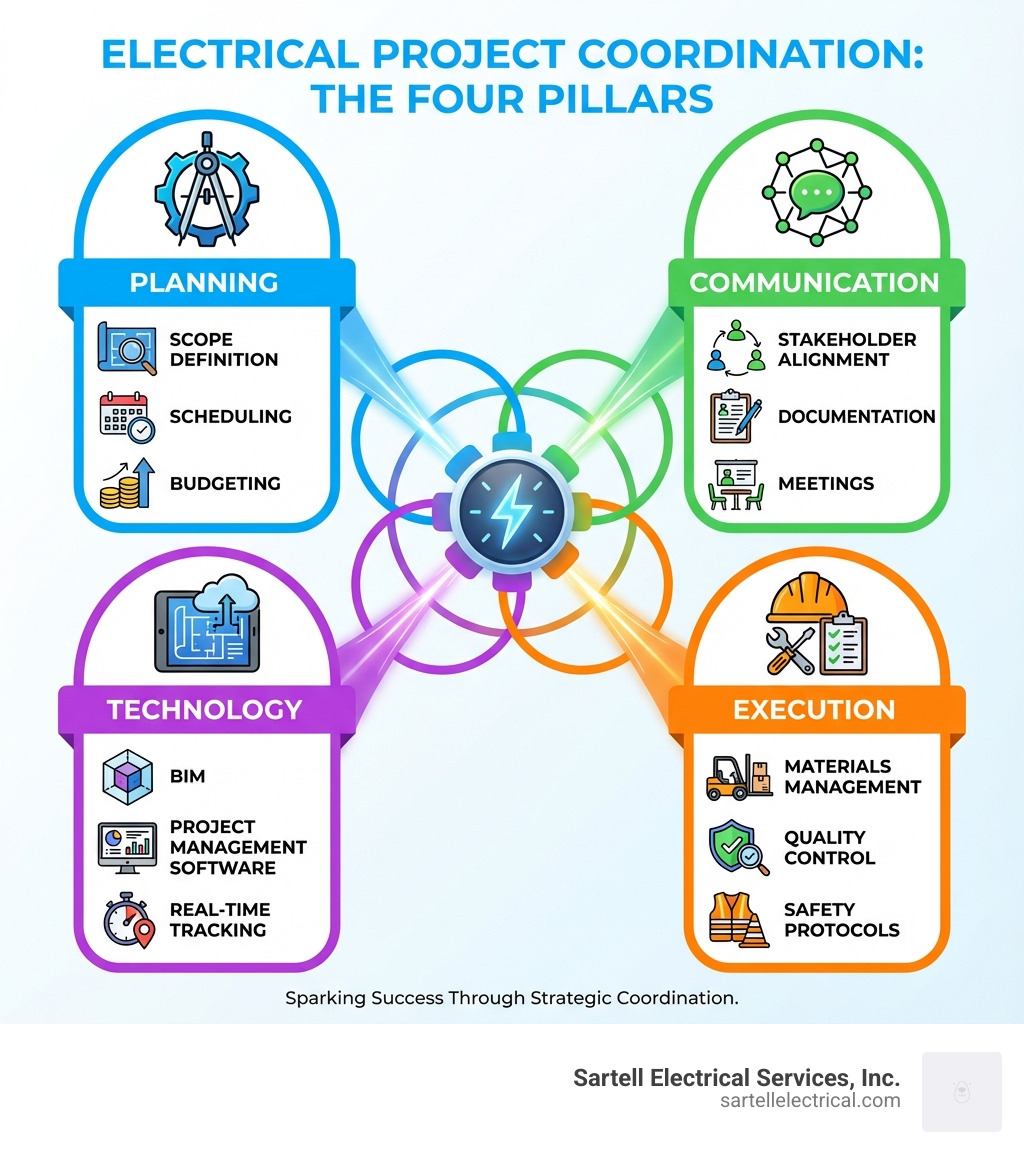
Key elements of effective Electrical Project Coordination include:
- Planning and Design - Establishing clear project scope, timelines, and deliverables
- Communication - Ensuring all team members, clients, and trades stay aligned
- Technology - Using project management software and BIM for real-time tracking
- Execution - Managing materials, change orders, and on-site activities
- Documentation - Maintaining accurate records, RFIs, submittals, and as-built drawings
The construction industry moves fast. According to research from ELECTRI International, projects that implemented structured management processes achieved an average gross profit margin of
27%, while poorly managed projects resulted in a
6% loss. That's a 33-point swing that can make or break a contractor's business.
Managing electrical projects requires a unique combination of technical expertise, meticulous planning, and effective communication. Without proper coordination, details get missed, budgets balloon, and deadlines slip. For commercial, industrial, and healthcare facilities—where electrical systems are mission-critical—the stakes are even higher.
The complexity of modern construction demands more than just technical skill. When you're dealing with multiple trades, evolving building codes, design-build overlaps, and tight timelines, coordination becomes the difference between success and costly rework. Research shows that
communication is the number one predictor of project success, outweighing even education and experience.
I'm
Ed Sartell, and since founding Sartell Electrical Services in 1985, I've led our team through hundreds of complex projects where strong
Electrical Project Coordination made all the difference. Whether it's a hospital expansion or a manufacturing facility, we've learned that the projects that succeed are the ones where coordination starts early and continues through every phase.
The Core Responsibilities of an Electrical Project Manager
At Sartell Electrical Services, we understand that an electrical project manager is the backbone of any successful electrical installation. Their role is far more than just overseeing electricians; it’s about orchestrating a complex symphony of tasks, people, and resources. Key responsibilities include meticulous project planning, creating and adhering to schedules, managing budgets, ensuring top-tier quality control, and, most importantly, upholding rigorous safety standards.
An effective electrical project manager ensures that every wire, every conduit, and every connection aligns with the project's vision and regulatory requirements. They are the central point of contact, ensuring everyone from the field crew to the client is on the same page. This comprehensive oversight is what drives efficiency and prevents costly errors. For a deeper dive into what it takes to manage these critical projects, explore our guide on
The Key Responsibilities of an Electrical Project Manager. You can also learn more about our general approach to
Electrical Project Management.

Managing Project Scope and Change Orders
One of the most challenging, yet critical, aspects of
Electrical Project Coordination is managing project scope and the inevitable change orders. No construction project ever proceeds exactly according to plan; that's just reality. What starts as a clear blueprint can quickly evolve, leading to "scope creep" if not managed proactively.
Our project managers are adept at navigating these shifts. They communicate updates to on-site personnel, revise costs, and integrate approved changes into the project plan. Change orders are an
essential element of any construction project and require meticulous documentation. This involves updating logs with new proposal costs, assessing potential damages, and sending revised figures to general contractors and customers.
A crucial tool in this process is the Request for Information (RFI). When a conflict arises—say, a conduit clashing with a heating duct—our project managers quickly identify a potential solution and present it with the RFI. This allows the engineer to simply check our proposed re-route rather than developing an entirely new one, saving valuable time. For more information on how we handle these critical planning stages, visit our page on
Pre-construction Electrical Planning.
Procurement and Materials Management
Effective
Electrical Project Coordination hinges significantly on seamless procurement and materials management. Imagine a project halted because a critical component is missing or delayed! Our project managers carefully track vendor information, delivery statuses, and material costs to prevent such scenarios.
This involves creating and maintaining detailed procurement logs, coordinating with our purchasing personnel, and ensuring timely job-site deliveries. Proactively identifying and ordering "long-lead items"—materials with extended delivery times—at the earliest stages of a project is a best practice we rigorously follow. This foresight helps mitigate potential delays and keeps the project on schedule. Ensuring a reliable supply chain and mitigating procurement issues are paramount, especially given the rapid pace of construction. Our commitment extends to every aspect of
Electrical Installation and Maintenance.
Documentation, Reporting, and As-Built Drawings
In
Electrical Project Coordination, if it wasn't documented, it didn't happen. Comprehensive documentation and reporting are non-negotiable. This includes maintaining daily job journals that track progress, achievements, and any issues encountered. These journals are invaluable for future project estimations and for resolving disputes.
Our project managers carefully track all project changes, noting who requested them and when. We manage submittals, ensuring all required product information is reviewed and approved in a timely manner. Meeting minutes are recorded and distributed promptly to ensure all stakeholders are aware of decisions and action items.
Perhaps most critical are as-built drawings. As construction progresses, changes to the original blueprints are almost guaranteed. Our foremen "red-line" drawings daily to capture the exact, actual installation of electrical systems. These revised sets of construction drawings reflect all on-site modifications and are essential for future maintenance, renovations, or troubleshooting. Neglecting this crucial step can lead to significant headaches down the line. It's how we handle changes made to drawings to ensure accuracy and accountability.
The Key Phases of Effective Electrical Project Coordination
Effective
Electrical Project Coordination is a journey, not a single event. It unfolds in distinct phases, each with its own set of challenges and requirements. At Sartell Electrical Services, we adopt a standardized approach, derived from extensive research and decades of experience, to guide every project from concept to completion. This structured process, often aligned with the Model Electrical Project Management Process, encompasses 81 specific activities across 14 categories, ensuring no detail is overlooked. This systematic approach is especially vital in Massachusetts, where adherence to local codes and regulations is paramount.
Integrating our electrical work with other building systems often involves MEP (Mechanical, Electrical, and Plumbing) coordination. This crucial process ensures that our electrical installations seamlessly integrate with a building's HVAC, plumbing, and fire protection systems, preventing clashes and optimizing performance. You can explore the
Typical Stages Involved in MEP Coordination to understand this collaborative effort better.

Phase 1: Pre-Construction and Design
This initial phase sets the stage for the entire project. It's where we define the scope, conduct thorough
electrical estimating to determine costs, and develop the detailed system design. For commercial and industrial projects, this often involves advanced tools like Building Information Modeling (BIM).
BIM allows us to create accurate 3D models of all electrical services within the architectural and structural limitations of a building. This digital visualization is a game-changer, enabling us to perform "clash detection" early in the process. By virtually identifying and resolving conflicts between electrical components and other building systems before construction even begins, we prevent costly on-site rework and delays. This proactive approach is a cornerstone of our
Commercial Electrical Design Build services, ensuring efficiency from day one.
Phase 2: Construction and Execution
With the plans finalized, the project moves into the construction and execution phase. This is where the rubber meets the road, and effective
Electrical Project Coordination truly shines. Site mobilization involves setting up the project site, ensuring all necessary resources—labor, tools, equipment, and materials—are in place.
On-site management includes daily supervision, ensuring that work progresses according to schedule and specifications. Quality control checks are performed regularly to verify that all installations meet our high standards and comply with local regulations in Massachusetts. Safety management is paramount, with strict adherence to OSHA standards and our own rigorous safety protocols to protect our team and other trades on site. This phase demands constant vigilance and real-time problem-solving, especially for complex
Industrial Electrical Services.
Phase 3: Post-Construction and Closeout
The final phase, post-construction and closeout, is just as critical as the initial stages. This involves system commissioning, where we rigorously test all electrical systems to ensure they function as intended and meet performance specifications. A "punch list" is created, detailing any remaining minor items or adjustments needed before final completion.
Once all items are addressed, we perform a thorough client handover, providing all necessary documentation, including operation manuals and maintenance schedules. The final delivery of accurate as-built drawings, reflecting all on-site changes, is crucial for the building's long-term maintenance and future modifications. This meticulous closeout process ensures client satisfaction and prepares the electrical systems for their operational life, complementing our
Building Electrical Maintenance offerings.
Strategies for Seamless Project Execution
Achieving seamless project execution in
Electrical Project Coordination isn't about luck; it's about implementing proven strategies and best practices. It's a proactive dance of management, ensuring all stakeholders are aligned and every step is taken with precision. Our goal is always to deliver projects that are not just functional, but exemplary in their execution.
The Role of Communication in Successful Electrical Project Coordination
Communication is the lifeblood of any construction project, especially in electrical work. As research from MIT's Human Dynamics' Laboratory found, communication is the number one predictor for success. It's not just about what we say, but how we say it, and to whom. Establishing clear communication protocols is essential. This means defining who needs to be in the loop (internal teams like project managers, procurement, field personnel, and external stakeholders like general contractors, owners, engineers, and other trades), what information needs to be shared, and how often.
At Sartell Electrical Services, we prioritize open and consistent communication to ensure team alignment and to quickly resolve any conflicts that may arise. Good communication helps prevent costly delays and errors. For instance, in our work with
Healthcare Electrical Contractors, clear communication can literally be a matter of life and death, ensuring critical systems are installed flawlessly. You can learn more about why communication is important on construction projects.
Leveraging Technology for Superior Electrical Project Coordination
In today's construction environment, technology is not just an advantage; it's a necessity for superior
Electrical Project Coordination. We leverage advanced project management software and collaborative work management (CWM) tools to streamline our processes. Tools like
Smartsheet and
Asana allow us to track progress, manage tasks, and share information in real-time.
Cloud-based solutions provide our teams, whether in the office or on a job site in Boston, Massachusetts, with instant access to project documents, schedules, and updates via smartphones, tablets, or computers. This ensures everyone is working with the most current information, minimizing discrepancies and improving decision-making. By embracing these digital platforms, we improve efficiency, reduce administrative burdens, and free up our project managers to focus on critical on-site coordination. For more on how we integrate technology into our work, see our page on
Electrical System Design.
Proactive Risk Management and Regulatory Compliance
Electrical Project Coordination is incomplete without robust risk management and unwavering adherence to regulatory compliance. Electrical projects inherently carry risks, from potential safety hazards to budget overruns and schedule delays. Our approach involves proactive risk identification, assessing potential issues like supply chain delays or unforeseen site conditions, and developing contingency plans.
Compliance with local regulations in Massachusetts, as well as national standards such as the National Electrical Code (NEC) and OSHA regulations, is non-negotiable. Our project managers are intimately familiar with these codes and ensure all necessary permits are secured and inspections passed. This diligent approach not only prevents legal issues and penalties but also guarantees the safety and longevity of our electrical installations. For us, safety is always priority number one, and we ensure it through rigorous
Electrical Safety Checks.
Tracking and Measuring Project Success
Measuring success in
Electrical Project Coordination goes beyond merely finishing a project. It’s about meeting objectives, staying on budget, adhering to schedules, and, ultimately, delighting our clients. We use Key Performance Indicators (KPIs) to track progress, monitor performance, and continuously improve our processes.
Regular progress monitoring ensures we're on track, identifying any deviations early so we can course-correct. This includes tracking schedule adherence and carefully monitoring our budget to prevent cost overruns. Client satisfaction is our ultimate metric; a successful project is one where the client is thrilled with the outcome and the value we’ve provided.
Best Practices for Project Schedules and Timelines
A well-crafted schedule is the roadmap for any electrical project. We start by establishing a baseline schedule, which serves as the approved timeline against which all progress is measured. Tools like Gantt charts visually represent project tasks and their dependencies, helping us identify the "critical path"—the sequence of activities that must be completed on time for the project to finish on schedule.
We track the schedule weekly, documenting progress and any changes, and present updated schedules to the general contractor. A common best practice we employ is the "three-week lookahead schedule." This detailed, short-term plan is used in production meetings to discuss forward-planning and ensure our foremen have the necessary personnel, materials, and tools for the upcoming weeks. This proactive planning helps build momentum and keeps our projects in Massachusetts moving forward efficiently. For an idea of what a detailed schedule looks like, you can see an
example of a weekly schedule template. Our expertise also extends to specialized projects like
Telecommunications Electrical Services, where precise scheduling is key.
Ensuring Profitability and Client Satisfaction
The ultimate goal of effective
Electrical Project Coordination is to ensure both profitability for our business and satisfaction for our clients. Projects managed with our structured processes have shown an average gross annual profit margin of 27%, a testament to the power of good coordination. We carefully track cost-to-complete reports, ensuring we stay within budgetary constraints.
Quality assurance is embedded in every step, from initial design to final commissioning. By identifying and resolving issues early, we minimize rework, which is often cited as a "profit killer" in electrical installations. When projects are completed safely, on time, within budget, and to the highest quality standards, it naturally fosters repeat business and strong client relationships.
The benefits of effective
Electrical Project Coordination are clear:
- Improved safety for all personnel and the public.
- Timely project completion, avoiding costly delays.
- Strict adherence to budget, preventing financial surprises.
- Superior quality of electrical installations.
- Increased client satisfaction and trust.
- Improved efficiency and productivity on the job site.
- Reduced risks and fewer unforeseen problems.
Frequently Asked Questions about Electrical Project Coordination
What is the difference between an electrical project manager and a project coordinator?
While both roles are crucial for project success, they typically have distinct responsibilities. An
electrical project manager holds overall responsibility for the project's success, encompassing planning, scheduling, budgeting, resource allocation, risk management, and client relations. They make high-level decisions and guide the project from start to finish.
An
electrical project coordinator, on the other hand, often supports the project manager by handling administrative and organizational tasks. This can include managing change orders, tracking drawing logs, coordinating procurement, updating schedules, and facilitating communication. They ensure that information flows smoothly and that the various moving parts of the project are aligned, freeing up the project manager to focus on strategic oversight and problem-solving.
How does MEP coordination relate to electrical project coordination?
MEP coordination stands for Mechanical, Electrical, and Plumbing coordination.
Electrical Project Coordination is a vital component
within the broader scope of MEP coordination. MEP coordination is a comprehensive process that ensures all mechanical (HVAC), electrical, and plumbing systems in a building seamlessly integrate with each other and with the building's architectural and structural designs.
For us, electrical coordination involves ensuring our electrical installations—wiring, conduits, panels, lighting, and power distribution—do not clash with ductwork, piping, or structural elements. It's about optimizing space, preventing interferences, and ensuring all systems can be installed efficiently and maintained effectively. Without proper MEP coordination, electrical systems could run into structural beams, or plumbing pipes might block access to electrical panels, leading to costly rework and delays.
What are the most common risks in large-scale electrical projects?
Large-scale electrical projects, such as those for industrial facilities or major commercial developments in Massachusetts, come with their own set of significant risks. Some of the most common include:
- Budget Overruns: Often caused by scope creep, unforeseen site conditions, material price fluctuations, or inefficient resource management.
- Schedule Delays: Can stem from supply chain issues (especially for long-lead items), permitting delays, coordination conflicts with other trades, labor shortages, or adverse weather conditions.
- Technical Issues: Complex electrical systems can encounter design flaws, equipment malfunctions, or integration challenges with existing infrastructure.
- Compliance and Regulatory Changes: Evolving building codes or local regulations can necessitate design changes or re-inspections, adding time and cost.
- Safety Hazards: Given the inherent dangers of electrical work, accidents can occur if safety protocols are not rigorously followed, leading to injuries, project delays, and legal ramifications.
- Communication Breakdowns: Gaps in communication among stakeholders can lead to misunderstandings, errors, and unaddressed issues.
Proactive risk identification, detailed planning, and robust communication strategies are essential to mitigate these challenges.
Conclusion
At Sartell Electrical Services, we firmly believe that effective
Electrical Project Coordination is not just a best practice—it's the cornerstone of successful project delivery. It’s the invisible force that transforms complex blueprints into functional, safe, and efficient electrical systems. From the busy streets of Boston to the industrial hubs of Lowell and the healthcare facilities in Worcester, our commitment to meticulous coordination has consistently delivered exceptional results for our clients across Massachusetts.
We've seen how a well-coordinated project ensures safety, guarantees on-time delivery, maintains budget control, and upholds the highest standards of quality. Our 30+ years of experience have taught us that investing in robust coordination processes saves time, reduces costs, and builds lasting relationships.
When you partner with Sartell Electrical Services, you're choosing a team that understands the art and science of
Electrical Project Coordination. We bring our expertise, leadership, and unwavering commitment to excellence to every project, ensuring your electrical systems are installed perfectly, every time.
To learn more about how our comprehensive approach to electrical project management can benefit your next endeavor, please visit our dedicated page on
Electrical Project Management. We're ready to spark success for you.