How to connect multiple light switches: Master 3-Way Safe
Why Multi-Location Lighting Control Matters for Your Facility
How to connect multiple light switches depends on the number of control locations you need:
- Two locations (3-way switching): Use two 3-way switches with traveler wires running between them. Power can enter at either switch or the light fixture.
- Three or more locations (4-way switching): Place 4-way switches between two 3-way switches at the end points. Each 4-way switch adds another control point.
- Key requirement: All switch boxes must contain a neutral wire per NEC code (since 2011), even if capped off, to support smart switches and modern controls.
Few things disrupt workflow or create safety concerns like poorly placed light switches. In commercial facilities, healthcare buildings, and institutional spaces, controlling lights from multiple locations isn't just convenient—it's essential for safety, efficiency, and code compliance. Walking across a dark warehouse to flip a switch, or forcing staff to steer an unlit stairwell, creates liability risks no facility manager wants.
This guide explains
how to connect multiple light switches safely and correctly. You'll learn the difference between single-pole, 3-way, and 4-way switches, understand proper wiring methods for your specific topology, and find when modern wireless solutions make more sense than pulling new wire through existing walls.
The stakes are higher for commercial and institutional projects than residential work. Circuit loads are heavier, code requirements are stricter, and downtime costs real money. Whether you're renovating a healthcare facility that can't afford lighting failures or coordinating a commercial build with tight deadlines, understanding these fundamentals helps you plan better and communicate clearly with your electrical contractor.
I'm Ed Sartell, and I've been connecting commercial and institutional electrical systems since founding Sartell Electrical Services in 1985. Whether you need
how to connect multiple light switches guidance for a complex renovation or pre-construction planning for a new facility, our four decades of Massachusetts experience ensures your project meets code and stays on schedule.
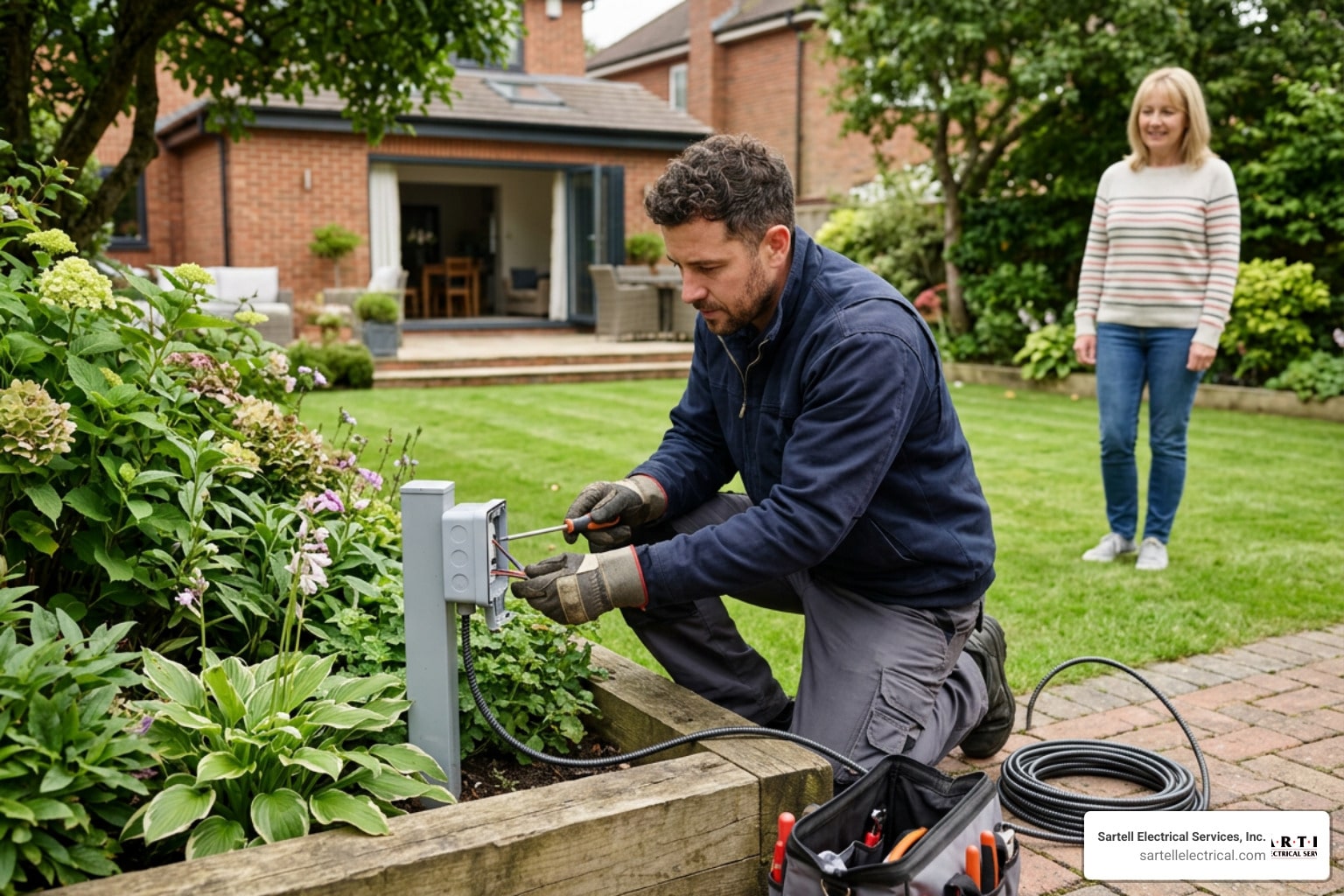
Before we even think about touching a wire, it's crucial to understand that electrical work demands respect. Safety isn't just a suggestion; it's the golden rule. Proper planning, having the right tools, and understanding your circuit's limits are foundational steps to ensure a safe and successful installation when you're figuring out
how to connect multiple light switches.
Prioritizing Safety: The Golden Rules of Electrical Work
Working with electricity can be very dangerous if not handled correctly. We cannot stress enough the importance of prioritizing safety. Our primary concern, both for our clients and for anyone attempting electrical work, is to prevent accidents.
Here are our golden rules:
- Turn Off the Power: Always, always, always start by turning off the power to the circuit you'll be working on at your main electrical panel. This isn't optional.
- Verify with a Voltage Tester: After flipping the breaker, use a non-contact voltage tester to confirm that the power is indeed off at the switch box. This simple step can prevent serious injury.
- Understand the Code: The National Electrical Code (NEC) sets the standards for safe electrical installations. In Massachusetts, we also have specific local codes and regulations that must be followed. These codes are in place to protect you and your property.
- Know When to Call a Professional: If you have any doubts about your ability to safely complete the task, or if the project involves running new circuits, altering existing wiring, or adding new fixtures, it’s always best to call a licensed electrician. For complex electrical projects in Massachusetts, our team at Sartell Electrical Services is here to help.
For more detailed information on electrical safety, we encourage you to review our
Electrical Safety Checks.
Having the right tools and materials makes the job easier and safer. You don’t need a vast collection, but a few essentials are critical:
- Screwdrivers: Both Phillips and flathead, insulated handles are a plus.
- Pliers: Needle-nose and lineman’s pliers are useful for bending and cutting wire.
- Wire Strippers: Essential for cleanly removing insulation without damaging the conductor.
- Voltage Tester: As mentioned, a non-contact voltage tester is a must-have safety tool.
- Utility Knife: For stripping outer cable sheathing.
- Electrical Tape: For marking wires (especially re-identified white wires) and insulating connections.
- Wire Connectors (Wire Nuts): To securely join wires.
- Switches: Depending on your project, you'll need single-pole, 3-way, or 4-way switches.
- Electrical Boxes: Ensure they are appropriately sized for the number of wires and devices.
- Romex Cable: Or other approved non-metallic sheathed cable for your region, typically 14/2, 14/3, 12/2, or 12/3 (number of conductors/gauge).
Planning Your Circuit: Load, Gauge, and Breakers
Careful planning prevents overloaded circuits and potential hazards. When you're considering
how to connect multiple light switches to multiple lights, you must consider the electrical load.
- Load Calculation: Each light fixture has a wattage. Sum the wattage of all lights that will be on a single circuit. This total wattage helps determine the amperage draw (Amps = Watts / Volts).
- Wire Gauge and Breakers: The wire gauge must match the circuit breaker's amperage rating.
- For a 15-amp circuit, 14-gauge wire is typically used.
- For a 20-amp circuit, 12-gauge wire is typically used.
- Crucially, you should never mix wire gauges on the same circuit (e.g., 14-gauge and 12-gauge). If any part of the circuit uses 14-gauge wire, the breaker must be 15-amp. If you have a 20-amp breaker, all wiring on that circuit must be 12-gauge.
- Most residential lighting circuits are 15-amp, using 14-gauge wire. However, if you're installing fixtures with higher wattage or extending a circuit that already has a 20-amp breaker, 12-gauge might be necessary.
Understanding these fundamentals is critical. To dig deeper into wire sizing, you can
learn about the American wire gauge (AWG) system. If your current electrical panel can't handle the new load or you're planning extensive additions, it might be time to consider an upgrade. Find out more by reading our guide on
Considering a Main Electrical Panel Upgrade?.
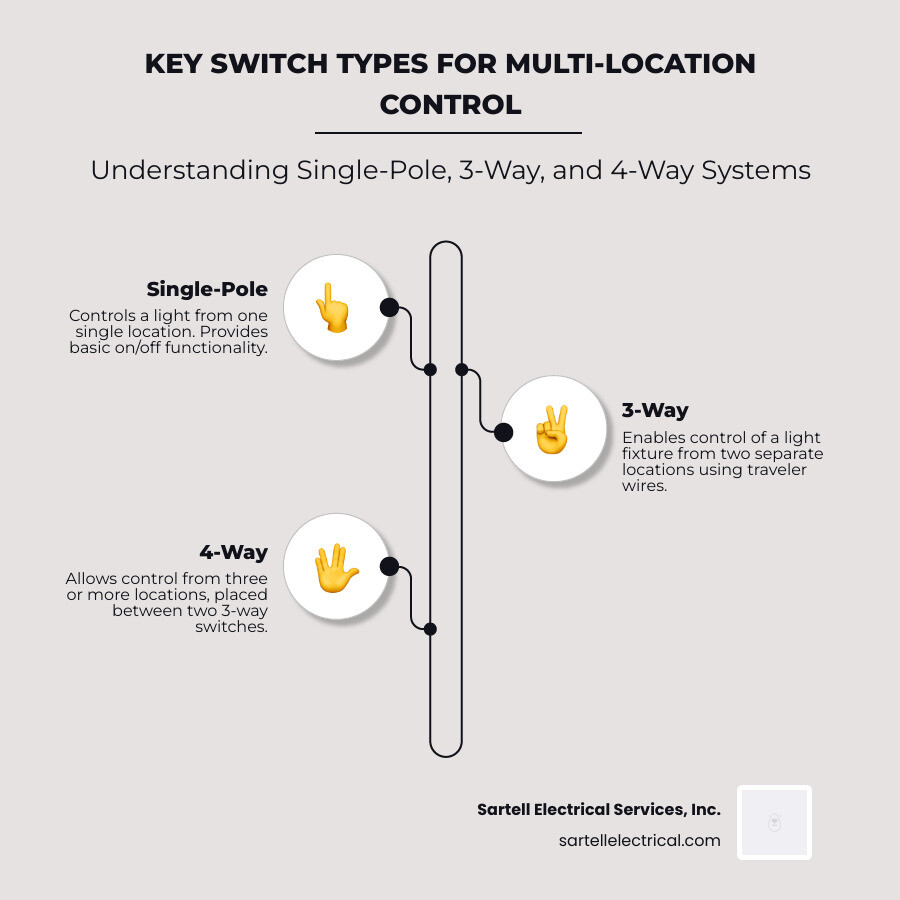
Understanding the Switches: Single-Pole, 3-Way, and 4-Way
The heart of controlling multiple lights from different locations lies in understanding the specialized switches designed for this purpose. It's not just about flipping a lever; it's about how these devices intelligently complete or break a circuit.
The Simple Start: Single-Pole Switches
The most basic type of light switch is the single-pole switch. It controls a light or group of lights from a single location.
- Function: A single-pole switch simply opens or closes a circuit, interrupting the flow of electricity to the light fixture. Think of it as a gate that either allows current to pass or stops it completely.
- Terminals: It typically has two brass-colored screw terminals (for the incoming hot wire and the outgoing switched hot wire) and a green or bare ground screw.
- Wiring Multiple Lights: When wiring multiple lights to one single-pole switch, they are always wired in parallel. This means each light receives the full voltage, and if one bulb burns out, the others remain lit. The switch simply controls the hot wire feeding all these parallel connections.
Two-Location Control: How 3-Way Switches Work
When you need to control a light from two different locations—like at the top and bottom of a staircase—you use 3-way switches. Despite the name, they don't have three "on" positions; they allow two switches to independently control one light.
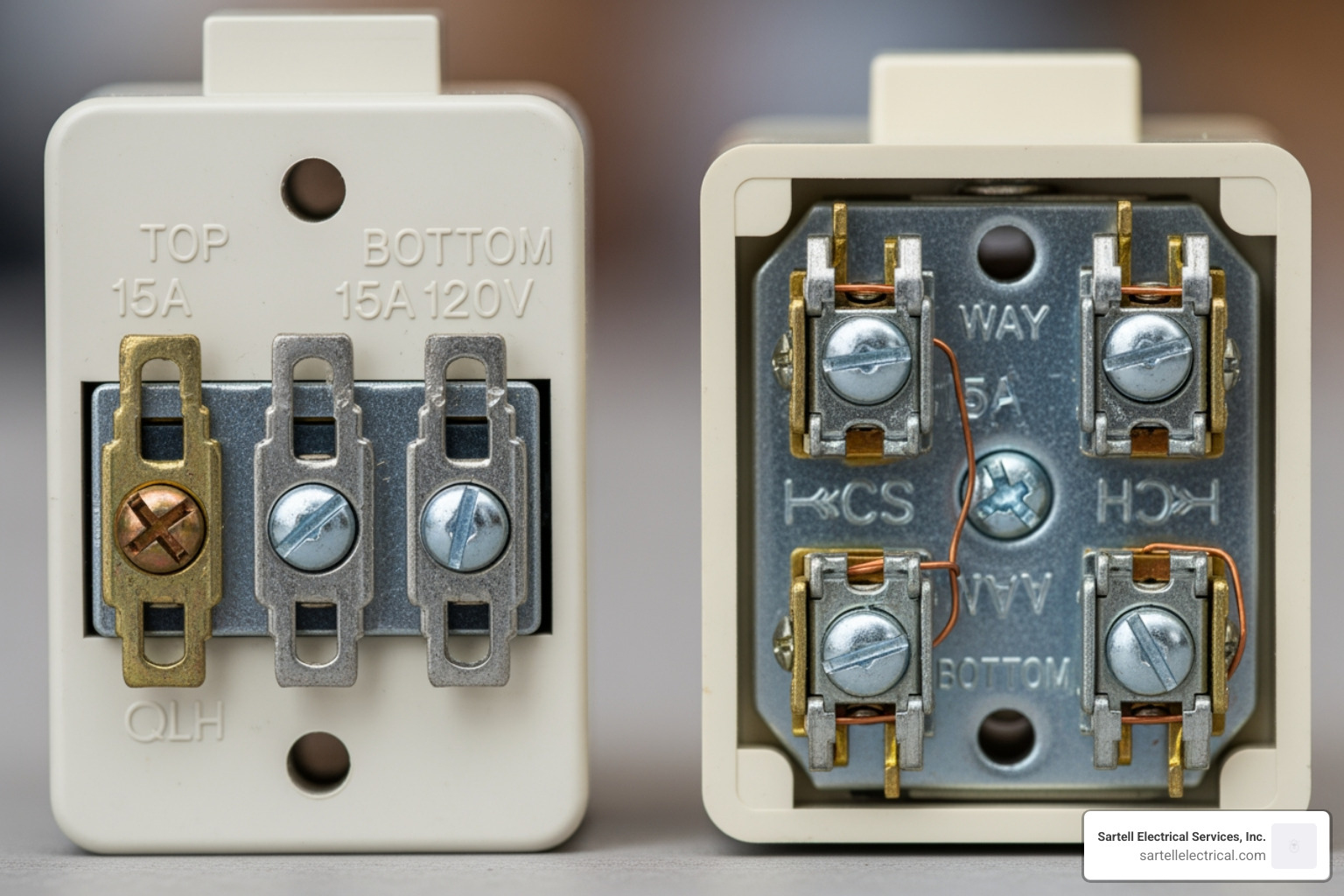
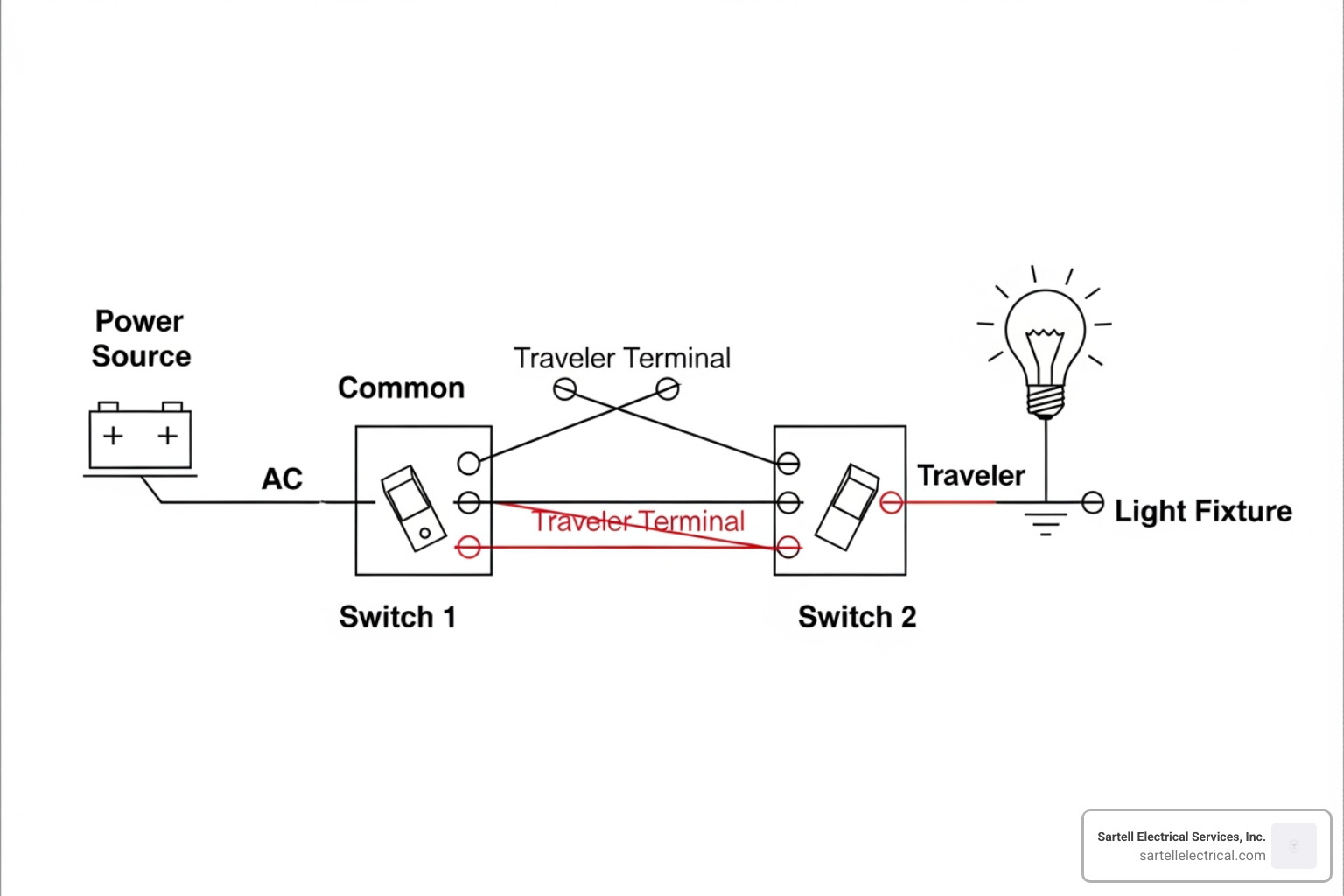
- SPDT Switch: A 3-way switch is technically a Single Pole Double Throw (SPDT) switch. This means it has one input terminal and two output terminals, allowing it to toggle its connection between two different paths.
- Terminals: A 3-way switch has three terminals:
- Common Screw: This is usually a darker colored screw (often black or copper) and is where the continuous hot wire (from the power source) or the switched hot wire (to the light fixture) connects.
- Traveler Screws: There are two lighter-colored (often brass) screws. These are where the "traveler" wires connect, forming a continuous loop between the two 3-way switches.
- Circuit Path Logic: The magic of 3-way switches lies in how the traveler wires work. When both 3-way switches are in the same position (both up or both down), the circuit is complete, and the light is on. If one switch is up and the other is down, the circuit is broken, and the light is off. Flipping either switch changes the path, either completing or breaking the circuit.
- Installation Time: Replacing an existing 3-way switch can be a straightforward task, often taking as little as 15 minutes with the right tools and understanding.
Three or More Locations: Adding a 4-Way Switch
If you need to control a light from three or more locations—for example, in a long hallway with multiple entrances—you add 4-way switches into the circuit. A 4-way switch never stands alone; it must always be placed
between two 3-way switches.
- Terminals: A 4-way switch has four terminals: two for incoming traveler wires from the preceding switch (either a 3-way or another 4-way) and two for outgoing traveler wires to the next switch.
- Circuit Reversal: The internal mechanism of a 4-way switch is designed to reverse the connections of the two traveler wires. In one position, it connects straight through (Traveler 1 to Traveler 1, Traveler 2 to Traveler 2). In the other position, it crosses the connections (Traveler 1 to Traveler 2, Traveler 2 to Traveler 1). This reversal ensures that flipping any 4-way switch, or either of the end 3-way switches, will change the state of the light.
- Unlimited Control Points: You can add as many 4-way switches as needed in series between the two 3-way switches to create an almost unlimited number of control points for a single light or group of lights.
How to Connect Multiple Light Switches: Common Wiring Methods
Understanding the types of switches is one thing; applying that knowledge to actual wiring configurations is another. When considering
how to connect multiple light switches, the wiring method largely depends on where the power source enters the circuit – at a switch box or at the light fixture itself. These different "wiring topologies" dictate how your cables run and how connections are made.
At Sartell Electrical Services, we ensure all our installations adhere to the highest standards of safety and efficiency, consistent with
Standard Residential Electrical Wiring practices in Massachusetts.
Method 1: Power Source to the First Switch
This is often considered one of the most common and straightforward methods for multi-way switching, particularly in new construction or when extending an existing circuit.
- Power Flow: The main power cable (hot, neutral, and ground) from your electrical panel runs directly to the first switch box in the series.
- Pigtailing Hot Wire: Inside this first switch box, the incoming hot wire is typically connected to a pigtail (a short piece of wire) that then connects to the common terminal of the first 3-way switch.
- Daisy-Chaining Power: If you have multiple switches in the same gang box (e.g., a 3-gang box with three single-pole switches or one 3-way and two single-pole), the incoming hot wire can be pigtailed to feed all the switches in parallel. This is a standard and safe method, and our experience shows inspectors in Massachusetts rarely object to it.
- 3-Wire Cable for Travelers: A 3-wire cable (containing black, red, white, and a bare ground wire) is then run from the first 3-way switch to the second 3-way switch (or to the first 4-way switch if applicable). The black and red wires typically serve as the traveler wires, while the white wire usually acts as a continuous neutral, passing through to the light fixture.
- To the Light: From the last switch in the series, a 2-wire cable (hot, neutral, ground) typically runs to the light fixture, carrying the switched hot and continuous neutral.
Method 2: Power Source to the Light Fixture
Sometimes, it's more practical for the power to enter the circuit at the light fixture box first, rather than at a switch box. This often happens during renovations or in older homes where existing wiring runs to the light. This setup uses what's called a "switch loop."
- Power Flow: The main power cable (hot, neutral, and ground) goes directly to the light fixture box.
- Switch Loop Configuration: From the light fixture box, a cable (typically a 2-wire or 3-wire) drops down to the switch(es) and then returns to the light. This cable forms the "switch loop."
- Re-marking White Wire as Hot: In a 2-wire switch loop, the white wire from the cable running to the switch is often used to carry the continuous hot down to the switch, and the black wire carries the switched hot back up to the light. According to NEC code, when a white wire is used to carry a hot (ungrounded) conductor, it must be re-identified at both ends with black electrical tape or another permanent marking to indicate it is carrying hot power, not neutral. This is crucial for safety and future troubleshooting.
- Neutral at the Fixture: The neutral connection for the light fixture is made directly at the fixture box, where the incoming neutral wire from the power source connects to the light's neutral wire.
The Importance of the Neutral Wire in how to connect multiple light switches
A significant change in the NEC code (since 2011) now requires a neutral wire to be present in nearly all switch boxes, even if it's not immediately used by a traditional mechanical switch. This requirement is especially critical when considering
how to connect multiple light switches in modern smart homes.
- NEC Requirement: This code change was driven by the rise of smart switches, dimmers, timers, occupancy sensors, and other advanced lighting controls. Many of these modern devices require a small amount of continuous power to operate their internal electronics, even when the light is off. This power is typically drawn between the hot and neutral wires.
- Smart Home Compatibility: Without a neutral wire, these smart devices often cannot function correctly or consistently. By ensuring a neutral is present, even if just capped off and unused initially, we future-proof your home or facility for smart home integration.
- Future-Proofing: While you might not plan for smart lighting today, having a neutral wire readily available makes future upgrades significantly easier and less costly, avoiding the need to run new wiring through finished walls.
Modern Solutions and Common Pitfalls
While traditional wiring methods are robust and reliable, modern technology offers new avenues for controlling lights from multiple locations. However, whether you go traditional or cutting-edge, understanding common mistakes is key to a safe and functional installation.
For additional guidance on electrical wiring, you can always
consult this general Electrical Wiring FAQ for more tips.
Going Wireless: Smart Switches and Modern Kits
Sometimes, running new wires through existing walls and ceilings can be a daunting, messy, and expensive task. This is where modern wireless solutions shine, offering convenient ways to
connect multiple light switches without the need for extensive demolition.
- Multi-Location Control Without New Wires: Wireless switch kits typically consist of a wired master switch (which replaces an existing switch and needs a neutral wire) and one or more battery-powered, wireless companion switches. These communicate with each other via radio frequency (RF) or Wi-Fi.
- Battery-Powered Switches: The wireless switches can be mounted anywhere with adhesive, offering incredible flexibility for adding control points where traditional wiring would be impractical.
- Smart Home Integration: Many of these systems integrate with smart home platforms, allowing app control, scheduling, and voice commands. For example, some kits use platforms like Netatmo to enable seamless communication and expansion.
- Ideal for Retrofitting: These solutions are perfect for renovations or adding control to existing rooms without tearing into drywall, making them significantly faster and less disruptive than traditional wiring methods. Installation can sometimes take as little as 15 minutes, with no cutting, wire-pulling, or drywall repair needed.
Mistakes to Avoid when you connect multiple light switches
Even for experienced DIYers, electrical work has its nuances. Avoiding these common mistakes will save you headaches, time, and potentially dangerous situations.
- Mixing Up Common and Traveler Terminals: This is a frequent error with 3-way and 4-way switches. If a 3-way switch is wired incorrectly, the light might only work from one switch, or behave erratically. Always identify the common terminal first (often darker colored) and correctly connect the traveler wires. Labelling wires before disconnecting old switches is a best practice.
- Overloading a Circuit: Connecting too many lights or high-wattage fixtures to a single circuit can cause the breaker to trip frequently or, worse, lead to overheating wires. Always calculate your total load and ensure it's within the circuit's capacity (e.g., 15 amps for 14-gauge wire, 20 amps for 12-gauge wire).
- Improper Grounding: The ground wire is a critical safety component. It provides a path for fault current to safely return to the panel, tripping the breaker and preventing shock. Always connect the ground wire to the green screw on the switch and ensure proper bonding within the electrical box.
- Loose Wire Connections: Wires that are not securely fastened in terminals or wire nuts can create resistance, leading to heat buildup, arcing, and a fire hazard. Ensure all connections are tight and secure.
- Not Following Local Codes: Electrical codes exist for safety. Failing to comply with NEC and local Massachusetts building codes can result in failed inspections, require costly re-work, and pose serious safety risks. Always check current regulations for your area. If you're running new wiring or making significant alterations, a permit is usually required.
Frequently Asked Questions about Multi-Switch Wiring
We often get asked various questions about multi-switch wiring. Here are some common inquiries and our expert answers.
Can I wire multiple lights to a single 3-way switch circuit?
Yes, absolutely! You can wire multiple light fixtures to be controlled by a single set of 3-way (or 4-way) switches. The key is that all the lights must be wired in parallel to each other. Typically, the power from the last switch in your 3-way (or 4-way) circuit will go to the first light fixture, and then you'll daisy-chain or branch off from that first fixture to all subsequent light fixtures. All these lights will then be controlled simultaneously by the same switches, turning on and off together.
What's the difference between US and European switch wiring?
There are several significant differences between electrical wiring practices in North America (including Massachusetts) and the European Union:
- Terminology: What we call a "3-way switch" in North America (for controlling a light from two locations) is referred to as a "2-way switch" in the EU. Similarly, our "4-way switch" (for three or more locations) is known as an "intermediate switch" in Europe.
- Voltage: In North America, the standard household voltage is typically 115-120 Volts AC. In the EU, the standard voltage is significantly higher, usually 220-240 Volts AC. This difference impacts everything from appliance compatibility to safety protocols.
- Wire Color Codes: The color coding for electrical wires differs substantially. While North America generally uses black for hot, white for neutral, and bare/green for ground, European systems use different colors (e.g., brown for live, blue for neutral, green/yellow for earth).
Do I need a licensed electrician for this project?
The need for a licensed electrician depends heavily on the scope and complexity of your project.
- DIY for Switch Replacement: If you are simply replacing an existing single-pole, 3-way, or 4-way switch with a new one of the same type, and you are comfortable with basic electrical safety precautions, this is often a task a skilled homeowner can undertake. As noted, replacing a 3-way switch can be a 15-minute job.
- Running New Cable or Altering Circuits: If your project involves running new electrical cable, adding new light fixtures, modifying existing circuits, or if you're unsure about any step, we strongly recommend hiring a licensed electrician. This is particularly true for commercial, industrial, or healthcare facilities where the stakes for safety and code compliance are much higher. In Massachusetts, such work almost always requires permits and inspections, which a licensed professional can handle.
- Safety and Code Compliance: A licensed electrician ensures the work is done safely, adheres to all NEC and local Massachusetts codes, and is properly inspected. This protects your property, ensures insurance validity, and avoids future hazards. For reliable, code-compliant electrical services in Massachusetts, you can always Find Licensed Residential Electricians Near Me through Sartell Electrical Services.
Conclusion: Taking Control of Your Home's Lighting
Mastering
how to connect multiple light switches transforms the functionality and convenience of any space, from a busy commercial office to a residential hallway. We've explored the critical role of safety, the importance of meticulous planning, and the distinct characteristics of single-pole, 3-way, and 4-way switches. Understanding wiring methods—whether power starts at the switch or the fixture—and the modern necessity of a neutral wire are key takeaways for any electrical project.
While modern wireless solutions offer exciting possibilities for retrofit applications, traditional wired installations remain the backbone of reliable electrical systems. Avoiding common mistakes and always prioritizing safety are paramount.
For complex projects, new installations, or when you simply need the peace of mind that comes with professional expertise, Sartell Electrical Services has been serving Massachusetts with commitment to excellence for over 30 years. Our licensed electricians ensure your lighting control systems are not only functional but also safe and compliant with all local codes.
To dig deeper into advanced lighting control, including options that can further improve your space, learn more about
Dimmer Switch Wiring.