Is Your Building Ready for a 3-Phase Switchboard Upgrade?
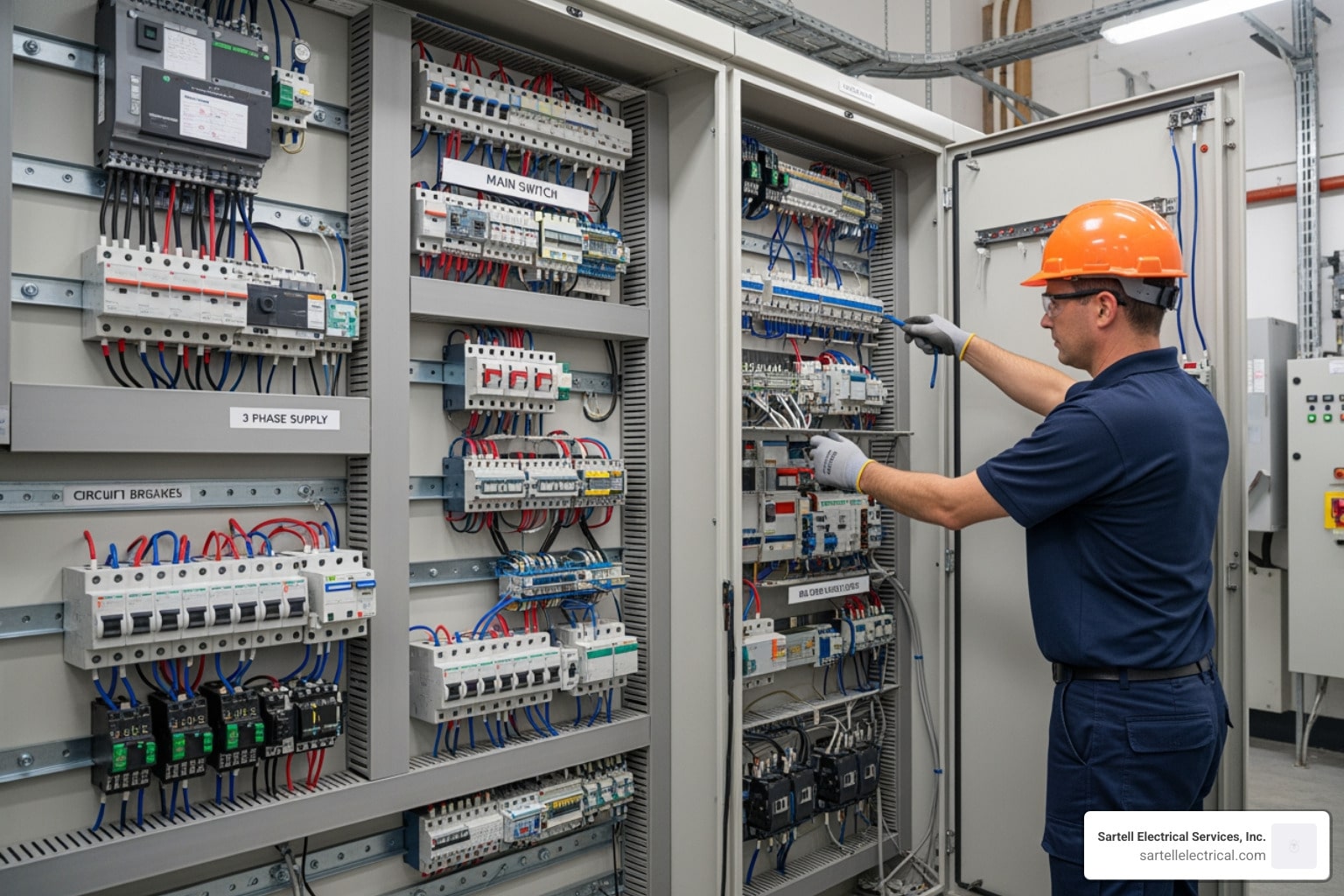
A 3 phase switchboard upgrade is one of the most impactful electrical improvements you can make for a modern commercial, industrial, or high-demand residential property. Here's a quick summary of what you need to know:
| Question | Quick Answer |
|---|---|
| What is it? | Replacing a single-phase panel with a 3-phase system that distributes power across three separate lines |
| Who needs it? | Buildings running heavy machinery, EV chargers, solar systems, or multiple high-draw appliances simultaneously |
| Key benefit | Handles up to 3x more load with better balance, fewer outages, and improved safety |
| Typical cost | $3,000 to $6,000+ depending on existing infrastructure |
| Typical downtime | 3 hours to 2 days depending on project complexity |
| Do you need a licensed electrician? | Yes — always. This is not a DIY job |
Most buildings constructed more than 20 years ago were designed around a simple reality: appliances were smaller, fewer, and less power-hungry. That reality no longer exists.
Today's facilities run EV chargers, ducted HVAC systems, solar inverters, and industrial equipment — often all at once. A single-phase panel simply wasn't built for this. When your system is pushed past its limits, the warning signs show up fast: flickering lights, tripped breakers, warm panels, and in worst cases, fire risk.
A 3-phase system solves this by splitting the electrical load across three separate power lines, keeping demand balanced and your operation running smoothly.
I'm Ed Sartell, President of Sartell Electrical Services, Inc., and with nearly four decades of hands-on electrical experience across Massachusetts, I've helped countless commercial and residential clients evaluate and complete a 3 phase switchboard upgrade that meets both their current demands and future growth. In this guide, I'll walk you through everything you need to make a confident, informed decision.
3 phase switchboard upgrade terms to know:
Understanding the 3 Phase Switchboard Upgrade
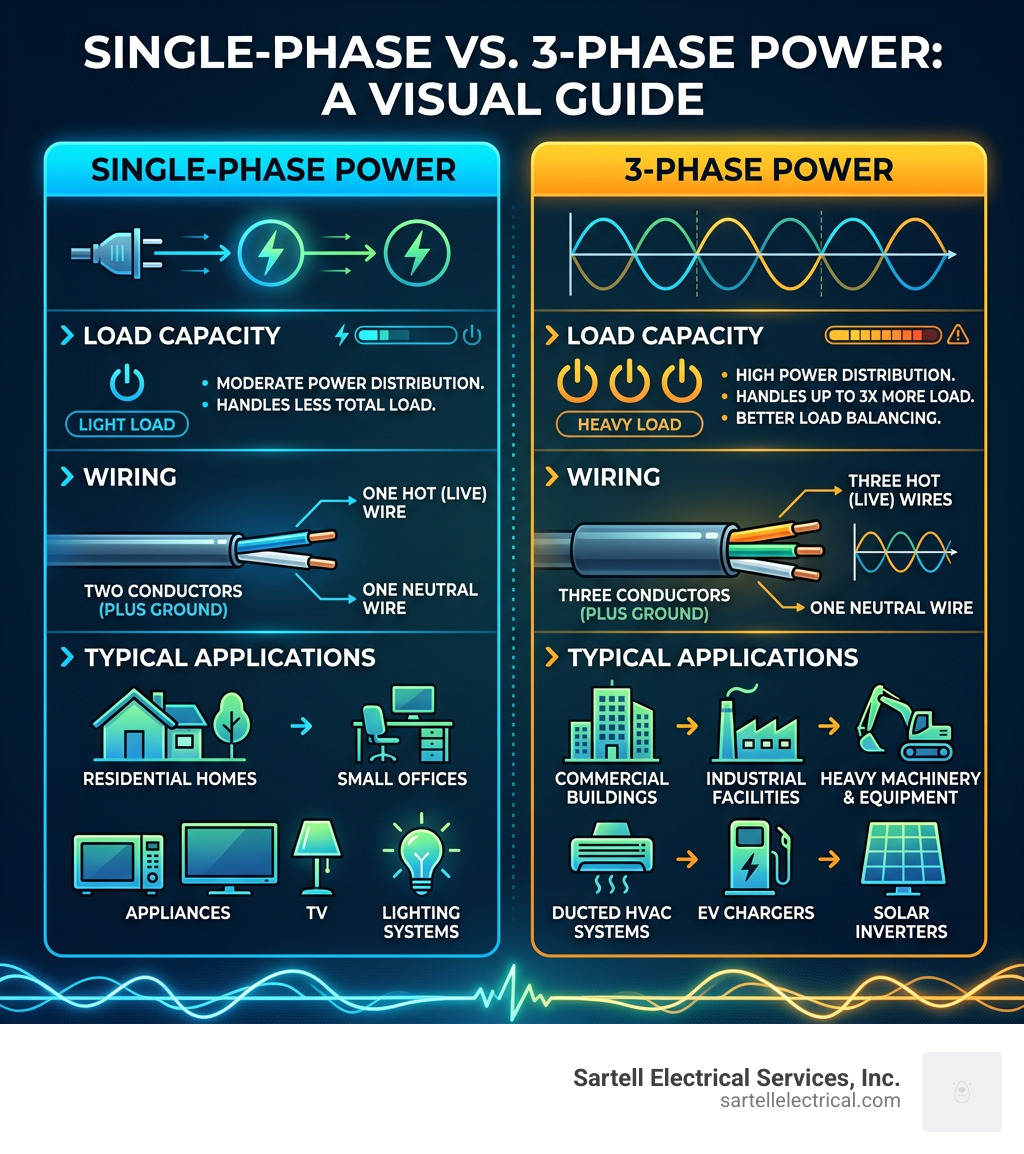
To understand why a 3 phase switchboard upgrade is such a game-changer, we have to look at the physics of how power enters your building. A standard single-phase system uses two wires: one "active" wire and one neutral. It’s like a single-lane highway. It works fine for a few cars, but as soon as rush hour hits, everything grinds to a halt.
A 3-phase system, by contrast, uses three active wires and one neutral. These three "phases" deliver alternating current (AC) in three distinct waves, each offset by 120 degrees. This means that while one wave is dropping in voltage, another is rising. The result? A much more consistent, stable, and powerful flow of electricity.
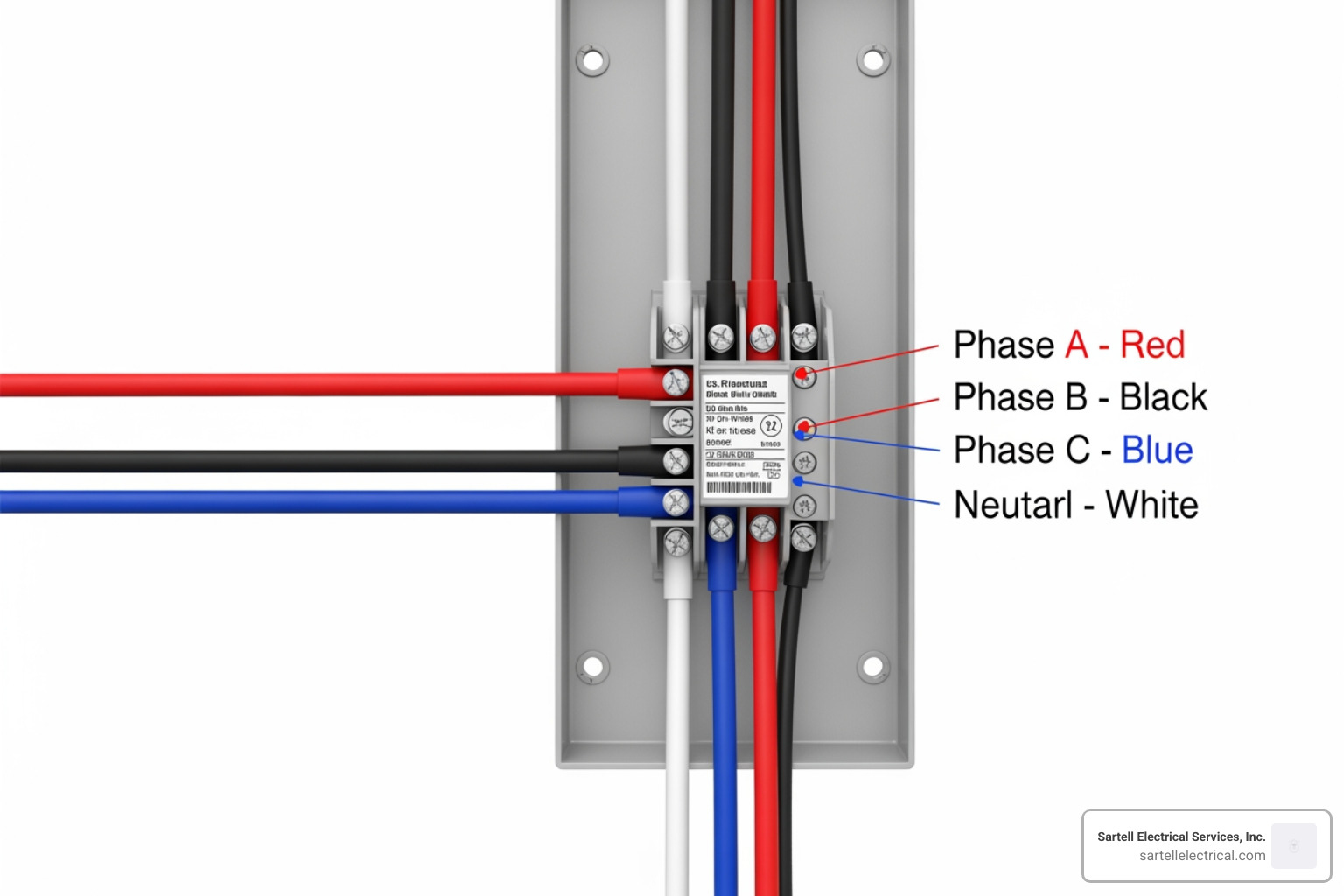
When we perform a Main Electrical Panel Upgrade Complete Guide, we are essentially expanding your "highway" to four lanes. This 120-degree phase difference ensures that the power supply never drops to zero, which is vital for the smooth operation of large motors and sensitive electronics. For businesses and large homes, What a Three Phase Switchboard Upgrade Means for Homes is a shift from "just getting by" to having a robust, industrial-grade power supply that can handle anything you throw at it.
Single-Phase vs. 3-Phase Capacity
The difference in capacity is staggering. In many regions, a standard single-phase connection maxes out at around 63 Amps, which translates to roughly 14kW of continuous demand. While that sounds like a lot, consider this: a single high-speed EV charger can pull 7kW to 11kW on its own. Add a ducted air conditioner and a commercial oven, and you’ve already exceeded your limit.
| Feature | Single-Phase | 3-Phase |
|---|---|---|
| Active Wires | 1 | 3 |
| Voltage | 120V / 240V | 120V / 208V or 277V / 480V |
| Max Capacity (Typical) | ~14kW (63A) | 42kW+ (Shared across phases) |
| Efficiency | Lower for large motors | High (uses less conductor material) |
| Wiring Weight | Heavier for high loads | Lighter and more efficient |
By upgrading, you aren't just getting "more" power; you're getting more efficient power. Because the load is split across three wires, 3-phase systems actually use less conductor material (copper or aluminum) to transmit the same amount of power as a single-phase system. This makes it the standard choice for Commercial Electric Panel Complete Guide projects where efficiency and high-amperage limits are non-negotiable.
Signs Your Property Requires a 3-Phase Transition
How do you know if your current system is waving a white flag? Most of the time, your building will tell you—you just have to know what to listen for. We often see clients in Middlesex and Essex County reach out when they notice their lights dimming every time the refrigerator or AC kicks on. This is a classic sign of voltage drop caused by an overloaded single-phase circuit.
Other red flags include:
- Frequent Tripping: If your circuit breakers are popping like popcorn, they are doing their job—preventing a fire—but they’re also telling you the demand is too high.
- Warm Switchboard: If you touch your panel and it feels noticeably warm, or if you detect a faint burning smell, you have a serious problem that requires immediate attention.
- Outdated Components: If your building still uses ceramic fuses (common in pre-1970s structures), you are at a significantly higher risk. These fuses don't always cut power when they overheat, which is a major fire hazard.
- The "One-at-a-Time" Rule: If you have to tell your staff or family members not to use the microwave while the dryer is running, your capacity is officially tapped out.
Our Electrical Service Upgrades Complete Guide highlights that these issues aren't just inconveniences—they are safety warnings. Ignoring them can lead to equipment damage or electrical fires.
Supporting Modern Technology with a 3 Phase Switchboard Upgrade
The push toward a 3 phase switchboard upgrade is often driven by the "Green Revolution." We are seeing a massive influx of requests for 200 Amp Service Upgrade and 3-phase transitions specifically to support:
- EV Charging: While a standard outlet can charge a car, it takes forever. A 22kW 3-phase charger can top up a vehicle in a fraction of the time. However, you need the infrastructure to support it.
- Solar Integration: Large solar arrays often require 3-phase inverters to feed power back into the grid efficiently.
- Heavy Machinery: If you run a workshop in Reading or a commercial kitchen in Boston, your welders, lathes, and industrial ovens likely require 3-phase power to operate at peak torque and efficiency.
- Smart Building Systems: Modern HVAC units, especially ducted systems, run much more quietly and efficiently on 3-phase power.
Even if you're working in a tight spot, there are solutions. For instance, knowing How to upgrade a LV switchboard in a crowded electrical substation? is a specialized skill we bring to commercial clients who need more power but have limited square footage.
The Benefits of Upgrading Your Electrical Infrastructure
Upgrading your switchboard is an investment that pays dividends in safety, functionality, and even property value. When we install a modern, organized 3-phase panel, we aren't just swapping boxes; we’re giving your building a new lease on life.
- Future-Proofing: You might only need 100 Amps today, but what about five years from now? A 3-phase upgrade ensures you won't have to touch your electrical system again for decades, even if you add more tech.
- Property Value: For commercial real estate, having 3-phase power is a major selling point. It tells potential buyers or tenants that the building is ready for high-capacity operations.
- Energy Efficiency: Because 3-phase motors are more efficient and the load is balanced, you often see a reduction in "vibration" and heat loss in your equipment, extending the life of your expensive appliances.
- Insurance Compliance: Many insurance providers now require modern panels and safety switches to maintain coverage, especially in older Massachusetts homes. Checking the Home Electrical Panel Upgrade Cost now is much cheaper than dealing with a denied claim later.
Enhanced Safety Features in a 3 Phase Switchboard Upgrade
Safety is the #1 reason we recommend an upgrade. Modern 3-phase switchboards come equipped with technology that simply didn't exist 30 years ago.
- RCDs (Residual Current Devices): These are life-savers. They detect tiny leaks in electricity (the kind that causes shocks) and shut off the power in milliseconds.
- Surge Arrestors: With the amount of sensitive electronics we use today, surge protection is mandatory. A 3-phase surge protector guards your entire building against lightning strikes and grid spikes.
- Asbestos Removal: Many older switchboards in the Boston area were mounted on asbestos panels. A professional upgrade includes the safe, certified removal of these hazardous materials.
- Arc Fault Detection: Modern breakers can sense the "sparking" that happens inside a wall before a fire even starts.
According to our Electrical Panel Upgrade Cost Guide 2025, moving to a modern system brings you into full compliance with the National Electrical Code (NEC), which is the gold standard for fire prevention and shock protection.
The Installation Process: What to Expect
At Sartell Electrical Services, Inc., we pride ourselves on a "no surprises" process. A 3 phase switchboard upgrade is a complex logistical dance that requires coordination between us, you, and the utility company (like National Grid or Eversource).
- Initial Assessment: We start by calculating your total potential load. We don't just look at what you’re using now; we ask what you plan to add in the next 10 years.
- Utility Coordination: We handle the paperwork to get a 3-phase service line brought from the street to your building if it isn't already there.
- Shutdown Planning: We work with you to find a time—often a weekend or a slow period—to safely disconnect the power.
- The Install: We remove the old equipment, address any asbestos or outdated wiring, and install the new 3-phase board.
- Testing and Grounding: We verify every circuit, ensuring the load is perfectly balanced across all three phases and that the grounding system is rock-solid.
- Final Inspection: A local Massachusetts inspector will sign off on the work, ensuring everything is up to code.
Whether you're doing a 200 Amp Service Upgrade or a full industrial overhaul, we aim for precision and speed.
Costs, Timelines, and Downtime
We know the biggest concern for any business or homeowner is: How much and how long?
- Costs: A 3 phase switchboard upgrade typically ranges from $3,000 to $6,000+. Factors that influence this include the distance to the street power lines, whether you need a new meter box, and the complexity of your interior wiring.
- Timeline: The physical installation of the switchboard usually takes 3 to 5 hours. However, the entire project (including permits and utility work) can take several weeks of lead time.
- Downtime: For most residential projects, the power is off for a single day. For complex commercial sites, we often schedule weekend shutdowns to ensure your business isn't interrupted during work hours.
For more details on commercial pricing, see our Commercial Electric Panel Complete Guide.
Frequently Asked Questions about 3-Phase Upgrades
Is a 3-phase upgrade necessary for residential homes?
Not every home needs it, but it's becoming increasingly common. If you have a large property in Andover or Lynnfield with a pool, multiple AC units, a workshop, and two EVs, a single-phase system will likely struggle. Upgrading to 3-phase ensures you never have to worry about which appliances you can run at the same time.
How long does the power need to be off during installation?
For a standard upgrade, expect the power to be off for about 4 to 8 hours. For large-scale commercial projects, we may perform the work in stages or over a weekend. We always provide a clear schedule so you can plan accordingly.
Can I just add a second single-phase board instead?
In some cases, yes. If your demand is only slightly higher than your current limit, a second board or a sub-panel might be a cost-effective alternative. However, this doesn't provide the efficiency or motor-starting benefits of a true 3-phase system. We can help you weigh the ROI of both options.
Conclusion
Your electrical system is the heart of your building. If it’s struggling to keep up with modern demands, it’s not just an inconvenience—it’s a bottleneck for your growth and a potential safety risk. Whether you are managing a commercial facility in Boston or a high-tech home in Reading, a 3 phase switchboard upgrade provides the capacity, safety, and efficiency you need for the 21st century.
At Sartell Electrical Services, Inc., we’ve spent over 30 years serving the Massachusetts community, from Middlesex to Norfolk County. Our team of licensed experts is ready to help you navigate the complexities of power distribution with a focus on excellence and customer service.
Don't wait for a total system failure or a dangerous overload. Schedule your 3-phase switchboard upgrade today and let us help you power your future with confidence.