
Holiday Lights and Outdoor Outlets: How Much Can One Circuit Safely Handle This Winter?
You'll learn how to add up your display's load, find out what else shares the outdoor circuit, and keep the GFCI from tripping every time it rains or snows.
The short answer
- A typical 15-amp household circuit maxes out around 1,800 watts. Plan to use well under that, because holiday lights run for hours at a time.
- Add up the wattage of every string, inflatable and spotlight. Include anything else on that circuit, such as garage or indoor outlets.
- Wet-weather GFCI trips usually mean water is reaching a plug or cord. Raise and cover your connections, and stop resetting over and over.
- Never replace a GFCI with a standard outlet, and never run indoor cords outside. If you need more capacity, have an electrician add an outlet or circuit.
Do the math with the labels
The arithmetic is simple. Watts = volts × amps, and household outlets run at about 120 volts.
- A 15-amp circuit can carry roughly 1,800 watts.
- A 20-amp circuit can carry roughly 2,400 watts.
Holiday displays run for hours every evening, so don't plan right up to the limit. Many electricians plan for about 80 percent of the rating on long-running loads. That works out to roughly 1,440 watts on a 15-amp circuit and 1,920 on a 20-amp one. The headroom keeps the breaker, outlet and cords from working at their edge all season.
How to add it up
- Find the tag near the plug of each light string, or check the box. It will list watts, amps or both.
- If it only lists amps, multiply by 120 to get watts.
- Add every inflatable, spotlight, projector and animated figure the same way.
- Add anything else on the circuit that might run at the same time, such as a garage fridge, a shop vac or a space heater.
A sample tally
Here is an example with made-up label numbers. Six LED strings at 10 watts each come to 60 watts. Add two inflatables at 150 watts each and one 50-watt spotlight, and the total is 410 watts. That is comfortable on a 15-amp circuit.
Now suppose the same circuit also feeds the garage, and someone switches on a 1,500-watt space heater out there. The total jumps past 1,900 watts and the breaker will eventually trip.
If the breaker trips at the same time every night, check what else switches on at that hour, like a heater, a freezer or a timer-controlled pump.
Strings, inflatables and cords each have their own limits
End-to-end connections
Most listed light strings carry a label or tag stating the maximum number of strings, or the maximum watts, you can connect end to end. If yours doesn't, check the box or the manufacturer's instructions. The wires inside a light string are thin, and the first string carries the current for every string after it.
Going past that limit can overheat the first string's plug even when the circuit as a whole is fine. Keep LED and incandescent strings on separate runs, because their limits differ.
Inflatables have motors
An inflatable stays up because a small blower runs the whole time it's on. Motors draw a brief surge when they start, and if a timer starts several inflatables at once, those surges stack up. Spread inflatables across different outlets where you can, or set their timers a minute or two apart.
Extension cords
- Use only cords marked for outdoor use, and check that each cord's rating covers the load you'll plug into it.
- Shorter, heavier cords run cooler than long, thin ones. Use one cord of the right length instead of chaining several together.
- Keep indoor power strips and indoor cords out of the yard.
- Don't run cords through doors or windows, where they get pinched, and never nail or staple through them. Plastic light clips are made for hanging.
- Uncoil cords fully when they're in use. A tightly coiled cord under load can heat up.
A warm plug on the first string of a run can mean too many strings end to end, a damaged plug or a poor connection, so unplug it and split the run, and throw the string away if it still warms up.
Why the GFCI trips when it rains or snows
A GFCI compares the current going out on one wire with the current coming back on the other. If a small amount leaks along another path, it cuts power almost instantly. On a holiday display, that path is usually water at a plug-to-plug connection, a cord nicked by a shovel, or a cracked bulb socket.
Melting snow, sleet, sprinklers, heavy dew and frost can all reach those connections. A big display adds to the odds, because many strings that each leak a tiny amount can add up to enough to trip the outlet.
A trip means the device is doing its job. Never swap a GFCI for a standard outlet to stop the trips, and don't keep forcing the reset while things are wet.
Narrowing it down on a display
- Unplug the display from the protected outlets and let the connections dry.
- Press reset with nothing plugged in.
- Plug the display back in one run or one inflatable at a time, waiting a few minutes between each.
- When it trips, the last run you added holds the problem. Unplug it before you handle or inspect it.
- Throw away strings with cracked sockets, exposed copper or melted spots. Don't try to patch them with tape.
If the GFCI won't reset even with nothing plugged in, the trouble is in the outlet or the wiring, and that's a job for an electrician. For tripping problems that have nothing to do with decorations, see our guide to fixing a GFCI that keeps tripping.
Press the GFCI's test button before you hang anything, then reset it, so you know the protection works before the display goes up.
Set up so water can't reach the connections
Most wet-weather trips start where two plugs meet. Small changes at those spots make a big difference:
- Get connections off the ground. Use stakes, hooks or a railing so plugs stay out of puddles and snowbanks.
- Point plugs downward and add a drip loop. A drip loop is a small dip in the cord just before the connection, so water drips off the low point instead of running into the plug.
- Use covered connection boxes. These weather-resistant clamshell boxes are made for outdoor holiday connections.
- Check the outlet cover. An in-use, or bubble, cover closes over the outlet even with cords plugged in. A flat flip cover that only seals when nothing is plugged in won't protect the outlet during the season.
- Skip plastic bags and electrical tape. They trap condensation against the plug, which can make trips more likely.
- Raise inflatable plugs. The blower sits low, but the connection to its cord shouldn't sit in the snow.
- Use an outdoor-rated timer. Fewer hours of run time means less heat and less time for moisture to cause trouble.
If one connection trips the GFCI in every storm, move it somewhere higher or more sheltered, such as under an eave.
Warning signs and when to call an electrician
Some problems go beyond a wet plug. Stop and unplug the display if you notice any of these:
- An outlet cover plate, plug or cord that feels warm
- Buzzing, crackling or a hot-plastic smell
- Scorch marks or melted plastic on a plug or outlet
- Indoor lights that dim when the display switches on
- An outlet that's loose in the wall, cracked, or missing its cover
- A breaker that trips even though your total load is modest
If you smell burning and the plug is hot, switch off that breaker if you can reach the panel safely. If you see smoke or flame, get out and call 911.
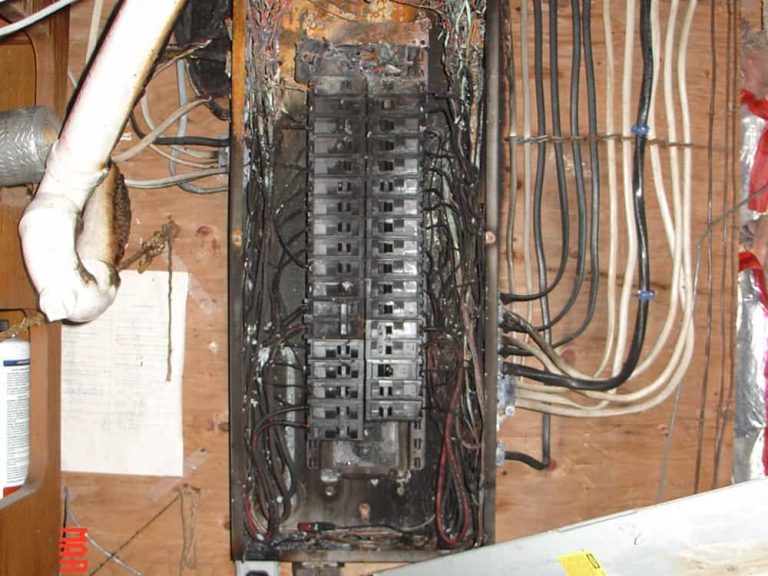
Leave anything beyond plugging and unplugging to a pro. That includes replacing a damaged outlet or GFCI, adding an outdoor outlet, running a new circuit, and any work inside the panel.
Sartell Electrical Services offers residential electrical services, and its service area pages cover Boston, Cambridge, Somerville, Newton, Waltham, Woburn, Burlington, Lexington, Reading, Peabody, Danvers and Framingham. If your display has outgrown your outlets, a licensed electrician is the right person to look at adding capacity.
Is your display already up and tripping? Scale it back to what the circuit can handle for now. If you're thinking about more capacity before next season, get in touch to ask about Sartell Electrical Services' residential electrical services.
Spreading the display across outlets on different circuits is often the quickest fix, and your circuit map shows which outlets those are.
Check it through the season and at takedown
A display that worked fine in late fall can start acting up after a few storms. After heavy snow or a freeze and thaw, walk the yard in daylight with the display off. Brush snow away from connections, re-hang any plugs that have slipped down, and look for cords that have been chewed or crushed.
When the decorations come down, a little care sets you up for next year:
- Unplug everything before you take anything down.
- Look over every string and cord as you pack it, and throw away any that are damaged.
- Write each string's wattage on a piece of tape on its plug, so next year's tally takes minutes.
- Keep your circuit map with the decorations, along with notes on which outlets tripped and how often.
- Store cords loosely coiled in a dry bin, up off a damp basement floor.
Those notes will tell you whether you have a capacity problem or just a wet connection. A GFCI that only tripped during storms points to a moisture fix. A breaker that tripped on clear, dry nights means the circuit is carrying too much, and that's worth raising with an electrician before the decorations come back out.
Clear snow carefully around the display, since a cord buried under a snowbank is easy to cut with a shovel or snowblower.
Common questions
Can I plug outdoor lights into an indoor outlet and run the cord out a window?
No. Windows and doors pinch cords and damage the insulation, and the indoor outlet may not have GFCI protection. Use an outdoor outlet with an in-use cover, or have an electrician add one where you need it.
Do LED holiday lights really make a difference?
Yes. LED strings usually draw a small fraction of the power of older incandescent strings, so many more fit on one circuit. Still check the end-to-end limit on the label, and keep connections dry so the GFCI doesn't trip.
Is it okay to keep resetting a GFCI that trips during wet weather?
Resetting once after everything dries out is fine. Resetting again and again while connections are still wet means you're ignoring the leak the device is warning you about. Unplug the display, let it dry, then add runs back one at a time to find the cause.
Can a GFCI outlet wear out?
Yes. Press the test button now and then, as the manufacturer's instructions suggest. If it won't trip when tested or won't reset afterward, have an electrician replace it.
Should I add a dedicated circuit just for holiday decorations?
If you trip breakers every year or your display keeps growing, it's worth considering. A dedicated outdoor circuit means a garage fridge or space heater won't compete with your lights. An electrician can check whether your panel has room for one.