Why You Need an Expert Electrical Safety Inspection
Many homeowners operate under the "if the lights turn on, everything is fine" philosophy. Unfortunately, electricity is a silent worker, and the most dangerous issues are often tucked away behind your drywall or inside a humming metal box in the basement. An
Expert electrical safety inspection is the only way to "see" through those walls and ensure your sanctuary isn't harboring a fire hazard.
The statistics are a wake-up call for any property owner. Electrical failures are the second leading cause of U.S. home fires. Every year, approximately 46,700 fires are attributed to electrical malfunctions, causing $1.5 billion in direct property damage. In Massachusetts, where our housing stock includes many beautiful but aging Victorians and Colonials, the risk is even more pronounced. Old wiring wasn't designed for the "gadget age" of air conditioners, high-end gaming PCs, and electric vehicle chargers.
Beyond fire prevention, these inspections are critical for shock prevention. With about 30,000 non-fatal shock incidents occurring annually in the U.S., ensuring your Ground Fault Circuit Interrupters (GFCIs) are functioning is a literal life-saver. Furthermore, an
Electrical System Safety Assessment helps identify outdated components that could lead to carbon monoxide risks—particularly if faulty wiring affects your HVAC system's control boards or sensors.
Scheduling
regular electrical safety checks also serves a practical financial purpose. Many insurance providers now require a professional
Electrical System Safety Assessment as part of their risk mitigation strategy. If you can’t prove your system is up to code, you might face higher premiums or even a denial of coverage.
How an Expert Electrical Safety Inspection Protects Your Investment
Think of an electrical inspection like a physical for your home. Early fault detection allows us to catch a $200 repair today before it turns into a $20,000 disaster tomorrow. By identifying loose connections or overloaded circuits, we help you avoid the "emergency call-out" fees that always seem to happen at 2:00 AM on a holiday weekend.
System longevity is another major benefit. When your electrical system is balanced and the load is distributed correctly, your appliances and sensitive electronics last longer. Power surges and "dirty power" from poor wiring can fry the motherboards in your refrigerator or smart TV. An
Electrical Safety Assessment & Fire Code Inspection ensures that your system is efficient, protecting both your electronics and your wallet. If you are planning to sell your home in the Greater Boston area, a clean bill of health from a licensed electrician can significantly boost your real estate value and prevent "surprises" during the buyer's home inspection.
When to Schedule Your Professional Assessment
How often should you have an electrician look at your wires? While "whenever something smells like it's burning" is a popular answer, it’s not the safest one. We recommend a professional inspection at 1-3 year intervals for most homes, but there are specific triggers that should move an inspection to the top of your to-do list.
- The 40-Year Rule: If your home was built more than 40 years ago, it likely has wiring that is reaching the end of its reliable lifespan. Homes built between 1965 and 1975, for example, often contain aluminum wiring, which is significantly more prone to fire than modern copper.
- Real Estate Transactions: Whether you are buying or selling, you need to know the state of the "veins and arteries" of the house.
- Major Renovations: If you are gutting a kitchen or adding a master suite, the Massachusetts Electrical Code requires that the new work meets modern standards. This is the perfect time for a rough-in inspection.
- New Appliance Installation: Adding a hot tub, a central AC unit, or an EV charger? These high-draw items can easily overwhelm an older 60-amp or 100-amp panel.
When
preparing for your inspection, it's helpful to have a list of any "quirks" you've noticed—like a flickering light in the hallway or a breaker that trips whenever you use the toaster. Whether you need
residential or commercial electrical inspections, being proactive is always the smartest choice.
What Happens During the Inspection Process
When a Sartell Electrical Services professional arrives at your door, we don't just "look around." We follow a rigorous, technical process designed to find the invisible.
| Feature |
Residential Inspection |
Strata/Multi-Unit |
Commercial Inspection |
| Primary Focus |
Family safety & appliances |
Shared services & fire code |
High voltage & load balance |
| Wiring Check |
Copper/Aluminum/Knob-and-Tube |
Conduit & riser integrity |
Three-phase power & raceways |
| Safety Devices |
GFCI/AFCI & Smoke Alarms |
Emergency lighting & fire pull |
Surge protection & OSHA compliance |
| Tech Used |
Visual & basic testing |
Thermal imaging & load logs |
Infrared scanning & harmonics |
We pay special attention to identifying hazardous materials like knob-and-tube wiring (common in older Reading and Salem homes) and testing for GFCI (Ground Fault Circuit Interrupter) and AFCI (Arc Fault Circuit Interrupter) protection. AFCIs are particularly important as they detect the "arcing" that happens when a wire is damaged, stopping a fire before it starts.
One of our most powerful tools is
Infrared (IR) Scanning. This technology allows us to see heat signatures. A loose connection or an overloaded circuit will glow bright "hot" on our thermal cameras, even if it looks perfectly normal to the naked eye. We use the
Electrical System Safety Assessment Checklist to ensure no stone is left unturned.
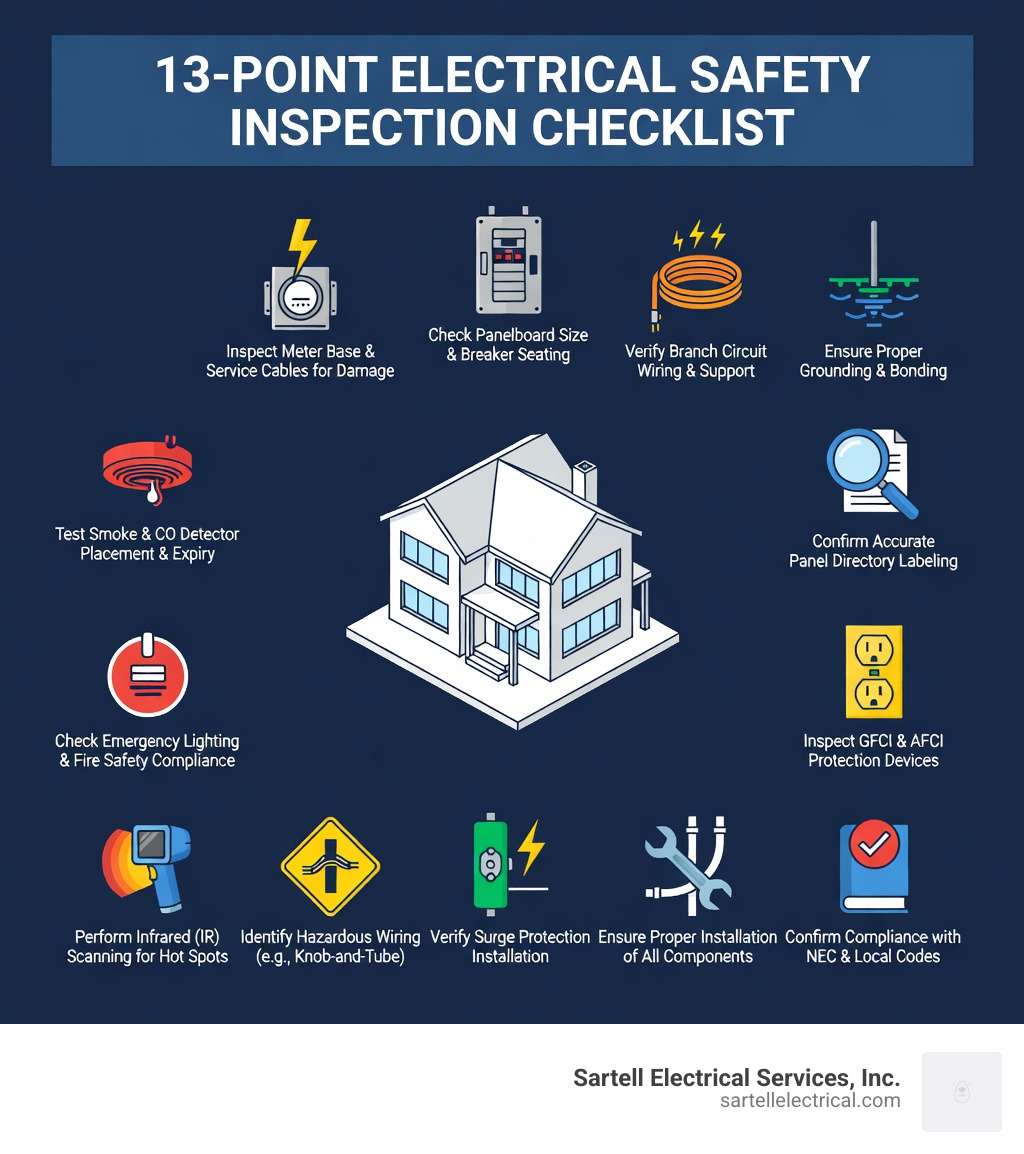
The Checklist for an Expert Electrical Safety Inspection
Our
Expert electrical safety inspection follows a meticulous path through your property:
- Service Equipment: We check the meter base and the main service cables entering your home for wear or weather damage.
- The Panelboard: We ensure the panel is correctly sized (modern homes typically need at least 200 amps) and that all breakers are seated properly.
- Branch Circuits: We verify that the wiring throughout the house is properly supported and not "daisy-chained" with dangerous power strips.
- Grounding and Bonding: We ensure your system has a clear path to the earth, which protects you from lightning strikes and surges.
- Smoke and CO Detectors: We verify that these life-saving devices are in the right locations and are within their expiration dates.
- Panel Directory: We make sure your breakers are accurately labeled. No more guessing which switch turns off the kitchen!
For those managing larger properties, we also provide specialized
electrical safety for industrial facilities, where the stakes and the voltages are even higher.
Navigating Massachusetts Electrical Codes and Compliance
Massachusetts has some of the strictest electrical safety standards in the country. Our state code is based on the National Electrical Code (NEC), which is updated every three years, but Massachusetts adds its own specific amendments.
For instance, Massachusetts has specific rules regarding GFCI protection for appliances and requirements for "Emergency" disconnects on the exterior of homes to help firefighters stay safe. It is also important to note that electrical permits in Massachusetts have a
12-month validity. If a project isn't completed and inspected within that year, the permit can expire, leading to legal and insurance headaches.
Compliance with these
Building Regulations isn't just about avoiding a fine; it's about ensuring that if something does go wrong, your insurance company can't claim "negligence" to avoid paying a claim. This is why it is vital to
find a licensed electrical contractor who carries professional indemnity insurance. Hiring an unlicensed "handyman" for electrical work in Massachusetts is not only risky—it's often illegal. Whether you are looking for a
commercial electrical inspection or a residential check-up, always ask to see a license.
Frequently Asked Questions about Electrical Safety
How much does an electrical inspection cost?
The
cost of an electrical inspection near you can vary based on the size of the home and the complexity of the system. At Sartell Electrical Services, we believe in "by the job" pricing rather than hourly rates. This means you know exactly what you’re paying upfront, with no "ticking clock" stress. Generally, a comprehensive inspection includes the full 13-point check, a thermal scan of your panel, and a detailed written report.
How do I prepare my home for an inspection?
To make the process go smoothly, ensure that our electricians have clear access to your main electrical panel and any sub-panels. Move boxes or furniture that might be blocking the workspace. If you have pets, it’s best to keep them in a separate room. Also,
preparing for your inspection involves gathering any previous repair records or permits you might have on file.
What happens if the inspection finds deficiencies?
Don't panic! The goal of the inspection is to find these issues so they can be fixed safely. If we find a "code violation" or a safety hazard, we will provide a prioritized list of repairs. We handle the
notifications and inspections required by local authorities, and once the repairs are made, we can issue a safety certificate that you can provide to your insurance company or a potential home buyer.
Conclusion
Your home’s electrical system is too important to leave to chance. With over 30 years of experience serving Middlesex, Essex, and Norfolk counties, Sartell Electrical Services, Inc. is committed to keeping our Massachusetts neighbors safe. From our home base in Reading, MA, we lead with a commitment to excellence and a deep understanding of local codes.
Don't wait for a flickering light or a burning smell to tell you there's a problem. Be proactive. Protect your family, your investment, and your peace of mind.
 Schedule your expert electrical safety inspection today with the team at Sartell Electrical Services. We’re here to make sure you never "get zapped."