
Data Center Electrical systems are the mission-critical infrastructure that powers every website you visit, every cloud file you save, and every streaming service you watch. Here’s what you need to know:
The stakes couldn’t be higher. A single power failure can take down thousands of servers, disrupt critical services, and cost businesses millions. That’s why data center electrical design requires precision, redundancy, and expertise at every level – from the utility connection to the individual rack.
As Ed Sartell, I’ve spent nearly four decades designing and implementing electrical systems for commercial and industrial facilities across Massachusetts, including critical infrastructure projects where Data Center Electrical reliability is non-negotiable. Understanding how power flows through these complex systems is essential for anyone planning or managing mission-critical facilities.
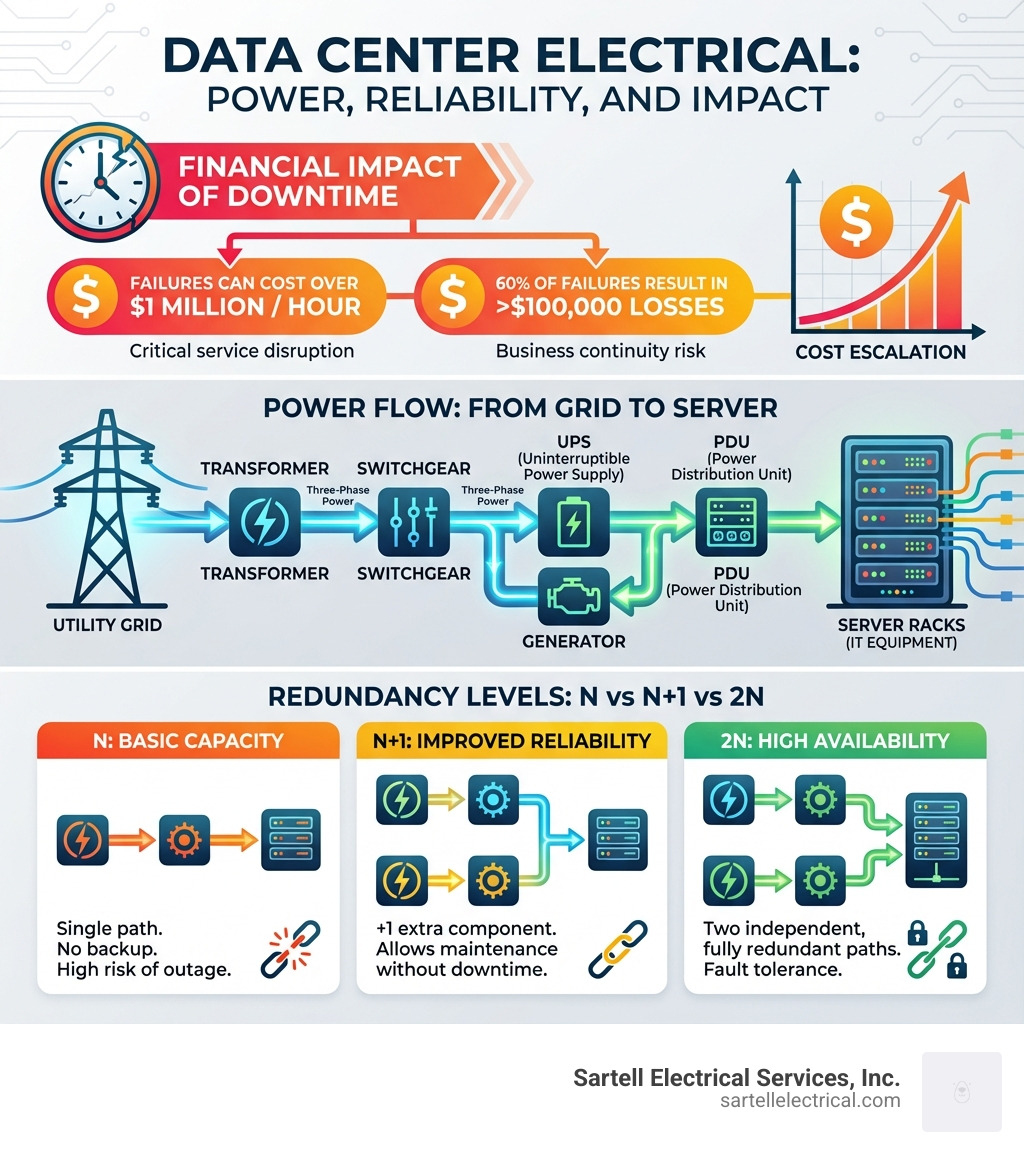
Imagine the sheer amount of electricity needed to keep the digital world humming. Modern facilities can demand over 50 times the electricity per square foot compared to a typical office building! This power doesn’t just magically appear in your servers; it starts on a carefully orchestrated journey, starting from the utility grid and flowing all the way to the IT equipment. Our role, as experienced electrical contractors in Massachusetts, is to ensure this journey is seamless and reliable.
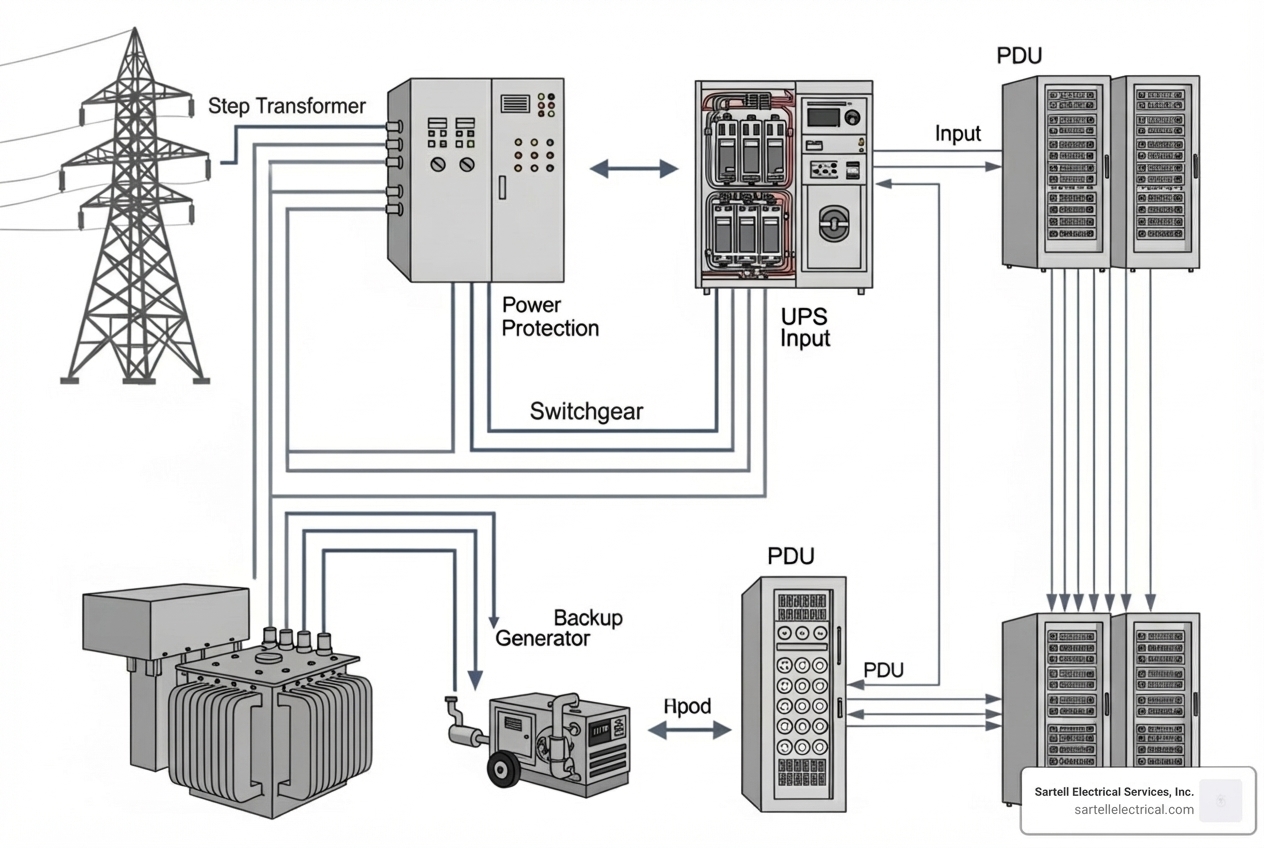
The journey typically begins with high-voltage power from the utility grid. This power is then stepped down through a series of transformers, often located in an on-site substation for large data centers. These transformers are crucial, using the principle of magnetic induction to convert the high utility voltage (which can be anywhere from 13.8kV to 345kV in transmission lines) to lower, more manageable levels suitable for the data center’s internal distribution. Once the voltage is stepped down, it flows through sophisticated switchgear, which safely distributes the power throughout the facility. This is where our Industrial Electrical Expertise truly shines, as managing these high-capacity systems requires meticulous planning and installation.
From the switchgear, power is directed to Uninterruptible Power Supply (UPS) systems and then to Power Distribution Units (PDUs) or Remote Power Panels (RPPs) before finally reaching the server racks. This intricate power flow ensures that every piece of IT equipment receives the precise amount of clean, stable power it needs to operate continuously.
When we talk about Data Center Electrical systems, we’re discussing a symphony of specialized equipment working in concert. Each component plays a vital role in maintaining the integrity and availability of your digital operations.
Here’s a breakdown of the fundamental electrical components:
When we talk about electrical power, you’ll often hear about single-phase and three-phase systems. Understanding the difference is crucial for appreciating why data centers are built the way they are.
Why is three-phase power the preferred choice for data centers?
Three-phase power is built for the heavy lifting and continuous operation that modern data centers demand, ensuring your critical IT infrastructure in Boston and beyond has the robust and reliable electrical foundation it needs.
Downtime is not just an inconvenience; it’s a catastrophic event. The cost of downtime can range from $137 per minute to well over $1 million per hour, depending on the industry and the scale of the outage. Statistics show that over 60% of failures result in at least $100,000 in total losses, a significant jump from previous years. When nearly 30% of major public outages in 2021 lasted more than 24 hours, the urgency for unwavering reliability becomes crystal clear. This is precisely why redundancy is not a luxury, but a fundamental requirement in Data Center Electrical design.

Our primary goal is to build systems that offer business continuity, fault tolerance, and concurrent maintainability. This means designing electrical infrastructure that can withstand component failures, allow for maintenance without interrupting service, and keep your operations running smoothly, 24/7.
When the utility grid falters, even for a moment, two critical systems spring into action: the Uninterruptible Power Supply (UPS) and backup generators. They work together to ensure a seamless transition and continuous power.
The UPS system is the first line of defense. It contains large battery banks or flywheels that provide instantaneous power during fluctuations or complete outages. This “ride-through” power is crucial because it bridges the short gap—typically 10 to 30 seconds—it takes for the backup generators to start up and stabilize. Without a UPS, even a momentary power dip could cause servers to crash, leading to data loss and service interruptions. Modern UPS systems often use advanced battery technologies, with Lithium-Ion batteries gaining popularity over traditional VRLA (Valve Regulated Lead-Acid) batteries due to their longer lifespan, faster charging, and greater energy density.
Once the generators are stable, an Automatic Transfer Switch (ATS) seamlessly switches the data center’s load from the utility power (or the UPS) to the generators. This process is so quick and smooth that your IT equipment won’t even notice the change. Generators then carry the load for as long as needed, provided there’s a sufficient fuel supply. Many data centers maintain enough fuel for 24 to 48 hours of full-load operation.
For us at Sartell Electrical, providing Emergency Electrical Service means understanding these critical transitions and ensuring your backup systems are always ready. We design, install, and maintain these complex systems across Greater Boston, ensuring your data center remains resilient against any power disruption.
To achieve the high levels of uptime demanded by modern businesses, data centers employ various power redundancy strategies. These strategies define how many backup components are available should a primary component fail.
The industry has standardized on these redundancy levels to guide data center design and communicate expected reliability. Other, more complex levels exist, such as 2N+1 (2N plus an additional component) or 3N/2 (three power delivery systems for two servers), which offer even greater fault protection.
Implementing the right level of redundancy requires careful planning and expert Electrical Project Management. We work closely with our clients in Massachusetts to assess their risk tolerance and operational needs, designing bespoke Data Center Electrical systems that strike the perfect balance between reliability and cost-effectiveness.
The reliability of a data center is often categorized using a “Tier” classification system developed by the Uptime Institute. These tiers provide a standardized framework for evaluating a data center’s infrastructure, particularly its power and cooling redundancy, and its expected uptime. Choosing the right tier is a critical decision that balances risk tolerance with investment.
The Uptime Institute’s Tier Classification System outlines four distinct levels:
| Tier Level | Power Redundancy | Cooling Redundancy | Expected Uptime | Annual Downtime |
|---|---|---|---|---|
| Tier 1 | N (No redundancy) | N (No redundancy) | 99.671% | 28.8 hours |
| Tier 2 | N+1 | N+1 | 99.741% | 22 hours |
| Tier 3 | N+1 (concurrently maintainable) | N+1 (concurrently maintainable) | 99.982% | 1.6 hours |
| Tier 4 | 2N (fault-tolerant) | 2N (fault-tolerant) | 99.995% | 26.3 minutes |
Let’s break them down:
The choice of tier directly impacts the complexity, cost, and ultimately, the resilience of the Data Center Electrical infrastructure. We partner with clients across Greater Boston to design and implement electrical systems that meet their specific tier requirements, ensuring their operations align with their business continuity goals.
The landscape of Data Center Electrical is constantly evolving, driven by an insatiable demand for computing power, particularly from Artificial Intelligence (AI) and machine learning workloads. This isn’t just about more power; it’s about smarter, greener, and denser power delivery.
AI workloads are fundamentally reshaping data center design. We’re seeing a dramatic increase in server power density – what used to be below 10kW per rack is now soaring to 130kW+ for specialized AI racks like Nvidia’s NVL72, which packs 72 GPUs. This massive concentration of power generates unprecedented heat, demanding innovative cooling solutions like direct-to-chip liquid cooling. This shift is creating “Gigawatt clusters” that will profoundly impact traditional supply chains for electrical components. It’s an exciting, albeit challenging, time to be in the electrical industry!
In our quest for optimal Data Center Electrical performance, efficiency isn’t just a buzzword; it’s a measurable goal. The primary metric we use to gauge this is Power Usage Effectiveness (PUE).
Power Usage Effectiveness (PUE) is a ratio that measures how efficiently a data center uses its energy. It’s calculated by dividing the total power entering the data center by the power consumed by the IT equipment alone.
PUE = (Total Facility Power) / (IT Equipment Power)
An ideal PUE is 1.0, meaning all power goes directly to the IT equipment with no overhead. While a PUE of 2.0 used to be typical, modern, super-efficient data centers are now achieving PUEs below 1.10. Cooling systems, for example, can account for about 50% of a data center’s total power, making efficient cooling crucial for a good PUE. The closer the PUE is to 1.0, the more efficient the data center.
Another related metric is Data Center Infrastructure Efficiency (DCiE), which is simply the inverse of PUE (DCiE = 1/PUE).
Monitoring and optimizing these metrics is crucial for cost management, capacity planning, and environmental sustainability. For our commercial and industrial clients, implementing an Industrial Power Monitoring System is key to understanding where energy is being consumed and identifying opportunities for improvement. This helps us ensure your data center isn’t just powerful, but also smart about its energy use.
For decades, Alternating Current (AC) has been the dominant form of power distribution in data centers, primarily because it’s what the utility grid delivers. However, a significant trend is emerging in Data Center Electrical design: the shift towards Direct Current (DC) power distribution within the data center itself.
Why the change? It boils down to efficiency and simplicity. Most IT equipment, from servers to networking gear, internally converts AC power to DC power for its components. Every time power is converted (AC to DC, or DC to AC), there are energy losses. By distributing direct-current (or DC power) is preferred within the data center, we can eliminate several conversion steps and their associated losses.
The benefits of DC power distribution include:
While AC power still offers advantages in terms of established equipment availability and maintenance familiarity, the efficiency and density demands of modern data centers, especially for AI workloads, are making DC power an increasingly attractive option for internal distribution.
The relentless march of technology, particularly with the rise of AI, is pushing Data Center Electrical systems to their limits. As power densities in server racks skyrocket (think 130kW+ for a single AI rack!), traditional air-cooling methods simply can’t keep up. This is where liquid cooling steps in as a game-changer.
Liquid Cooling involves circulating a cooling liquid directly to the heat-generating components (like GPUs in AI accelerators) or immersing entire servers in a non-conductive fluid. This direct contact is vastly more efficient at transferring heat away from IT equipment than air, allowing for much higher power densities and more compact server designs. While it sounds futuristic, liquid cooling is becoming a necessity for next-generation data centers, ensuring that these powerful machines can operate at peak performance without overheating.
Another significant trend is Modular Design, exemplified by the use of “Data Halls” and “Pods.” Instead of building one massive, monolithic data center, facilities are increasingly designed with standardized, repeatable modules or “pods.”
Modular designs offer immense advantages:
These trends, from liquid cooling to modular pods, highlight the dynamic nature of Data Center Electrical design. It’s about building flexible, efficient, and future-proof infrastructure that can adapt to ever-increasing demands. For us, this means staying at the forefront of technology, ensuring our Data Cabling Installation in Boston and surrounding areas integrates seamlessly with these advanced power and cooling solutions.
We’ve journeyed from the utility grid to the server rack, explored the critical components of Data Center Electrical systems, digd into the intricacies of redundancy, and peered into the future of efficiency and high-density demands. The takeaway is clear: the electrical infrastructure of a data center is its lifeblood, a complex and critical system that demands precision, reliability, and continuous innovation.
The digital world relies on uninterrupted power, and the consequences of failure are severe. From the foundational decision of single-phase versus three-phase power to the strategic implementation of N, N+1, or 2N redundancy, every choice impacts uptime and operational costs. As AI workloads push power densities to unprecedented levels, emerging trends like DC power distribution, liquid cooling, and modular designs are not just interesting concepts—they are essential solutions for a resilient future.
For businesses and organizations across Massachusetts, including Boston, Reading, and Andover, ensuring your data center’s electrical infrastructure is robust, efficient, and future-ready requires more than just off-the-shelf solutions. It demands expert Electrical System Design and implementation, backed by decades of experience. Our commitment at Sartell Electrical Services is to provide that expertise, partnering with you to build and maintain the reliable, high-performance electrical systems your critical operations depend on.
Don’t leave the heart of your digital operations to chance. Contact us to discuss your Data Center Solutions in Boston and let us help you power a resilient future.
236 Ash St Reading, MA 01867
(By Appointment Only)
