
Why Electrical Testing for Commercial Premises Is Not Optional
Electrical testing for commercial premises is the process of inspecting and verifying that a building's fixed electrical installations are safe, functional, and compliant with current safety standards.
Here's what you need to know at a glance:
| Question | Quick Answer |
|---|---|
| What is it? | Inspection and testing of all fixed wiring, circuits, and electrical systems in a commercial building |
| Is it required? | Yes — under the Electricity at Work Regulations 1989 and Health and Safety at Work Act |
| How often? | Every 5 years for most commercial premises; every 1–3 years for high-risk environments |
| Who does it? | A qualified, accredited electrician |
| What do you get? | An Electrical Installation Condition Report (EICR) with a pass/fail rating |
| What if you skip it? | Risk of electrical fires, voided insurance claims, unlimited fines, or imprisonment |
Electrical faults are the most common cause of fire in commercial buildings. And unlike a residential property, a commercial premises runs harder — more equipment, longer hours, more people. That means more wear on your wiring, and more risk if something goes wrong.
The stakes are high. A single missed inspection can lead to a rejected insurance claim after a fire. Or worse.
I'm Ed Sartell, President of Sartell Electrical Services, and I've been helping Massachusetts businesses stay safe and compliant with electrical testing for commercial premises since 1985. In that time, I've seen what happens when electrical systems are neglected — and how straightforward it is to prevent those problems with the right inspection schedule.
Must-know electrical testing commercial premises terms:
Understanding electrical testing commercial premises
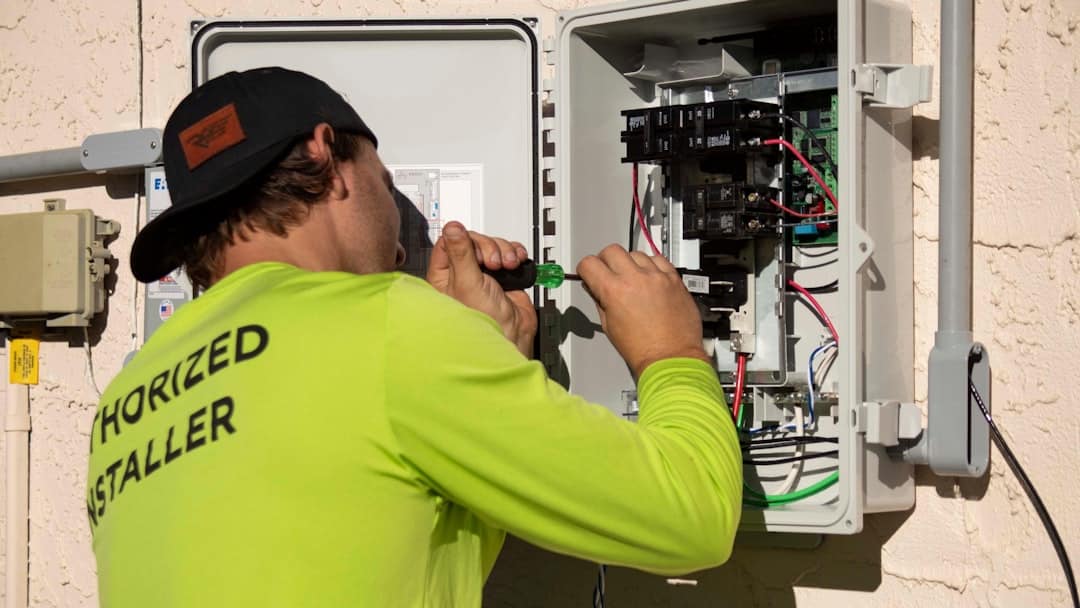
When we talk about electrical testing commercial premises, we are specifically referring to the assessment of the "fixed" parts of your electrical system. This is often called fixed wire testing or a periodic inspection. Unlike a lamp you can unplug and move, fixed wiring includes everything from the main incoming supply and distribution boards (circuit breaker panels) to the cables hidden in your walls, the conduits, the sockets, and the hardwired machinery that keeps your business running.
It is a well-known industry fact that electrical installations and wiring can deteriorate over time or with use. Often these changes are hidden or go undetected. It is important to identify whether your electrical installations are satisfactory for continued use.
In a busy commercial environment—whether it's an office in Cambridge or a warehouse in Reading—your electrical system is under constant stress. Overloaded circuits, loose connections caused by building vibrations, and even environmental factors like dust or moisture can compromise the integrity of your wiring. A professional Commercial Electrical Inspection is designed to find these hidden defects before they manifest as a power outage or, worse, a fire.
Determining the Frequency of electrical testing commercial premises
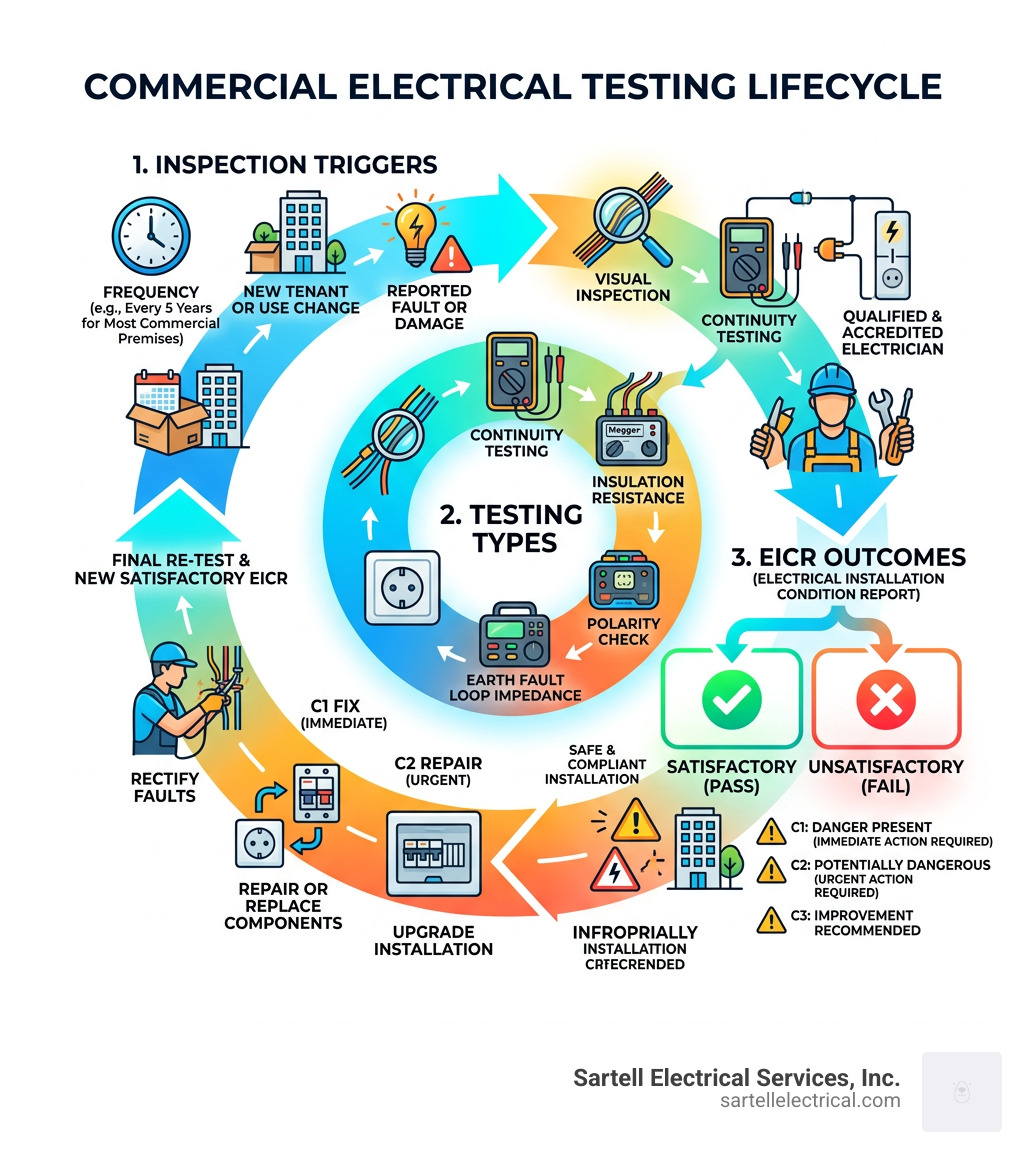
How often should you be calling us to look at your wires? While the "standard" recommendation for most commercial properties is every five years, this isn't a one-size-fits-all rule. Several factors can shorten that window:
- Change of Occupancy: If you are moving into a new storefront in Boston or a new office suite in Waltham, you should have an inspection immediately. You don't want to inherit the previous tenant’s electrical "surprises."
- Building Age: Older buildings in historic areas like Salem or Gloucester often have aging infrastructure that doesn't meet modern power demands. These systems require more frequent Electrical Safety Checks to ensure they haven't reached the end of their safe lifespan.
- Environmental Degradation: Buildings exposed to extreme temperatures, high humidity, or heavy dust accumulation will see their wiring deteriorate much faster than a climate-controlled office.
- Routine Annual Checks: Even if your full testing is scheduled for every five years, we highly recommend annual visual inspections. These quick "walk-throughs" can spot obvious damage like scorched outlets or frayed cables that occur between major tests.
High-Risk Environments and Specialized Facilities
Some businesses operate in "high-risk" categories where the standard five-year interval is simply too dangerous. In these environments, we typically recommend or require testing every 1 to 3 years.
- Healthcare Facilities: From hospitals in Boston to clinics in Newton, medical environments have zero tolerance for electrical failure. Specialized equipment and patient safety requirements mandate frequent, rigorous testing.
- Swimming Pools and Spas: Moisture and electricity are a deadly combination. Corrosive atmospheres and wet conditions mean that systems in leisure centers or hotels need annual testing to prevent electrocution risks.
- Industrial and Manufacturing Sites: Factories in Lawrence or Lowell often deal with heavy machinery, high-vibration environments, and dust accumulation. These factors accelerate wear and tear, often requiring testing every 3 years.
Legal Requirements and Insurance Compliance
In the United States, and specifically here in Massachusetts, the primary "bible" for electrical safety is the national electric code (NEC). Published by the National Fire Protection Association (NFPA), these standards are updated regularly to reflect new safety technologies and lessons learned from past accidents.
Beyond the NEC, business owners must answer to OSHA (Occupational Safety and Health Administration). OSHA requires employers to provide a workplace free from recognized hazards, which includes maintaining a safe electrical system. If an employee is injured due to a faulty circuit that hasn't been inspected in a decade, the "duty holder" (the business owner or landlord) faces significant legal liability.
One of the most critical reasons for regular electrical testing commercial premises is insurance. Most modern commercial insurance policies contain a warranty stating that the premises must be maintained and inspected according to recognized standards (like BS7671 or local equivalents). If you have a fire and cannot produce a valid, up-to-date electrical certificate, your insurance provider has a legal loophole to reject your claim entirely. We’ve seen businesses lose everything because of a missing piece of paper. Regular Building Electrical Maintenance isn't just a safety chore; it's a financial shield.
The Inspection Process and EICR Reporting
So, what actually happens when our team arrives at your doorstep in Andover or Peabody? We don't just walk around with a flashlight. A comprehensive inspection involves several layers of analysis.
- Visual Assessment: We look for the "obvious" problems—damaged fittings, overloaded sockets, improper grounding, and signs of overheating.
- Dead Testing: With the power off, we test the continuity of cables and the quality of the insulation. This ensures that electricity stays where it belongs (inside the wires) and doesn't leak out.
- Live Testing: We check that your system reacts correctly in the event of a fault. We test that your circuit breakers trip fast enough to prevent a fire and that your RCDs (Residual Current Devices) or GFCIs (Ground Fault Circuit Interrupters) are working to prevent shocks.
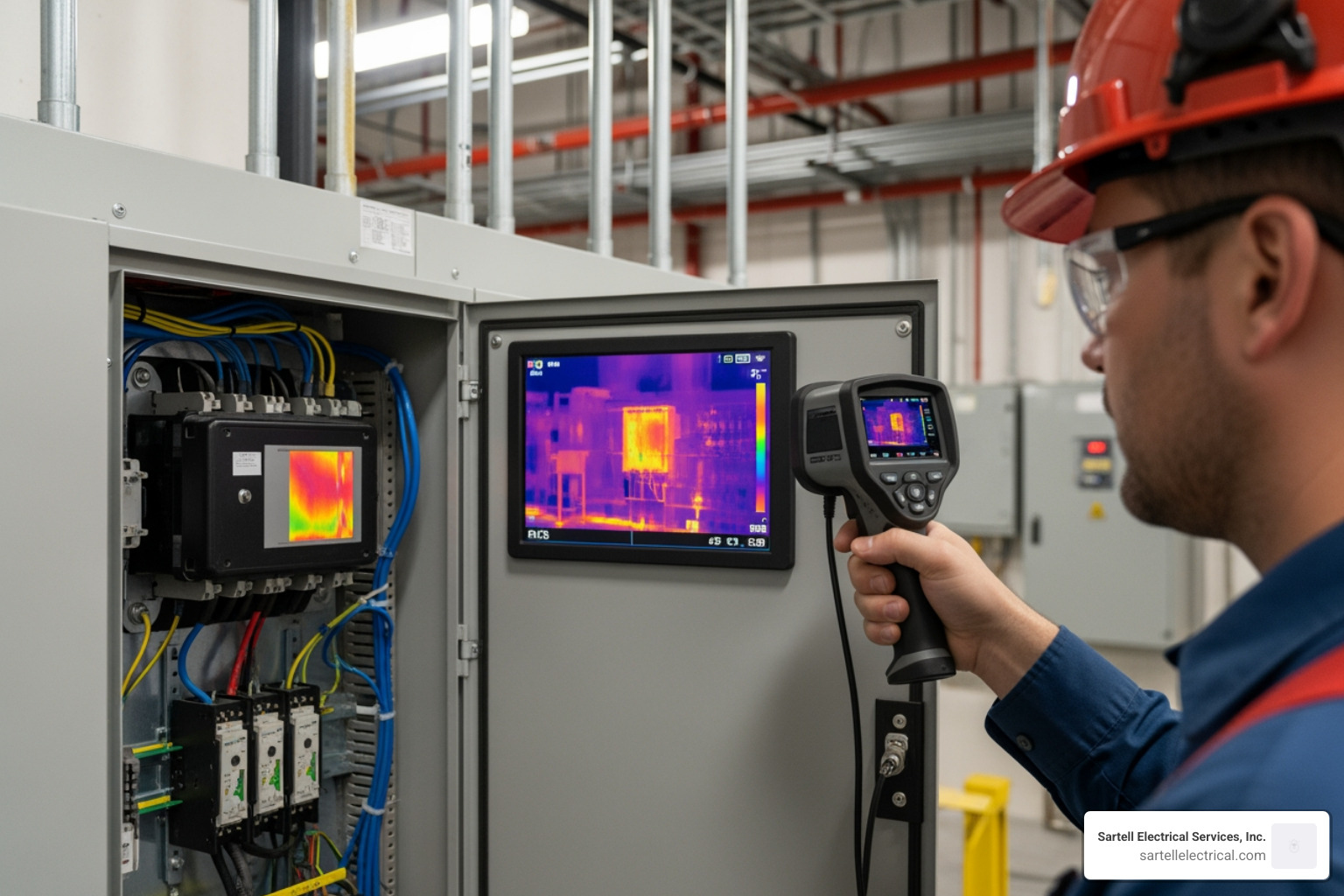
- Thermal Imaging: This is one of our most powerful tools for Commercial Electrical System Maintenance. Using infrared cameras, we can see "hot spots" inside your walls or panels that are invisible to the naked eye. These hot spots are often the first sign of a loose connection or an overloaded circuit that is about to fail.
Decoding the Electrical Installation Condition Report (EICR)
Once the testing is complete, you receive an Electrical Installation Condition Report (EICR). This document is your official record of the system's health. If you see any of the following observation codes, you need to pay attention:
- C1 (Danger Present): This is the highest risk. There is a risk of injury, and immediate action is required. We usually won't leave the site until this is made safe.
- C2 (Potentially Dangerous): While not an immediate threat, this issue could become dangerous in the event of a secondary fault. This must be fixed as a priority.
- C3 (Improvement Recommended): Your system isn't technically "dangerous," but it doesn't meet modern safety standards. It’s a "heads up" that you should plan for an upgrade soon.
- FI (Further Investigation): We’ve found something suspicious that requires a deeper look that wasn't part of the initial scope.
If your report has any C1 or C2 codes, it will be marked as Unsatisfactory. You must have these issues rectified to receive a Satisfactory rating and remain compliant with your insurance and legal obligations.
Remedial Works and Certification
If your building fails its EICR, don't panic. It’s actually a good thing—you found the problem before it found you. Most insurers and regulatory bodies require that Priority 1 (C1) and Priority 2 (C2) remedial works be completed within a specific timeframe, often 30 days.
When you hire Sartell Electrical Services, we don't just give you a list of problems; we provide the solutions. Once the repairs are made, we issue the final safety certificates. Always ensure your electrician is properly accredited (such as through the NICEIC or listed on a Competent Persons Register) to ensure the documentation is legally recognized.
Benefits of Proactive Maintenance
Many business owners view electrical testing as a "grudge purchase"—something they have to do but would rather not. However, shifting your mindset from reactive repairs to proactive testing can actually save you a significant amount of money.
| Feature | Reactive Maintenance (Fixing when broken) | Proactive Testing (EICR/Maintenance) |
|---|---|---|
| Cost | High (Emergency call-out fees) | Controlled (Scheduled, fixed pricing) |
| Downtime | Unpredictable (Can shut you down for days) | Planned (After-hours or phased) |
| Safety | High Risk (Faults are found by accidents) | Low Risk (Faults found by professionals) |
| Equipment Life | Shortened by surges/overheating | Extended by stable power supply |
| Insurance | Risk of claim rejection | Guaranteed compliance |
Beyond the numbers, regular testing fosters a safety culture in your workplace. Your employees in Medford or Somerville will feel more secure knowing their employer takes their physical safety seriously. Furthermore, a "Satisfactory" EICR can actually increase your property value if you ever decide to sell or lease your commercial space.
Fixed Wire Testing vs. PAT Testing
It’s important to distinguish between the two types of testing your business needs.
- Fixed Wire Testing (EICR): This covers the building’s "skeleton"—the panels, the wiring in the walls, and the main distribution. This is usually done every 5 years.
- PAT Testing (Portable Appliance Testing): This covers anything that plugs into a socket—computers, kettles, power tools, and desk lamps. Because these items are moved and handled frequently, they are more prone to damage. PAT testing is often done annually or every two years depending on the equipment's use.
For total safety, these two services should work in synergy. There’s no point in having perfect wall wiring if the toaster in the breakroom has a frayed cord that’s about to start a fire.
Frequently Asked Questions
Does electrical testing commercial premises disrupt daily business operations?
This is the biggest concern we hear from business owners in Greater Boston. The short answer is: It doesn't have to.
While some "dead testing" requires the power to be turned off briefly, we specialize in professional planning to minimize impact. We can perform testing in phases, shutting down only one floor or department at a time. For businesses that simply cannot have downtime during the day—like retail stores in Quincy or restaurants in Burlington—we offer off-hours and weekend scheduling. Our goal is business continuity; we want to keep you safe without getting in the way of your "buzz."
What is the difference between a visual inspection and a full EICR?
Think of a visual inspection like a quick health check-up, while an EICR is a full MRI.
- Visual Inspection: We look for surface-level damage, missing covers, or signs of heat. It’s fast and identifies obvious risks, but it can’t see through walls or detect "invisible" electrical faults.
- Full EICR: This includes technical testing with specialized meters. We measure resistance, check grounding paths, and simulate faults to see how the system reacts. This is the only way to achieve true regulatory compliance.
What are the penalties for non-compliance with electrical safety regulations?
The consequences of ignoring electrical testing commercial premises go far beyond a slap on the wrist. Under the Health and Safety at Work Act and related regulations, the penalties for failing to maintain a safe electrical system can include:
- Unlimited Fines: Courts can impose massive financial penalties that can bankrupt a small to medium-sized business.
- Imprisonment: In cases of gross negligence where a death or serious injury occurs, business owners can face up to two years in prison.
- Operational Suspension: Authorities have the power to shut down your building until it is made safe, leading to a total loss of revenue.
Conclusion
At the end of the day, electrical testing commercial premises is about peace of mind. Your focus should be on growing your business, serving your customers, and managing your team—not worrying if a loose wire in the ceiling is about to cause a catastrophe.
Since 1985, Sartell Electrical Services has been the trusted partner for businesses across Massachusetts. From our home base in Reading, MA, to projects in Boston, Worcester, and the North Shore, we bring over 30 years of experience to every inspection. Our commitment to excellence and leadership in the industry ensures that your commercial, industrial, or healthcare facility isn't just "compliant"—it's truly safe.
Don't wait for a flickering light or a tripped breaker to tell you there's a problem. Be proactive. Keep your business buzzing safely.