Building electrical wiring: Master 2025 Safety
Why Understanding Building Electrical Wiring Matters for Your Project
Building electrical wiring is the network that safely delivers power throughout a commercial, industrial, or institutional structure. Understanding the basics helps you make informed decisions, communicate effectively with contractors, and ensure your facility meets safety codes and operational demands.
Key Components of Building Electrical Wiring:
- Service Entrance - Where utility power enters the building
- Main Service Panel - The central distribution point with circuit breakers
- Circuit Breakers - Overcurrent protection devices that prevent overloads
- Conductors - Wires (copper or aluminum) that carry electrical current
- Conduits - Protective tubes that house and route wiring
- Outlets and Switches - End-point devices where power is accessed
- Grounding System - Safety feature that redirects excess electricity
Common Wiring Methods:
- Raceways and Conductors - Individual wires run through metal or PVC conduit (EMT, RMC)
- Cable Assemblies - Pre-packaged wiring like Metal-Clad (MC) or Armored Cable (AC)
- Busways - Compact metal enclosures for high-density power distribution
The world of electrical wiring can feel overwhelming. A faulty wire or improper installation can cause sparks, leading to ignition, or result in costly downtime and safety hazards. Unlike residential systems (120-volt, single-phase), commercial buildings require
higher voltage systems (often 277/480-volt, three-phase power) to handle heavy equipment loads, complex circuitry, and stricter regulatory compliance.
Commercial buildings use robust cables like EMT, MC, and AC, and wires must be run in protective conduit rather than the simpler non-metallic sheathed cable (Romex) common in homes. The National Electrical Code (NEC) sets the standard for safe electrical installation and is updated every three years. Local jurisdictions like Massachusetts add specific amendments, such as requiring GFCI protection for certain appliances and detailed wiring regulations.
Proper supervision during installation is crucial, which is why obtaining permits, scheduling inspections, and working with qualified professionals is essential. The primary objective is to provide a safe, consistent power supply while preventing hazards like shocks, short circuits, and fires.
I'm
Ed Sartell, and as President of Sartell Electrical Services since 1985, I've spent nearly four decades ensuring
Building electrical wiring systems are installed safely and to code. My experience has taught me that understanding the fundamentals empowers clients to make better decisions and ensures every project is completed right the first time.
The Anatomy of a Commercial Electrical System
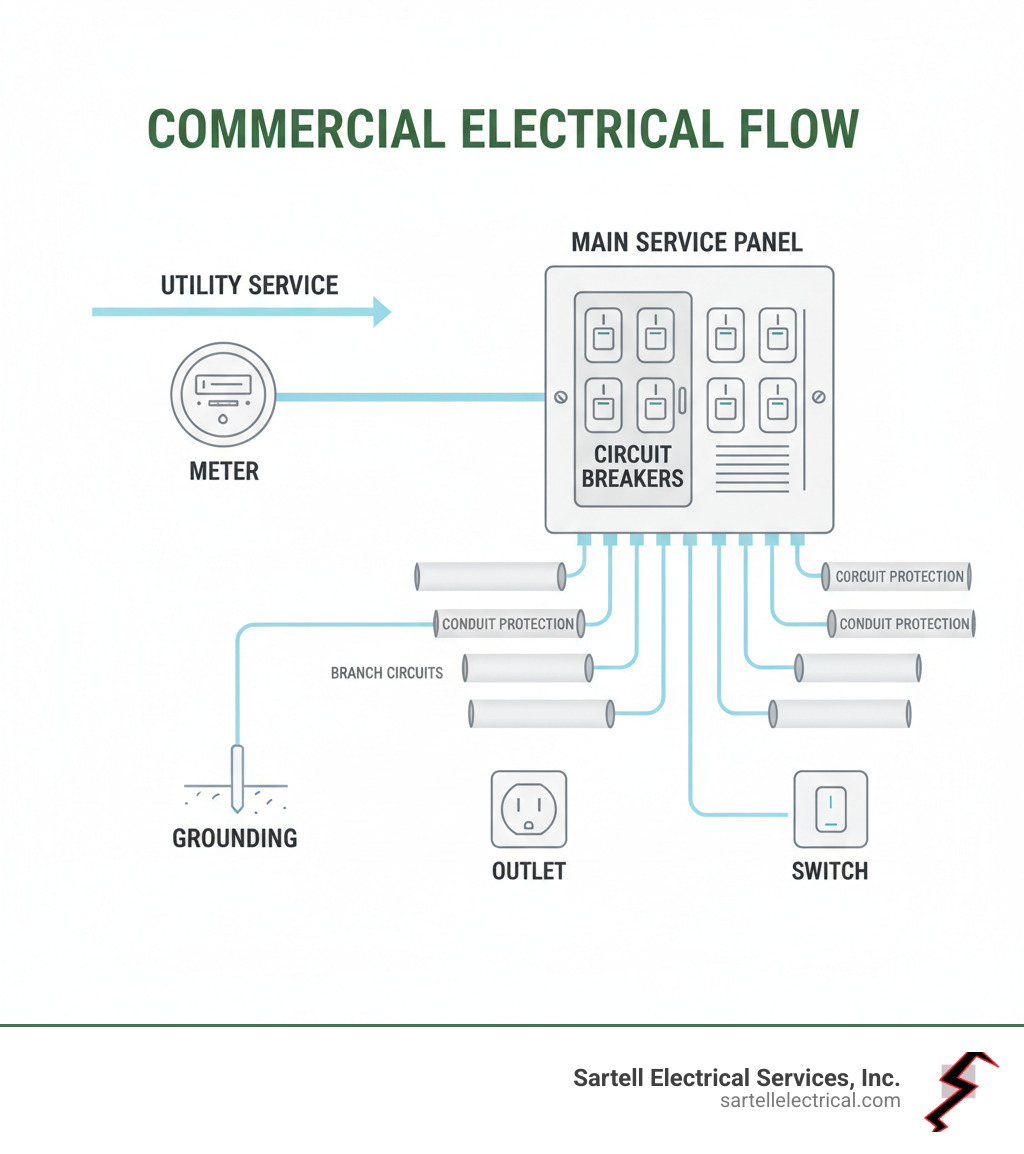
Think of a commercial electrical system as the circulatory system of your building—invisible but essential. Dozens of carefully designed components work together to deliver safe, reliable electricity exactly where it's needed.
Key Components of a Building Electrical Wiring System
The journey starts at the
service entrance, where utility power connects to your building and a
meter tracks usage. Power then flows to the
main breaker panel, the command center of your
Building electrical wiring system. Here, electricity is divided into circuits, each protected by a
circuit breaker. These switches trip automatically during an overload to prevent overheating and fires, and they can be easily reset. For more on panel safety, see our resource on
Electrical Panel Wiring.
Larger buildings use
subpanels to efficiently serve specific areas and
transformers to step down high utility voltages (e.g., 480V) to usable levels (e.g., 208/120V). Power travels through
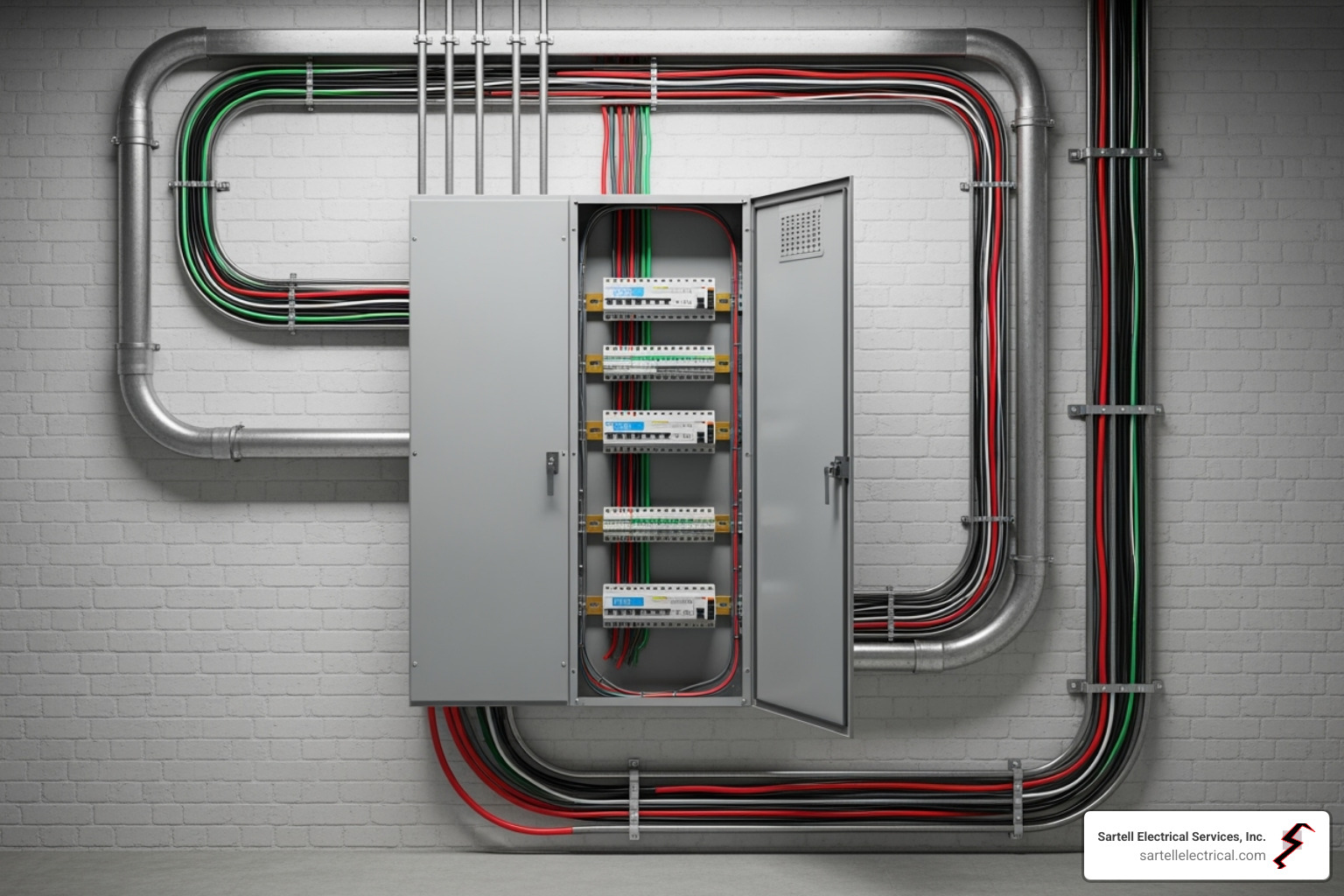
conductors (wires) protected by
insulation. In commercial settings, these wires are housed in
raceways or conduits—protective pipes that shield them from damage.
Junction boxes provide safe access points for wire connections, and the system terminates at
outlets and switches. Underlying it all is the
grounding system, a safety net that directs stray current into the earth to protect people and equipment.
Commercial vs. Residential Systems
Comparing commercial and residential wiring is like comparing a freight train to a bicycle. The demands, complexity, and regulations are in different leagues.
The biggest difference is the power itself. Homes use single-phase 120/240-volt power. Commercial buildings typically need
higher voltage (277/480 volts) and
three-phase power to efficiently run heavy machinery, large HVAC systems, and extensive lighting. Three-phase power delivers a more constant, balanced supply ideal for industrial motors.
Protection is another key distinction. Residential wiring often uses non-metallic sheathed cable (Romex). Commercial installations demand that wires run in protective
conduit (metal or PVC pipes) for superior defense against physical damage, fire, and moisture.
Finally, commercial systems have far greater
complexity and load capacity to support everything from server racks and medical devices to manufacturing lines. This means more circuits, larger wires, and multiple subpanels. These projects also face
stricter regulatory oversight from the National Electrical Code (NEC) and local authorities, with additional standards for specific industries like healthcare or data centers.
Commercial electrical systems are engineered for reliability and performance at a scale residential systems never encounter. To explore our approach to both, visit our page on
Residential and Commercial Electrical Systems.
Core Wiring Methods and Materials
Choosing the right wiring method and materials is fundamental to the safety and efficiency of your
Building electrical wiring system. The decision depends on factors like environment, load, and budget.
Conductors and Cable Assemblies
Two common wire types for commercial projects are
THHN and
XHHW. THHN is the workhorse for dry and damp locations, with a nylon jacket that resists abrasion. XHHW has more durable, water-resistant insulation, making it suitable for wet locations and demanding environments.
Regarding the conductor material,
Copper is the gold standard for conductivity and durability.
Aluminum is a lighter, more budget-friendly option for larger feeder circuits but requires expert installation to prevent oxidation and fire hazards.
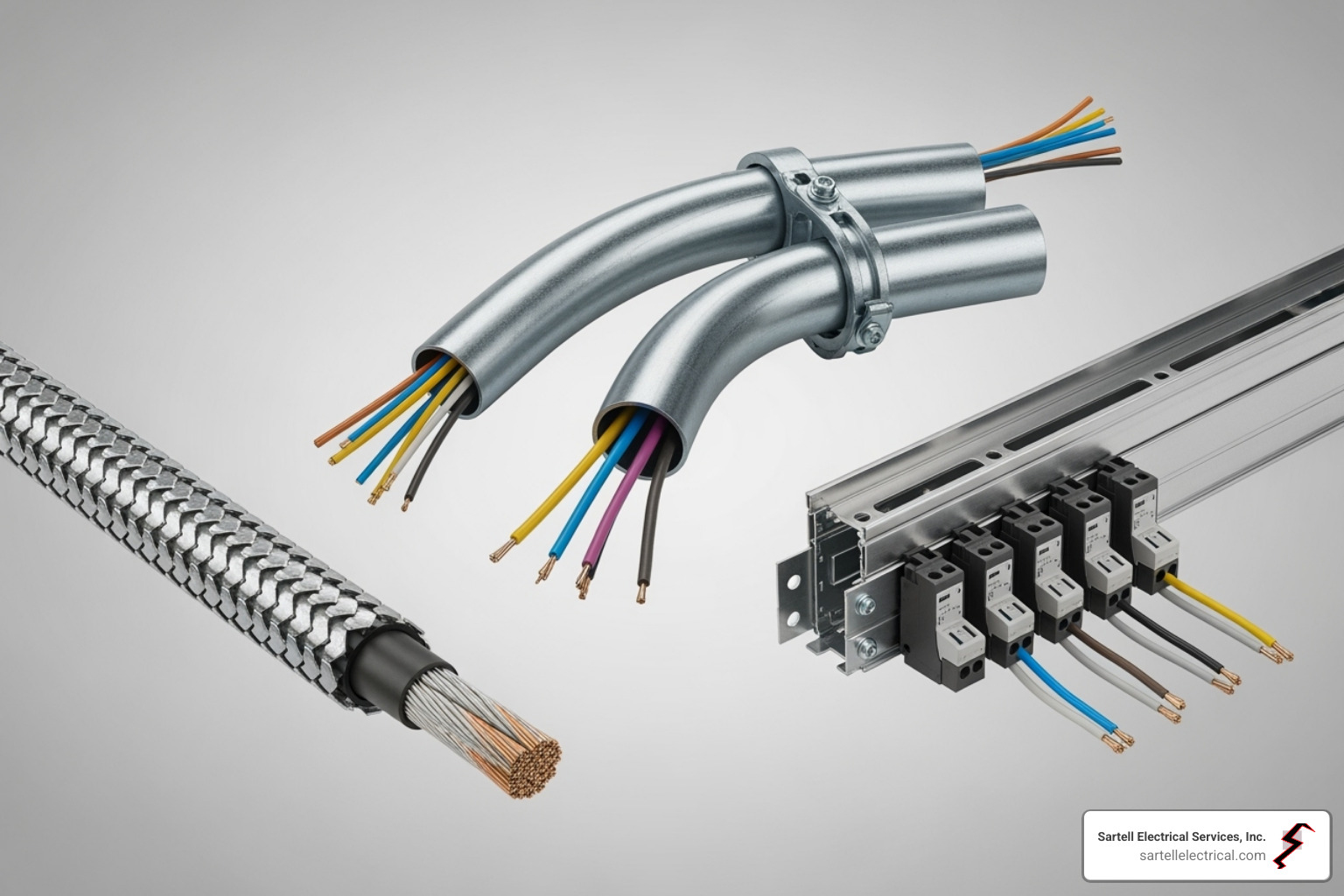
Cable assemblies are pre-manufactured bundles of insulated conductors inside a protective sheath, offering speed and protection during installation.
- Armored Cable (AC) has a spiral metal sheath to guard against physical damage, often used for exposed connections to lights and equipment.
- Metal-Clad (MC) Cable features interlocking metal armor for excellent protection. We use MC cable extensively in commercial installations for its robustness and adaptability.
- Mineral-Insulated (MI) Cable is the most durable, with copper conductors in a copper sheath. It's virtually fireproof and ideal for critical circuits.
Cable assemblies install faster and more cost-effectively than pulling individual wires through conduit. For expert solutions using these materials, see our
Commercial Electrical Wiring services.
Raceways and Busways
Raceways and
busways are other essential wiring methods in commercial settings.
Raceways are protective enclosures—primarily conduits—that house individual conductors. This method offers great flexibility, as wires can be easily added or replaced. Common conduit types include:
- EMT (Electrical Metallic Tubing): Lightweight metal conduit common in commercial buildings.
- RMC (Rigid Metal Conduit): Heavy-duty, thick-walled conduit for maximum physical protection.
- PVC (Polyvinyl Chloride) Conduit: A corrosion-resistant plastic option ideal for underground or corrosive environments.
Busways (or bus ducts) are metal enclosures containing insulated busbars, designed for high-amperage power distribution in data centers, industrial facilities, and large commercial spaces. Their compact design saves space, and while the upfront cost may be higher, they are often more cost-effective long-term for high-density power needs due to their reliability and flexibility for future modifications.
Here's how these methods compare:
| Feature |
Raceways (Conduit & Wires) |
Cable Assemblies (MC, AC, etc.) |
Busways |
| Advantages |
Flexible, easy to modify/upgrade, excellent protection, temperature resistance, cost-effective long term |
Fast/low-cost installation, pre-engineered, good protection, fire resistance |
Compact, high-density power, long lifespan, reliable, flexible for future changes, cost-effective for high loads |
| Disadvantages |
More labor-intensive for initial installation, requires careful wire pulling |
Less flexible for modifications, can be bulky, specific applications |
Higher upfront cost, less common for lower power needs, requires specific installation expertise |
| Typical Applications |
Industrial, commercial, hazardous locations, outdoor |
Commercial offices, retail, data centers, general power |
Industrial plants, data centers, large commercial buildings, high-amperage feeders |
| Primary Protection |
Conduit provides physical and environmental protection |
Outer sheath/armor provides physical protection |
Metal enclosure protects busbars |
Planning and Sizing Your Building Electrical Wiring
Successful
Building electrical wiring projects start with thorough planning and accurate sizing. This roadmap accounts for today's needs while leaving room for tomorrow's growth.
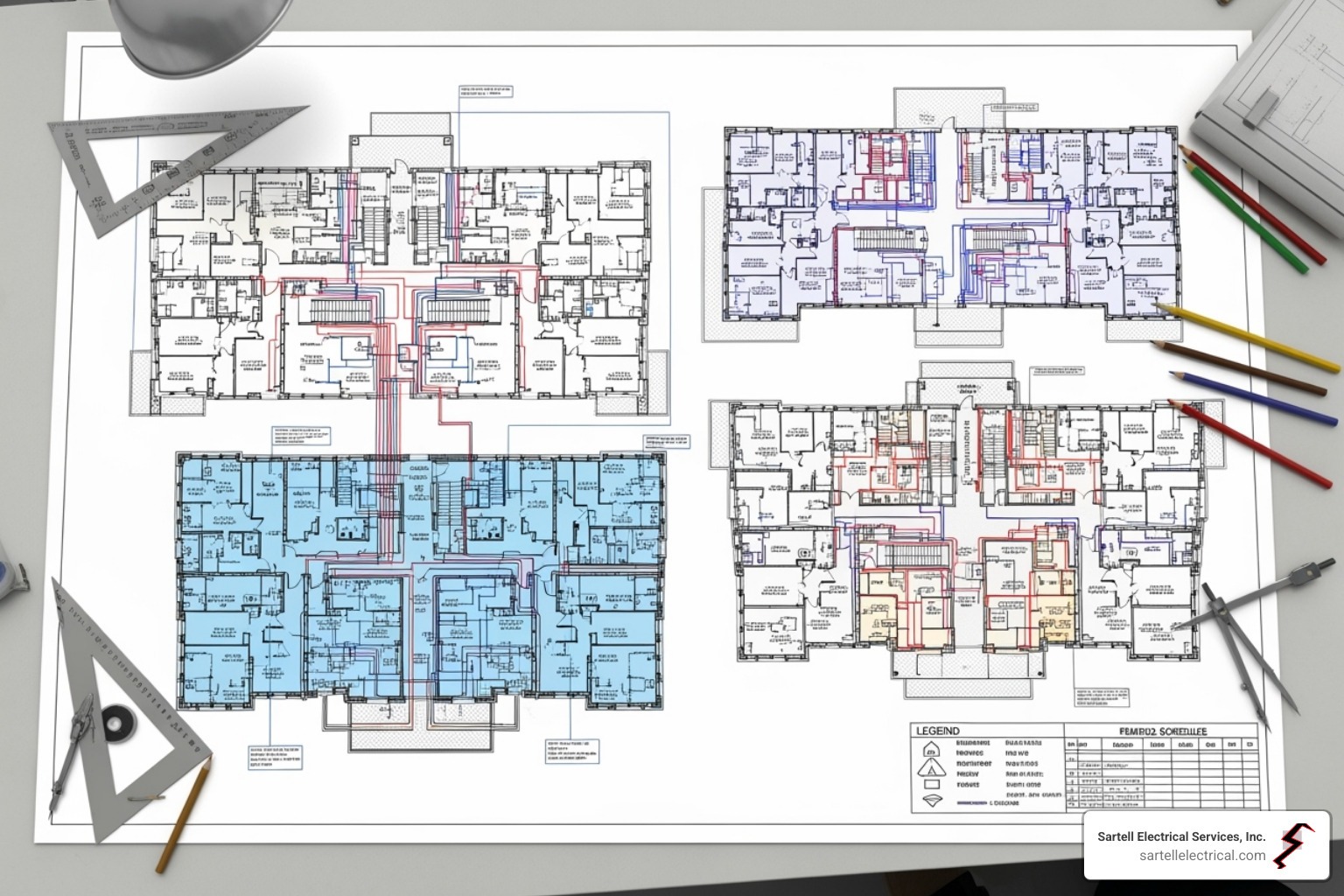
The planning phase involves precise
load calculation to determine how much power your building will draw now and in the future. A well-designed system also considers
area-specific requirements, as a server room's needs differ vastly from an office.
Future-proofing by installing extra capacity in panels and conduit paths saves significant money on later retrofits.
Sizing Wires for Different Loads
Proper wire sizing is critical. A wire that's too small for its electrical load will overheat, risking equipment failure and fire. The relationship between
amperage (current),
wire gauge (size), and load is fundamental to safe design.
In the
American Wire Gauge (AWG) system, a smaller gauge number means a thicker wire that can carry more current. For example, a 10-gauge wire is thicker and carries more amperage than a 14-gauge wire.
Voltage drop is another key factor, especially over long wire runs in commercial buildings. As electricity travels, voltage is lost. If the wire is too thin or the run too long, equipment at the far end may not receive enough voltage to operate correctly. Undersized wiring generates excessive heat, which can melt insulation and cause short circuits or fires. As noted in electrical safety research,
Controlling Current in Electric Circuits is essential for preventing these hazards.
Load calculations vary dramatically by area.
Machinery areas often require dedicated high-amperage, three-phase circuits with heavy-gauge wires (e.g., 8 AWG or 6 AWG) for industrial motors or manufacturing equipment. In contrast, typical
office areas use 15-amp or 20-amp circuits with 14 or 12 AWG wire for computers and lighting. Kitchens and breakrooms need dedicated 20-amp circuits to handle high-draw appliances.
Best Practices for Installing Building Electrical Wiring
Commercial
Building electrical wiring installation demands meticulous attention to detail and adherence to best practices.
- Layout and Planning: A detailed electrical blueprint that maps every outlet, switch, and fixture is the foundation. In offices, outlets should be placed to avoid the use of extension cords. Commercial kitchens often need at least eight separate circuits.
- Adherence and Labeling: Sticking to the approved plan is paramount to avoid code violations. Every circuit in your panels must be clearly and accurately labeled for safety and maintenance.
- Box Fill and Securing: Avoid overcrowding electrical boxes, as this can cause overheating and fire risks. All cables and conduits must be properly supported and secured at code-specified intervals to prevent strain and damage.
Different areas have unique needs. Offices require accessible power and data infrastructure. Machinery areas need robust, dedicated circuits and heavy-duty protection. Kitchens demand high-amperage and GFCI-protected circuits. Healthcare facilities and data centers have even more stringent requirements for reliability, redundancy, and backup power.
Managing these complex installations requires professional oversight. Our approach to
Electrical Project Management ensures every phase proceeds smoothly, on schedule, and to the highest standards.
Safety Codes and Regulatory Compliance
When it comes to
Building electrical wiring, safety is a legal and ethical imperative. Every installation must meet rigorous standards developed to protect lives and property.
The National Electrical Code (NEC) and Safety
The
National Electrical Code (NEC, or NFPA 70) is the benchmark for electrical safety in the U.S., establishing minimum standards for design, installation, and inspection. The NEC is not a federal law but is adopted by local jurisdictions, giving it legal force. It is updated every three years to incorporate new technologies and safety findings, making it essential for electricians to stay current.
Here in Massachusetts, we follow the
Massachusetts Electrical Code | Mass.gov, which builds on the NEC with state-specific amendments, such as improved GFCI requirements. These
regional differences are significant and must be followed.
Ensuring compliance involves proper design, using qualified electricians, obtaining permits, and scheduling inspections. Non-compliant work leads to failed inspections, costly rework, and serious liability issues.
Critical Safety Measures: Grounding, GFCI, and AFCI
Modern electrical systems include specific devices that are your last line of defense against electrical hazards.
Proper grounding is the foundation of electrical safety. As
OSHA emphasizes, it provides a safe path for stray electrical current to flow to the earth, preventing shock and tripping the circuit breaker during a fault. All metal components in an electrical system must be grounded.
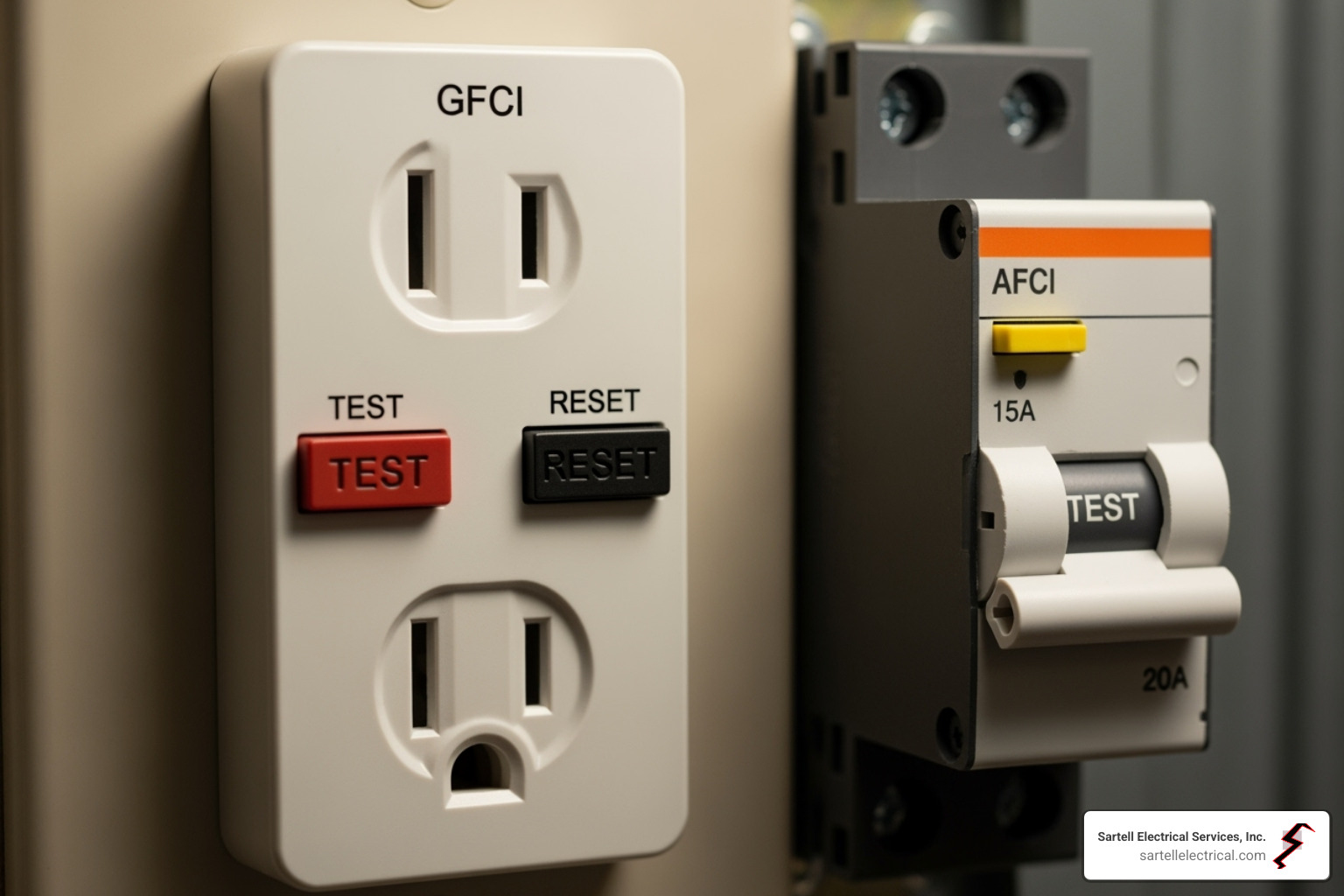
GFCI (Ground Fault Circuit Interrupter) protection prevents electric shock by detecting small current leaks—as when current passes through a person—and shutting off power instantly. GFCIs are required in commercial kitchens, restrooms, outdoor areas, and other wet locations.
AFCI (Arc Fault Circuit Interrupter) devices prevent fires by detecting dangerous electrical arcs from damaged or loose wiring and tripping the circuit. While first developed for homes, AFCIs are increasingly required in commercial settings for their fire prevention capabilities.
These devices work together to create a comprehensive safety system. However, they require regular testing and maintenance to ensure they function correctly. Ongoing
Building Electrical Maintenance is crucial for verifying that your safety systems are ready to protect you.
Frequently Asked Questions about Building Wiring
Over my nearly four decades working on
Building electrical wiring projects, certain questions come up repeatedly from business owners and facility managers.
How does commercial building wiring differ from residential wiring?
Commercial wiring uses higher voltage (e.g., 277/480V) and three-phase power for heavy equipment, unlike residential 120/240V single-phase systems. It also requires robust protection like metal conduit and is designed for heavier, continuous loads under stricter safety codes.
What are the most common issues in commercial electrical wiring?
The most common issues are overloaded circuits causing breakers to trip, improper grounding creating shock hazards, outdated wiring that poses safety risks, voltage drops affecting equipment performance, and a lack of regular maintenance which allows small problems to become major failures.
Why is a licensed electrical contractor essential for commercial projects?
A licensed contractor is essential for ensuring all work complies with the
National Electrical Code (NEC) and local regulations. They handle permits, manage the complexity of commercial systems, and provide the expertise for a safe, reliable installation. This protects you from liability and ensures the long-term value and safety of your investment.
Ensure Your Building's Electrical System is Safe and Reliable
Proper
Building electrical wiring is the non-negotiable lifeline of any commercial facility. From understanding core components and wiring methods to planning for future needs and adhering to strict safety codes, a professional approach is paramount. Following the National Electrical Code and using critical safety devices like GFCIs and AFCIs protects lives and property.
Complex commercial electrical systems, especially in specialized environments like healthcare or telecommunications, demand expertise that only comes from years of hands-on experience. The stakes are too high to entrust your electrical infrastructure to anyone but qualified professionals.
At Sartell Electrical Services, Inc., we've been providing expert electrical solutions for businesses across Massachusetts since 1985. Our experienced team ensures your building's system is safe, efficient, and built for the future. Whether you're planning new construction or upgrading an aging system, we bring the knowledge and commitment your project deserves.
For specialized projects in the Boston area, particularly in the telecommunications sector, we invite you to learn more about our work as a leading
telecommunications electrical contractor in Boston, MA. Your building's electrical system is too important to leave to chance—let's ensure it's powered for success.