What You Need to Know About a 60 Amp Breaker to 100 Amp Subpanel
Yes — a 60 amp breaker to 100 amp subpanel connection is safe and code-compliant, as long as the feeder wire is sized for the 60 amp breaker. Here's the short answer:
- The 60 amp breaker in your main panel protects the feeder wire — not the subpanel itself
- The 100 amp rating on the subpanel is its maximum capacity, not a minimum requirement
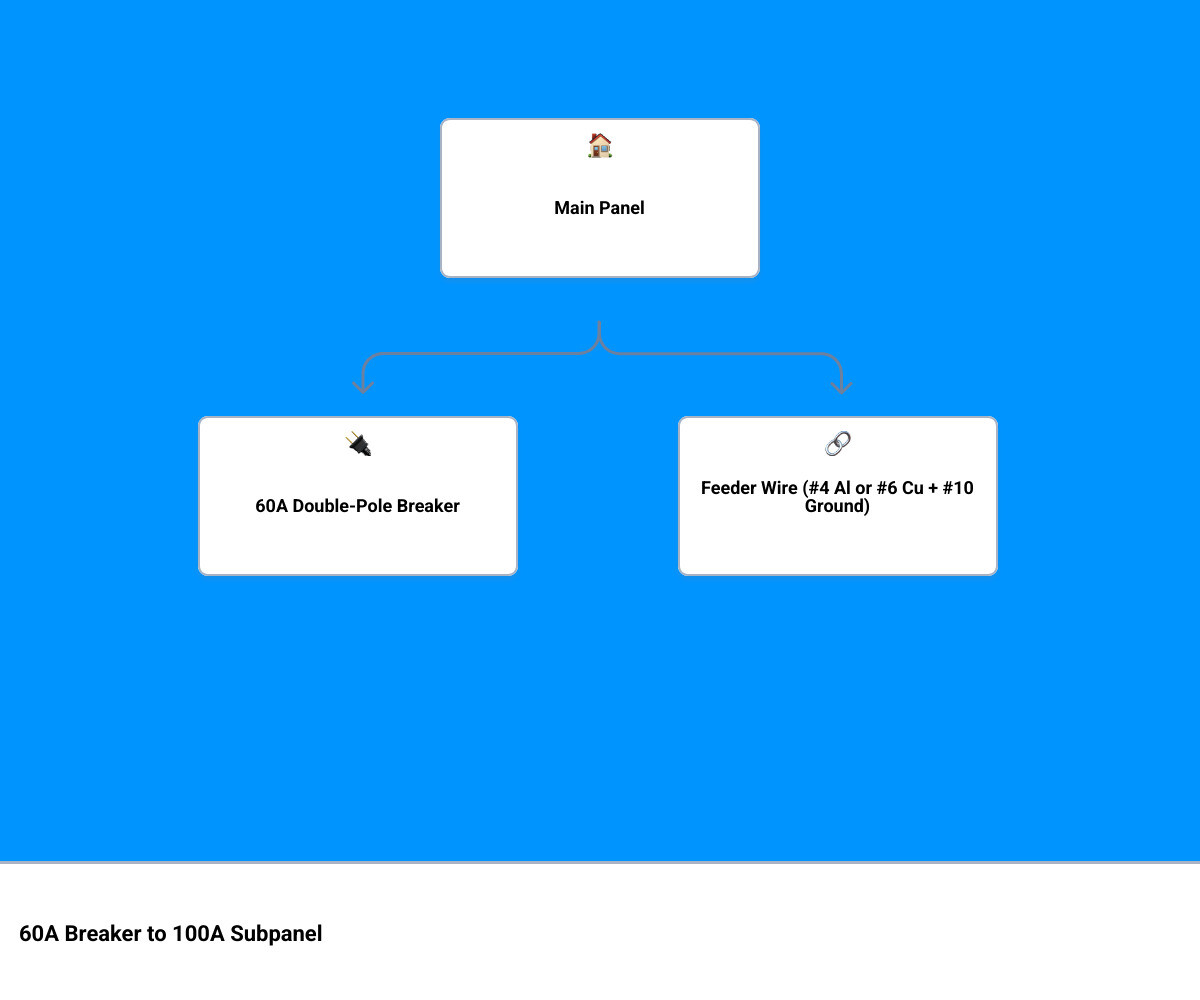
- Your feeder wire must match the 60 amp breaker (typically #4 aluminum or #6 copper)
- A separate ground wire is required — #10 copper is sufficient for a 60 amp feeder
- Branch breakers in the subpanel can total more than 60 amps due to load diversity — not all circuits run at once
This setup is done all the time in garages, sheds, workshops, and detached structures across the country.
But there are real details that matter — wire type, lug compatibility, load balancing, grounding rules, and NEC compliance. Getting any of these wrong can create a fire hazard or fail inspection.
I'm Ed Sartell, President of Sartell Electrical Services, and I've been installing and inspecting feeder circuits — including countless 60 amp breaker to 100 amp subpanel setups — across Massachusetts since 1985. In this guide, I'll walk you through exactly what's required to do this right.
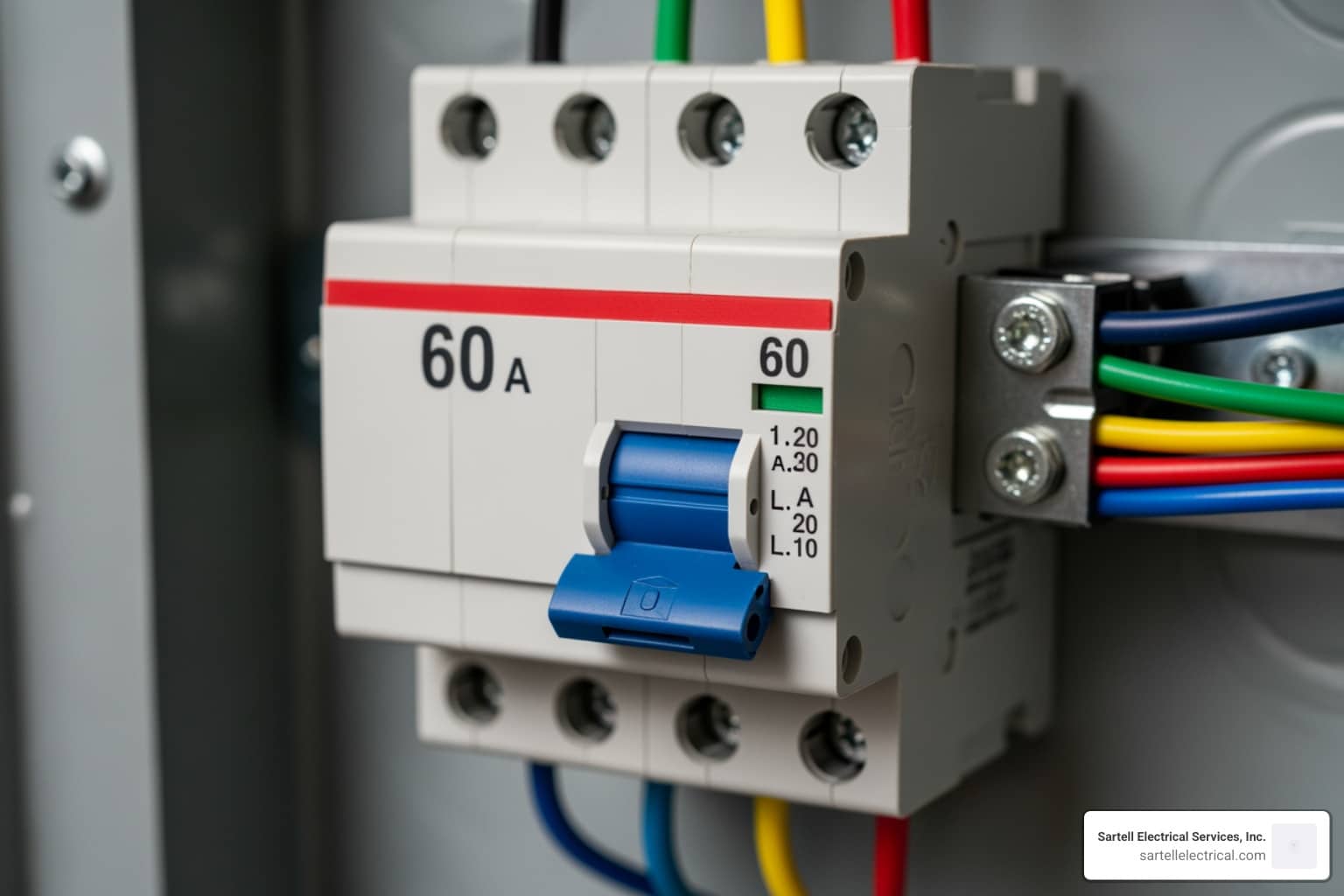
60 amp breaker to 100 amp subpanel definitions:
- 60 amp electrical panel
- 60 amp electrical sub panel
Is it Safe to Connect a 60 Amp Breaker to a 100 Amp Subpanel?
When we talk about electrical safety, the most important rule is that the overcurrent protection device (the breaker) must protect the conductors (the wire). Many homeowners worry that a "100 amp" box requires 100 amps of power. In reality, that 100 amp label is simply the busbar's maximum thermal rating. Think of it like a bridge: if a bridge is rated for 100 tons, it is perfectly safe to drive a 60-ton truck across it. The danger only arises if you try to drive a 150-ton truck across.
In a 60 amp breaker to 100 amp subpanel configuration, the 60 amp breaker sitting in your main service panel acts as the "gatekeeper." If the demand in your subpanel exceeds 60 amps, that breaker will trip, protecting the feeder wire from overheating. This setup is not only safe but is a standard industry practice. For a deeper look at how these systems integrate, you can explore more about residential main panel wiring.
Understanding the 60 amp breaker to 100 amp subpanel compatibility
The compatibility here hinges on the concept of "inverse time rating." Breakers are designed to allow small, short-term surges (like a motor starting up) but will trip quickly if a massive short circuit occurs or if a sustained overload is detected. For example, a 60 amp breaker can actually support a 300 amp surge for about 6 seconds. This allows high-draw tools in your garage to start up without nuisance tripping, provided the steady-state load stays within safe limits.
Mismatched amperages are actually a benefit for future-proofing. By installing a 100 amp or 125 amp subpanel today, you gain more "spaces" for breakers. If you ever need to upgrade the feeder to a full 100 amps later, you won't have to replace the entire subpanel—you’ll just need to pull larger wire and swap the feeder breaker. You can find more Expert Q&A on subpanel setups that confirm this "oversizing" of the panel is a smart move.
Lug compatibility and termination concerns
One technical hurdle we often see in the field involves the physical connection. Most 100 amp main breakers or main lugs are designed to accept a specific range of wire gauges. For instance, a 100 amp breaker might be listed for wire sizes between #4 AWG and 1/0 AWG.
If you are using #6 copper wire for your 60 amp feed, you must verify that the 100 amp lugs are actually rated to hold a #6 wire securely. If the wire is too small for the lug's "minimum listing," the mechanical connection might not be tight enough, leading to arcing and heat. Always check the manufacturer's label inside the panel door; it will list the "Wire Range" for the main terminals. If your wire is too small for the lug, you may need to use a larger gauge wire (even if the breaker doesn't require it) or find a compatible reducer pin.
NEC Requirements for Wire Sizing and Installation
The National Electrical Code (NEC) is very specific about how we feed subpanels. You cannot simply grab any roll of wire and hope for the best. Since the feeder carries the entire load of the subpanel, the ampacity of the wire must meet or exceed the rating of the breaker protecting it.
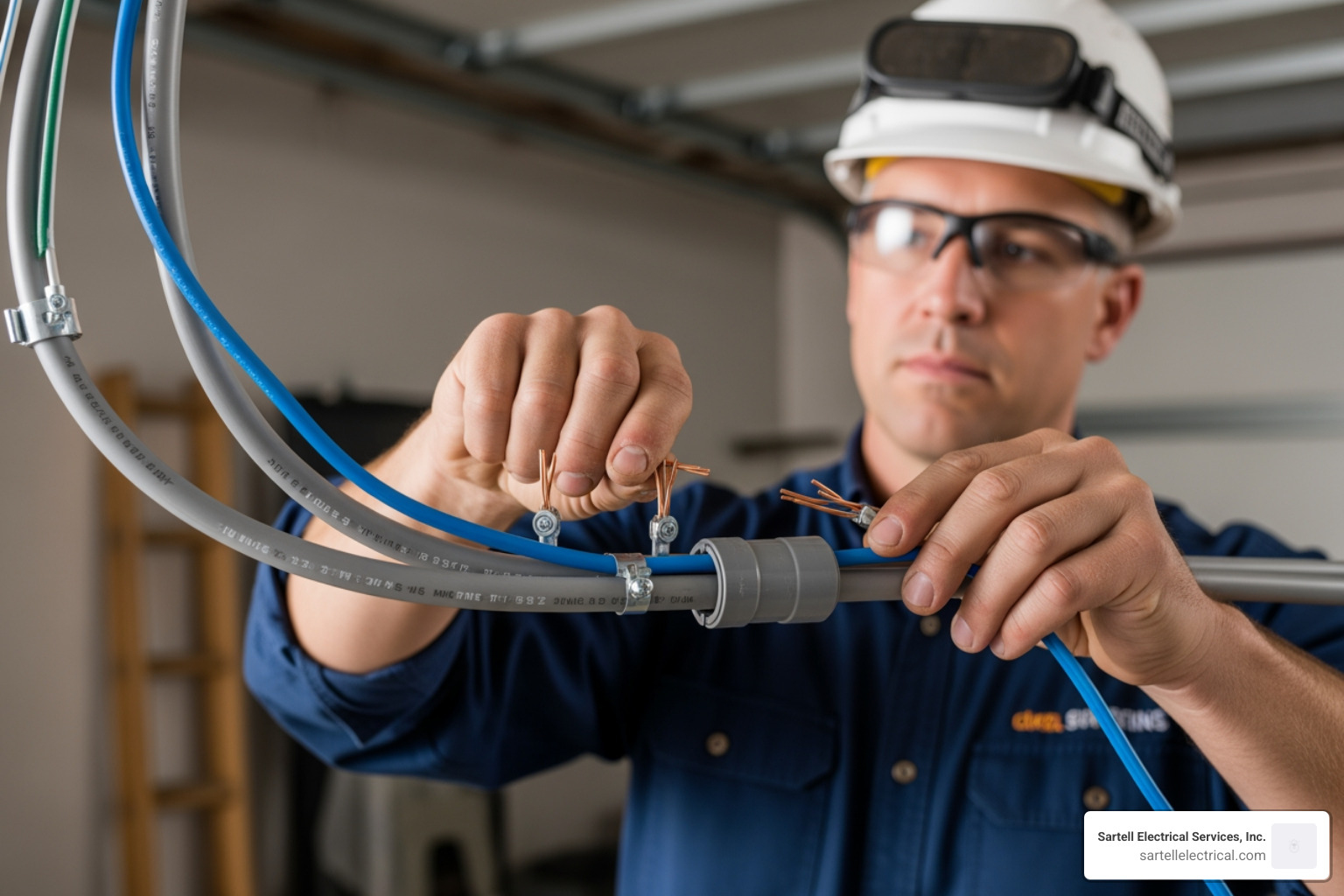
When we install a 60 amp breaker to 100 amp subpanel in Massachusetts, we also have to account for environmental factors. If the wire is going underground or through a damp basement, we use THWN-2 or XHHW individual conductors inside a conduit. If it’s staying inside the thermal envelope of the house, a multi-conductor cable like NM-B (Romex) or SER might be used, but keep in mind that different cables have different temperature ratings that affect their allowed ampacity. Check out our guide to 60 amp subpanel sizing for more specifics on these rules.
Choosing the right wire for a 60 amp breaker to 100 amp subpanel
The choice between copper and aluminum is usually a matter of cost versus ease of installation. Aluminum is significantly cheaper for long feeder runs, but it requires larger gauges to carry the same current as copper.
For a 60 amp circuit:
- Copper: You generally need #6 AWG (rated for 55A or 65A depending on the insulation type and the 60°C/75°C column rules).
- Aluminum: You need #4 AWG. #6 aluminum is only rated for 40-50 amps in most residential applications and is not sufficient for a 60 amp breaker.
If your run is longer than 100 feet, we also have to calculate "voltage drop." To keep your lights from flickering when the fridge kicks on, we might upsize that #4 aluminum to #2 aluminum just to ensure consistent power at the end of the line.
Grounding and bonding for subpanels
This is where many DIY projects fail inspection. In a main service panel, the neutral (white) and ground (bare/green) wires all land on the same bar. In a subpanel, they must be separated.
- 4-Wire Feeder: You must run four wires to the subpanel: two hots, one neutral, and one equipment grounding conductor (EGC).
- Isolated Neutral: The neutral bar in the subpanel must be "floated" (isolated from the metal box). You must remove the green bonding screw or strap that comes in the box.
- Grounding Bar: All ground wires must land on a separate bar that is physically bonded to the metal enclosure.
- Grounding for Detached Structures: If your subpanel is in a detached garage or shed, the NEC requires you to install two 8-foot ground rods spaced at least 6 feet apart. These rods connect to the subpanel's ground bar, but the neutral remains isolated.
For a 60 amp feeder, a #10 copper ground wire is usually sufficient to meet code requirements for the equipment ground.
Managing Loads: Branch Circuits and High-Starting Currents
One of the most common questions we get at Sartell Electrical is: "How can I have a 40 amp AC breaker and a 30 amp dryer breaker in a 60 amp panel? Doesn't that add up to 70 amps?"
The answer is load diversity. In a typical home, you rarely run the vacuum, the toaster, the dryer, and the air conditioner all at the exact same moment. The NEC allows for this by using demand factors. Most homes operate at only 30% to 50% of their total breaker capacity.
Balancing the load in a 60 amp breaker to 100 amp subpanel
A subpanel has two "legs" of power (120V each). If you put all your heavy loads on Leg A and nothing on Leg B, you could trip your 60 amp main breaker even though you're only using 60 amps total. This is because the breaker trips if either leg exceeds 60 amps.
When we arrange circuits, we use an amp clamp meter to test the draw. We aim to balance the "continuous loads" (things that run for 3 hours or more) across both legs. For example, if you have two small window AC units, we put one on an even-numbered slot and one on an odd-numbered slot to ensure they pull from different sides of the power feed.
Handling high-inrush loads
High-inrush loads are the "heavy lifters"—central AC units, large table saws, or air compressors. When these motors start, they can momentarily pull 5 to 6 times their running current.
On a 60 amp breaker to 100 amp subpanel, you must look at the MCA (Minimum Circuit Ampacity) on the appliance nameplate. If your central AC has an MCA of 26.4 amps, it is perfectly fine on a 60 amp feeder. Even though the startup surge might hit 150 amps for a split second, the "inverse time" curve of your 60 amp breaker will ignore that brief spike. You can see an example of this in the AC unit nameplate information and startup data.
Upgrading Your Service: From 60 Amps to 100 Amps and Beyond
Sometimes, a subpanel isn't enough. If your main house service is only 60 or 100 amps, adding a workshop or an EV charger might push your entire system to the brink.
Upgrading your service is a coordinated effort. The utility company (like National Grid or Eversource here in Greater Boston) is responsible for the "service drop" (the wires from the pole to your house). The homeowner is responsible for everything from the "weatherhead" down, including the meter socket and the main panel. Interestingly, many power companies today install 200 amp wire for their service drops regardless of your panel size, making future upgrades easier.
When to consider a full breaker panel upgrade
If you live in a historic home in Reading or Salem, you might still have an old 60 amp fuse box or an early circuit breaker panel that is maxed out. Signs you need a full upgrade include:
- Flickering lights when the fridge starts.
- Fuses that blow or breakers that trip frequently.
- The need to install an EV charger (which usually requires a 40-60 amp dedicated circuit).
- Planning a kitchen remodel with modern high-draw appliances.
A full upgrade provides peace of mind and significantly increases your home's resale value. Learn more about the Home electrical panel upgrade benefits and the cost to replace main breaker panel.
Professional vs. DIY considerations
While many homeowners are capable of wiring a simple outlet, feeding a subpanel involves high-voltage connections that can be lethal if handled incorrectly. In Massachusetts, electrical work requires a permit and an inspection by the local building department.
A professional electrician ensures that:
- The load calculation is accurate.
- The grounding system meets the latest NEC 250 standards.
- All connections are torqued to the correct inch-pounds (to prevent fire-causing loose connections).
- The "main bonding jumper" is correctly handled to prevent stray currents on your plumbing.
If you're curious about the investment, you can check the cost to change electrical panel from 100 to 200.
Frequently Asked Questions about Subpanel Compatibility
Can the total of branch breakers exceed the feeder breaker?
Yes, absolutely. It is common and legal for the sum of the branch breakers (e.g., five 20 amp breakers = 100 amps) to exceed the feeder breaker (60 amps). This is because of "load diversity"—the statistical reality that you won't use every outlet and light at full capacity simultaneously. The 60 amp breaker protects the wire if you ever do happen to turn everything on at once.
Will a 60 amp wire fit into 100 amp main lugs?
Usually, yes, but you must check the "listing." Most 100 amp lugs accept #4 wire, which is what you would use for an aluminum 60 amp feed. However, if you are using #6 copper, some 100 amp breakers might have a minimum wire size of #4. If the wire is too small for the lug, it won't be physically secure, which is a major fire hazard.
Do I need a separate ground rod for an attached subpanel?
No. If the subpanel is in the same building (like in a basement or an attached garage), you do not need a separate ground rod. You must rely on the equipment grounding conductor (the 4th wire) that runs back to the main panel. Adding a second ground rod to an attached structure can actually create "ground loops" and other electrical issues. This is covered under NEC 250.32.
Conclusion
Installing a 60 amp breaker to 100 amp subpanel is a fantastic way to add power to your garage, workshop, or home addition without the massive expense of a full service upgrade. By using a 100 amp panel, you're giving yourself plenty of room for future circuits while staying safely protected by that 60 amp breaker in your main box.
However, electrical safety is never something to "guess" at. Between wire ampacity rules, grounding requirements for detached structures, and the nuances of load balancing, there are plenty of places where a small mistake can lead to a big problem.
At Sartell Electrical Services, Inc., we’ve spent three decades helping homeowners across Reading, MA, and the Greater Boston area stay safe and powered up. Whether you need a quick inspection of your DIY work or a professional team to handle a complex service upgrade, we’re here to help. For a comprehensive look at your options, see our complete guide to main electrical panel upgrades.
Ready to get that subpanel installed correctly? Give us a call today—we’ll make sure your "Breaker Blues" are a thing of the past!